LibreOffice on the Sustain podcast

Sustain is a podcast that “brings together practitioners, sustainers, funders, researchers and maintainers of the open source ecosystem – we have conversations about the health and sustainability of the open source community.”

Mike Saunders from The Document Foundation, the non-profit entity behind LibreOffice, appeared on a recent episode of the podcast to talk about the LibreOffice community and long-term sustainable development. He discussed growing the project and ensuring that the work of volunteers and the wider ecosystem is recognised.

Click here to listen!

Best Wishes from TDF

Dear community members, TDF members, Advisory board members, team members, membership committee and board!

Another year marked by the global pandemic is coming to an end these days. In addition to all the depressing news and circumstances that affect us all, there are also pleasing and uplifting developments.

Apart from the painfully missed opportunity to meet in person, be it in the local communities or at our annual conference, we have nevertheless achieved so much together, worked together and brought our foundation forward, so that we can already say that it was one of the most successful years for and with our project.

I would like to thank all of you on behalf of our project. Everyone has contributed to the success story in different ways. All the contributions intertwine, and without these individual parts the whole thing would not be possible and so successful. Especially in these times. Thank you very much again for this.

And it is precisely this commitment, this proof of the resilience of our project during this time, that allows me to look to the future with good cheer. Please continue to support our community in so many ways in the coming year, every contribution is needed.

After two very intensive and busy years, I myself will say goodbye to the board, but after a short phase of rest, I will continue to work with you in the project in one or two different places again. I wish the newly elected board all the best!

I wish you and your beloved ones a few days of recreation at the end of this year and a stable good health for the next one.

Thanks again and hope to see you all with your contributions in the new year again,

yours
Lothar Becker
as chairman of the board

The Writer Guide 7.2 just arrived

The new Guide comes one week after the release of the latest LibreOffice Community software

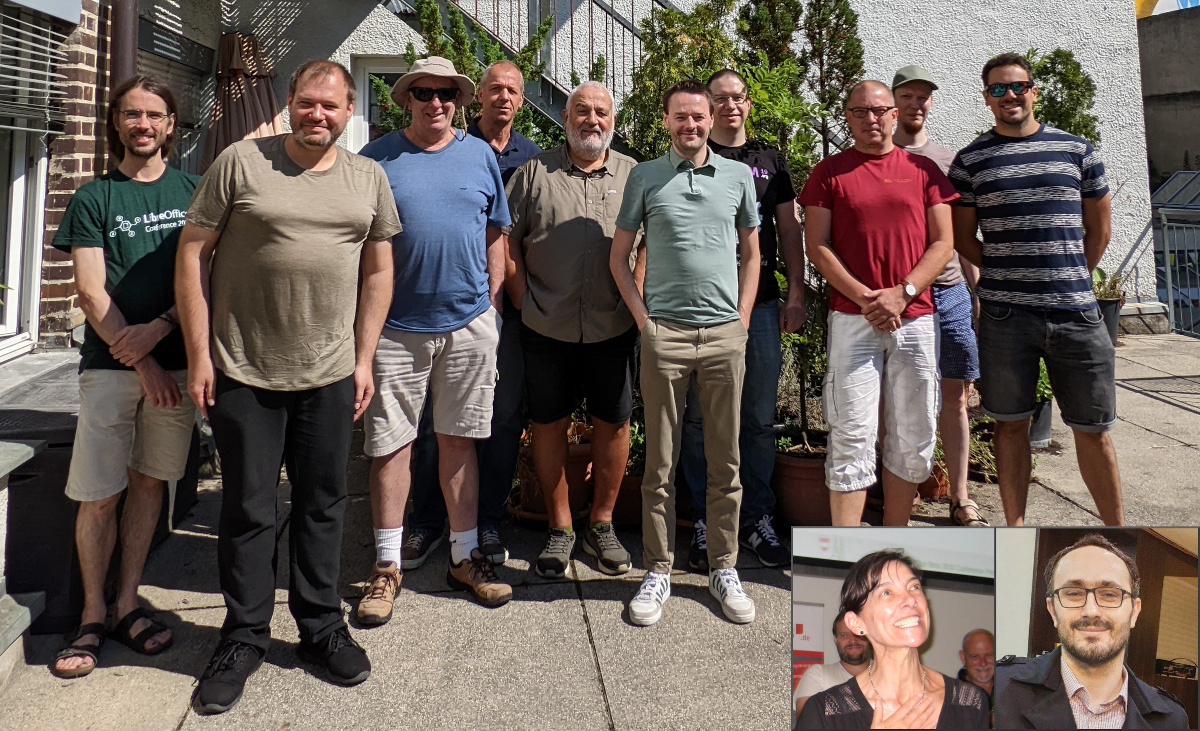
Jean H. Weber and Kees Kriek from the LibreOffice Documentation Team are happy to announce the immediate availability of the Writer Guide 7.2, one week after the release of LibreOffice Community 7.2

LibreOffice 7.2 Community includes many changes not visible in the user interface. These changes include improved interoperability with Microsoft’s proprietary file formats and performance improvements in handling large files, opening certain .docx and .xlsx files, managing font caching, and opening presentations and drawings that contain large images.

The Writer Guide 7.2 has been updated from Writer Guide 7.1. It covers changes that are visible in the user interface, including:

  • Added a note about icon sets and Gallery sets in this Preface.
  • Added details about the Insert > Formatting Mark submenu (Chapter 2).
  • Updated list terminology and changed screenshots in Chapters 4, 8, 9, 11, and anywhere else lists are mentioned.
  • Added new gutter margins and choices for page background fills (Chapters 5, 6, and 9).
  • Updated details about some options on tabs of the PDF Options dialog (Chapter 7).
  • Added new, advanced features of the Style Inspector (Chapter 9)
  • Updated details about Templates dialog (Chapter 10).
  • Added “no registered database” error message in Mail Merge Wizard (Chapter 14).
  • Added information on classifying document contents (Chapter 17).
  • Added Basic Fonts options and custom dictionaries (Chapter 20).
  • New Chapter 21 on user interface variants.
  • Minor rewording, updates to terminology, and replacement figures in many chapters.

LibreOffice Community 7.2 release notes are here: https://wiki.documentfoundation.org/ReleaseNotes/7.2.

A big thank you to Jean and Kees for their wonderful work.

Jean Weber
Kees Kriek


The LibreOffice Documentation Team is devoted to produce the best documentation for LibreOffice and is open to everyone interested in contributing to our collective effort.

Interview with Hossein Nourikhah

Which is your perception of the project, as seen from the outside world?
I see LibreOffice project as an alternative path. The road to office productivity suites doesn’t have to end up in proprietary office applications and file formats. LibreOffice project is a way out, trying to provide freedom to the users, alongside providing user friendly, cost efficient products that are also accessible for the disabled people.
On the other hand, LibreOffice is a complex piece of software, consisting of ~10 millions of lines of code [1], which is somehow difficult for an average programmer to get involved in its development. This is something that can be improved through various means, including better tools and documentation, and of course, more helping hands.

How do you see office suites – desktop, mobile and cloud – evolving in the next 10 years?
As software/hardware platforms change, so does the application software, and office suite is not an exception. Being able to run on the mobile devices and cloud is one thing that we see today, but for the next decade, pervasive computing and internet of things seem to be the next platforms. So, being able to communicate with the user through new and challenging input and output channels like TTS, voice recognition and haptic technologies would be something feasible, and perhaps plausible. AI is something essential in this road-map.
I think it is very important for the LibreOffice community to accept these new platforms, and embrace the new ways of communicating with the users, providing the users the freedom and privacy they need in the new era.

Are you a LibreOffice user? Which is your opinion of LibreOffice as a user of desktop software?
Yes, of course! I use the latest Ubuntu LTS, and I am a LibreOffice user on a daily basis. In fact, I was an enthusiastic user of an early version of OpenOffice.org from Red Hat 9.0 in 2003 [2], and I have switched to LibreOffice when it was released.
I am a happy user, although there are glitches in text rendering for my own language (Persian/Farsi). I hope we can fix them sooner with the help of kind LibreOffice developers.

Why did you decide to apply for the position of Developer Community Architect?
For at least two reasons:
Firstly, I wanted to spend my time on a free software that will benefit the people, no matter their skin color, nationality, race and wealth.
And secondly, I wanted to get involved in an international community of developers, and try to attract more and more people, convincing them to use LibreOffice, and encourage them to contribute in the way they can.

Although you have just started working as Developer Community Architect, which is your opinion about LibreOffice source code?
Looking at the history of the code, it is more than 30 years now since the start, and I think there are hidden gems out there! You design a GUI with glade, and at runtime, you can get X, Qt, gtk, etc user interface out of it with visual class library (VCL). This is very interesting.
On the other hand, I think there are a lot of places for improvement, and the most important part of it is from the architectural point of view. Instead of a monolithic application, a multi-process architecture would provide advantages that are available today in some web browsers.

You are from Iran, a country with a huge historical heritage. Can you provide a short description?
Yes. Iran (previously called Persia), is a country from the west of Asia. Currently It spans from Caspian Sea in the north to Persian Gulf in the south. I am originally from Mazandaran, a lovely flourishing area in the southern coast of Caspian Sea with the well known Hyrcanian Forests.
Iran (Persia) has a long history of civilization. Alongside Italy (Ancient Rome), Persia was one the great civilizations of the ancient world. Now, the heritage of the ancient Persia, from the old landmarks to the distinguished scientists and figures spans over several countries. 24 UNESCO World Heritage Sites are currently inside today’s Iran [3], in which most of them are cultural sites, except 2 natural sites of Lut Desert and Hyrcanian Forests.
But besides the long history, it has kind people that want to have a good relation with all the nations worldwide. We also have nice looking Persian kitties that many people around the world love them. 🙂

Which is your operating system of choice, and your preferred development tools?
I use Ubuntu LTS. Debian-based distros are neat, and in case Ubuntu is a platform that I can describe as both user-friendly and developer-friendly. Advanced Package Tool (APT) and Debian Package Manager (dpkg) are great tools that were far ahead of their time, even compared to the commercial software tools from expensive proprietary operation systems. It is very interesting from a user’s viewpoint that you can install any package you like with a single click or a single command:
sudo apt-get install some-pacakge
And it is very helpful from a developer’s viewpoint that you can build a package with just 3 simple commands: Installing dependencies, getting the source code, and building the package is straightforward:
sudo apt-get build-dep some-package (install dependencies)
apt-get source some-package (install the sources)
cd some-package-dir; dpkg-buildpackage -b (build it!)
Let’s remember Ian Murdock (rip), the founder of Debian project and the original creator of these great tools.
I usually use Qt Creator IDE for most of my development work, but I occasionally use Visual Studio Code.

Your personal message to the LibreOffice community, in your native language (and of course in English).
In Farsi/Persian:
پیام من به جامعه لیبره‌آفیس این است: لیبره افیس یک فرصت برای دسترسی به نرم‌افزاری آزاد، دوست داشتنی و بسیار مفید برای کارهای روزمره است. اگر می‌خواهید بهتر شود، باید خودتان کمک کنید؛ چون لیبره آفیس نرم‌افزار خودتان است!
In English:
LibreOffice is an opportunity to have access to a free, lovely and useful software for the daily tasks. If you want it to become better, you should help; because LibreOffice is your own software!

References
[1] LibreOffice at OpenHub: “507,456 commits made by 2,118 contributors representing 9,706,279 lines of code”, https://www.openhub.net/p/libreoffice
[2] Red Hat Linux 9 Features Latest Open Source Technologies, https://www.redhat.com/en/about/press-releases/press-redhatlinux9
[3] Properties inscribed on the World Heritage List (24), Iran (Islamic Republic of), https://whc.unesco.org/en/statesparties/ir

To get in touch with Hossein:

E-Mail: hossein@libreoffice.org
IRC: hossein at libreoffice-dev room in LiberaChat Network irc://irc.libera.chat/#libreoffice-dev

Hossein Nourikhah joins the TDF team as Developer Community Architect

Next week, Hossein Nourikhah will join the team at The Document Foundation, the non-profit behind LibreOffice, as Developer Community Architect. Hossein is a developer, university lecturer and FOSS advocate. He writes programs, teaches programming to students, and is an advocate for the use of free software applications, because they have a huge positive impact on the quality of our life by providing the essential freedoms that we all deserve.

Hossein has a B.Sc. in Computer Engineering (Software) from Isfahan University of Technology, and a M.Sc. and a Ph.D. in Information Technology from Amirkabir University of Technology, also called the Tehran Polytechnic. Since 2016 he has been an instructor at the Amirkabir University of Technology, teaching various courses including C/C++ programming, operating systems, software design, and many others.

Hossein started programming in BASIC and Pascal when he was 12, and after two and a half decades he is still involved in programming for fun and profit. He has worked with several programming languages, including C/C++, Java, Pascal, PHP and many more.

Industry experience

In addition to the university activities, including teaching and research, Hossein has several years of experience in the industry, working at various software/hardware companies as a C/C++/Java programmer – and lately as a software team manager and lead developer.

Hossein’s work experience ranges from web development with PHP to industrial application development with C++/Qt. He considers Qt a great platform for C++ software development, and he likes it very much as a clean and lovely tool.

Hossein has worked with many programmers as mentor, helping them to improve and reach their potential in software development by better understanding programming languages, libraries and tools. He feels great when he can empower other people, also because this helps him to expand his knowledge and understand things much better than before.

As Developer Community Architect, Hossein will be responsible for attracting new contributors to the LibreOffice project by identifying and onboarding new potential developers, building relationships between them and the community, and introducing them to TDF’s communication channels – where they will meet fellow co-hackers. He will encourage everyone’s contribution, and show community members ways to grow by bringing the more skilled contributors in contact with existing experts in the various fields for even deeper learning.

We’re happy to have him on board, and look forward to working with him!

Annual Report 2020: TDF and LibreOffice infrastructure

In 2020, the infrastructure team added new services, implemented a new Extensions and Templates site, and worked on a replacement for Ask LibreOffice

(This is part of The Document Foundation’s Annual Report for 2020 – the full version is here.)

LibreOffice’s infrastructure team is responsible for maintaining the hardware, virtual machines and services that enable the wider community to develop, market, test, localize and improve the software. The public infrastructure is powered by around 50 kernel-based virtual machines (KVMs) spread across four hypervisors, plugged to an internal 10Gbps switch, hosted at Manitu in St. Wendel (Germany), and managed with libvirt and its KVM/QEMU driver. The virtual disk images are typically stored in GlusterFS volumes – distributed across the hypervisors – except for some transient disks (such as cache) where the IOPS requirement is higher and the redundancy less important.

In 2020, the infra team added various new services, such as the new SilverStripe-based Extensions and Templates site. Some background to the technical and design decisions behind the site are here on the blog.

Meanwhile, Discourse was investigated as a likely AskBot replacement, while several VMs for deployment tests outside the scope of infra were handed over (such as decidim). The infra team worked on Moodle (an e-learning platform), build bots, integration of the Weblate translation platform into the TDF development dashboard, and a crashtest box (sponsored by Adfinis).

Along with the new services, there were many notable upgrades too. Some machines are still running Debian GNU/Linux 9 (codename Stretch), but most are now upgraded to Debian 10 (codename Buster). Other updates include: Nextcloud 16 to 20, Gerrit 2.16 to 3.2, LibreOffice Online 6.3 to 7.0, and Mediawiki 1.31 to 1.35. Finally, OpenGrok, Etherpad Lite, Weblate and the Grimoire dashboard received updates too.

Notable refactoring/improvements took place in the online help backend, along with the backends for bibisecting and mailing lists. The team started collecting metrics for download counters and the update checker, and worked on improving IRC bots, the monitoring setup, and a distributed backup solution.

Documentation was improved to make onboarding of new infra team members easier, while the SSO (Single Sign-On authentication) system was expanded with more services: Gerrit, the new extension site, Discourse, Jitsi and Moodle.

Like what we do? Support the LibreOffice project and The Document Foundation – get involved and help our volunteers, or consider making a donation. Thank you!