Financials and Budget – TDF Annual Report 2025

TDF Annual Report 2025 banner

This is part of the Annual Report 2025 from The Document Foundation, the non-profit that coordinates the LibreOffice project and community.

TDF exists because of a large, dynamic global community — volunteers, ecosystem companies and committed end users who support our work with donations of both time and money. The 2025 accounts tell a clear story: a foundation that grew significantly, while keeping its finances transparent and its spending tied to its mission.

A year of strong growth in income

Total income for 2025 reached € 2,175,997, a substantial increase on the € 1,387,589 recorded in 2024. The growth came from three distinct sources, and it is worth being precise about each.

The largest share, € 1,976,825, came from donations — overwhelmingly from individual users and small businesses, mostly in Europe. This was the fifth consecutive year in which donations exceeded one million euro, and the highest figure to date. Part of this increase was organic, reflecting the continued strength of LibreOffice downloads. A further part can be attributed to a concrete change: in mid-2025 we introduced a new in-product update notification on Windows, which periodically — after every major release and selected minor ones — informs users that an update is available, presents the new features, and invites them to support the project with a donation. The effect was immediately visible as a step-up in donations from the moment it was deployed, and it is keeping donations at a higher level into 2026. We mention this openly, because transparency about *why* the numbers move is as important as the numbers themselves.

The second source was income from the sale of LibreOffice through online stores, sponsoring and related commercial activity, which together generated € 168,975. The Apple App Store (€ 118,942) and the Microsoft Store (€ 35,393) accounted for most of this. The third source was € 30,197 in income from securities held under the foundation’s asset management.

How the money was spent

Total expenditure for 2025 was € 1,457,343. The breakdown by category shows where donor money goes.

  • Staff and operations remained by far the largest commitment, at € 1,091,032. This covers salaries (€ 406,736), statutory social security contributions (€ 93,244) and freelancers (€ 591,052) — the people who keep infrastructure, communication, administration and project coordination running, in order to share knowledge, support the community in its activities, and enable contributors to do their work.
  • Tenders. As in 2024, no development tenders were funded in 2025. Tenders related to LibreOffice development remain on hold, and will be resumed based on the development strategy currently under discussion according to the new Procurement Policy.
  • Events and community support amounted to roughly € 87,000, including the LibreOffice Conference (developer conference, € 51,184), community projects (€ 15,014) and student scholarships (€ 17,368), together with marketing initiatives. These funds support the events and local activities that hold the global community together, and help us to share knowledge around the world.
  • Infrastructure and hosting came to € 51,420, covering the hosting, virtual machines, services and domains that underpin the project’s technical independence — a foundational asset we continue to prioritise.
  • Legal and administrative expenses totalled roughly € 92,000, including accounting and the preparation of financial statements (€ 34,164), legal advice and counselling (€ 36,597 across project and general legal work), and insurances (€ 4,626).
  • Cost of fundraising. Receiving donations is not free. In 2025, payment-processing and banking fees came to roughly € 98,000 — Stripe fees of € 46,446 and bank transfer and money-transfer fees of € 51,190. These are simply the cost of doing business: they scale with the volume of donations we receive. It is worth adding that these figures do not capture the full picture, because PayPal’s currency-conversion costs are embedded in the transactions and not separately visible — though they are comparable in scale to the Stripe fees. We report this plainly so that no reader underestimates what it costs to collect the donations that fund our work.

Results and transparency

After expenses, the charitable entity closed the year with a result of € 554,476, asset management contributed € 21,263, and the commercial business operations returned a profit of € 142,916.

Transparency remains one of TDF’s defining characteristics — towards our donors, contributors, community and users. Our accounting is handled by a professional accountant, and our complete ledgers, listing all income and spending broken down by project, are published on our public wiki at https://wiki.documentfoundation.org/TDF/Ledgers, with only a few items obfuscated for privacy. As in previous years, and given the scale the foundation has reached, our books have been audited, and the Board continues to work with the authorities in Berlin to implement the improvements the audit recommended.

To everyone who contributed time, skills, resources and money in 2025: thank you. The foundation’s strength is your achievement.

Note: The expense categories above are indicative groupings drawn from the foundation’s accounts. They exclude VAT flows and certain material costs that the ledger handles separately, so the categories are not intended to reconcile arithmetically with the per-sphere annual results. The authoritative, fully itemised figures are published in the ledgers.

Like what we do? Support the LibreOffice project and The Document Foundation – make a donation, or get involved and help our volunteers. Thank you!

What We Owe Each Other, in Millimetres and Volts

You arrive in a city you have never visited before. You are tired. You find your room, open your suitcase, pull out a charger, and plug it into the wall. The small green light comes on. You think nothing of it, because nothing happened. You moved between two countries, two electrical grids, two regulatory regimes, and the machine in your hand simply continued to work.

Behind that uneventful moment sits more than a century of meetings, arguments, technical drawings, and compromises between people who will never meet you. The plug fits because somebody, somewhere, decided that it should – and decided further that the decision should be written down, made public, and not owned by anyone. We almost never notice this kind of work. We only notice it when it fails: the adapter that does not fit, the document that does not open, the part that cannot be replaced. Standards are the infrastructure we live inside, and like most infrastructure, they are invisible until they are not.

The public agreement

A standard is a public agreement about how things should fit together. Two words in that sentence carry the weight: public and agreement. Public, because the rules are written down and anyone can read them. Agreement, because nobody imposes them alone; they are negotiated between parties who accept that the shared space is more valuable than any individual advantage within it.

This distinguishes a standard from two things it is often confused with. It is not a law, because no state enforces it directly. And it is not a product, because no company owns it. A standard sits in a peculiar middle ground – it is something that belongs to everyone and to no one, maintained by institutions whose only task is to keep it coherent and accessible. The metric system is a standard. So is the size of a sheet of A4 paper, the shape of a stop sign, the gauge of a railway track, the dimensions of a shipping container. None of these things were inevitable. Each of them was once contested, and each of them was resolved not by conquest but by convention.

A civic act, not a technical one

It is tempting to treat standards as a matter for engineers. They are not. Or rather, they are only incidentally so. The engineering is the easy part. The hard part is the decision that the rules of a shared space should not belong to any single actor – that the measurement of length, the width of a road, the voltage in a socket should be held in common rather than owned.

The history of standards is, almost without exception, a history of fragmentation followed by painful consolidation. In the nineteenth century, European railways had dozens of incompatible track gauges, because each company built its own. Goods had to be unloaded and reloaded at every border, and sometimes at every regional boundary. The loss was enormous, and it was eventually resolved not because engineers invented a better track but because societies decided that the common good of interoperability was worth more than the private advantage of incompatibility. The same story repeats with screw threads, with time zones, with paper sizes, with electrical systems. Each consolidation was a political act dressed in technical clothing.

When we say a standard is public, then, we are saying something quite radical. We are saying that a certain category of rules – the ones that govern how we connect to each other – must be held outside the market, because if the market owns them, the market can charge rent on the simple act of cooperation.

What standards give us

From the point of view of the person who uses them – which is to say, all of us, every day – open standards provide three things that are easy to take for granted until they are gone.

The first is interchangeability. Because the rules are public, anyone can build to them. If the lamp you bought five years ago breaks, you can replace the bulb with one from any manufacturer. If your supplier raises prices unreasonably, you can switch to another. If a company goes out of business, its customers are not stranded. You are not captured by the choices you made in the past, because the choices were made against a common framework rather than inside a private one.

The second is continuity. What works today will still work tomorrow, and what was made yesterday still works today. This is a quieter gift, but it may be the most important one. A standard that is public and stable means that your past remains legible to you. The documents you wrote twenty years ago, the tools your grandfather used, the measurements recorded in an old building plan – all of these remain available, because the rules that governed them are still available. Continuity is how a society talks to itself across time. It is how we remain connected to what we have done and what has been done for us.

The third is shared ground. Standards let people who have made different choices still cooperate. You and I do not need to use the same brand, the same supplier, the same tool. We only need to agree on the interface between us. A standard is, in this sense, a kind of peace treaty – a recognition that a common format for exchange matters more than uniformity of preference. It is the opposite of a monoculture. It is the condition that makes plurality possible without chaos.

When the rules become private property

Now consider what happens when the rules of a shared space are privately owned.

Imagine that the thread on every screw in your country belonged to a single company, and that using a screw at all required permission from that company. Imagine that the gauge of the railway tracks was the property of one firm, and that every other operator had to pay to run trains on lines they did not own. Imagine that the voltage of the electrical grid was licensed, and that plugs from any other manufacturer simply did not fit.

The three goods we just described begin to erode. Interchangeability disappears, because you cannot replace one part with another without the owner’s permission. Continuity depends on the corporate survival of a single actor: if the company changes its terms, raises its prices, or goes bankrupt, you lose access not just to a product but to the entire category of things that depended on it. Shared ground shrinks until it includes only the people who have paid the same licence as you have. Cooperation becomes a privilege extended by a third party, rather than a right held between equals.

This sounds absurd when we imagine it happening to physical infrastructure. We would never accept it for screws or rails or electricity. And yet the history of standards is also the history of attempts to do exactly this, resisted successfully in some domains and less successfully in others. The reason we have open standards for physical infrastructure is not that anyone thought them obviously good. It is that societies fought, sometimes for decades, to keep them out of private hands.

The ancestor question

There is a useful way to think about all of this, which is to ask what kind of ancestor we want to be.

Every time we accept an open standard, we are making a small bet on behalf of people who do not yet exist. We are saying that the thing we are building – the document, the product, the system – should remain accessible to them, even though we will not be here to help them open it. We are choosing to be hospitable to a future we cannot see. And every time we accept a closed one, we are making the opposite bet. We are saying that our successors will have to rely on the continued goodwill of a private actor to reach back to what we have made. We are outsourcing their access to our own lives.

This is not a technical question. It is a civic one, and it is also a moral one. Standards are how a society decides whether its own infrastructure should be owned or shared, whether its past should be accessible or licensed, whether its future should be open or gated. They look like engineering. They are really a quiet, continuous answer to the question of what we owe each other, and what we owe to those who come after us.

So the next time you plug something into a wall and it simply works – the next time a door handle fits, a page prints cleanly, a part slots into place without thought – consider for a moment what had to be true for that to happen. Consider who refused to own it. And ask yourself what kind of ancestor a closed standard lets you be.

The non technical dependency layers: the Calendar and the Invoice

Earlier in this series I described the invisible architecture of lock-in as three stacked layers. A document depends on its format, which depends on a rendering engine to become visible, which depends on the fonts that give it its final shape. Each layer is a dependency the user rarely sees and almost never chooses deliberately, and together they explain why “just open it in something else” so often fails. The argument has always been structural rather than moral: it does not matter whether the vendor is benevolent or predatory, because the dependency exists either way.

Two pieces of news from late June give me occasion to extend that architecture. They are not, at first glance, about formats at all. But read structurally, they reveal two further layers of dependency that sit on top of the technical ones. Layers I left implicit until now because the technical case was enough to make the point. It is worth making them explicit, because they complete the account of what dependency actually means.

The first piece of news: Microsoft has extended free security updates for Windows 10 by a further year, to October 2027. The original end date for consumer support was October 2026. Hundreds of millions of users, and the institutions that manage them, had organised their procurement, their budgets, and their migration planning around that date. Then the date moved, quietly, through an editor’s note appended to a blog post, with no formal announcement.

The second: Italy’s competition authority, the AGCM, has opened an investigation into whether Microsoft adequately informed consumers when it integrated its Copilot and Designer AI tools into Microsoft 365 and moved subscribers onto more expensive plans. The allegation, still under investigation, concerns transparency and consent: whether users were given a genuine choice, or were migrated to a costlier tier unless they actively opted out.

I want to be careful here, because the temptation is to treat these as two instances of the same thing, and they are not. They are two sides of one coin. A coin has two faces and a single substance. The substance, in both cases, is that the user is not in control of his desktop stack. The faces are different, and naming them precisely is what gives the argument its force.

The temporal layer

The Windows 10 extension is not, on its surface, bad news. A further year of free security updates is, taken in isolation, a gift to users who cannot or will not upgrade. If you read the story as a tale of corporate character – Microsoft breaking its word, Microsoft flip-flopping – you reach for the weakest version of the argument, and you hand a critic the easy reply that extending support is pro-consumer.

The structural reading is harder to answer. The point is not that the date was wrong, or that moving it was wrong. The point is that the date was never yours. The lifecycle of your own desktop – when it is supported, when it is abandoned, when you must spend money on new hardware – is governed by a vendor’s strategic calendar, not by your operational needs. You reorganised a year of planning around October 2026 because Microsoft told you to, and you will reorganise again around October 2027 for the same reason. A benevolent vendor moving the date without consulting you proves the point exactly as well as a cynical one would. You do not own the clock.

This is the fourth layer. Above format, rendering, and fonts sits time. Your dependency is not only in the file, it is in the calendar.

There is a detail in this story that sharpens the point rather than softening it. The free extension is not unconditional: to enrol without paying, a user must sign in with a Microsoft account and sync settings to the company’s cloud. So the price of keeping your old operating system alive is to move more of yourself into the vendor’s stack. The remedy deepens the dependency it claims to relieve. This is the difference, which I have written about before, between a solution and a substitution. A solution would reduce your dependence. A substitution merely relocates it from the operating system to the account.

The commercial layer

The Italian investigation looks, at first, like a different kind of story altogether: a matter of consumer-protection law, of disclosure and dark patterns, with no obvious connection to open standards. And it would be a mistake to press it into service as evidence of format lock-in, because that is not what it is about. The discipline of letting structure carry the argument requires resisting exactly that kind of stretch.

But it illustrates a different layer cleanly, and the layer is real. When your productivity suite is a proprietary bundle, the vendor can change what you are paying for, and how much, without your meaningful consent. New tools you did not ask for are folded into the package, the price rises to match, and the path to opting out is, allegedly, buried. Whether the AGCM ultimately finds against Microsoft is not the point I am making, as the investigation may take until 2027 to conclude. The point is that the arrangement permits this. The economic terms of your daily work are set by a party that is not you, and can be revised by that party at a moment of its choosing.

This is the fifth layer. Above format, rendering, fonts, and time sits price. Your dependency is in the invoice as much as in the file.

What the layers have in common

Five layers, then: format, rendering, fonts, time, price. The first three are technical and largely invisible. The last two are not technical at all, and they are the ones the user feels most directly, in a migration deadline he did not set, in a subscription cost he did not agree to. Listing them together changes the character of the argument. Lock-in is no longer a catalogue of technical grievances of interest mainly to specialists. It is a complete account of dependency, and it reaches every part of how a person works: what his documents are made of, when his tools will stop being supported, and what he will be charged for them.

What unites all five is a single absence: the user has no exit. He cannot take his documents elsewhere without loss because of the technical layers, he cannot escape the vendor’s calendar or its pricing because of the other two. Every one of these dependencies is only possible because there is no door.

That is why I have spent this series on formats, and on rendering, and on fonts, and now on calendars and invoices. They are not separate complaints. They are the same observation seen from different angles, and the observation is this: an open format and a free application are not, in the first instance, about cost or ideology. They are an exit, they are the door that makes every one of these dependencies optional rather than fixed. The Open Document Format and LibreOffice do not promise that you will never depend on anyone. They promise something narrower and more important: the dependency is one you have chosen, and one you can leave.

A vendor’s calendar will always move. A vendor’s prices will always rise. These are not scandals, they are simply what it means to be governed by someone else’s strategy. The only question that matters is whether you are free to walk away when they do. Everything in this series has been an argument that you should arrange your affairs so that you can.

Images by Manfred Steger from Pixabay

LibreOffice project and community recap: June 2026

Monthly recap banner

Here’s our summary of updates, events and activities in the LibreOffice project in the last four weeks – click the links to learn more…

LibreOffice 26.2 banner

Format Sovereignty banner

  • Our marketing and design communities worked on a new video: Join the LibreOffice Community! (This video is also available on PeerTube.)

Please confirm that you want to play a YouTube video. By accepting, you will be accessing content from YouTube, a service provided by an external third party.

YouTube privacy policy

If you accept this notice, your choice will be saved and the page will refresh.

Annual Report banner, with LibreOffice community group photo

Guidebook cover

Like what we do? Support LibreOffice with a donation – or join our community and help to make LibreOffice even better! Also keep in touch – follow us on Mastodon, Bluesky, Reddit and Facebook.

The invisible architecture of lock-in: the layering of dependencies

There is a sophisticated mechanism by which proprietary technology ecosystems maintain their grip on users and institutions, even when those users and institutions believe they are making free choices, using open standards, and building independent digital infrastructure.

The mechanism does not work through force, but through a subtler and more durable strategy: the layering of dependencies, in which each layer obscures the one beneath it, so that when the system fails the apparent cause is something other than the real one.

It is a structural pattern with identifiable components and predictable failure modes, and with a single political consequence: the systematic attribution of interoperability failures to open alternatives rather than to the proprietary dependencies that actually cause them.

Understanding all of this is essential for anyone working on a genuine interoperability policy, because without it even the best-intentioned policy interventions address the visible symptom while leaving untouched the larger problem of the underlying architecture, which goes on working exactly as designed.

The perception of malfunction

Let us start from the user’s experience, because this is where the political damage occurs.

A document is created in Microsoft Word and sent to a colleague who uses LibreOffice on a Linux desktop. The colleague opens the file. Something is wrong: a table has shifted, the text has reflowed, a font looks different, the page breaks have moved.

The experience is familiar to millions of people in institutional settings that have adopted, or are considering adopting, open source software. It is the experience that generates the helpdesk tickets, the emails of pure frustration to the IT department, the conversations that end with “can you just send me a PDF?”, and the broader sentiment, consolidating over time, that open source software is not ready for professional use.

What is the cause of this failure? Users will blame LibreOffice, IT managers will blame format incompatibility, policymakers will blame the immaturity of open standards.

These are all wrong answers. Or rather, they are all answers to the wrong question, because they describe where the failure manifests rather than where it originates.

The actual cause is a set of interdependent technical systems, each contributing a different failure mode, all producing a single visible result.

The format contains proprietary structures that only Microsoft’s implementation handles correctly. The rendering introduces platform-dependent variations that the format specification does not control. The proprietary fonts cannot be legally bundled with open source software.

Three distinct failure modes producing the same symptom, and equally invisible to the user, who perceives only that things worked in Word and do not work in LibreOffice.

This is the architecture of layered dependency. Each layer absorbs the causal chain and emits a different signal, one that points toward the open alternative.

Layer One: the format and its hidden features

The first layer is the most discussed and the most politically visible: the document format. The conflict between ODF and OOXML has been extensively documented, litigated within standards bodies, and debated in national parliaments and in the European institutions.

But even within this well-mapped terrain, it is worth clarifying the specific mechanism of obscuration at the format layer.

OOXML, the format Microsoft Office produces by default, exists in two conformance levels. Strict is a reasonably clean specification. Transitional is something categorically different: a format designed to encode the accumulated behaviour of earlier Microsoft Office versions, preserving decades of proprietary implementation choices as normative elements of an apparently open standard.

OOXML Transitional includes VML — Vector Markup Language, a proprietary drawing format from the late 1990s that predates and contradicts the DrawingML system defined elsewhere in the same specification.

It includes references defined as “as in earlier versions of Microsoft Office”, which make sense only if one has access to those earlier versions and to their undocumented implementation details.

It includes extensions that allow Microsoft to embed proprietary functionality in documents, invisible to non-Microsoft implementations, and capable of causing silent rendering differences ranging from minor visual variation to complete layout failure.

Crucially, OOXML Transitional is what Microsoft Office produces by default.

Every time a user saves a Word document without selecting a different format, they produce a file optimised for the Microsoft ecosystem and subtly hostile to every other.

Users do not know this is happening, because the choice is made for them at the format level, and when the document fails in LibreOffice, the format layer’s contribution to that failure is invisible. The user sees a rendering problem, not a format problem.

This is the first layer of obscuration: proprietary format constructs masked by the label “industry standard”, producing errors that appear to be implementation shortcomings in the receiving software.

Layer Two: rendering and its unspecified behaviour

The second layer is less discussed, less politically visible, and for these very reasons more durable as a source of interoperability failure: text rendering.

Document format standards specify content. They define what a document contains: text, structure, logical relationships, embedded objects, and formatting instructions.

What they do not specify, and what none of the major document format standards has ever specified, is how that content should be rendered. The translation of encoded content into visible glyphs on a screen or a page is left to the implementation, and different implementations make different choices.

These choices operate across several subsystems.

Shaping engines — the software components that translate sequences of Unicode characters into sequences of glyphs, and that handle the complex rules of scripts such as Arabic, Devanagari and Thai — differ by platform.

HarfBuzz, the open source shaping engine used by LibreOffice and by most Linux applications, produces correct, standards-compliant output, but that output may differ in detail from Windows’ Uniscribe or DirectWrite engines, particularly for complex scripts with context-sensitive glyph selection.

The differences are almost always invisible for Latin text, but for the non-Latin scripts used by a significant portion of the European public sector and citizenry, they can be significant.

Hinting interpretation varies across rendering engines. Fonts embed hinting instructions — algorithms that adjust glyph outlines for crisp display at low screen resolutions — but those instructions are interpreted differently by different renderers.

A font optimised for Windows’ GDI rendering engine may display with different weight and spacing under FreeType on Linux, even at identical sizes.

The differences are minute for any single character, but they affect the perceived quality of the text and contribute to the general impression that open source environments are slightly less polished.

Line-breaking and justification algorithms are the most significant source of rendering variation and the most direct cause of document reflow.

The algorithm that determines where to break lines — how to distribute words across a line of a given width, whether and how to hyphenate, how to handle justified text — is an implementation choice that no format specification regulates.

Microsoft Word’s line-breaking algorithm is proprietary and undocumented, and it is very different from LibreOffice’s. Both are legitimate implementations of the same function, and they can produce different line breaks; different line breaks mean different page breaks; and different page breaks mean that a document paginated in Word will not be paginated the same way in LibreOffice.

This is not a defect in implementation quality, but the normal and predictable consequence of differing rendering choices that document format standards do not define. And it produces errors that are invariably attributed to the software receiving the document, because that is where the visible difference appears, rather than to the specifications that are their cause.

The rendering layer is the most technically complex component of the layered dependency and the hardest to address, but it is also the layer that most clearly reveals the dimensions of the problem: an error generated by a different choice made by two projects, attributed solely to the open source software, on the basis of an entirely unjustified, almost faith-based trust in the quality of the proprietary software.

Layer Three: fonts and the dependency on proprietary resources

The third layer completes the picture and, in many practical settings, causes the greatest damage: fonts. Here we will not analyse font-level lock-in as such, but will instead explain how the font layer operates within the layered dependency model.

Fonts interact with both layers above. At the format level, fonts appear as named references: a document declares that the body text is set in Calibri and the headings in Cambria. If those two fonts are not available on the receiving system — and this is the case on every system for which a licence for the proprietary fonts has not been acquired — the software must substitute them.

Substitution changes the metrics, and the metrics in turn change the geometry. Altered geometry produces reflow, broken layouts, forms overflowing their margins; and here too the failure is attributed to the application receiving the document.

At the rendering level, fonts interact with the shaping engine, the hinting system and the antialiasing pipeline in ways specific to each font’s design and embedded instructions. A font optimised for the Windows rendering stack will display differently under FreeType, even before any substitution occurs, and this contributes to the overall visual divergence between environments.

What makes the font layer particularly effective as a lock-in mechanism is the combination of legal unavailability and the user’s lack of information. The proprietary fonts at the heart of the problem — Calibri and Cambria, and before them Arial and Times — are not available under any kind of open source licence.

This is a legal constraint that open source software cannot overcome, but one that users perceive not as a licensing problem but as a software problem — not as the consequence of a strategy but as proof that open source software cannot handle ordinary documents.

Only Aptos, the latest of Microsoft’s proprietary fonts, is released under a partially restrictive licence, since it ties use to a download from Microsoft’s site. It can therefore be installed by Linux users too, and used legally, but this has not been communicated widely enough, so the lock-in mechanism is only reduced, not eliminated.

Why “invisible” is the key word

Each of the three layers would be a manageable problem if it were visible, and if users had the chance to see clearly that the error originates in the proprietary format, or in the insufficient rendering specifications, or in the proprietary font. Visible problems can be addressed and solved on the basis of accurate diagnosis and targeted intervention.

The strength of this scheme lies in its obscurity. Each layer acts as a signal re-encoder: it takes the output of the layer beneath it and re-emits it as something that looks like a different kind of problem.

So the dependency on proprietary fonts produces an error that looks like a software rendering issue; the rendering problem produces an error that looks like an implementation shortcoming; and finally the proprietary format structure produces an error that looks like a failure to comply with standards.

By the time the error reaches the user, its origin is completely obscured, and responsibility is systematically redirected to the last element in the chain: the open source software, which was merely trying to display a document designed to defeat it.

This is not a coincidence arising from poor design.

Software that generated random errors would be a problem for the company that developed it, because user frustration would flow back toward the originating software.
A system that generates errors at the boundary with competitors, in such a way that they are always attributed to those competitors, is a competitive asset.

Here the question of intent matters less than the question of structure: whatever the motivation behind the original design decisions, the resulting architecture functions as a constraint, and its effects are observable and measurable.

How policy responded, and where it failed

The policy response to document lock-in has concentrated on the format: mandating the use of ODF and open formats in public procurement, and guaranteeing that government documents can be created and consulted without the use of proprietary software. Unfortunately, these interventions have almost never been paired with penalties to enforce compliance, and the rules have often been ignored.

Moreover, these format mandates have not addressed the use of proprietary fonts in document templates, so by fixing only the upper layer they leave the lower one exposed and fully operational, where it is less visible and less politically salient, and therefore more durable.

Documents continue to fail at the boundary with open source software, and users continue to blame the latter. The political will behind the format mandate is progressively eroded by user complaints about interoperability problems, which seem to contradict the promise of the open, standard format mandate itself.

An institution that deploys LibreOffice but fails to address rendering consistency — allowing a mixed infrastructure of Windows and Linux systems to exchange documents without recognising that rendering variation is not a software defect — risks creating an internal interoperability problem that could be used to justify a return to monoculture.

The rendering layer has received almost no policy attention. No major digital sovereignty framework specifies rendering-fidelity requirements. No procurement standard defines conformance in terms of visual consistency across implementations.

The tools to address this problem — reference rendering implementations, rendering test suites, fidelity benchmarks — exist only as prototypes or proposals, and have not been integrated into any serious policy framework.

Knowing this pattern is a political act

The invisible layering of dependencies is a pattern born of nearly fifty years of unregulated evolution of personal productivity software, and one that threatens to make the path toward digital sovereignty extraordinarily complex.

It matters to give the pattern a name, so that it can be used in policy discussions, in parliamentary questions, in procurement specifications and in the public debate on digital sovereignty, at every level, including by the media.

The invisible layering of dependencies connects phenomena that do not appear to be related — document format incompatibilities, rendering variation, font substitution failures — and shows that they are expressions of the same underlying architecture.

Once these phenomena are seen as a pattern rather than as isolated technical problems, an appropriate policy response becomes clearer, because it is not enough to fix a single layer and mandate a single standard — even though that is a fundamental first step.

It is necessary to make all the dependencies legible and to integrate them into interoperability policies that address format, rendering and fonts explicitly and specifically, with enforcement mechanisms applying to all three layers.

The open source and open standards community has built the technical foundations for genuine interoperability: open formats are mature and solid, open source applications are fully up to the task, and there are hundreds of openly licensed fonts, many of them metric-compatible with the proprietary ones.

The architecture of lock-in does not persist because the alternatives are inadequate. It persists because policy has not yet learned to look beyond the visible surface of format conformance and to recognise the underlying layers where proprietary dependencies go on operating — invisible and ignored — doing the work they were designed to do.

LibreOffice Marketing Activities in 2025 – TDF Annual Report

TDF Annual Report 2025 banner

This is part of the Annual Report 2025 from The Document Foundation, the non-profit that coordinates the LibreOffice project and community.

In 2025, The Document Foundation and the global LibreOffice community pursued a marketing and advocacy programme that combined the established work of community building and software promotion with a sharpened public argument about digital sovereignty and open document standards. The year was framed by two anchoring milestones — LibreOffice’s fifteenth anniversary and the passing of 400 million cumulative downloads — and by an increasingly explicit defence of the Open Document Format as the only open standard for office documents. What follows is a thematic overview of the major activities carried out in support of TDF and LibreOffice over the course of the year, grouped by area rather than reported month by month.

Anniversary and Adoption Milestones

Two milestones gave the year its public narrative.

In January, TDF announced that LibreOffice had surpassed 400 million cumulative downloads since 2011, with an average of 28.6 million downloads per year and an upward trend reaching over 35 million annual downloads. The announcement reaffirmed the project’s standing against the long-running narrative that the desktop office suite was destined to disappear into the cloud.

In September, the project celebrated the fifteenth anniversary of LibreOffice, launched on 28 September 2010 as a fork of OpenOffice. The anniversary was treated not merely as a software birthday but as a statement about the movement LibreOffice represents: a community of thousands of contributors and dozens of companies, localisation into more than 120 languages reaching billions of potential users, and a sustained argument for digital autonomy in an era of cloud lock-in and disappearing ownership. The communication tied the milestone directly to ODF as the guarantee of perpetual, transparent control over one’s own documents.

Montage of photos from LibreOffice events

Advocacy: Digital Sovereignty and Open Standards

The most distinctive development of 2025 was the consolidation of marketing into a coherent advocacy campaign around digital sovereignty and open document standards.

The end of Windows 10 support, scheduled for 14 October 2025, provided the central advocacy occasion. TDF backed the international @endof10 campaign and argued that the moment was a crossroads rather than a routine product transition, positioning Linux and LibreOffice as a privacy-respecting, future-proof alternative to a forced upgrade path toward Windows 11 and Microsoft 365, with their attendant subscription costs, cloud dependency, and hardware obsolescence.

Alongside this, the foundation built a body of technical and policy-oriented material making the case for ODF as the only open standard for office documents and exposing the structural problems of OOXML. This advocacy strand reframed the project’s communication from product promotion toward a public argument about format ownership, lock-in, and institutional control of documents — an argument that resonated strongly with public-sector and policy audiences.

ODF logo

Conferences and Major Events

International and regional conferences remained central to the foundation’s visibility.

The annual LibreOffice Conference 2025 was the flagship gathering of contributors — developers, designers, documentation writers, translators, and marketers — and was promoted across the project’s channels in the now-established pattern of agenda, speaker, and live-update coverage. Two major regional conferences extended the programme across the world’s communities: the LibreOffice Asia Conference 2025, hosted in Japan, and the VI Latin American LibreOffice Congress, held in Havana. Both brought together contributors and users from their respective regions, generated substantial follow-up content, and reinforced the project’s presence in two of its most active geographies.

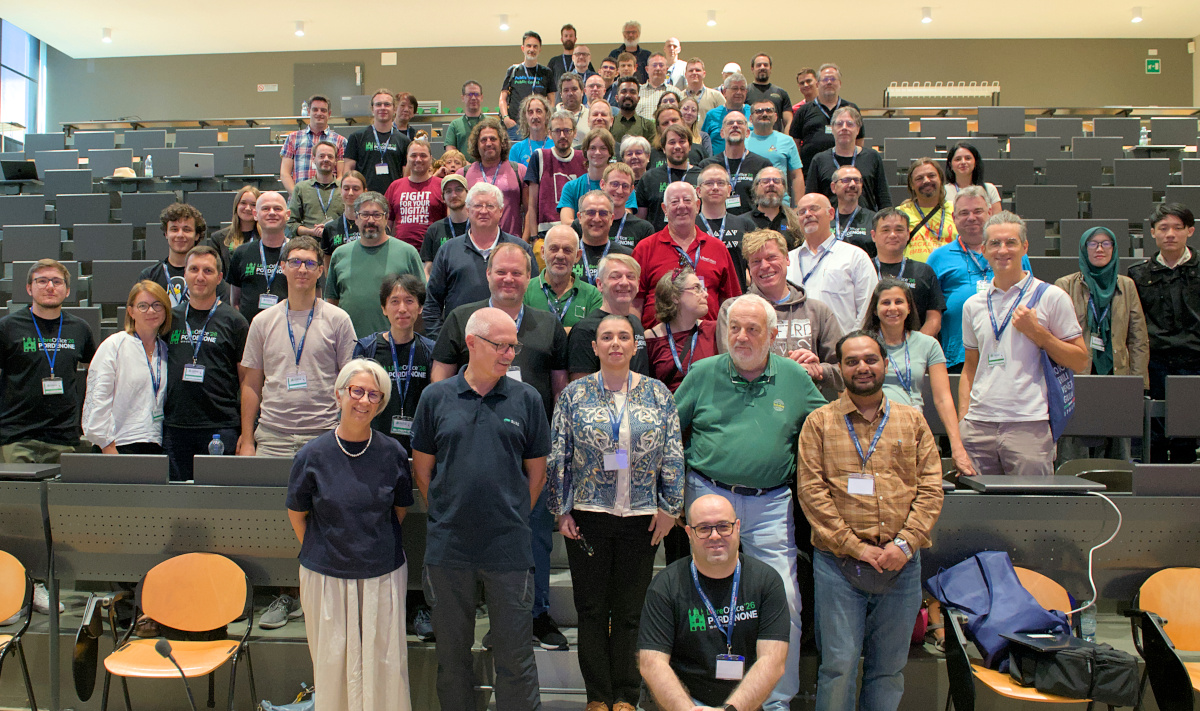
The community calendar was also rich with smaller regional events that the marketing team supported and amplified, including the LibreItalia Conference 2025, LinuxDays 2025 in Prague, the OSS Conf 2025 in Luxembourg, an event in Nepal tied to Software Freedom Day, the Augsburger Linux-Infoday, the Prague Installfest, the Univention Summit, the Linux Arena in Pordenone (Italy), and FLISoL Brasília. The project also maintained a presence at FOSDEM 2025 in Brussels at the start of the year.

Brazilian LibreOffice Community at FLISOL Brasilia 2025

Community Building and Recognition

The recurring Month of LibreOffice campaigns ran again in May and November, recognising and rewarding contributors across development, documentation, QA, localisation, and marketing through digital badges, public acknowledgement, and sticker packs and merchandise shipped to participants. The campaign continued to serve both as a celebration of existing contributors and as an on-ramp for new ones.

A significant structural development was the launch of the LibreOffice US community in November. Recognising that the United States, despite a large user base, had never developed an organised local community, TDF created dedicated communication channels (Discord, bridged to Matrix, and a Mastodon account) with the goal of supporting US-specific merchandise, marketing and advocacy materials, and meetups.

LibreOffice US community banner

Documentation, Publications and Merchandise

The community continued to expand its published resources as a marketing and onboarding asset. New user guides were released for the 25.2 line, alongside the Calc Guide 24.8 and Czech translations of the Getting Started Guide 24.8 and the Calc Guide 25.2, reflecting the contribution of native-language communities. New LibreOffice Expert magazines for 2025–2026 were made available for schools and local communities, and a new line of LibreOffice merchandise was introduced to support events, giveaways, and fundraising.

LibreOffice Calc Guide 24.8

Media, Press Relations and Social Media

TDF sustained its media relations work throughout the year, issuing press releases tied to releases, milestones, events, and public-sector adoption, and reinforcing LibreOffice’s position as a cost-effective, secure, and privacy-respecting alternative to proprietary office suites. The social media strategy continued across Mastodon, LinkedIn, and the project’s other channels, with particular emphasis on reaching decision-makers in public administration through case studies and adoption stories, and on carrying the digital-sovereignty argument to professional and policy audiences. Monthly project-and-community recaps provided a steady, aggregated record of activity across the year.

Public-Sector Adoption

Public-sector migration continued to be one of the most persuasive elements of the project’s external messaging, demonstrating LibreOffice’s viability at institutional scale and lending concrete weight to the digital-sovereignty argument that ran through the year’s advocacy. These migrations were amplified through press and social channels as evidence that open standards and open-source office software are a realistic foundation for public administration.

Conclusion

In 2025, TDF’s marketing and advocacy work matured from software promotion into a coherent public case for digital sovereignty built on open document standards. Anchored by the fifteenth anniversary and the 400-million-download milestone, sharpened by the end of Windows 10 and the defence of ODF, and sustained by conferences, community campaigns, publications, and steady media work, the year’s activities both amplified LibreOffice’s visibility and strengthened the wider argument that documents — and the institutions that depend on them — are better served by open standards and community-driven software.

Like what we do? Support the LibreOffice project and The Document Foundation – make a donation, or get involved and help our volunteers. Thank you!

The Document Foundation 2026
Proudly powered by WordPress | Theme: Refined Magazine Pro by Candid Themes.