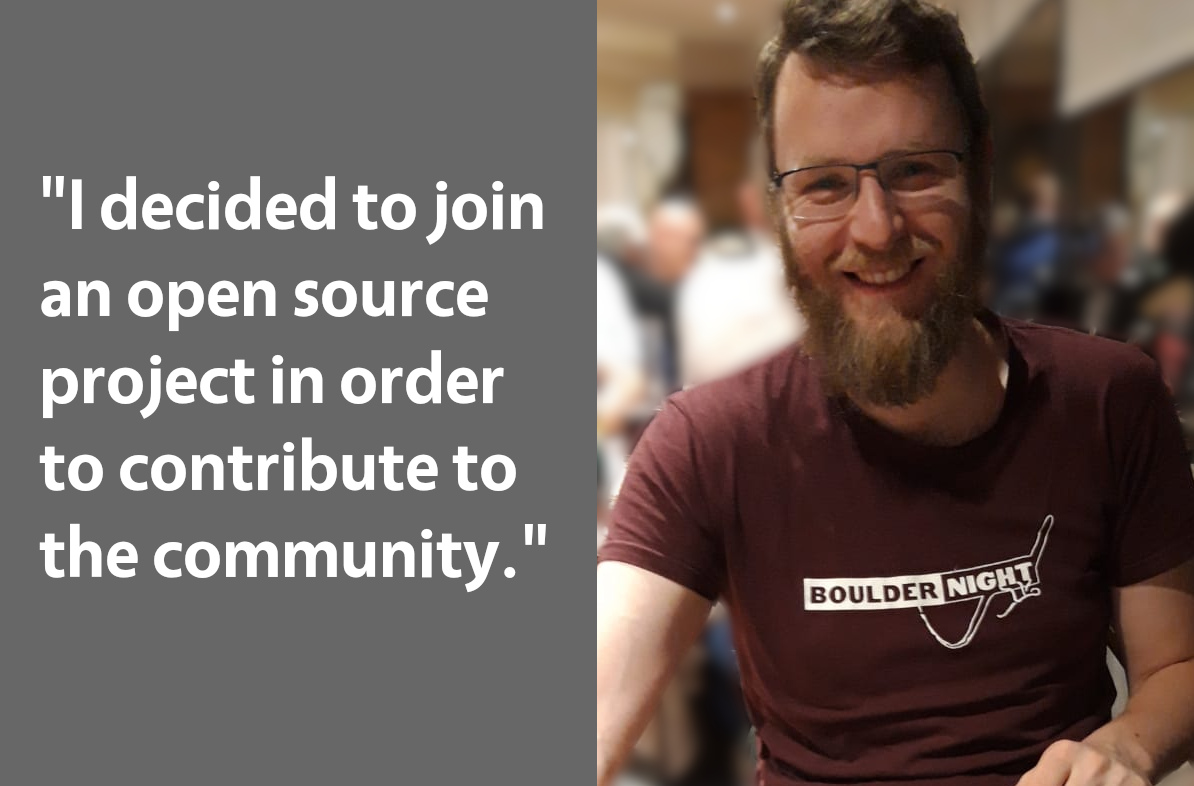
Community Member Monday: Nige Verity

Today we’re talking to Nige Verity who’s helping out in the LibreOffice marketing community…

Tell us a bit about yourself!

I’ve been working in IT since the mid 1980s, spread across the aerospace, defence, science and financial services sectors. In the beginning I was mostly coding and testing, but as time went by I found myself working on requirements, designing systems and documenting them as much as doing any actual coding.

I first learned to program using Fortran on a VAX computer running the VMS operating system. Since then I’ve used all sorts of hardware and programming languages, even including a brief spell updating an ancient legacy system written in Algol running on an Elliott computer of late 1960’s vintage, for which the program was loaded from paper tape. This was an experience that gave me enormous respect for the programmers of the past for whom that was hi-tech.

Having worked on some extremely complex systems over the years I have come to value simplicity. When I am developing software for my own use my tool of choice these days is Gambas – an amazing but surprisingly little-known IDE, best described as “Visual Basic for Linux”, only Gambas is far superior to VB and leaves Python for dead in terms of productivity and performance.

Away from IT I am a musician – playing flamenco and blues guitar, and also the piano. In parallel with IT I’ve worked on the fringes of the art world, helping to organise four large-scale public art shows in recent years.

Although originally from London, I am blessed to live in rural South Shropshire, surrounded by farmland and arguably the most beautiful scenery the UK has to offer.

How did you become a LibreOffice enthusiast?

I started using GNU/Linux after years of frustration with the limitations and failings of Windows. My first distro was Xubuntu 8.10 which came with OpenOffice.org as its office software package. Until then I’d never heard of it, but it didn’t take long to discover that it had all the functionality that I’d ever used in MS Office, and a lot more besides.

When LibreOffice was launched as a fork of OO.org I jumped ship to it and have never looked back. I never cease to be astonished at how powerful and stable it has become. In my ideal world I would see Base become much more closely aligned with MS Access, in the way that the other components are close analogs for their MS Office counterparts. At the moment, any organisation with a sizeable investment in the use of Access is really not likely to migrate to LibreOffice.

What are you doing in the LibreOffice project at the moment?

Compared with most contributors I am a total lightweight. While my initial inclination was to get involved with developing the software itself, I felt daunted by the likely learning curve, given the size of the codebase, so it would be a long time before I could become really useful. I decided I might be more effective in helping to spread the word about LibreOffice.

I got myself added to the marketing mailing list and this has proven to be a great way to get involved. You get an inside view of the project and initiatives to expand the userbase. Crucially you get the opportunity to comment on these marketing activities and contribute any ideas you may have.

Recently I have been distributing flyers promoting LO around secondary schools and colleges of Further Education in my area, along with the local university campus. My car has a LibreOffice banner displayed in the windscreen. Every email I send includes a promotion for LibreOffice in the signature section. These are minor activities in the scheme of things, but as I see it if every LO user successfully encourages just one other person to try it some of those new users will inevitably be decision makers, in a position to bring many others on board. “From little acorns….” and all that.

By putting myself forward as a LibreOffice point of contact I hope I will be able to help get some prospective new users “across the line”, by helping to resolve any questions or reservations which may be holding them back.

What are some of the challenges/opportunities with promoting LO and free software?

I feel the greatest challenge to the adoption of LibreOffice is simple resistance to change. In organisations where MS Office is already deeply entrenched, and possibly the only software many of their staff ever use at work, migrating from a tool they know very well to another which they may barely have heard of is a big ask. The bigger the organisation, the greater the task of migration is perceived to be. We have to persuade organisations that it is worth the effort.

A great opportunity where the UK is concerned is its highly dynamic business environment, which probably generates more startup companies than any other country in Europe. Some of these are highly professional, well-funded affairs but most involve only one or two people initially, seeking to create a business based on their skills and talents. With the bare minimum of funding and very little in their budget for software, this is where LibreOffice has great potential, if only ways can be found to reach people still in the planning stage of a new enterprise. This has the added advantage that if a startup includes LibreOffice in its workflows from day one, and that new business becomes a success, it is likely to stay with LO as it grows, thereby furthering its adoption.

In my experience of advocating the use of free software, people usually “get” the advantages of open source. They are not difficult to explain. The additional advantages of free software, however, are a much harder sell. If you are not involved in software development they really don’t seem that relevant. Does that really matter, though, as long as the applications people use are indeed free and open source? Does it really matter if the motivation for choosing that free software is the concept of free as in “gratuit” rather than free as in “libre”?

At the level of day-to-day users I don’t think it does all that much, as long as their managers understand that somebody somewhere has paid for their “cost free” software to be developed, in terms of man hours of effort and/or hard cash, and that this can only continue if sufficient numbers of users express their appreciation in financial or other practical ways.

Thanks a lot to Nige for his time and contributions! Everyone is welcome to join our marketing project, mailing list and Telegram group. Let us know your ideas – and we can provide you with materials, to help spread the word!

Let’s do awesome things! Get support for your projects and ideas from our budget

Want to organise a local (or online) LibreOffice event? Need some merchandise to boost your project or community? Then we can help you! The Document Foundation, the non-profit behind LibreOffice, is backed by contributions from ecosystem members and volunteers, as well as donations from end-users. This helps us to maintain TDF, but we can do a lot more too. And next year, we want to do a lot of projects again!

Each year, we set a budget that LibreOffice projects and communities can use for financial support. Some examples:

  • Booking a location, and travel refunds for a local event (eg a translation sprint)
  • Merchandise for community members, to use at events and conferences
  • Infrastructure to start a new project (or help an existing one)

So if you have some ideas for a meetup, project or activity that could benefit from financial help, let us know! We can also assist you in other ways: our team members are there to help you, and enable you to do exciting and interesting things.

You don’t need to work out all the technical details right now – the main thing is that we have an overview. To help us with planning, we kindly ask you to send your ideas by the end of November, as we try to prepare the 2022 annual budget during December.

You can send your proposal (with estimated costs) to budgets@documentfoundation.org and we’ll take a look. Of course, can’t guarantee that everything will be approved, but we’d love to hear your ideas!

Further reading

LibreOffice 7.2: A week in stats

One week ago, we announced LibreOffice 7.2, our brand new major release. It’s packed with new features, and has many improvements to compatibility and performance too. So, what has happened in the week since then? Let’s check out some stats…

473,308 downloads

These are just stats for our official downloads page, of course – many Linux users will have acquired the new release via their distribution’s package repositories.

44,814 Tweet impressions

The announcement Tweet was viewed almost 45,000 times, and had 418 likes and 187 retweets. We’re also on Mastodon, a FOSS-friendly federated microblogging service: our Mastodon toot had 48 likes and 45 shares. Meanwhile, the Facebook post reached 7,604 people, with 297 reactions and 32 shares.

15,156 video views

Our LibreOffice 7.2 New Features video has been popular, with 57 comments and 522 likes. (We also uploaded the video to PeerTube, an open source, decentralized and federated video platform.)

Please confirm that you want to play a YouTube video. By accepting, you will be accessing content from YouTube, a service provided by an external third party.

YouTube privacy policy

If you accept this notice, your choice will be saved and the page will refresh.

1077 upvotes on Reddit

As always, we posted the announcement on the /r/linux subreddit, where it had 1077 upvotes and 161 comments. We also have our own dedicated /r/libreoffice subreddit – check it out!

A huge thanks to our worldwide community of volunteers, and certified developers, for all their work on this release!

Community Member Monday: Jessé Moreira

Love LibreOffice too? Want to help us spread the word about it, and other free and open source software (FOSS) projects? Then we appreciate your help! Everyone can raise awareness about the importance of FOSS and open standards, like the OpenDocument Format, LibreOffice’s native format.

For instance, Jessé Moreira from the Brazilian Portuguese LibreOffice community has created a set of tutorial videos. Here’s what he has to say:

Hello! I am a high school math teacher. I love LibreOffice and make videos demonstrating educational software applications. I have a channel that talks about libreoffice in Portuguese on Odysee and YouTube.
I intend to continue promoting LibreOffice by recording videos and contributing to the incredible project. Greetings from Brazil!

Thanks, Jessé! We have more videos created by other community members too. Recently, we talked to Harald Berger from the German community about how he makes his tutorials. To anyone reading this who also wants to contribute videos in their language, drop us a line and let’s work together!

And one more thing: Jessé recently became a Member of The Document Foundation, the non-profit entity behind LibreOffice. This means that he can help to steer the project and vote for the Board of Directors, amongst other things. All LibreOffice contributors are welcome to become Members and help us to keep doing awesome things:

Please confirm that you want to play a YouTube video. By accepting, you will be accessing content from YouTube, a service provided by an external third party.

YouTube privacy policy

If you accept this notice, your choice will be saved and the page will refresh.

LibreOffice flyer for schools and universities: extra design

Our LibreOffice New Generation project aims to bring new – and especially younger – contributors into the LibreOffice community. Earlier in the year, we created a flyer for schools and universities, and we’ve sent out printed versions to many people around the world.

Now, here’s an alternative design, thanks to Rizal Muttaqin and the Indonesian community! Click the image to get the original SVG file, if you want to make updates and translations (Vegur font required). And if you’d like some printed flyers to hand out in a school or university, drop us a line and let us know

Translations

Annual Report 2020: Attracting new contributors to LibreOffice

Bringing new community members on board and helping them get started is an essential part of our work. Here’s what we did in 2020

(This is part of The Document Foundation’s Annual Report for 2020 – the full version is here.)


Onboarding tools and sites

Joining a large and established project like LibreOffice can be daunting for many. The software has a large codebase, and its sub-projects use a wide array of tools. In recent years, we’ve made efforts to simplify the onboarding process by linking more services together with SSO (single sign-on), thereby reducing some of the complexity. In addition, we’ve created Easy Hacks and similar “bite size” projects in other areas, so that newcomers can get involved quickly and achieve something – without months of work.

Currently, we have two websites that function as starting points for new contributors: What Can I Do For LibreOffice and Get Involved. The former was set up by LibreOffice’s Albanian community, and lets users click through topics of interest, until they find something they want to do. The latter is a regular page, with a list of sub-projects inside LibreOffice, and quick steps to make initial contact.

Throughout 2020, we posted regular “Community Member Monday” interviews on this blog. In many cases, we emphasised how these contributors started off as regular LibreOffice users, but wanted to “scratch an itch” and start to make changes to the software. We highlighted the ways in which other community members helped newcomers to start working on projects, and used these as “success stories” on our social media accounts, encouraging others to make the step-up from being a user to an active contributor.

Volunteer platforms

Also in 2020, we used a number of online volunteering platforms to “recruit” new community members. These are websites which link people who are keen to volunteer with projects that may interest them. Users can browse organisations and projects in their country/region, see the list of open tasks, and then get in contact. We found that many people were volunteering because they wanted to do something for the public good, outside of their work – while others were looking to bridge gaps between jobs.

We set up accounts and listed projects on various volunteering platforms, including VolunteerMatch and Idealist (English), Vostel (German), Vapaaehtoistyo (Finnish), TuDu (Polish) and HeroClan, Um sem um tam and Zapojim se (Czech). Here’s what our projects look like on VolunteerMatch:

In terms of results, we received messages from various volunteers throughout 2020. For instance, one person reached us via Idealist and expressed interest in helping out with the LibreOffice website redesign. Although he didn’t have time to contribute in the long run, he introduced us to Christine Louie who took the redesign efforts further, and started to work (with other volunteers) on design concepts, user profiling and other tasks. So this was an example of a volunteering platform creating a network of helpers.

In the German community, we were contacted by Sabine Achilles who offered to help out with translations of the software and website content. She worked on translating various blog posts from English to German, which we posted on our German blog.

In 2021, we continue to explore other volunteering platforms. Ilmari Lauhakangas, responsible for Development Marketing at TDF, also schedules interviews with new contributors to give them personal contact from the start, and explain our tools and processes.

Like what we do? Support the LibreOffice project and The Document Foundation – get involved and help our volunteers, or consider making a donation. Thank you!