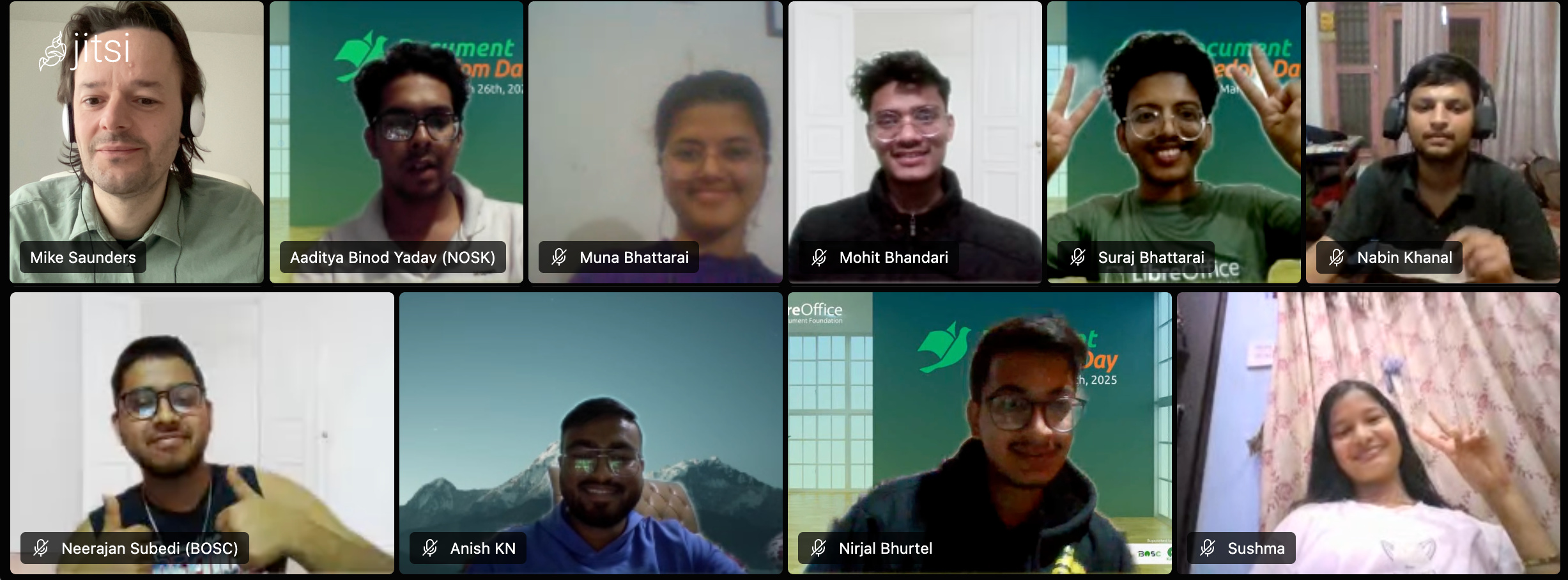
On March 26, we celebrated Document Freedom Day. Mike Saunders from The Document Foundation, the non-profit behind LibreOffice, gave an online talk about the importance of open standards and free software:
Please confirm that you want to play a YouTube video. By accepting, you will be accessing content from YouTube, a service provided by an external third party.
Now, Stephane Fermigier from EuroStack – which promotes European technological sovereignty and open source – has posted an update, citing an article in the German c’t Magazin. It discusses various reasons for the migration to LibreOffice and Linux, including:
Digital Sovereignty – Schleswig-Holstein is actively reducing its dependence on a single, non-European tech giant
Public Money, Public Code – Improvements made to open source software, like accessibility enhancements to LibreOffice, are available to the public
Public Procurement as a Lever – Schleswig-Holstein is not only improving its own IT infrastructure but also sending a strong signal to the market, potentially encouraging other public administrations to follow suit
In Fermigier’s post he also points to a recent talk from the LibreOffice Conference 2024 in Luxembourg (see below – video also available on PeerTube). Meanwhile, Dirk Schrödter, Head of the State Chancellery of Schleswig-Holstein, posted some thoughts on LinkedIn, including:
This is not just about technological independence but also about economic aspects. At present, our administrations and businesses are trapped in a system characterized by monopolistic structures and high licensing fees. […] It is a core responsibility of our state to be able to influence the operational processes of its IT systems at all times and to ensure the data security of its citizens and businesses. […] The necessary conclusion can only be: Open Source software must become the standard in our digitalized administration.
Please confirm that you want to play a YouTube video. By accepting, you will be accessing content from YouTube, a service provided by an external third party.
LibreOffice 25.2 is our new major stable release, with many new features. This video which shows a few of them (also available on PeerTube) is in English but has subtitle translations in 17 languages, thanks to our awesome localisation communities! (You can see their work on this wiki page.)
Please confirm that you want to play a YouTube video. By accepting, you will be accessing content from YouTube, a service provided by an external third party.
One week ago, we announced LibreOffice 25.2, our brand new major release. It’s packed with new features, and has many improvements to compatibility and performance too. So, what has happened in the week since then? Let’s check out some stats…
647,961 downloads
These are just stats for our official downloads page, of course – many Linux users will have acquired the new release via their distribution’s package repositories.
11,313 views, shares and likes on social media
Combining our Mastodon, Bluesky, X/Twitter and Facebook posts about the announcement, and all the likes, shares, views and comments, we get 11,313. Thanks to everyone who spread the word on social media! 😊
528 upvotes on Reddit
On release day, we organised an “ask us anything” event on Reddit. Members of The Document Foundation and LibreOffice community joined in the discussions and answered questions from users and potential contributors.
Huge thanks to our worldwide community of volunteers, and certified developers, for all their work on this release!
Please confirm that you want to play a YouTube video. By accepting, you will be accessing content from YouTube, a service provided by an external third party.
Italo Vignoli and Mike Saunders from The Document Foundation, the non-profit organisation behind LibreOffice, discuss marketing free and open source software (FOSS). This video is also available on PeerTube.
Please confirm that you want to play a YouTube video. By accepting, you will be accessing content from YouTube, a service provided by an external third party.
If you accept this notice, your choice will be saved and the page will refresh.
Transcript
Mike: Welcome to episode one of the LibreOffice Podcast, a new podcast from the LibreOffice project and community. I’m Mike Saunders, and I’m joined by Italo Vignoli. Hi, Italo.
Italo: Hi.
Mike: We work for The Document Foundation, which is the small non-profit foundation behind LibreOffice. We are not the developers of LibreOffice, but we coordinate the LibreOffice project and community that’s made up of hundreds of people around the world: volunteers, ecosystem company developers as well.
At TDF we’re quite small — I think 14 people — and survive mostly from donations. So donations are always very welcome to keep us going.
We wanted to start this podcast to keep users informed about what’s happening, but also talk a bit about what we do in the project. How is LibreOffice made? What are different people working on?
We estimate around 200 million users of the software, but where does it come from? Why is it free? Who’s working on it? What are the challenges?
We’re recording this episode in the middle of November, which is about halfway through the development cycle. We have new major releases of LibreOffice every six months, and the next release, which will be called version 25.2, will be released in February 2025 – at the start of February, when we get back from attending FOSDEM, a big open source event in Brussels. We’ll put a link to the release notes for LibreOffice 25.2 in the video description so people can check it out.
There are already quite some major improvements and new features — some big improvements to change tracking, for instance. It really, really helps with collaboration.
A couple of months more of development from our volunteers, community members and ecosystem, and then we’ll have a big, shiny new major release to go out.
But today, in this first episode of the podcast, let’s talk a bit about marketing. How do we market LibreOffice? I’ve been at TDF since 2016, involved in marketing, community outreach and other things. Italo, I think you’ve been involved for much longer, in the predecessor, OpenOffice.
Italo: Yes, since 2004.
Mike: Right. So you know what it’s like to market something that is free, and I think that’s quite a challenge because a lot of people are sceptical when something is free. They say, “There must be a catch somewhere. Why is this thing free? Why is somebody giving it away? Where is the catch? Where do I have to pay something extra? Or is it taking my data?”
When you started marketing OpenOffice back around 20 years ago, were people quite sceptical that suddenly there was a free office suite compared to Microsoft Office, which cost hundreds of dollars or euros?
Italo: The market was quite different at the time.
It was just around the corner of the new century, and the internet was not as developed as it is today. The concept of having web-based software was not there. People were used to having desktop software.
It was already a time when users were looking for alternatives to Microsoft Office, which was by far the leading office suite. There were a number of clones really mimicking Microsoft Office, but they left no trace in the market. They were just reducing the price, cutting some features, and looking very much like the leading Microsoft Office software.
Then, around 2002, the announcement of OpenOffice came out. Actually, the first announcement was earlier, but it was just the announcement of the donation of the code to the community, so there was no real product.
The product started in late 2001 or early 2002 with version 1.0. It was quite behind in terms of features and was especially full of bugs, because porting such a large piece of software was not trivial. So let’s say the real story started with version 1.1 in late 2003.
I was curious. I was one of the people looking for alternatives to Microsoft Office, so I saw the announcement, downloaded OpenOffice, and realised that it was different from the other clones. It was software with a soul — software with something behind it in terms of thinking. It provided more or less the same features as Microsoft Office, but in a different way. It was developed by people who had put ideas behind the software.
So I started using it, and I remember, after a while, I sent a message to the community manager saying, “You have very nice software with large potential, but you don’t have marketing. You should start doing marketing because people are not aware of your software.”
So I started doing marketing in Italy because people were a little sceptical about doing it at a global level. And in six months, the projected annual number of downloads in Italy went from two million to eight million. They quadrupled. They asked me, “What have you done?”
I said, “I’ve just told users that the software is available.” At the time, it was easy to do marketing because users were really unaware of the software. Just informing them about the possibility of downloading free software and trying it was enough to attract the technology enthusiasts — the people who were looking at technology not just to find alternatives, but also to be up to date with new technologies. I think we got that slice of the market in quite a short time.
Then, of course, the next challenge was to get the users who were not technically curious or savvy, but were more conservative, which is the majority of users.
Then we started to talk about why it’s free, why you can trust free software, and why there’s no catch behind it. It’s just a different approach to development. We consider the development of the software as a common good, and you don’t have to pay for a common good.
But, of course, you can pay for value-added features on top of the common good. So companies migrating to LibreOffice can get consultants and trainers, and you have to pay the trainer. The software is free, but someone doing the training has a lot of work behind it to get prepared and to be able to explain the software. The same is true for people who are managing projects.
So we slowly evolved the marketing during the OpenOffice times, and when LibreOffice started, it was almost a natural evolution that I handled marketing, this time at the global level.
We have tried to evolve marketing over the years, although with the changing scenario around us. Most media today is online, so the consumption of news is much shorter in time. We have a lot of news spread through social media, and that is another factor which makes it challenging to inform people.
Social media usually doesn’t give you the space to explain. It just gives you some short bits to describe a product. So it has changed. I think we have to change again, or we have to evolve again, to follow the evolution of the market. LibreOffice has some distinctive features which are important to explain to users.
Mike: I remember the early versions of OpenOffice, and before that StarOffice, being available on magazine discs.
It was a different time when OpenOffice came out, and I think it was good that they went straight to version 1.0, because there were many free software projects — some of them really, really good — that stayed around version 0.8 or 0.9 for a long period of time.
I think Inkscape did this. Everybody in the free software world knew Inkscape was great. It’s powerful, it’s usable, but the team, for their own reasons, decided to keep it at version 0.9-something for a long time. That made it really hard to recommend it to people—the non-technical, more conservative users.
You’d say, “Here’s a vector image editor. It’s great.”
“But why is it version 0.9? Is it going to crash?”
I remember when OpenOffice 1.0 came out, and, like you said, it was quite buggy. It was very slow. It was huge. I think there were so many optimisations put into versions 1.1 and 2.0, but I remember first installing it from a disc and thinking, “Wow, a free office suite.” It’s big, it’s clunky, it’s heavy, because it wasn’t optimised at all for any of the platforms.
But I also remember thinking, “This is free.” At that time, the context was going out and buying software—going to the shop and buying a box of software — which I don’t think anybody really does now. Here in Germany, you can still go to MediaMarkt and other technology shops and buy some software, including LibreOffice — not from us, but from publishers who sell it. So there is a tiny market for that, but nowhere near what it used to be.
Of course, LibreOffice was the successor project to OpenOffice. It came out in 2010 as the OpenOffice project moved on and slowly diminished. Obviously, OpenOffice is not really being developed now, but I guess that was also the time when people started moving towards online office suites.
Then the definition of “free” kind of changed. Somebody came up with that quote: “If something is free, then you are the product.” I can’t remember who said it, but services like Facebook really changed the conversation.
People thought, “Wow, Facebook. It’s free. I have this whole platform and communication with friends for free.” But it wasn’t really free.
You, the user, are the product, because Facebook is selling your profile to advertisers so they can target you.
So you think it’s free, but actually you are the product. Today, people are still quite wary. We tell them this thing is free, but increasingly people ask, “Does it mine my data?”
Everybody is talking about artificial intelligence and tools harvesting data, mining data to improve AI engines, which some people could argue is a good thing. But I’ve seen this because, like you, I manage and monitor our social media channels, and I see people asking, “What are you doing with my data?”
When we tell people, “We don’t do anything with your data. We have no interest in your data. We are a small non-profit. We are not a company,” it kind of blows people’s minds.
Italo: They’re so used to being profiled that it seems impossible to them that we are not profiling them. In fact, we are not profiling them.
When I used to do training — I don’t anymore — I remember when we were introducing the user data that people could enter into LibreOffice. We just said, “You have a form. You can fill in whatever you like, but your name and initials allow you to see who edited a document.”
In the history of a document, it is stored when you edited it, so when you make changes, that history is saved. In some cases, that can be useful information. But given the trend now, we allow people to get rid of that data.
So the reality is that you can have a LibreOffice document without any data that allows anyone to connect the document with a particular user. In my personal opinion, this is not always a wise choice because, if you work in a company, for instance, it can be important for the next editor to know who edited the document before, or simply for the history to know who created a paragraph or changed the structure of a document.
But, of course, this is my opinion, and people are absolutely welcome to have different opinions and say, “I don’t want to be recognised through a document.”
So LibreOffice allows you to get rid of that data when you save the document. The document is then like it was created by no one, which means no strings attached: no names, no IP numbers, no computer data, nothing that can be used to profile the user in any way.
That is different from what other software is doing, because they’re not only storing user data, but they keep track of the changes that the user has made to the document and use those changes to profile the user. It seems strange or difficult to understand, but let’s make a very simple example.
You are talking about a recipe for a dish, and you change the adjective or the adverb related to the dish. One person says, “It was a fabulous dish,” and the next one says, “It was a very good one.”
The fact that you are using “fabulous” or “very good” will allow the artificial intelligence behind the profiling, indirectly, to understand that you like certain ingredients more than another person. Therefore, maybe you like lamb more than someone else, and you like lamb cooked in a certain way.
I’m just making a very simple example related to a dish, but imagine if you are commenting about a film, or you are commenting about any other kind of more important topic. From the topic, they can understand your mood, your political orientation, your economic status, even your gender, and all the other information.
It’s very subtle because, from these small changes in our behaviour, the search engines or the associated software can understand a lot more than we think they can understand.
Mike: This is the kind of story we need to tell when marketing.
It’s very easy to say, “LibreOffice doesn’t store X, Y or Z,” but for a lot of non-technical users, they say, “I don’t have a problem with that. What’s wrong with it?” But when you actually have a story to tell and a real-world example of the problems this can cause, or the risks, then suddenly people understand it a lot more.
We know we have a lot of people now recommending LibreOffice on social media and other places. Tech influencers make videos and get tens of thousands of views where they’re talking about data privacy, data protection and control of your data.
Increasingly, I think, this is how people are promoting us through grassroots campaigning. I think a lot of people also don’t know the difference from our side. For LibreOffice marketing, it’s like David versus Goliath.
There’s you and me, and then, of course, our marketing community — lots of people around the world in the LibreOffice project doing marketing in their own languages and talking to people, which is essential because they can do all the languages we can’t.
We have people in Japan and South America doing great work, but ultimately there’s me and you coordinating the marketing project. I think that’s not even one percent of Microsoft’s Office marketing team in Italy alone, I think you once said. The difference in size.
So what we’re trying to do is have two people, with a very helpful community around us, compared to that vast number of people.
I think that’s why you need the grassroots. You need people helping to tell these stories and spread these messages.
But you also said we have to change. How do you think things are going to change in marketing in the coming years? I mean, there’s mobile, there’s collaboration, data protection is a big thing, but what do you think will change?
Italo: I think the key point will be to grow the marketing reach inside the community. When I say “community”, I’m talking not only about volunteers, but also ecosystem companies and Advisory Board members. We should act like a more cohesive group of companies and people than we have done in the past.
It’s not easy because, when you move to another continent, marketing is probably done in a different way or using different keys to reach the user. But either we are able to do this, or I think we will always be far behind the large corporations because they have that power based on money.
If we think about Microsoft or Google, they have the power of money to have skilled marketing people in each market, while we have volunteers in many markets. Those volunteers may not be skilled in marketing, so we also have to try to teach them or improve their marketing understanding. In some cases that’s easier, in other cases it’s less easy.
But I think the battle will be transforming our community into something like the Roman legion of the past. They seemed to move forward like a single man, even though there were hundreds of men under the same protection.
Of course, not to go to war, but to do marketing. That gives the idea of something based on many different people, but acting like a single element. I think our main challenge will be this one in the next few years.
Mike: Because we, at The Document Foundation, have a bit of a limit in what we can do.
We are set up in Germany as a non-profit organisation, so we don’t provide technical support. We can’t provide technical support to millions of people. That’s just not possible, and it’s not part of our remit or part of our goal.
We do have the ecosystem companies doing a lot of good work, doing marketing to big enterprises and saying, “You can get LibreOffice from us and get technical support from us, long-term support as well.”
So I think, like you said, yes, marketing as a cohesive whole. Even though we at TDF offer different things to the ecosystem, the ecosystem offers versions much more suited to the enterprise. I think we can work on consistent messaging for that.
But these are the challenges. People ask us at TDF, “I want to install LibreOffice on 10,000 computers in my business.” We say, “That’s great, but you probably don’t want 14 people at TDF supporting you. You want a company.”
And we have really good companies in the ecosystem who can provide this. So I think that’s a challenge as well: raising awareness of that.
Also, another part of the marketing is making sure that this wider community is healthy. We have 200 million users, but if nobody’s actually contributing or getting involved, then you just have a lot of users and nothing’s happening. We can see this now in the OpenOffice project. Nothing’s really happening.
They still have a lot of users because of the name, but they’ve had no major update for ten years, no new committers for years. It’s pretty much entirely dead now.
So there are a lot of users, but nothing happening. I think that’s also a challenge: telling people that they can get involved. A lot of people are really intimidated by this, but you yourself said you were a user of OpenOffice. You had a lot of experience in marketing and said, “I’m going to step up and do something.”
Italo: Yes and I don’t have a technical background.
People today think I have a technical background because I’ve been in technology for many years as a consultant, but the reality is that I have a degree in humanities.
I’m seventy today, which means that I’m not young anymore. I saw my first computer when I was twenty-seven, because before that there were no computers. It’s not because I refused to look at computers. It was because there were no computers on desktops. So I saw my first computer at twenty-seven, and although I was already a mature worker, I slowly adapted my way of working to computers.
Today I’m a Linux user. People think Linux is difficult. No. Linux today is as easy as any other operating system. It’s probably a lot more robust than Windows, and it’s quite similar in robustness to macOS, because macOS is really based on a Linux-like operating system.
So people are sometimes shy about contributing because they think they don’t have the right skills. But I think you can find the right skills almost everywhere, in almost every person.
Of course, do not approach the community as if the community is made up of incompetent people, because that is not the reality. In the community there are very competent people in many areas. I have forty years of marketing background. For instance, Jean Weber, who created the documentation project, was a technical editor in a major Australian company. She has the background to be an editor of, books because she did it for most of her life.
We have localisers who are professional translators in their languages. They know how to localise and how to translate. They do it professionally, and they help LibreOffice.
So the community has very skilled people. So if you approach the community like you can add to the skills that are already there, then it’s a positive approach. If you come and say, “Look, you should do this and that,” we have probably already done this and that, and we’ve also seen that some things are working and some things not.
So we are not naïve. The problem is that we are not many, and we don’t have money behind our marketing budget. Apart from a few euros for gadgets, it’s probably zero — or close to zero. Just think about having a project with a zero marketing budget against a project with an eighteen-billion-dollar marketing budget on a yearly basis, which is Microsoft Office. That’s a little bit of a difference.
Mike: Sometimes people join us in the marketing project and say, “Let’s spend some money on advertising.” But we have quite limited resources anyway, and we’re a non-profit. We’re also a bit restricted. People donate money to us, and they don’t donate money to us so that we can spend it all on Twitter adverts.
You also talked before about social media, how you’ve got such limited space and people have such short attention spans. I think read a while back that, if somebody is scrolling down a social media feed, you have 0.4 seconds to capture somebody’s attention. Otherwise they’ll just keep scrolling. The whole perpetual scrolling just goes on and on. It’s not like, “Go to the next page.”
So if you don’t capture somebody… So you can spend a lot of money on advertising, and people say to us, “You should spend money on advertising.” But we don’t have that much money, and again, it’s not really the idea of using money that people donated to us.
It’s better if we can build a marketing community. Also I think it’s worth noting that it’s not just about different marketing in different languages around the world. There are also huge cultural differences. The kind of marketing that may work for us — you’re in Italy, I’m in southern Germany, we’re not far away, that’s central Europe — but even there, there are differences between countries and cultures.
The marketing that may work in Japan may be very, very different. It’s not like we just take an English Twitter or Mastodon message and say, “OK, let’s turn that into Japanese,” and then, voilà, we have Japanese marketing, Japanese social media. There are big cultural differences.
People are talking about different things there. What’s important in software? Why are people interested in potentially switching? So I think that’s another challenge. There are big cultural differences in marketing and storytelling all across the world.
It’s an interesting topic, and anybody who’s watching this is welcome to join us in the marketing community. As Italo said, we have experience, so having people add to that is really, really useful.
People from areas where we’re not active — so if somebody’s watching this, knows LibreOffice, uses LibreOffice, but never hears anything about it in their own language or country — get in touch with us. Let us know, because these are the markets we also want to reach. We proudly say that LibreOffice is available in, what, 120 languages or something?
Italo: One hundred and twenty, and another forty are in development. That means that 5.5 billion people can use LibreOffice in their native language.
Mike: Exactly. So the vast majority of the world can use LibreOffice in their own language, and we want to push that even further. But we also want to do marketing in those languages as well, and reach people. So anybody is welcome to join us.
Check the video description for notes, get in touch with us, and help us on this journey. It’s exciting, it’s interesting, and it’s a challenge, but it’s also really satisfying when things go well.
Thanks, Italo.
Italo: Thanks, Mike.
Mike: So that was episode one of the LibreOffice Podcast. We hope to do some more soon with other people in the project and community. Let us know your feedback. What did you think of the episode? If you have any questions, we’ll post this video in a few different places—social media, PeerTube and YouTube as well. So let us know what you think, and see you in the next episode. Bye-bye.