Please confirm that you want to play a YouTube video. By accepting, you will be accessing content from YouTube, a service provided by an external third party.
LibreOffice’s presentation tool, Impress, includes a bunch of features for home and office use. But one thing that’s missing is recording and playback for audio comments in presentations.
Please confirm that you want to play a YouTube video. By accepting, you will be accessing content from YouTube, a service provided by an external third party.
If you accept this notice, your choice will be saved and the page will refresh.
This feature is important in eLearning: in contrast to video recordings, audio recordings are stored per slide, and can be adjusted to match the individual pace of the presentation. This is particularly suitable in school, academic as well as corporate environments to make learning content and product presentations more interactive.
So, how can we get this feature in LibreOffice? Well, the CH Open association, which has been promoting open systems and standards in the Swiss ICT landscape for over 40 years, is organising a crowdfunding campaign to implement the feature. The project is estimated to cost €62,000 in total – with various milestones along the way.
The LibreOffice project is on Mastodon, a free, open-source and federated social media service (with similar features to Twitter). Specifically, we’ve been on the Fosstodon server since April 2019 – and now we have 10,000 followers! A huge thanks to everyone who supports us there 😊
Bringing new community members on board, and helping them to get started in the LibreOffice community, is an essential part of our work. Here’s what we did in 2021…
(This is part of The Document Foundation’s Annual Report for 2021 – we’ll post the full version here soon.)
Onboarding tools and sites
Joining a large and established project like LibreOffice can be daunting for many. The software has a large codebase, and sub-projects use a wide array of tools. In recent years, we’ve made efforts to simplify the onboarding process by linking more services together with SSO (single sign-on), thereby reducing some of the complexity. In addition, we’ve created Easy Hacks and similar “bite size” projects in other areas, so that newcomers can get involved quickly and achieve something without months of work.
Currently, we have two websites/pages that function as starting points for new contributors: What Can I Do For LibreOffice and the Get Involved page. The former was set up by LibreOffice’s Albanian community, and lets users click through topics of interest, until they find something they want to do. The latter is a regular page, with a list of sub-projects inside LibreOffice, and quick steps to make initial contact.
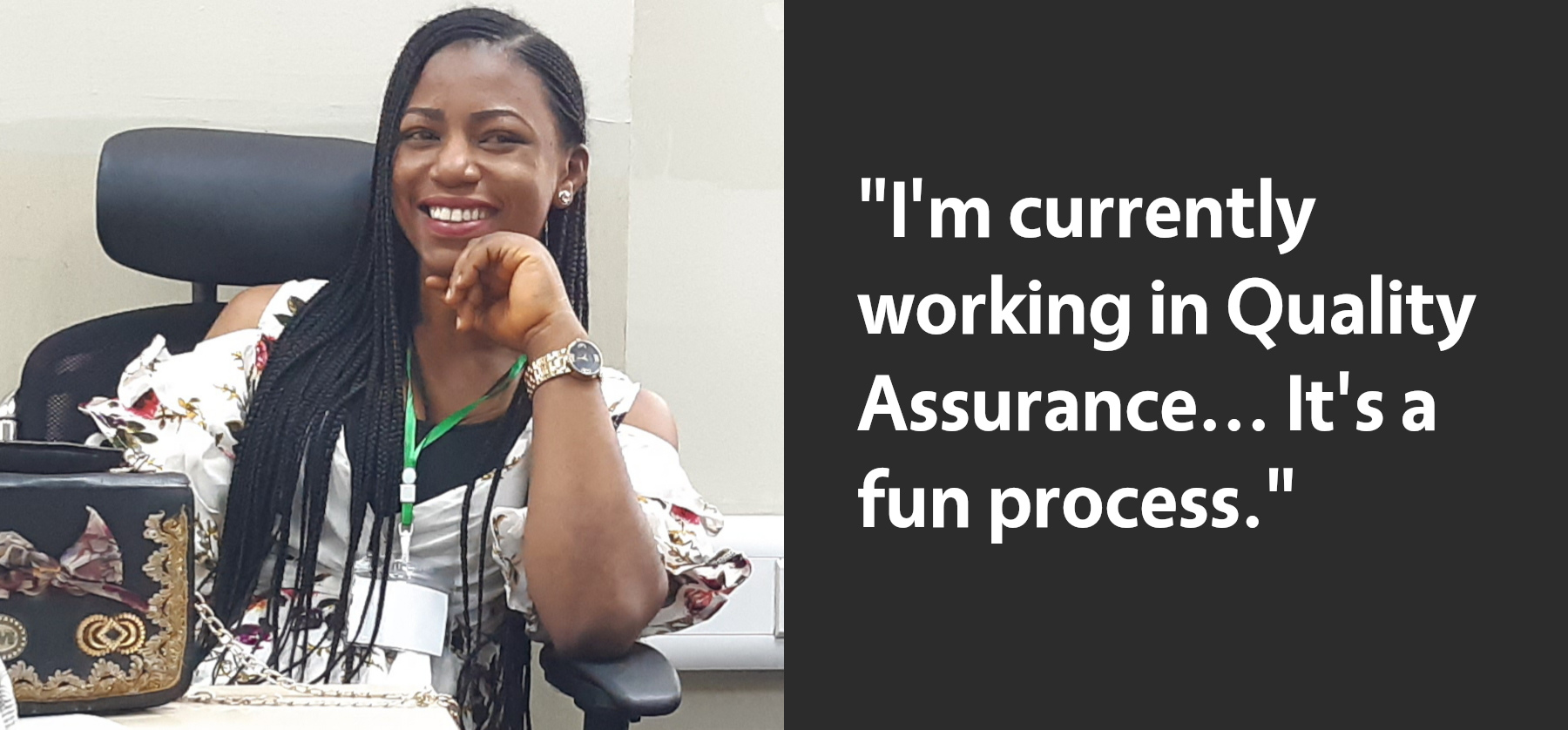
Throughout 2021, we posted regular “Community Member Monday” interviews on this blog. In many cases, we emphasised how these contributors started off as regular LibreOffice users, but wanted to “scratch an itch” and start to make changes to the software. We highlighted the ways in which other community members helped newcomers to start working on projects, and used these as “success stories” on our social media accounts, encouraging others to make the step-up from being a user to an active contributor.
In addition, we have accounts and projects listed on various volunteering platforms, including VolunteerMatch and Idealist (English), Vostel (German), Vapaaehtoistyo (Finnish), TuDu (Polish) and HeroClan, Um sem um tam and Zapojim se (Czech).
LibreOffice New Generation
In early 2021, we announced LibreOffice New Generation, a project to bring new – and especially younger – people into the LibreOffice community. While The Document Foundation is proud that our community is diverse and has people from all ages, younger people help to bring fresh ideas and approaches to the project. So we wanted to make it easier for everyone to join, get involved and have fun – regardless of age.
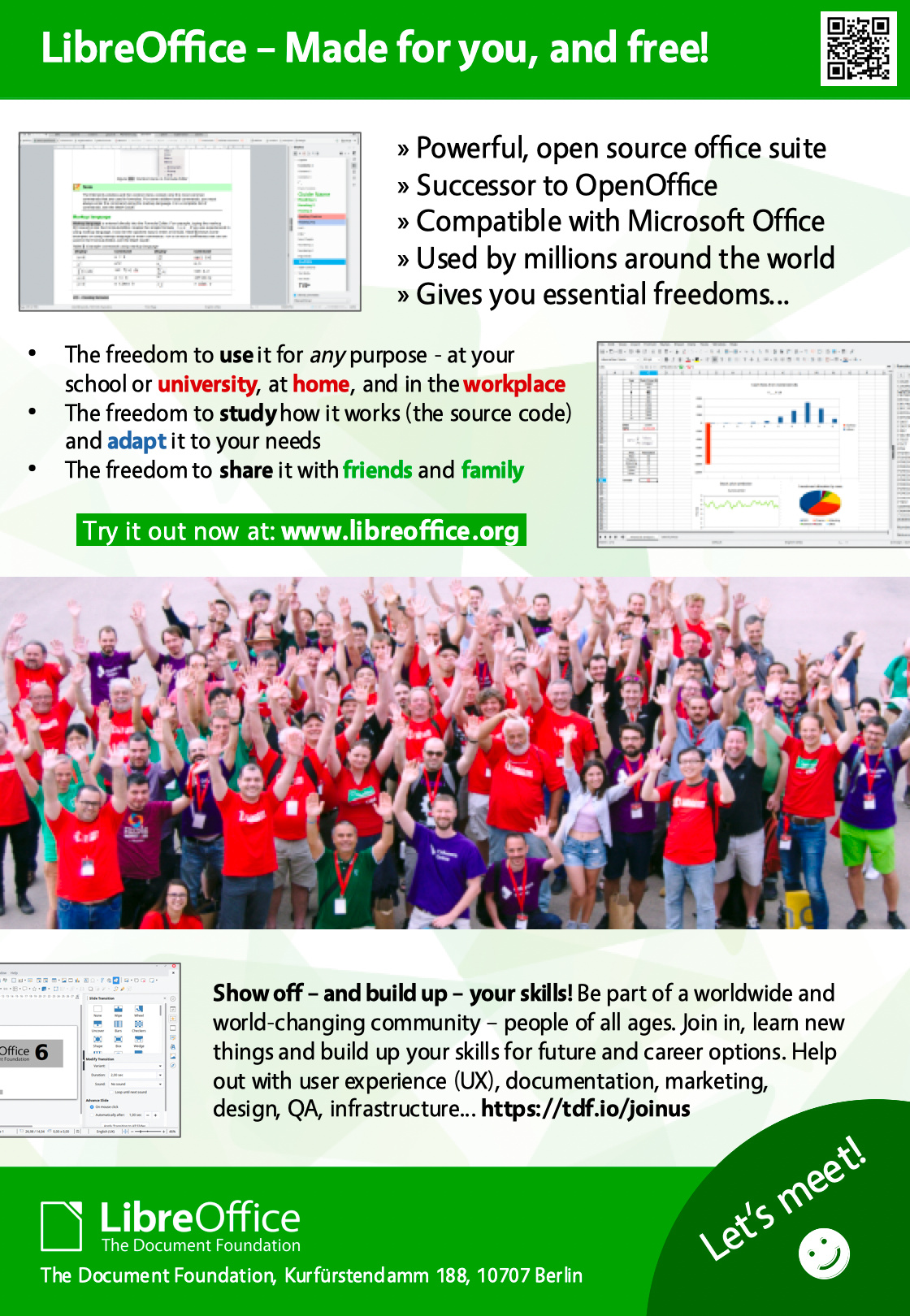
To achieve this, we set up the New Generation project with communication channels, contact points in the community, and initial ideas for things to work on. The community grew quickly, with 300 members arriving in the Telegram group within the space of a few weeks, and many ideas being proposed. One was to create a distinctive flyer that can be distributed in schools and universities, which not only explains what LibreOffice does, but how all users can also get involved and help to improve the software. New Generation community members created an initial design for the flyer, along with an update, and then translated it into several languages. TDF used funds from its marketing budget to get flyers printed and distributed to people around the globe.
Open Badges
We also continued to issue Open Badges, special, custom images with embedded metadata, confirming contributions from people in the community. For instance, we sent our personalised badges to French translators of the Math Guide, along with Brazilian Portuguese documentation team members and Czech documentation contributors.
How do different free and open source software projects do mentorship, and how can we all learn from each other? Daniel Garcia Moreno (EndlessOS Foundation and GNOME), Emily Gonyer (openSUSE), Ilmari Lauhakangas (The Document Foundation), and Marie Nordin (Fedora) discuss this in a panel moderated by Ben Cotton:
Please confirm that you want to play a YouTube video. By accepting, you will be accessing content from YouTube, a service provided by an external third party.
In 2021, LibreOffice celebrated its eleventh birthday. Two new major versions of the suite introduced a variety of new features, while minor releases helped to improve stability as well
(This is part of The Document Foundation’s Annual Report for 2021 – we’ll post the full version here soon.)
The Document Foundation announced two major releases of LibreOffice in 2021: version 7.1 on February 3, and version 7.2 on August 19. In addition 13 minor releases were also made available:
LibreOffice 7.1.1 – March 4
LibreOffice 7.0.5 – March 12
LibreOffice 7.1.2 – April 1
LibreOffice 7.1.3 – May 6
LibreOffice 7.0.6 – May 13
LibreOffice 7.1.4 – June 10
LibreOffice 7.1.5 – July 22
LibreOffice 7.1.6 – September 9
LibreOffice 7.2.1 – September 16
LibreOffice 7.1.7 – November 4
LibreOffice 7.2.3 – November 25
LibreOffice 7.2.4 and 7.1.8 – December 6
In July, our Quality Assurance community organised a Bug Hunting Session in preparation for the release of LibreOffice 7.2. This was based on the first Release Candidate (RC), and we encouraged technically-minded users to try out the RC and help to identify and fix bugs before the final release. Communication took part on our QA IRC channel, which is also bridged to a Telegram group. The session ran from 07:00 UTC to 19:00 UTC.
LibreOffice 7.1
On February 3, LibreOffice 7.1 was officially released after six months of work. Developers at Collabora, allotropia, CIB, Red Hat, NISZ, The Document Foundation and other companies and organisations – along with volunteers – worked on many new features. For instance, a new dialog was added which lets users select their desired user interface design on first startup (including the regular menu+toolbar setup, and NotebookBar alternative).
In Writer, a new Style Inspector was created to display the attributes of Paragraph and Character Styles, and manually formatted (Direct Formatting) properties. In Calc, significant speed improvements for Autofilter and find/replace operations were implemented, while the possibility to add visible signatures to existing PDF files in Draw was included too. On top of the new features, there were many other general improvements to performance, compatibility and stability.
With the help of the Indonesian community, TDF produced a video to explain and demonstrate many of the new features in LibreOffice 7.1. This was linked to in the announcement, and embedded into various web news websites that covered the release. The video is also available on PeerTube.
Please confirm that you want to play a YouTube video. By accepting, you will be accessing content from YouTube, a service provided by an external third party.
If you accept this notice, your choice will be saved and the page will refresh.
LibreOffice 7.2
Later in the year, on August 19, TDF released LibreOffice 7.2. Based on the LibreOffice Technology platform for personal productivity on desktop, mobile and cloud, it provided a large number of interoperability improvements with Microsoft’s proprietary file formats. In addition, LibreOffice 7.2 Community offered numerous performance improvements in handling large files, opening certain DOCX and XLSX files, managing font caching, and opening presentations and drawings that contain large images. There were also drawing speed improvements when using the Skia back-end that was introduced with LibreOffice 7.1.
A popup list to search for menu commands was added to the user interface, helping new users to find features that may otherwise be tucked away inside the menu. In addition, a built-in “Xray”-like UNO object inspector was implemented, along with a new list view for the Templates dialog. In Writer, background fills were updated to cover whole pages, beyond margins, while in Calc, HTML tables listed in the External Data dialogue now show captions. Impress was boosted with a set of new templates, to make presentations more attractive and appealing: Candy, Freshes, Grey Elegant, Growing Liberty, Yellow Idea and more.
Many other features were added as well, and there were a large number of compatibility improvements. As with the previous release, the TDF team worked with the Indonesian LibreOffice community to make a video to demonstrate the new features:
Please confirm that you want to play a YouTube video. By accepting, you will be accessing content from YouTube, a service provided by an external third party.