LibreOffice installer improvements coming, thanks to Ximena Alcaman, Rachael Odetayo and Outreachy

Ximena Alcaman

Today we’re talking to Ximena Alcaman, who is working on LibreOffice installer improvements as part of the Outreachy programme. Outreachy provides internships to people subject to systemic bias and impacted by underrepresentation in the technical industry where they are living.

Ximena is working alongside Rachael Odetayo on the LibreOffice installer, and is being mentored by Marina Latini and Jussi Pakkanen, with support from sponsors SUSE and The Document Foundation. Let’s learn more…

To start with, tell us a bit about yourself!

Hi! My name is Ximena but most people call me Xime and I’m from Chile. I have a degree in Business Administration, but I recently switched to the tech world to become a software developer. In my free time, I enjoy coding and trying out new technologies. I also like to learn new languages and travel to new places. When I’m not doing all that, you can probably find me in the garden or in the kitchen baking something (hopefully) delicious!

How did you get involved in Outreachy?

I came across a post about the Outreachy internships and it immediately caught my attention. At first, I wasn’t very familiar with open-source, but after doing some research, I soon realized that it was the perfect opportunity for me to gain experience and build my tech career through this internship. On top of that, the chance to be a part of a fantastic community like LibreOffice and to contribute to a product used by millions is truly exciting.

What are you working on in LibreOffice right now?

The Windows installer is a crucial component of the LibreOffice project, as it’s the primary way in which millions of users can install and use the office suite on their computers.

However, the current installer for LibreOffice is based on old code, which makes it difficult to maintain.

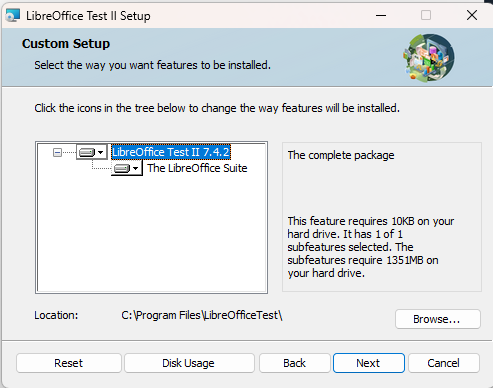
Our project aims to address this issue by upgrading to a more modern installer, which will make maintenance a lot easier. We’re using tools like the WiX Toolset and MSI Creator to rework the LibreOffice Windows installer. Our goal is to move away from an outdated infrastructure and upgrade to a more modern one.

Mockup installer screenshot

How can others help out with the things you’re working on?

We’re in the early stages of this project and we could definitely use help from the community. For example, we’re currently trying to localize the right pipeline for the installer and gather the necessary information to build a proper JSON file. However, gathering all the necessary information within the large LibreOffice codebase can be quite difficult. So, if community members can help us to locate the necessary files, it would be greatly appreciated! We would also welcome any testing or bug reports as we continue working on the project.

After this experience, what is your opinion of Equity, Diversity and Inclusion? Did the Outreachy program give you a new perspective or is there anything you would like to highlight?

After this, my belief in the importance of equity, diversity and inclusion has only been reinforced. The Outreachy program has been an incredible experience as it has provided me with the opportunity to work alongside people from different backgrounds and experiences. Outreachy allowed me to learn and grow in a welcoming and supportive environment, which I think is something crucial for underrepresented groups in the tech industry. I believe that having a diverse and inclusive environment is essential for innovation and creativity, and also for creating a more equitable society.

Outreachy logo

Did your opinion of open source change after this experience? How?

Before this experience, I had limited knowledge and understanding of open source, so I had the idea that it was only for advanced students from tech careers or experienced developers. However, my participation in the program has changed my perspective. Outreachy offers opportunities for people of all skill levels and backgrounds, so this made me feel more welcome and included as a newcomer in open source communities.

Is there any contribution, experience, anecdote you would like to share from your time in the Outreachy programme? Would you recommend the program?

When the contribution period started, I had doubts about my programming skills and almost waited for the next cohort to apply again. It took me about two weeks to finally contact my current mentors and I also contacted Ilmari, who kindly provided guidance and support throughout that period. I highly recommend the Outreachy programme for anyone interested in open source, as it provides valuable opportunities to get involved in open source communities and gain experience.

Follow Ximena on WordPress and Twitter. And stay tuned for our next interview, with Rachael Odetayo!

Welcome Juan José González, TDF’s new Web Technology Engineer!

Photo of Juan José

Here at The Document Foundation, the non-profit entity behind the LibreOffice community, we have many websites and services: this blog, the LibreOffice website, our wiki, the extensions website, Weblate and many more.

To improve them and keep them up-to-date, TDF now has a new Web Technology Engineer! So let’s get to know him…

Tell us a bit about yourself!

My name is Juan José and I am from México. I moved from my beautiful hometown to Guadalajara nearly thirteen years ago looking for a good job as a developer and I fell in love with the city. In Guadalajara I met my wife, my friends and many free software enthusiasts.

Since the first day, I realized that there were local communities around free software so I like to keep in contact with them, and contribute with technical talks about various topics.

I studied a masters degree in Computer Science, where I got interested in the semantic web and the automated reasoning discipline behind it. I’ve been working as a web developer for more than a decade now.

I am so happy that I found this position at The Document Foundation – I am determined to contribute as much as I can to improve our existing web sites and web apps that support the foundation’s efforts.

Were you using LibreOffice before you joined TDF?

I used LibreOffice to write the final project of my bachelor degree, I can say that LibreOffice was the first application for what I consider myself a power user (that was 10 years ago – but I have lost most of my talents sadly). I also remember writing an essay about the importance of open document formats, and my references included many people from the LibreOffice community.

This role marks my first time actively contributing to LibreOffice – so I hope I can help the project significantly.

ODF logo

What’s your new role at TDF?

I joined the Foundation as the new Web Technology Engineer, where I will dedicate my time to support, fix and improve the experience of our websites.

I believe it’s a great role since the web has become the default entry point to all people that want to interact with LibreOffice, from being an end-user, to collaborate on the software’s development. I have adopted the mission to facilitate this interaction.

What are you working on?

I am starting on the extensions site – it’s the place where you can get templates and extensions for LibreOffice. I am replying to reported issues by improving the web experience. I also want to keep an eye on the experience of the end user, taking care of both ends: extension developers and the users.

We’re really happy to have Juan José on board! LibreOffice users and community members can give him feedback and help via the website mailing list. Looking forward to seeing all the great things to come 😊

Community Member Monday: Afshin Falatooni

Afshin Falatooni

Today we’re talking to Afshin Falatooni, from the Persian-speaking LibreOffice community!

Tell us a bit about yourself…

I am from Iran, the city of Mashhad. I speak Persian (Farsi), and I love to contribute to LibreOffice! This January, I have just turned 46 years old. My favorite hobby is climbing, and if I have time, I usually go to the mountains on Fridays, which is the weekend holiday in our country.

I work as a book editor, typesetter and layout designer. I became interested in the LibreOffice project because of my job. Many editors and typesetters use Microsoft Word more than any other program, and I was one of them before I got acquainted with LibreOffice. But, now that I know the advantages of LibreOffice as a free software project, I use Writer as much as the norms of the publishing market allows me.

What are you working on in the LibreOffice project right now?

I write regularly on the Persian LibreOffice blog. My goal is to provide educational contents around LibreOffice there. Additionally, if I find a bug that is either directly or indirectly related to Persian language, in addition to reporting it to Bugzilla with the necessary screenshots and documents, I post it to the blog to make others aware of the important bugs.

We also have a Persian-speaking group in Telegram, where I answer questions as far as I can, alongside the other admin of the group.

Many years ago, I added a large collection of Persian words to OpenOffice.org project, which were likely to be written incorrectly. Using that word list, the Persian language was added as part of the OpenOffice.org auto-correction feature. The word bank continues to exist in LibreOffice, and is useful for the Persian speaking users.

Many thanks to Afshin for all his contributions 😊 All LibreOffice users are welcome to build up our native-language communities and reach more people around the world!

Community Member Monday: 锁琨珑 (Kevin Suo)

Photo of Kevin Suo

Today we’re talking to 锁琨珑 (Kevin Suo), who’s doing great work improving LibreOffice and fixing bugs…

Tell us a bit about yourself!

I’m 36 years old, and I was born in the Gansu Province of China. I live in Beijing and I’m working as an Of Counsel in a leading law firm in Beijing. Some people may think that I’m a lawyer. No, I am not a lawyer – I am a professional accountant. My team work as local counsel on behalf of clients defending on Antidumping and Countervailing Duty investigations initiated by authorities (e.g., the U.S. Department of Commerce, the European Union etc) against companies and industries in China, and accountants play an important role in this field.

Although I am very busy at work every day, I love the internet, computers and programming. I can program using Python+Pandas and SAS, and tools such as these have greatly helped me in my daily data analysis work. I’m also a Linuxer. Many years ago I used Ubuntu, Debian, Arch Linux, and even Gentoo, but now I stick to Fedora Workstation. Currently 99.9% of my daily work is done under Linux, including those mission-critical work we submitted to the U.S. DOC and EU authorities.

I also know some HTML, CSS and PHP, and I have a server running at home with a WordPress instance and a Nextcloud instance. The server also servers as a mirror of some of the Libreoffice bibisect repositories (it is very slow to download from the TDF server here in China, so I need to mirror them).

What are you working on in the LibreOffice project right now?

I started using LibreOffice many years ago, probably when I was in college (when it was the OpenOffice.org era). After that, I became a contributor to LibreOffice. I started with localisation and quality assurance (QA), reporting, testing and confirming bugs. Then I learned and started bibisecting. Soon, I started building LibreOffice by myself, and then I started to learn C++ and fix some easy bugs. I am even surprised by myself, that before contributing to LibreOffice I only learned very little of the C language (when I was in collage, as an “elective course”), and at that time I never thought I might learn and use C++.

Most of the commits I have made to LibreOffice were related to the pdfimport feature in the sdext module. I think I got involved in this module very randomly – I wanted to know more about the the LibreOffice code base, then I read the sdext pdfimport module by chance, and found that to understand the code I first need to read the PDF specifications!

Then I read the specifications, learned some C++ online, identified some bugs which have affected me on my daily work, and then found that I was able to fix them! Also, as I am trying to fix more bugs, I now find that I need to learn something about Unicode! That is a lot of fun. You learn, you contribute, and then you learn more!

Some of you may know that, recently, I fixed a bug related to right-to-left text mirroring in the Draw/Writer pdf import (i.e. tdf#104597) which has impacted many RTL (right-to-left text) users for a long time. That bug came to my view, since someone added me to CC due to several of my patches in the sdext pdfimport module. I got interested in that bug because, although I am a Chinese, I learned some Arabic characters and words in the mosque when I was young. Yes, I am a Chinese muslim!

When did you get involved in LibreOffice, and what was it like?

I don’t remember when I get involved, but my first commit to the core repository was in year 2014. Many people have helped me, e.g. Eike Rathke, Noel Grandin, Caolán McNamara, Mike Kaganski etc. At the beginning I thought everything is difficult, but now I feel comfortable.

What advice would you give for others who want to help out with the code?

I would like to say that, to contribute to LibreOffice, you do not need to be a programmer. An accountant can also contribute, given that you are desired to learn!

Welcome Stéphane Guillou, new QA Analyst for LibreOffice

Photo portrait of Stéphane Guillou

We have a new team member at The Document Foundation, the non-profit entity behind LibreOffice! (That means we’re now 13 people.) Stéphane Guillou joins us as a Quality Assurance Analyst – so let’s get to know him better:

Tell us a bit about yourself!

I am from France, with roots also in Peru, but lived for the last 10 years in Australia with my awesome little family before coming back to France. We now live in Alsace, close to the forest in the Vosges mountains.

I studied plants, ecology and sustainability before working in agricultural research. I am still very passionate about plants and the environment, but my focus has moved towards supporting researchers in their data analysis, promoting Open Science principles and offering training about FLOSS research software, which I was able to do for the last 4 years at the University of Queensland’s Library, and before that as a certified instructor of the Carpentries organisation.

I am passionate about sharing information about Open Science, and contributing data to the Commons. You can for example find me on other wonderful projects like OpenStreetMap, iNaturalist and MusicBrainz.

When I am not parenting or working, I like spending time on electronic music, amateur radio and cycling.

What’s your new role at The Document Foundation?

I am the new Quality Assurance (QA) Analyst, and a lot of my time will be spent on triaging the issues users report on Bugzilla – our bug-reporting platform. There is a lot of activity on Bugzilla, and classifying and testing the reports is fundamental for us to focus on the most pressing issues, help the work developers are doing, and keep improving the software for everyone! Part of the work will also be to analyse and summarise the wealth of data available to help us see the bigger picture and make better decisions when allocating resources.

Pie chart showing the split between resolved bug statuses on Bugzilla. Four main categories are fixed (40.7%), duplicate (18.8%), insufficient data (13.1%) and works for me (12.5%).

Pie chart showing the split between resolved bug statuses on Bugzilla. Four main categories are “fixed” (40.7%), “duplicate” (18.8%), “insufficient data” (13.1%) and “works for me” (12.5%).

How did you get involved in LibreOffice, before you joined TDF?

I have used LibreOffice since it was first released in 2011, and have always liked reporting problems and helping out with the QA process in little bursts, just like I like doing with any FLOSS tool I use. I feel it’s a great way to give back to the community.

How can regular users of LibreOffice help out with the QA project?

Everyone can help our QA project by first using the software, and reporting problems when you encounter them. Have a look if the issue has been reported before, and if not, you might have found a new one! It’s important to not assume that someone has reported the issue before you. LibreOffice is a very customisable and rich office suite, so people use it in vastly different ways.

If you want to help some more, feel free to install development versions to test them, look at reports on Bugzilla to confirm issues and classify them, identify exactly when an issue arose (it’s called “bibisecting“), and share your learnings and processes with others! There is a wealth of tasks you can start on on our Wiki.

Thank you for your help building an office suite for all!

We’re really happy to have Stéphane on board! Donations from LibreOffice users help us to grow our team, maintain our infrastructure and support the communities working on LibreOffice. Support us here!

Community Member Monday: Muthuramalingam Krishnan (Tamil project)

Today we’re talking to Muthuramalingam Krishnan, who’s helping to spread the word about LibreOffice in southern India…

Tell us a bit about yourself!

I’m Muthuramalingam, from Tirunelveli – a southern district in Tamil Nadu, currently living in Chennai. I was in the IT industry for around 10 years, from 2007 to 2017. Currently, I’m giving training on technical matters around open source programming languages like Java and Python in Payilagam, Chennai.

What are you doing with LibreOffice in Tamil?

A long time ago, I started contributing to LibreOffice by raising a few bugs. After a while, as I had the opportunity to meet a number of youngsters and graduates, I started introducing them to LibreOffice. Once they started using LibreOffice, it became very easy for us to get them involved in LibreOffice QA (Quality Assurance) related of activities. Thus, we started conducting few offline and online trainings. A few links about them are here, here and in this video.

What are some of the opportunities and challenges with free and open source software (FOSS) adoption in your region?

Let me think about the challenges first regarding FOSS adoption. As many people are using proprietary operating systems here, they don’t have much idea or clue about FOSS adoption. Thus, it would be difficult for us to convince them that they are capable of contributing to any FOSS software.

Where there are challenges, there are also opportunities. Hence, our easiest opportunity is creating awareness about open source first, and then ask them to use a FOSS operating system. (Linux Mint is a good start for Beginners.) Once they adopt the operating system (dual-booting is also fine for us), every other FOSS ddoption will automatically follow, including LibreOffice.

How can other people help out in the Tamil community?

There are lot of people who are involved in FOSS development in Tamil. There are many active communities including Kaniyam, ILUGC, KanchiLUG etc. They will definitely help us with spreading the word about events, by publishing on their websites, Telegram groups, Sometimes they will help us to get event spaces at places including colleges and Universities. We can get senior members of these communities to guide people with translations, QA and other activities.

Join the Tamil community on Telegram here! And thanks to Muthuramalingam for all his help 😊