LibreOffice Conference 2021: Call for Papers is Open!

The Document Foundation invites all members and contributors to submit talks, lectures and workshops for this year’s LibreOffice Conference, which will take place online. The event is scheduled from September 23 to 25, Thursday to Saturday. Whether you are a seasoned presenter or have never spoken in public before, if you have something interesting to share about LibreOffice, ODF, the Document Liberation Project or the ODF Toolkit, we want to hear from you!

Proposals should be filed by June 30, 2021, in order to guarantee that they will be considered for inclusion in the conference program.

The conference program will be based on the following tracks:

  • a) Development, APIs, Extensions, Future Technology
  • b) Quality Assurance
  • c) Localization, Documentation and Native Language Projects
  • d) Appealing Libreoffice: Ease of Use, Design and Accessibility
  • e) Open Document Format, Document Liberation and Interoperability
  • f) Advocating, Promoting, Marketing LibreOffice
  • g) Diversity and Inclusion, New Generation Project for Students’ Inclusion

Presentations, case studies and technical talks will discuss a subject in depth and will last 30 minutes (including Q&A), while Workshops will last 90 minutes (including Q&A). Lightning talks will cover a specific topic and will last 5 minutes (including Q&A). Sessions will be streamed live and recorded for download.

Please send a short description/bio of yourself as well as your talk/workshop proposal to the program committee on the conference list: conference@libreoffice.org

If you do not agree to provide the data for the talk under the “Creative Commons Attribution-Share Alike 4.0 License”, please explicitly state your terms. In order to make your presentation available on TDF YouTube and PeerTube channels, please do not submit talks containing copyrighted material (music, pictures, etc.).

If you want to give multiple talks, please send a separate email for each one.

Thanks a lot for your participation!

LibreOffice Macro Team: progress report

Macros help users to automate common tasks in LibreOffice. In September 2019 we announced a new team in our community to work on macro support. The last progress report was published in April 2020, so it is high time to look into what has happened since then.

If you are interested in contributing to the macro team (development, testing or documentation), we’d love to hear from you – please send an email to ilmari.lauhakangas@libreoffice.org and we’ll get in touch.

ScriptForge Libraries

The biggest single event was the introduction of ScriptForge Libraries in LibreOffice 7.1. ScriptForge and its documentation is a collaboration betwen Jean-Pierre Ledure, Alain Romedenne and Rafael Lima. You can read more about it in the January 2021 blog post and the work-in-progress Help content.

Wiki docs

Nathan Ullberg continued working on Impress macro articles.

Celia Palacios improved the Python guide and added new macro tutorials, such as populating spreadsheets with data from an SQL database.

Alain Romedenne continued adding syntax diagrams and improved and expanded the Python guide and macro articles.

Mauricio Baeza improved and expanded articles and added new ones, such as Insert a comment with custom presets, Copy content cell from Spreadsheet to other and Charts in Calc.

Steve Fanning added several new examples of Calc macros.

Code contributions from macro team members

Alain Romedenne:

Andreas Heinisch:

George Bateman:

Tomoyuki Kubota:

Code contributions from honorary associate members

Compatibility fixes for Python 3.8 to 3.12 done by David Ostrovsky, Dante Doménech, Noel Grandin (Collabora) and Stephan Bergmann (Red Hat).

Anshu Khare:

Arnaud Versini:

  • Many cleanups and optimisations in Basic handling code

Arpit Bandejiya:

Caolán McNamara (Red Hat):

John Turpish:

Maxim Monastirsky:

Michael Stahl (allotropia):

Mike Kaganski (Collabora):

Noel Grandin (Collabora):

Serge Krot (CIB):

Shubham Jain:

Stephan Bergmann (Red Hat):

Tushar Kumar Rai:

Xisco Fauli (TDF):

Help content

Improved by Alain Romedenne:

Added by Alain Romedenne:

Improved by Rafael Lima:

Improved by Olivier Hallot (TDF):

Added by Olivier Hallot (TDF):

Annual Report: LibreOffice in 2020

In 2020, LibreOffice celebrated its tenth birthday. Two new major versions of the suite introduced a variety of new features, while minor releases helped to improve stability as well

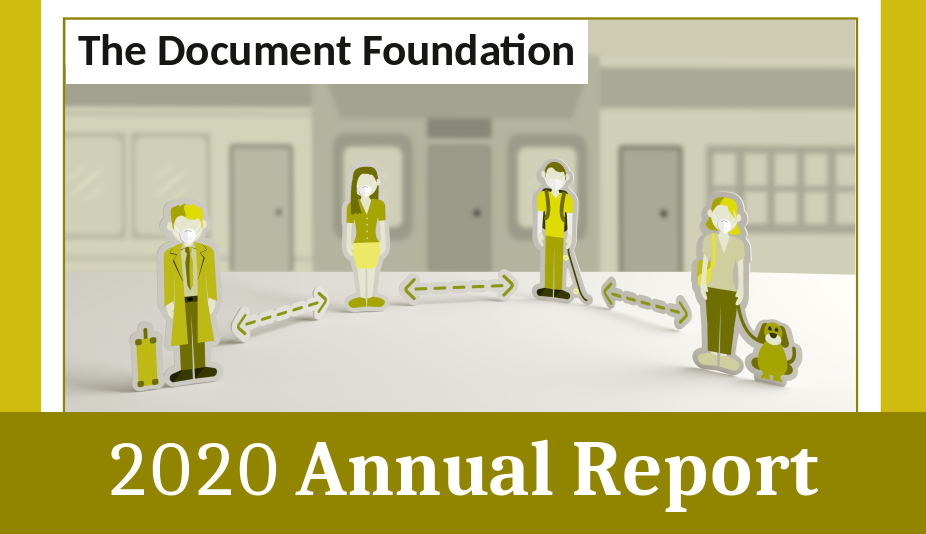
(This is part of The Document Foundation’s Annual Report for 2020 – the full version will be posted here on the blog soon.)

The Document Foundation announced two major releases of LibreOffice in 2020: version 6.4 on January 29, and version 7.0 on August 5. In addition, 13 minor releases were made available over the year:

RELEASE DATE
LibreOffice 6.3.5 February 20
LibreOffice 6.4.1 February 27
LibreOffice 6.4.2 March 19
LibreOffice 6.4.3 April 16
LibreOffice 6.3.6 April 30
LibreOffice 6.4.4 May 21
LibreOffice 6.4.5 July 2
LibreOffice 6.4.6 August 13
LibreOffice 7.0.1 September 3
LibreOffice 7.0.2 October 8
LibreOffice 6.4.7 October 22
LibreOffice 7.0.3 October 29
LibreOffice 7.0.4 December 17

Throughout the year, we held three Bug Hunting Sessions in preparation for new major releases. These typically took place on a single day between set times, so that experienced developers and QA engineers could help new volunteers to file and triage bugs via the IRC channels and mailing lists. The Bug Hunting Sessions for LibreOffice 7.0 were held on May 11 and July 6 – while the one for LibreOffice 7.1 took place on October 26.

LibreOffice 6.4

On January 29, LibreOffice 6.4 was officially released after six months of work. Developers at Collabora, CIB, Red Hat, SIL and other companies – along with volunteers – worked on many new features. For instance, a QR Code generator was added to the suite, making it easy to add QR codes (which can be read by mobile devices) to documents.

Hyperlink context menus were unified throughout the software to provide the following menu entries: Open Hyperlink, Edit Hyperlink, Copy Hyperlink Location and Remove Hyperlink.

Meanwhile, a new Automatic Redaction feature was added to hide classified or sensitive data in a document, based on text or regular expression matches, while the help system was reworked to provide faster and more precise search results – and many help pages were given localized screenshots for a better user experience.

TDF produced a video to explain and demonstrate many of the new features in LibreOffice 6.4. This was linked to in the announcement, and embedded into various web news websites that covered the release:

Please confirm that you want to play a YouTube video. By accepting, you will be accessing content from YouTube, a service provided by an external third party.

YouTube privacy policy

If you accept this notice, your choice will be saved and the page will refresh.

LibreOffice 7.0

Later in the year, on August 5, TDF released LibreOffice 7.0. OpenDocument, LibreOffice’s native open and standardised format for office documents, was updated to version 1.3 as an OASIS Technical Committee Specification. Important new features included digital signatures and OpenPGP-based encryption of XML documents, with improvements in areas such as change tracking, and additional details in the description of elements in first pages, text, numbers and charts. The development of ODF 1.3’s features was funded by donations to The Document Foundation, and the implementation was done by CIB and other developers in the ecosystem.

Additionally, support for Skia graphics engine was added thanks to sponsorship by AMD, and was set as the default on Windows, for faster performance. Skia is an open source 2D graphics library which provides common APIs that work across a variety of hardware and software platforms, and can be used for drawing text, shapes and images. Vulkan is a new-generation graphics and compute API with high-efficiency and cross-platform access to modern GPUs. Luboš Luňák (Collabora) did a large part of the work to support Skia.

Many other features were added as well, and there were a large number of compatibility improvements.

As with the previous release, TDF staff worked with the LibreOffice community to make a video (PeerTube version here) to demonstrate the new features:

Please confirm that you want to play a YouTube video. By accepting, you will be accessing content from YouTube, a service provided by an external third party.

YouTube privacy policy

If you accept this notice, your choice will be saved and the page will refresh.

Like what we do? Support the LibreOffice project and The Document Foundation – get involved and help our volunteers, or consider making a donation. Thank you!

Community Member Monday: Necdet Yücel

Today we’re talking to Necdet Yücel from the Turkish LibreOffice community, who has been mentoring students and helping them to get involved with LibreOffice…

Tell us a bit about yourself!

I have been working as a lecturer at a university for more than 20 years. I teach programming and computer networks courses in the computer engineering department. My main area of interest is free software. My personal contribution to the free software world is mostly by making Turkish translations of free software – and I try to explain the free software world to my students, and guide them through it.

What are you doing in the LibreOffice project right now?

I’m one of the old translators of LibreOffice. I have translated hundreds of thousands of words, but I have no motivation to work on translations for a while.

Since 2015, the year Gülşah Köse become a LibreOffice developer, more than 15 of my students made contributions to LibreOffice. One of them is Mert Tümer’s, who is an active LibreOffice developer. Gülşah’s work was a major influence for LibreOffice developments in Turkey. I am very proud of my students, who started with her and continued until Gökçe Küler.

Do you have any tips/thoughts to share from bringing people into the community?

I think we have no choice but to direct students to free software in universities. Because it’s the only chance to to study how the programs work. Reading well-written code, changing it, compiling and redistributing it are the main requirements for being good developers. If we can explain them to students, they will become free software developers.

Is there anything else you plan to do in the project

The only thing I think I know well is mentoring students to free software. My short term plan is to continue translating and consulting students for free software.

Many thanks to Necdet for all his contributions! And to everyone reading this who uses LibreOffice and is interested in getting more involved: find out what you can do here. We’d love to have you on board, in our community!

LibreOffice flyers for schools and universities – Help us to hand them out!

Our New Generation project is encouraging new – and especially younger – people to join the LibreOffice community, improve the software, and gain valuable skills.

We’ve created a flyer that can be handed out in schools and universities, and here it is:

Now, we need your help to spread the word! If you study or work in a school or university, we can send you some flyers that you can give to interested people. We also have versions of the flyer in other languages, translated from the source file (Vegur font required) by our community:

Want some flyers?

We’re happy to send them to you – just send us an email with some details, such as the school/uni where you work or study, how many you want, and in which language. Then we’ll get them printed and posted to you.

Thanks for helping to spread the word! To learn more about LibreOffice New Generation and share your ideas, join our Telegram group.

Annual Report: The Document Foundation in 2020

In 2020 we had with elections for the foundation’s Membership Committee, along with regular Advisory Board calls, and support for other projects and activities

(This is part of The Document Foundation’s Annual Report for 2020 – the full version will be posted here on the blog soon.)


Election of new Membership Committee (MC)

Members – more formally known as the “Board of Trustees” – are a crucial part of The Document Foundation. They are people from across the globe who contribute time, effort and skills, whether on a voluntary or paid basis. Members can vote for the Board of Directors (aka BoD) and the Membership Committee (MC), and also nominate themselves for a position in the BoD and the MC. The mission of the MC is to administer membership applications and renewals following the criteria defined in the Foundation’s Statutes.

In July, we announced the process of elections for the next MC, which is in place from 19 September 2020 until 18 September 2022. Initially, we started by opening up nominations; TDF members could nominate themselves for a position in the MC, or nominate others.

On 1 September, Franklin Weng announced the final list of 13 candidates, along with the voting phase, which ran from 4 – 10 September. All members were sent tokens so that they could vote anonymously during this time. On 16 September, Franklin announced the final results, where voting preferences were considered according to the Meek STV method with Droop-Dynamic-Fractional setting, default threshold.

  • Elected Members: Marina Latini, Muhammet Kara, Gabriele Ponzo, Gustavo Buzzatti Pacheco, and Ahmad Haris. Elected Substitute (Deputy) Members: Shinji Enoki, Uwe Altmann, Dennis Roczek, Jona Azizaj.

TDF’s Board would like to say thank you to all past and new members of the Membership Committee for their service to the community, and to all candidates for running. Congratulations to the newly elected Committee Members and their deputies.


Advisory Board members and meetings

The Document Foundation relies on its Advisory Board Members in order to receive advice and support. The Advisory Board’s primary function is to represent The Document Foundation’s supporters and to provide the Board of Directors with advice, guidance and proposals. Current members are Adfinis SyGroup, allotropia software GmbH (joined in 2021), Red Hat, Collabora, GNOME, Google, Kopano b.v., City of Munich (Landeshaupstadt München), the Free Software Foundation (FSF), CIB Software, LLC RusBITech-Astra, IHC Invest Inc., Software in the Public Interest (SPI), KDE e.V., UK Government Digital Services, and the Free Software Foundation Europe (FSFE).

Throughout the year, TDF had regular calls with representatives of the Advisory Board. Staff and Board members at TDF provided updates on the foundation, software and community, and described plans for the future. Advisory Board members were invited to provide valuable feedback on TDF’s activities, and various ideas and proposals were discussed. TDF would like to express its thanks to all of the members for their help.


Highlights of activities

Throughout the year, TDF supported various campaigns and events, via this blog and social media channels. For instance, on 14 February we joined the Free Software Foundation Europe’s campaign “I love Free Software”. This was the perfect opportunity to say thank you to the contributors of the various Free Software we love: developers, translators, designers, testers, or documentation writers, of huge software projects – or smaller ones.
Similarly, we backed International Women’s Day on March 8, raising awareness against bias and prejudices. Free Software projects tend to be heavily male-dominated, but our community is trying to be more open and inclusive.

In March, we celebrated Document Freedom Day 2020, to educate organizations and users about the importance of adopting open document standards. This helps users to get back full ownership of their documents and content that they have developed, but have then – often unwittingly – left in the hands of a proprietary software vendor. LibreOffice’s native format, OpenDocument, is fully standardised and available to everyone to implement, making it the best long-term storage format for office data.

In June, TDF celebrated its 500,000th donation (since we started counting on 1 May 2013). We are grateful to all the people who have donated, because they help all of us to keep the LibreOffice community growing and developing. Over the years, many donors added notes and feedback to their donations, so we collected them together in a blog post.

2020 had two milestone anniversaries for our projects, the first being 20 years of free office suites. On 19 July 2000, Sun Microsystems announced the release of the source code of its StarOffice Suite to the open source community, at the O’Reilly Open Source Convention in Monterey, California. This started the history of the community that helped to grow the OpenOffice project for nearly ten years, until the announcement of the acquisition of Sun by Oracle.

Then, on 27 September, we celebrated 10 years of LibreOffice, putting together a video with highlights of community activities and events over the past decade:

Please confirm that you want to play a YouTube video. By accepting, you will be accessing content from YouTube, a service provided by an external third party.

YouTube privacy policy

If you accept this notice, your choice will be saved and the page will refresh.

(PeerTube version here)

Finally, on 30 September, we supported International Translation Day. This is celebrated every year on the feast of Saint Jerome, the Bible translator who is considered the patron saint of translators. The celebrations have been promoted by International Federation of Translators (FIT) ever since it was set up in 1953. In 1991, FIT launched the idea of an officially recognized International Translation Day to show solidarity to the worldwide translation community, in an effort to promote the translation profession in different countries.

We celebrate our community of translators, which provide LibreOffice in 119 different languages (with more hopefully becoming available in the future), more than any other software. This helps us to fulfil one of the most important objectives of The Document Foundation: “to support the preservation of mother tongues by encouraging all people to translate, document, support, and promote our office productivity tools in their native language”. Today, there are over four billion people in the world who can use LibreOffice in their native languages.

Like what we do? Support the LibreOffice project and The Document Foundation – get involved and help our volunteers, or consider making a donation. Thank you!