LibreOffice’s localisation community translates the software’s user interface, along with its documentation and websites.
Julia Spitters, Heiko Tietze and Sophie Gautier ran a survey among members of the localisation teams to learn what tools are used, how they engage in workflows, and what future developments they might expect.
Demographics
The survey had a total of 29 participants and 18 complete entries of quantitative data. When asked to rate their experience on a scale from (1) Beginner to (5) Expert, most of our participants had intermediate to advanced translation experience (M = 3.75, Min = 1.00, Max = 5.00), and worked on an average of 5.56 localisation projects besides LibreOffice (SD = 7.31, Min = 0, Max = 30). Our results may capture more experienced members of the localisation community who are working on quite a few projects at once, so we want to thank everyone for their work!
Tooling
We were particularly interested in what tools participants use besides Weblate, which is likely the most common translation tool used among LibreOffice translators. We allowed participants to rate their satisfaction with additional tools they use on a scale from (1) Very Dissatisfied to (5) Very Satisfied, and rate the importance of potential changes. Participants who did not leave any response were excluded.
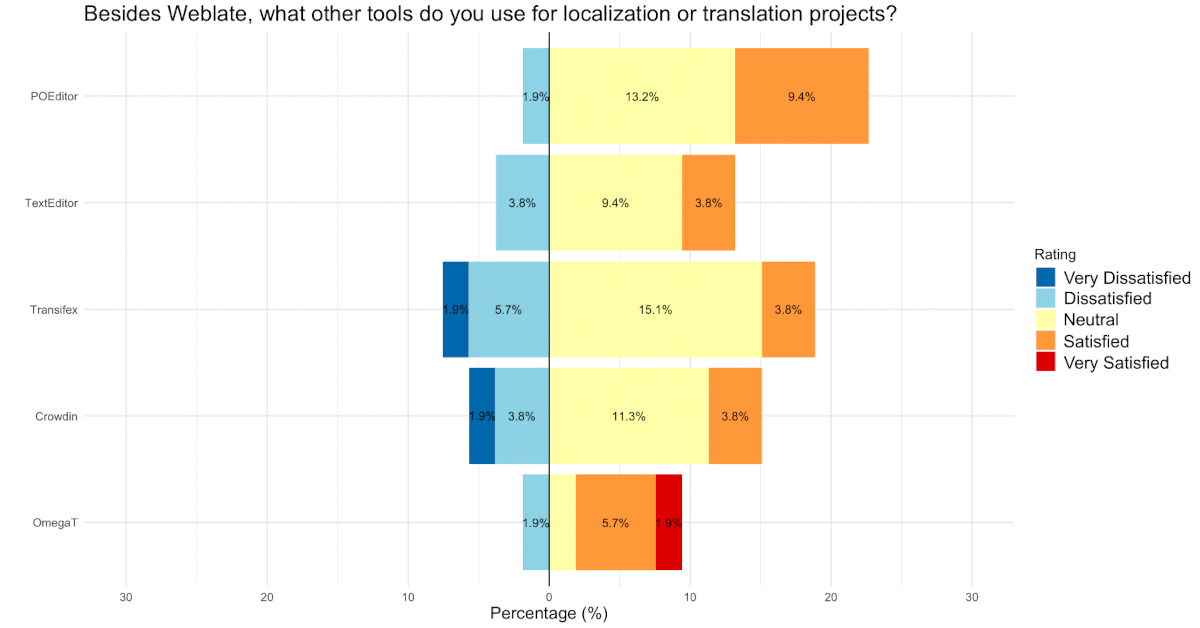
Among the different Localization tools available, most participants felt neutral towards the most commonly used tools, which include POEditor, TextEditor, Transifex, Crowdin, and OmegaT. However, the few participants who use OmegaT seemed to be relatively satisfied with the tool.
Q: Do you download strings and translate locally?
When asked if they download strings and translate locally, most participants reported that they either partially did so, or not at all.
Q: Do you want to receive notifications on updates related to translation tasks?
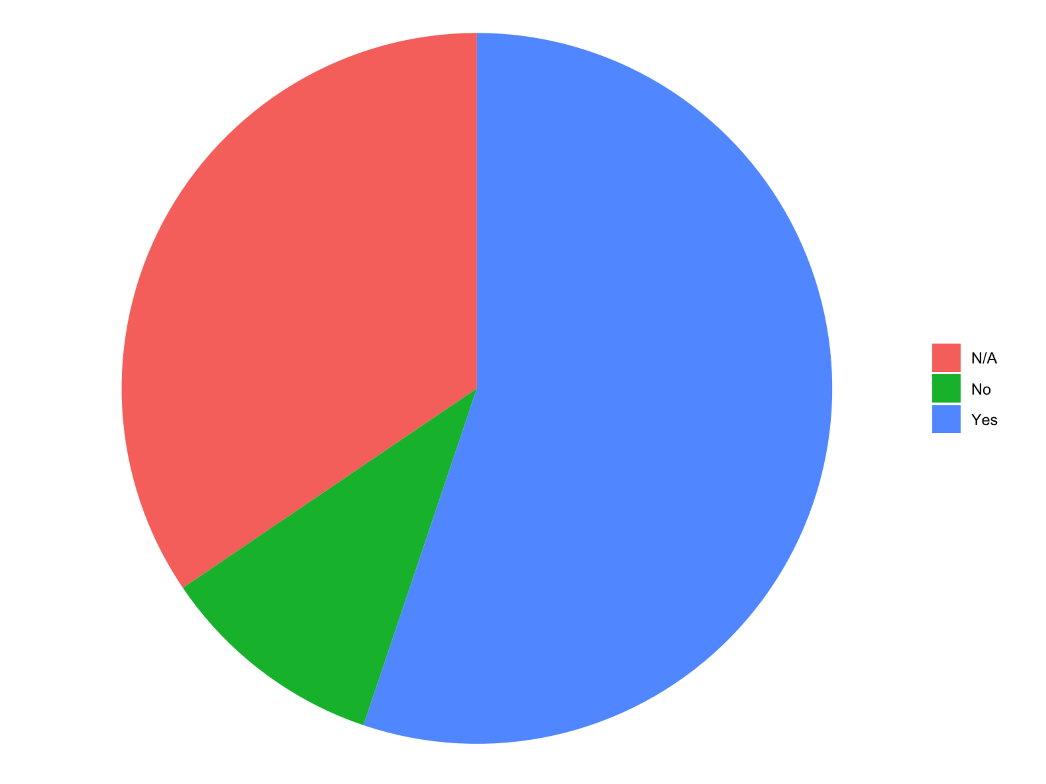
The majority of participants were interested in receiving notifications for translation task updates.
Q: How satisfied are you with the translation memory?
When asked about their satisfaction with translation memory from (1) Very Dissatisfied to (5) Very Satisfied, there were very mixed reviews, which did not allow us to capture where the majority opinion lies.
Q: If Weblate were able to auto-accept string matches, how important would this function be for you?
When asked to rate the importance of auto-accepting string matches on a scale from (1) Not at all important to (5) Extremely important, 10 out of 16 total participants rated this as at least (3) Moderately important. This might suggest that this could be a useful feature to add, but our qualitative responses will also show some potential issues that might arise if it is enabled for all translators.
Is the dashboard too complex?
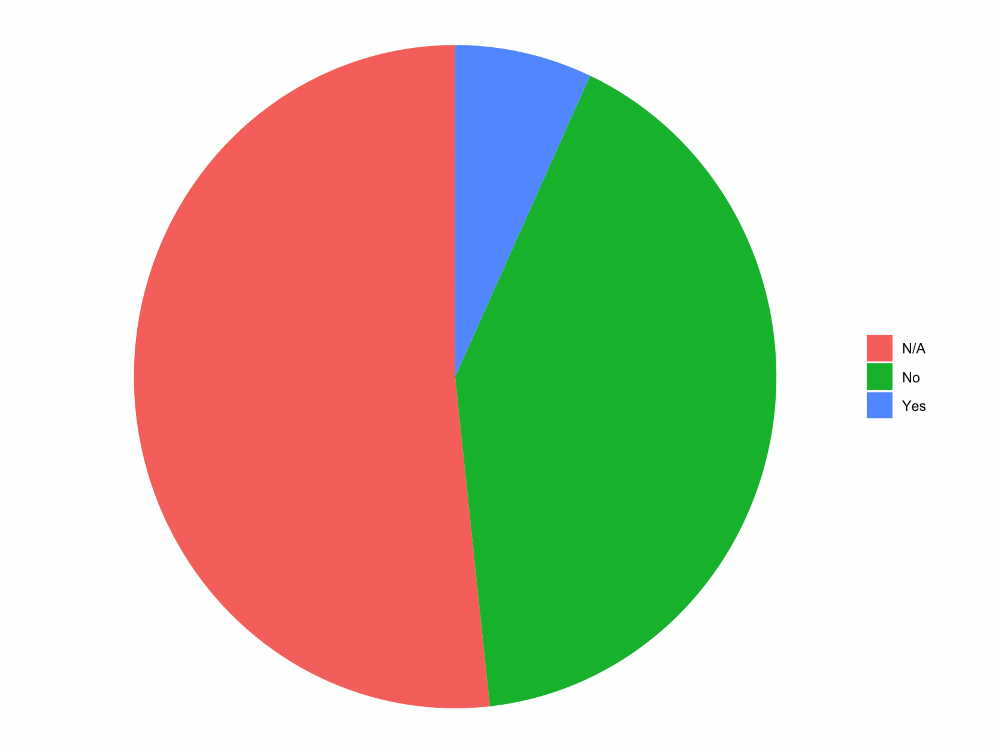
Although most participants who responded did not seem to have a problem with the Weblate dashboard, more than half of our responses were empty, making it difficult for us to understand the team’s opinion.
Q: What parts of the dashboard contribute to your satisfaction or dissatisfaction?
The few participants who assessed their satisfaction with the dashboard in the open-ended format touched on a number of topics, suggesting that the Weblate dashboard might be too complex or chaotic. They mentioned that they would like it if less projects were displayed, or if they were able to view only what they were working on.
However, another participant was interested in being able to view more projects on the dashboard so that they could more easily receive recommendations for a new project to start. Despite this valued feedback, only four participants left complete open-ended responses, making it a challenge to generalise these results across the whole team.
Q: Would you like to have machine translation such as LibreTranslate available in Weblate?
When asked to rate the importance of access to machine translation in Weblate on a scale from (1) Not at all important to (5) Extremely important, the reviews for this question were rather mixed. Though out of our 16 responses, slightly more than half (10/16) of our participants rated this as at least (3) Moderately important. Nonetheless, there may be need for a follow-up or additional data collected before a decision should be made, but this preliminary data suggests some support for the LibreTranslate project.
Q: How do you feel about the current separation between Weblate, the wiki, and user guides for translation memory?
- Support for centralisation: Those who hoped for centralisation of these tools believe it would help to save work and maintain consistency, and help projects if there is more overlap in all instances, while another participant specifically mentioned that they would appreciate having LibreOffice user guides available on Weblate.
- Thoughts on the current separation: A few participants reported that this centralisation would be inconvenient, while a few others who primarily used Weblate anyway felt neutral about the topic or liked the current separation as it is.
Are there any other problems that need attention?
- Add Machine Translation: Feedback from one participant included support for a good machine translation service, but that it is not a priority. However, our close-ended data indicate that more than half of participants find having machine translation at least moderately important.
- Increase access to translator publishing status: One participant reported that in the French section, there is limited mobility for translators to publish as there are only two authorised publishers. This prevents contributors from receiving credit for their work.
- Satisfaction and difficulties translating in Weblate: One participant particularly liked Weblate, especially compared to competing products, while another reported an issue relating to not finding which words are used in which functions in Weblate. Two participants found difficulties in adding existing translations to re-occurring words and that some single words require approval before they do not have to be translated over and over again.
- Individual translation issues: One participant wrote that auto-accepting string matches is not helpful in languages such as Japanese, where one word can have multiple meanings across contexts. One participant also reported difficulties in accessing information for specific releases (ie how many new strings to translate, who did translations, and how good translation has been for certain languages)
- Individual issues – needing updates: One participant also had trouble with publishing updates to translations after previously uploading an entire glossary. They found difficulty with making changes to whole glossary entries, and currently can only make changes one by one, thus slowing down the pace of updates.
Looking to the future
Although Weblate is a very popular and effective translation tool, a number of pain points were shared. These issues generally related to auto-accepting string matches, status hierarchies in publishing translations, and needing updates on translations and translation information.
One participant focused on the need for future changes and felt limited by the current pace of progress in the development of Weblate under the support of The Document Foundation and the community. There seems to be quite some room for improvement, but we thank you for your participation in helping us refine our vision in supporting the localisation community.