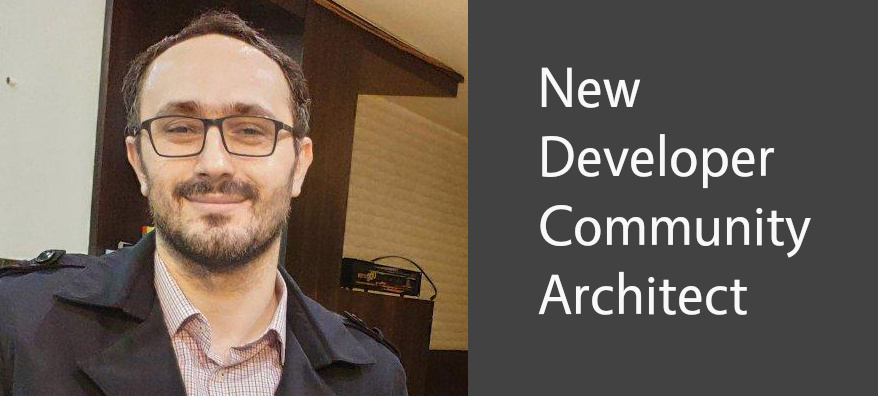
Hossein Nourikhah joins the TDF team as Developer Community Architect

Next week, Hossein Nourikhah will join the team at The Document Foundation, the non-profit behind LibreOffice, as Developer Community Architect. Hossein is a developer, university lecturer and FOSS advocate. He writes programs, teaches programming to students, and is an advocate for the use of free software applications, because they have a huge positive impact on the quality of our life by providing the essential freedoms that we all deserve.

Hossein has a B.Sc. in Computer Engineering (Software) from Isfahan University of Technology, and a M.Sc. and a Ph.D. in Information Technology from Amirkabir University of Technology, also called the Tehran Polytechnic. Since 2016 he has been an instructor at the Amirkabir University of Technology, teaching various courses including C/C++ programming, operating systems, software design, and many others.

Hossein started programming in BASIC and Pascal when he was 12, and after two and a half decades he is still involved in programming for fun and profit. He has worked with several programming languages, including C/C++, Java, Pascal, PHP and many more.

Industry experience

In addition to the university activities, including teaching and research, Hossein has several years of experience in the industry, working at various software/hardware companies as a C/C++/Java programmer – and lately as a software team manager and lead developer.

Hossein’s work experience ranges from web development with PHP to industrial application development with C++/Qt. He considers Qt a great platform for C++ software development, and he likes it very much as a clean and lovely tool.

Hossein has worked with many programmers as mentor, helping them to improve and reach their potential in software development by better understanding programming languages, libraries and tools. He feels great when he can empower other people, also because this helps him to expand his knowledge and understand things much better than before.

As Developer Community Architect, Hossein will be responsible for attracting new contributors to the LibreOffice project by identifying and onboarding new potential developers, building relationships between them and the community, and introducing them to TDF’s communication channels – where they will meet fellow co-hackers. He will encourage everyone’s contribution, and show community members ways to grow by bringing the more skilled contributors in contact with existing experts in the various fields for even deeper learning.

We’re happy to have him on board, and look forward to working with him!

100 Paper Cuts as a new student mentoring activity

Just before the pandemic, the Board of Directors of The Document Foundation approved a budget to launch an educational program targeted to universities, where students at selected tech schools would receive an economic incentive to promote LibreOffice amongst their peers, with the objective of increasing the number of young contributors both in source code development and in other areas. Unfortunately, the pandemics has forced all universities to stop all collateral activities, and this has resulted in the program being frozen for over one year.

Although the situation is not yet back to normal, we have the opportunity to mentor a student in Turkey. Muhammet Kara, a member of the MC and a Collabora full time developer, will mentor Ahmet Hakan Çelik, an undergraduate computer science student at Çanakkale Onsekiz Mart University, who will be working on 100 Paper Cuts – a list of bugs and enhancement requests relating to LibreOffice’s user experience – during June and July, trying to solve as many issues as he can. The target is to collect 10 points.

This is a first step in the direction set before the pandemic. We are planning to make similar announcements soon.

After the summer, if the academic activities will be back to normal – although the recover will be slow, and will have to cope with entirely new regulations – The Document Foundation will be able to get back in touch with the universities to start the planned Ambassador Program.

LibreOffice Documentation Team Activities in 2020

In 2020, the documentation community released many updated guidebooks, translated them into several languages, and participated in the Google Season of Docs

(This is part of The Document Foundation’s Annual Report for 2020 – the full version is here.)

New and translated guides

In January 2020, just before release of LibreOffice 6.4, the Documentation Team was proud to announce the Math Guide 6.4, an update of the previous version (4.0), updated to cover all of the innovations included in the latest release of the software. The guide was updated by Roman Kuznetsov and revised by Dave Barton from the documentation community. This was followed by the Calc Guide 6.2, a long-awaited update of the old Calc Guide 4.4.

In May, the guide to Base for LibreOffice 6.2 was released, covering, LibreOffice’s database component. It was updated by Pulkit Krishna, Dan Lewis, Jean Hollis Weber, Alain Romedenne, Jean-Pierre Ledure and Randolph Gamo. Another update in May was the Getting Started Guide 6.4 – the introductory guide for the latest LibreOffice 6.4, aimed to the general public interested to quickly get familiar with the software. It’s available as a PDF for offline reading, and ODT (OpenDocument Text) for editors and translators.

In summer, the Documentation Team announced the availability of the LibreOffice Draw Guide 6.4, the complete handbook for the drawing tool of LibreOffice. The guide was updated from the existing release (4.3) and include all the improvements developed since early 2014, when the last version of the guide was published.

Then there was the LibreOffice Calc Guide 6.4, the complete handbook for the spreadsheet tool. It was also updated from the existing release (6.2) and included all of the improvements developed in Calc since then.

In October, the Math Guide 7.0 was published – being the first guide based on LibreOffice 7.0. The effort was mostly carried by Rafael Lima and reviewed by Jean H. Weber. The new guide covers were designed by Rizal Muttaqin and Drew Jensen. The final publication was carried by Olivier Hallot. This was followed by the Calc Guide 7.0, a team effort of Steve Fanning, Gordon Bates, Kees Kriek, Annie Nguyen, Samantha Hamilton, Olivier Hallot and Jean Hollis Weber, coordinated by Felipe Viggiano.

Many guides were also translated in to various languages, thanks to our worldwide communities. For more information on their work, and the specific guides that they translated, see the “Native Language “Projects” section of this Annual Report.

Google Season of Docs

For the second year in a row, The Document Foundation was accepted as an organization in the Google Season of Docs, a programme whose goals are to give technical writers an opportunity to participate in contributing to open source projects, and to give open source projects an opportunity to engage the technical writing community.

In 2020, TDF’s documentation community offered a wide range of projects for technical writers, and extended the reach by providing projects for e-learning, mathematical documentation and code-oriented documentation.

TDF received several applications, containing important information including the technical writer’s resumés, proposals for project schedule and suggested deliverables. After a careful evaluation by the project mentors, TDF accepted the application of Ronnie Gandhi, a computer science undergraduate student enrolled at IIT Roorkee, India.

Steve Fanning, who had already worked as coordinator of the Calc Guide, served as mentor with Olivier Hallot as second mentor. Ilmari Lauhakangas and Olivier managed the administrative aspects of the project on behalf of The Document Foundation.

Ronnie worked on improving the descriptions for Calc’s functions, adding statements describing each function’s compliance with the Open Document Format for Office Applications (OpenDocument) Version 1.2 specification. Each function was also supplemented by extra use cases, illustrations and external references (where applicable).

Access the Extensive Calc Functions Description on The Document Foundation’s wiki. Thanks to Ronnie for all his work, and the mentors for assisting him on his journey.

Like what we do? Support the LibreOffice project and The Document Foundation – get involved and help our volunteers, or consider making a donation. Thank you!

TDF Annual Report 2020

The Annual Report of The Document Foundation for the year 2020 is now available in PDF format from TDF Nextcloud in three different versions: low resolution (4.7MB), medium resolution (18MB) and high resolution (24.7MB). The annual report is based on the German version presented to the authorities in April.

The 54 page document has been entirely created with free open source software: written contents have obviously been developed with LibreOffice Writer (desktop) and collaboratively modified with LibreOffice Writer (online), charts have been created with LibreOffice Calc and prepared for publishing with LibreOffice Draw, drawings and tables have been developed or modified (from legacy PDF originals) with LibreOffice Draw, images have been prepared for publishing with GIMP, and the layout has been created with Scribus based on the existing templates.

All pictures are licensed under the Creative Commons Attribution-Share Alike 4.0 License, courtesy of TDF Members from all over the world. Stock photos are CC0 by Pixabay.

Lothar Becker, Chairman of TDF Board of Directors, has written in the welcome address:

You will learn that our jubilee year was one of the most successful in our history. With all activities that took place, despite the situation that we could rarely meet in-person, it is really really incredible how the local communities and all supra-national activities carried on. And furthermore we grew in every aspect: our community base has more contributors than ever, and we had an impressive number of releases of LibreOffice, with a lot of code contributions – especially for the new major release of LibreOffice 7.0. And last but not least, the financial report of the foundation shows a year better than ever.

Certainly, we also had some shortfalls last year, starting with the lack of personal meetings and the consequences in the relationships between members – but also with changes and moves in the community and its ecosystem within. And let’s not forget the members of the community who suffered from bad health because of the pandemic situation. But overall, we could feel lucky and proud coming out of this year strengthened as described in this annual report. For all shortfalls, we are working hard in all TDF bodies (the Board, the old and new Membership Committee, the Advisory Board, the team led by Florian Effenberger), with the whole membership as well as national and international parts of the community.

So for all these activities, code and non-code contributions, personal engagements and donations we truly say a big THANK YOU, thank all of you for being with TDF in such a special year for every one of us.

Tender to implement the new TDF Membership Committee’s web-based tooling (#202105-01)

Introduction

The Document Foundation (TDF) is the charitable entity behind the world’s leading free/libre/open source (FLOSS) office suite LibreOffice.

The main activity of the Foundation’s Membership Committee (MC) is to administer membership applications and renewals following the criteria defined in the Foundation’s statutes.

Tender description

We are looking for an individual or company to implement the new TDF Membership Committee’s web-based tooling.

The tasks consists of developing and implementing this tooling. All of the mentioned features and requirements are explained in detail in the provided document “MC tooling specifications”, which is to be considered a part of this tender. The document lists which items are a part of the deliverables and therefore have to be part of the bid.

Note that this tender also contain some optional items, which are marked respectively. All items that are not explicitly marked as optional are to be considered mandatory.

The solution we seek, and as such the scope of this tender, is to implement the new TDF Membership Committee’s web-based tooling that will support the Membership Committee during the daily business.

Decision criteria

All technology standards of relevance, as well as their targeted versions for this tender should be declared or defined in the offer’s description of implementation.

Amongst the decision criteria for the bids are qualification, references, price, and completeness of fulfillment, as well as documentation. We expect bidders to provide documentation on the code, optionally also on the system administrator part.

Requirements

We prefer the use of a secure programming environment. As such, we strongly prefer Python/Django or Ruby on Rails over PHP. The use of server-side Java has to be discussed with TDF’s infrastructure team before bidding. In order to do so, please get in touch with us using the e-mail address below.

We strongly prefer the use of FOSS software and libraries, i.e. for DBMS, crypto and mailing.

The delivered software, code, documentation and all associated parts shall be published under an OSI approved license (see https://opensource.org/licenses) with TDF as owner of the copyright as well as all transferable rights. TDF intends to make the deliverables available to the general public.

Proposed milestones

Milestone #1 – Defining of the architecture; initial prototype with testing and knowledge sharing (with the Membership Committee) about the new solution; usability improvements. Main process elements like voting are tested and work fine. Implementation of the database and the management back-end user interface to interact with it. Import of member information from the old database.

Access to the current production database can be granted to the successful bidder after signing a privacy and non-disclosure agreement. Otherwise, and less preferred, a database with anonymized sample data will be provided.

Milestone #2 – Handling of a new request to become a member of TDF.

Milestone #3 – Have the membership renewal process working.

Milestone #4 – Move the full daily work of the membership committee to the new platform; all voting can be done directly with the new platform. The implementation of reporting and mail system must be completely functional for:

  • Receipt of application
  • Mail for accepted applicants
  • Mail for denied applicants
  • Mail for pending applicants
  • Quarterly report on accepted members in English
  • Quarterly report on accepted members in German

Milestone #5 – Implement and test:

  • Reminders for MC members
  • All time-triggered jobs
  • Quarterly report as CSV file
  • Database integrity check by checking the signature and re-reading this file
  • Deleting of obsolete records cleanup

Required skills

  • Extensive knowledge of Python/Django or Ruby on Rails
  • Extensive knowledge of front-end and back-end development of web-based applications
  • Extensive knowledge of design and implementation of accessible web-based applications
  • Experience in working on open source projects

Other skills

  • English (conversationally fluent in order to coordinate and plan with members of TDF)

TDF welcomes applications from all suitably qualified persons regardless of their race, sex, disability, religion/belief, sexual orientation or age.

Bidders will get a preference for including a partner or independent developer who has not been involved in a successful tender before.

As always, TDF will give some preference to individuals who have previously shown a commitment to TDF, including but not limited to certified developers and/or members of TDF. Not being a member, or never having contributed before, does not exclude any applicants from consideration.

The task offered is a project-based one-off, with no immediate plans to a mid- or long-term contractual relationship. It is offered on a freelance, project basis. Individuals and companies applying can be located anywhere in the world.

TDF is looking forward to receiving your applications for the aforementioned tasks, your offer in form of a fixed-time, fixed-budget approach, and the duration period for the implementation in calendar weeks of the mentioned milestones after the final awarding of the tender, via e-mail to a committee at tender20210501@documentfoundation.org no later than June 23, 2021.

Applicants who have not received feedback by July 21, 2021 should consider that their application, after careful review, was not accepted.

All bidders are invited to ask their questions on this tender until June 11, 2021. Questions can be sent informally to the above e-mail address, and answers will be made public in a collected and anonymized form.