Meet the LibreOffice community at FOSDEM 2025 in Brussels!

FOSDEM logo

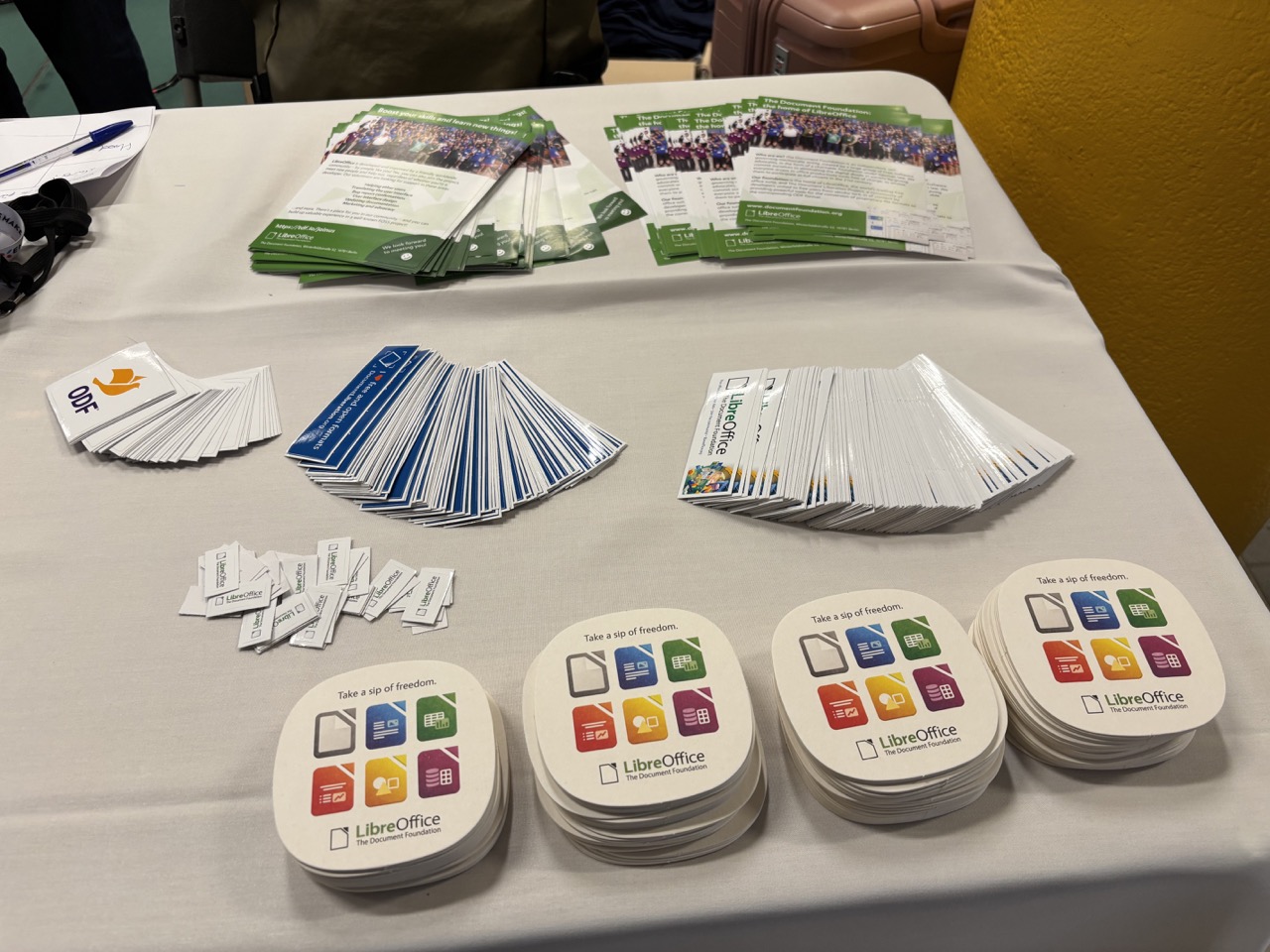
FOSDEM is one of the largest meetups for free and open source software projects, and it takes place every year in Brussels at the ULB Solbosch campus. This year it’ll be on 1 and 2 February – and, of course, LibreOffice and The Document Foundation will be there! Our stand will be in in K level 1, so come by and have a chat, grab some merchandise (stickers, pens, flyers, beer/coffee mats), and support us with a donation if you like 😊

LibreOffice stand at FOSDEM

We also have the LibreOffice devroom on the first day, with 20 talks and presentations about the software, technology and community.

See you there!

localwriter: An optional LibreOffice Writer extension for local generative AI

localwriter screenshot

LibreOffice is a privacy-oriented office suite that runs on your own computer and doesn’t include AI features out-of-the-box. But we know that many users are interested in combining AI tools with the suite, so we talked to John Balis who is working on a (fully optional!) LibreOffice extension called localwriter. Here’s what he had to say…

What does the extension do?

Localwriter is a libreoffice writer extension to allow for inline generative editing with local inference. It can be used with any language model supported by Ollama or text-generation-webui. This extension adds two powerful commands to LibreOffice Writer:

  • Extend Selection – Uses a language model to predict what comes after the selected text. There are a lot of ways to use this. Some example use cases for this include, writing a story or an email given a particular prompt, adding additional possible items to a grocery list, or summarizing the selected text.
  • Edit Selection – A dialog box appears to prompt the user for instructions about how to edit the selected text, then the selected text is replaced by the edited text. Some examples for use cases for this include changing the tone of an email, translating text to a different language, and semantically editing a scene in a story.

When did you start working on it?

I started working on localwriter in July 2024, because I wanted an AI tool to assist with my writing that would benefit from the intrinsic advantages in terms of availability (can’t lose access), confidentiality (doesn’t leak data), and integrity (no surprise model version changes) that come with using a fully open source local AI stack instead of a third-party API. I feel it is really important to embrace learning to benefit from artificial intelligence without sacrificing agency, and this software follows from that line of thinking.

What are the current limitations, and what’s coming next?

localwriter currently only supports LibreOffice Writer, although Calc support is in development and will be offered in the next release. Another limitation is that it does not support streaming, and does not offer a “Chat with document” feature.

How can others help to improve it?

There are a ton of open feature requests in the repository from several users, which should be really easy for an experienced LibreOffice extension developer to complete. I can easily set up anyone interested with a task to work on. Tests would be welcome, as currently it doesn’t have any tests. Also, donating to me helps me allocate my own time towards development.

Get the extension here

Czech translation of LibreOffice Getting Started Guide 24.8

Czech LibreOffice Getting Started Guide cover

Zdeněk Crhonek (aka “raal”) from the Czech LibreOffice community writes:

The Czech team has finished its translation of the LibreOffice Getting Started Guide 24.8. As usual it was a team effort, with translations by Petr Kuběj, Zdeněk Crhonek and Radomír Strnad; localized pictures from Roman Toman; and technical support from Miloš Šrámek. Thanks to all the team for their work!

The Czech translation of the Getting Started Guide 24.8 is available for download here.

The team will continue working on a translation of the Math Guide 24.8. We always looking for new translators and correctors. Join us!

Stanislav Horáček cleaned up the bookshelf page and he added an online version of the Math Guide. More online versions are to come.

Great work everyone! 😊

Announcing the LibreOffice Calc Guide 24.8

Dione Maddern and The Documentation Team are proud to announce the immediate availability of the LibreOffice Calc Guide 24.8, an update of the existing Calc Guide 24.2 with enhancements taken from the current LibreOffice 24.8 Calc module.

Calc Guide 24.8

The book was reviewed for clarity, readability and content additions, notably the Calc database table referencing in formulas, removal of deprecated JavaScript debugger and refactoring of the Calc’s chart topic – in which the chapter on charts was split in two, one for the chart basics and the second for the chart types. Dione Maddern, Calc editor says:

I took on the challenge of compiling the Calc Guide because I wanted to learn about advanced editing and working with master documents. While I’ve previously worked on large documents in the engineering and insurance industries, documents were often compiled with clunky cut-and-paste techniques which created a lot of errors and labor-intensive rework. Working on the Calc Guide 24.8 was a great opportunity to expand my skills in LibreOffice and document production generally. It was also a wonderful opportunity to work with the LibreOffice Documentation Team. I had a great time working with such a fun and supportive team.

Special thanks to Ed Olson, Lisa Samy and Claire Wood for their review of the contents of the guide. And to B. Antonio F. for his throughout review of formatting the guide and by writing a set of macros, bundled in an LibreOffice extension that allows automatic and assisted fixing of images, tables , styles and more.


Dione Maddern

It was also a wonderful opportunity to work with the LibreOffice Documentation Team. I had a great time working with such a fun and supportive team. (Dione Maddern)


Ed Olson

It has been an honor to share my wordsmithing skills with the LibreOffice documentation team. Replacing verbose paragraphs in the Calc guides with simplified, minimalist text has been both challenging and rewarding. I look forward to continuing my work on other applications in the suite as new releases become available. (Ed Olson)


Lisa Samy

Joining the Calc Guide team marked my first time contributing to an open-source platform. My time working with other team members was both enriching, yet eye-opening to all the facets of document editing. As such, I thoroughly enjoyed my experience with the LibreOffice Community as a whole. (Lisa Samy)


B. Antonio F.

I accepted the challenge of creating mechanisms to harmonize he appearance of chapter text according to the chapter template established by the documentation team. It was an opportunity to delve deeper into macro programming and get to know the LibreOffice API better. SanityCheck macros allow you to correct formatting errors (based on styles), correctly adjust images, tables, and automatically apply descriptions for accessibility. With SanityCheck you can check documentation chapters in English, Spanish and Portuguese. (B. Antonio F.)


Claire Wood

I enjoyed working on the Calc Guide as it gave me the opportunity to work with a truly global team. The content also challenged my knowledge about spreadsheets. I was happy to develop my knowledge, getting new information and develop my strengths in LibreOffice. (Claire Wood)


You can download the LibreOffice Calc Guide 24.8 from the LibreOffice Bookshelf and the LibreOffice Documentation website.

Hazard: A LibreOffice Impress template to play Jeopardy-like games

Hazard LibreOffice template screenshot

Marcial Machado recently posted on Reddit about his “fully-featured LibreOffice Impress template for creating Jeopardy-style games. Just add your questions and categories, and you’re good to go!” So let’s find out more…

What does the template do?

At its core, the template is meant to emulate what a game of Jeopardy is like. You can click on any of the squares on the game board and it will send you to the slide with the associated question, where you can either return to the board in the case of a misclick, or reveal the answer to the question. Returning to the board from the revealed answer slide will erase the square you clicked on to clearly show which questions are left to be answered.

You can also use the green and red arrows at the top to give and remove points to up to 6 teams in increments of 100, in order to keep track of everyone’s correctly- and incorrectly-guessed answers. Once the board’s cleared, you can click the pink button at the bottom right to clearly display the top three teams and the points they earned. I made sure to include details on how to edit, and use, the template in the first two slides!

Why did you develop it?

The simple reason for why I developed this template was because: I use LibreOffice, I wanted a Jeopardy presentation that worked in LibreOffice, and I couldn’t find one. The more verbose reason is that there is a comparative dearth of visually-appealing presentation templates in the OPT world than there is in the PPTX world; this is no fault of the creators of OPT templates, but rather because the proprietary nature of something like PowerPoint incentivizes templates made for profit, whereas most people who create LibreOffice Impress templates do it out of interest.

This necessarily means that there are just less people making LibreOffice Impress templates in total, without mentioning the much smaller userbase LibreOffice has compared with Microsoft Office. Now, some PowerPoint files do work in Impress, and the work done by the dev team and contributors is commendable, but a converted document is still a converted document. Formatting might be slightly off, and macros are almost always a bust. Since I realized I wanted this Jeopardy project to exist, and realizing my own frustration with the fact that such a project didn’t exist already, I went ahead and tried it out myself, and then released it to the public!

Hazard LibreOffice template screenshot

Do you have any tips for other people interested in creating templates in LibreOffice?

I have a few:

  • Focus on a problem you, yourself, have. You’ll be much more eager to bring a project to completion and to a high level of quality if you have a vetted interest in the final product.
  • Tell yourself that no one, ever, is going to make what you want to be made. The problem with a community of like-minded contributors is that everyone thinks everyone else is likely to fix the problem they have, so there’s a huge diffusion of responsibility; think of walking past some trash on the sidewalk and thinking, “someone else will pick that up eventually.” No! You be the one who throws it in the trash! In the same way, once you realize there’s an issue you can fix, or you can learn how to fix, be the one to fix it – no one else is gonna fix it for you!
  • Be patient. Like, really patient. Because no one is gonna fix this problem for you, you have all the time in the world to get it right. Read some documentation, go to some forums, sit on it a few days. Maybe get some feedback. Depend on time and on others to both find motivation and create a better end-product. The Jeopardy template I ended up releasing was the third completed project I made!

Get the template from here