Fixing an Interoperability Bug in LibreOffice: Missing Lines from DOCX (part 3/3)

By Hossein Nourikah, Developer Community Architect at The Document Foundation

In LibreOffice, interoperability is considered a very important aspect of the software. Today, LibreOffice can load and save various file formats from many different office applications from different companies across the world. But, bugs are inevitable parts of every software: there are situations where the application does not behave as it should, and a developer should take action and fix it, so that it will behave as it is expected by the user.

What if you encounter a bug in LibreOffice, and how does a developer fix the problem? In these series of articles, we discuss the steps needed to fix a bug. In the end, we will provide a test and make sure that the same problem does not happen in the future, again.

The article is presented in three parts:

  1. Understanding the Bugs and QA
  2. Developing a Bug Fix
  3. Writing the Tests and Finishing the Task

This is the third part.

3. Writing the Tests and Finishing the Task

So, if you have read the two previous parts on “Fixing an Interoperability Bug: Missing Lines in Save and Load” (part 1, part 2), this is the third and last part of these series. In this part, we discuss how to write a test, submit the patch to the Gerrit and try to get it incorporated into the LibreOffice code.

3.1. Writing a Test for the Regression

In order to make sure that this regression will not happen again, we should create test for every bug that is fixed. If we don’t do this, there is a big chance that this bug will occur again and again.

But how to start writing a test? The answer is that there are ~3000 tests available in sw/qa/extras/ folder, and there is a tiny document sw/qa/extras/README that describes them. These tests can be a basis for writing a new test. For example, test for tdf#91687 consist of these lines:

DECLARE_WW8EXPORT_TEST(testTdf91687, "tdf91687.doc")
{ // Exported Watermarks were resized
 uno::Reference xWatermark = getShape(1);
 CPPUNIT_ASSERT_EQUAL(sal_Int32(5172), xWatermark->getSize().Height);
 CPPUNIT_ASSERT_EQUAL(sal_Int32(18105), xWatermark->getSize().Width);
}

It uses a macro DECLARE_WW8EXPORT_TEST too, that checks some properties of the document after loading it, and then again after saving and reloading it. If some property is erroneously changed, the test will fail, and you will get noticed.
As you can see, the name of the test, and the name of the test document in which here is .doc file, come from the bug number.

The test for this regression should check for the position and size of the shapes, so there are similarities between the our desired test and the test above. But how can we find the properties of the elements of the document? The answer is the new UNO object inspection tool for the LibreOffice:

https://blog.documentfoundation.org/blog/2021/03/02/update-on-tender-for-a-built-in-uno-object-inspection-tool-in-libreoffice/

As can be seen in figure 1, the size for Shape7 which is the first vertical line, is visible on the right.

In previous versions, tools called XRAY or MRI were used for object inspection.
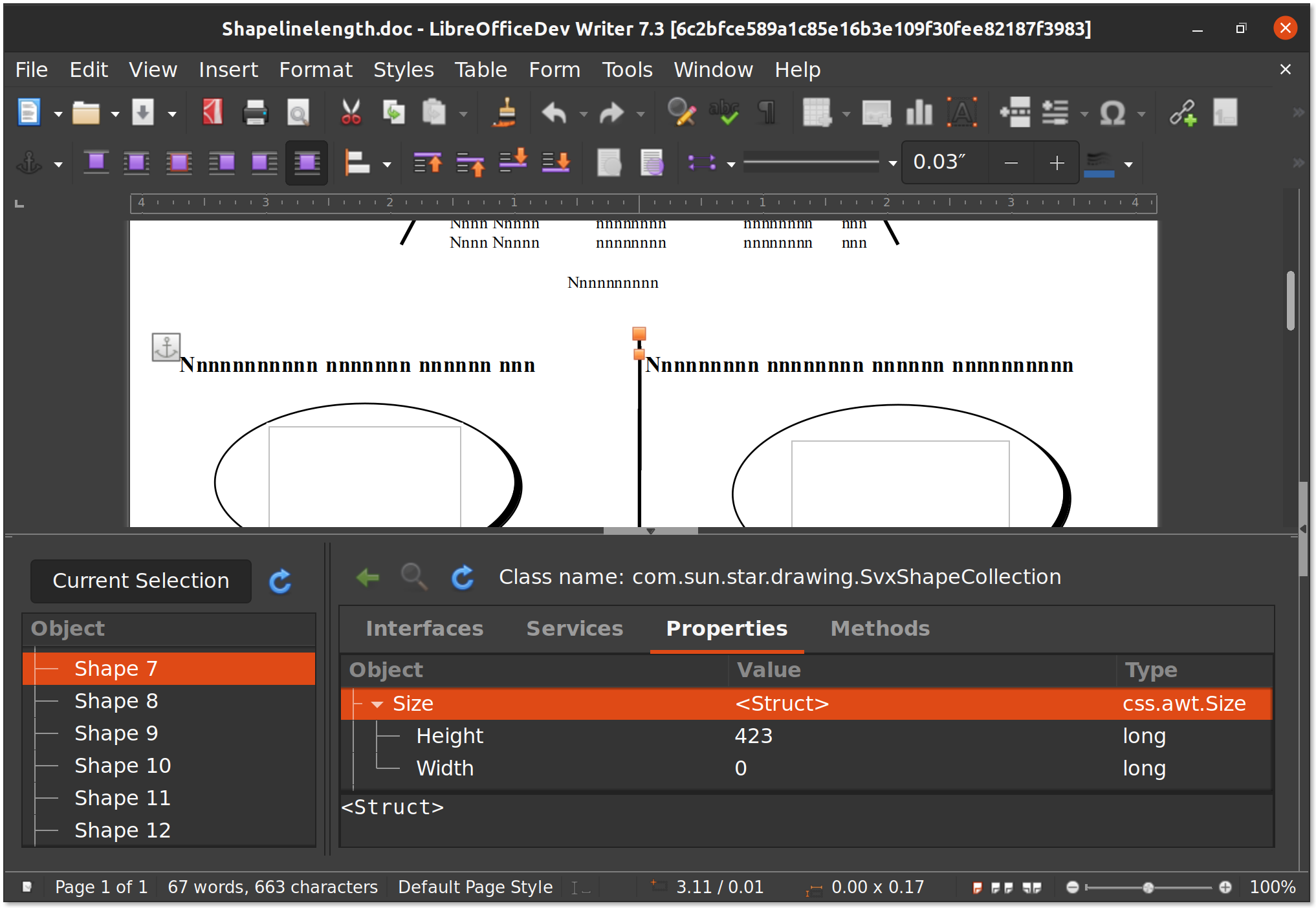
Figure 1. UNO object inspection tool for the LibreOffice

The completed test comes below. It takes Shape7, Shape8 and Shape9 which are the three vertical lines, and ensures that they have the same size in the first load, and after save and reload. Without the fix, some of these test fail, which are size checking for the first and last vertical lines. Their size was reduced to ~0, so it is justifiable that previously they were erroneously disappearing after save and reload. The test passes after applying the fix.

DECLARE_WW8EXPORT_TEST(testTdf123321, "shapes-line-ellipse.doc")
{
 // These are the 3 lines in which 1st and 3rd one were
 // disappearing before
 uno::Reference<drawing::XShape> l1 = getShape(7);
 uno::Reference<drawing::XShape> l2 = getShape(8);
 uno::Reference<drawing::XShape> l3 = getShape(9);
 // first line (smallest)
 // Fails without the fix: Expected: 423, Actual: 2
 CPPUNIT_ASSERT_EQUAL(sal_Int32(423), l1->getSize().Height);
 // Fails without the fix: Expected: 0, Actual: 2
 CPPUNIT_ASSERT_EQUAL(sal_Int32(0), l1->getSize().Width);
 CPPUNIT_ASSERT_EQUAL(sal_Int32(7908), l1->getPosition().X);
 CPPUNIT_ASSERT_EQUAL(sal_Int32(37), l1->getPosition().Y);
 // second line (larger)
 CPPUNIT_ASSERT_EQUAL(sal_Int32(2542), l2->getSize().Height);
 CPPUNIT_ASSERT_EQUAL(sal_Int32(2), l2->getSize().Width);
 CPPUNIT_ASSERT_EQUAL(sal_Int32(7916), l2->getPosition().X);
 CPPUNIT_ASSERT_EQUAL(sal_Int32(289), l2->getPosition().Y);
 // third line (largest)
 // Fails without the fix: Expected: 7027, Actual: 2
 CPPUNIT_ASSERT_EQUAL(sal_Int32(7027), l3->getSize().Height);
 // Fails without the fix: Expected: 0, Actual: 2
 CPPUNIT_ASSERT_EQUAL(sal_Int32(0), l3->getSize().Width);
 CPPUNIT_ASSERT_EQUAL(sal_Int32(7911), l3->getPosition().X);
 CPPUNIT_ASSERT_EQUAL(sal_Int32(231), l3->getPosition().Y);
}

As you can see, not all the tests fail without the fix, but they are in place to protect the correct load and save of the shapes in the future.

3.2. Cleaning up and Submitting the Changes

After we finished the fix, we commit the changes, and submit it to the LibreOffice Gerrit.

$ git add include/svx/svdopath.hxx svx/source/svdraw/svdopath.cxx sw/qa/extras/ww8export/data/shapes-line-ellipse.doc sw/qa/extras/ww8export/ww8export2.cxx

$git commit

Let’s see our latest commit:

$ git show --name-only

Author: Hossein <hossein@libreoffice.org>
Date:   Mon Jul 19 13:03:42 2021 +0200

    tdf#123321 Fix DOC/DOCX export bug which made some lines disappear
    
    * Fix the wrong calculation of SdrPathObj (line) extent while exporting
      to .doc and .docx formats. This resolves tdf#123321 which cause some
      lines to disappear after save and reload. This fix does not break
      tdf#91687
    * added tests to make sure this does not happen again, based on the
      .doc file provided in Bugzilla
    * Loading the bad exported file in MS Word is OK, but it does not work
      in LibreOffice, and some of the lines will be hidden. This needs
      additional work.
    
    The regression came from d72e0cadceb0b43928a9b4f18d75c9d5d30afdda
    
    Change-Id: Ic5a7af4d29df741204c50590728542e674ee9f91

include/svx/svdopath.hxx
svx/source/svdraw/svdopath.cxx
sw/qa/extras/ww8export/data/shapes-line-ellipse.doc
sw/qa/extras/ww8export/ww8export2.cxx

The actual commit information is lengthy, but for making it shorter, we only listed the name of the changed or new files. Then, we submit the patch:

$ ./logerrit submit master

This is with the assumption that we have successfully configured Gerrit before. One should set up Gerrit before doing this. A step-by-step manual is presented in The Document Foundation Wiki.

https://wiki.documentfoundation.org/Development/gerrit/setup

3.3 Getting the Submission Merged

Every submission to the Gerrit is reviewed by one or more developers, and is possibly gets merged into to the code after the submitter has done all the requested fixes and improvement. This is done by the decision one of the people with commit access. Commit access is granted to the developers who had a good record of contributions and are trusted to change the code base directly.

So, the code is reviewed in the Gerrit:

https://gerrit.libreoffice.org/c/core/+/119116

Every submitted code is built automatically by Jenkins in a process called CI (continues integration). If the build is successful, you will get a     Verified +1     from Jenkins.

If, for any reason, one of the builds for several platforms that is tested fails, you will get     Verified -1     from Jenkins. Then, you will have to fix the problem and re-submit again. Please note that there are situations that some tests fail because of the Jenkins problem itself. If that is the case, you should ask people in the #libreoffice-dev irc channel to invoke a resume for you, or try rebasing to initiate a rebuild.

The original submission (patch set 1) lacked the tests, so a test was requested. After doing the improvements, including a change in the title and uploading seven patch sets in total, it was given the   Code Review +2   from the reviewer. Here, Miklos Vajna from Collabora has done the reviews and merging.

Then, the proposed changes eventually got merged into the code by the reviewer with appropriate access. After that, everyone can pull the changes from Git:

https://git.libreoffice.org/core/+/bda4d7a7c3fcc259e023f568606be5dcba818db9

3.4 Marking the Bug as Fixed

After the commit is done, the journey ends with marking the bug as fixed. Looking at the other possible registrations of the symptoms at TDF Bugzilla, it turns out that another bug can be considered a duplicate of this one:

Bug 127296 – FILESAVE: DOC Rotated line loses rotation when saved

https://bugs.documentfoundation.org/show_bug.cgi?id=127296

It is reported in 2019-09-02, and it is newer than the one we have fixed. So, we can mark tdf#127296 as a duplicate of this one. After that, we can safely change the status of tdf#123321 to “RESOLVED FIXED”, and we’re done!

3.5 Want to Get Involved?

If you want to get involved in Libreoffice development, you can help in fixing the bugs. Looking at the statistics from TDF’s Bugzilla, we see that there is a total of ~12k open bugs, in which ~1.3k of them are regressions. Among them, around 1.1k are bibisected. They are more suitable for getting into, because the root of the problem is known to some extent.

You can go through the same process that was discussed in the series of articles here to fix the bugs and submit your patch, and if you had any questions, #libreoffice-dev is a good place to ask. Also, it is suggested that you join the LibreOffice development mailing list. See the instructions here.


Hossein Nourikhah is the Developer Community Architect at the The Document Foundation (TDF), the non-profit behind LibreOffice. If you need assistance getting started with LibreOffice development, you can get in touch with him:

E-Mail: hossein@libreoffice.org

IRC: hossein in the IRC channel #libreoffice-dev on the Libera.Chat network connect via webchat

Fixing an Interoperability Bug in LibreOffice: Missing Lines from DOCX (part 2/3)

By Hossein Nourikah, Developer Community Architect at The Document Foundation

In LibreOffice, interoperability is considered a very important aspect of the software. Today LibreOffice can load and save various file formats from many different Office applications from different companies across the world. But, bugs are inevitable parts of every software: There are situations where the application does not behave as it should, and a developer should take action and fix it, so that it will behave as it is expected by the user.

What if you encounter a bug in LibreOffice, and how a developer fixes the problem? In these series of articles, we discuss the steps needed to fix a bug. In the end, we will provide a test and make sure that the same problem does not happen in the future, again.

The article is presented in three parts:

  1. Understanding the Bugs and QA
  2. Developing a Bug Fix
  3. Writing the Tests and Finishing the Task

This is the second part.


2. Developing a Bug Fix

So, if you have read the previous part of “Fixing an Interoperability Bug: Missing Lines in Save and Load” (part 1), this is the sequel. Here we try to develop a solution for the problem with our knowledge of C++.

The first thing we need is to build the LibreOffice core. Depending on the platform, you can find the instructions in the TDF wiki.

See the instructions for building LibreOffice on:

2.1. Finding the Responsible Change

So, now we know that through this commit, these files were changed. One (or possibly all) of the changes is responsible for the regression. So we try to find a minimize set of changes that lead to the problem. We can use --name-only option from git:

$ git show d72e0cadceb0b43928a9b4f18d75c9d5d30afdda --name-only

So, the changed files are:

  1. filter/source/msfilter/escherex.cxx
  2. filter/source/msfilter/msdffimp.cxx
  3. include/svx/msdffdef.hxx
  4. sw/qa/extras/ww8export/data/tdf91687.doc
  5. sw/qa/extras/ww8export/ww8export2.cxx
  6. sw/source/filter/ww8/wrtw8esh.cxx

Sometimes we have to go back to this specific commit using git checkout command to be able to work on the exact commit before the one that created the bug. But, most of the time, reverting the specific commit is easier, and the build will be much faster. Also, building older versions of LibeOffice is tricky. We can instead invoke this command:

$ git revert d72e0cadceb0b43928a9b4f18d75c9d5d30afdda

Now we should try to resolve the possible conflicts, then build the code and make sure the problem has gone away! Then we can try to re-introduce one or more changes to achieve a minimal set of changes that reproduces the problem.

We can start at the file level to find the relevant files to work on. Files 4 and 5 are related to the tests, so they should have no impact. File 1 and 2 seem to be related, as both are from filter/source/msfilter folder, file 3 is also related to these two files. After leaving out all the files, we see that changes from 6 (sw/source/filter/ww8/wrtw8esh.cxx) is enough to reproduce the problem. So, we have few lines of code changes in front of us:

@@ -756,7 +756,12 @@ void PlcDrawObj::WritePlc( WW8Export& rWrt ) const
                OSL_ENSURE(pObj, "Where is the SDR-Object?");
                if (pObj)
                {
-                   aRect = pObj->GetSnapRect();
+                   aRect = pObj->GetLogicRect();
+
+                    // We have to export original size with padding
+                    const SfxItemSet& rSet = pObj->GetMergedItemSet();
+                    const SdrMetricItem* pItem = static_cast(rSet.GetItem(SDRATTR_TEXT_UPPERDIST));
+                    aRect.SetSize(Size(aRect.GetWidth(), aRect.GetHeight() + pItem->GetValue()));
                }
            }

If we work further on this piece of code, we will find that the change from pObj->GetSnapRect() to pObj->GetLogicRect() is the source of regression: Good catch!

2.2. Creating a Fix

As described in the previous section, going back to pObj->GetSnapRect() fixes the problem, but wait! Isn’t that change supposed to fix a problem?

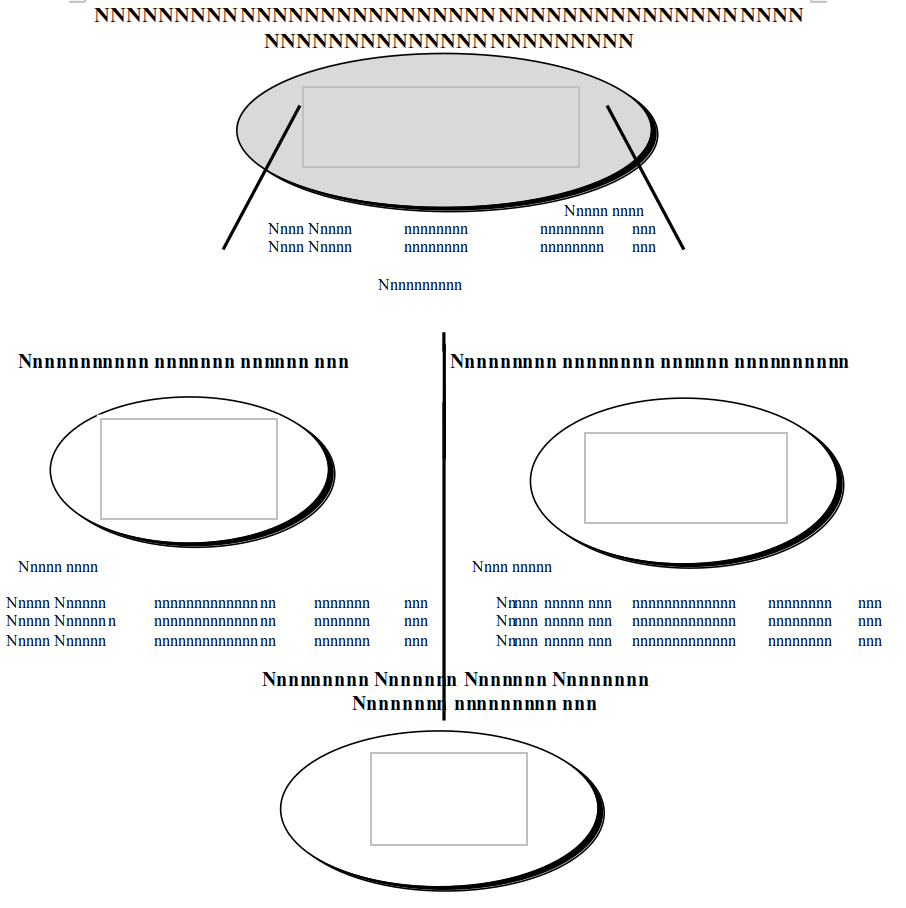
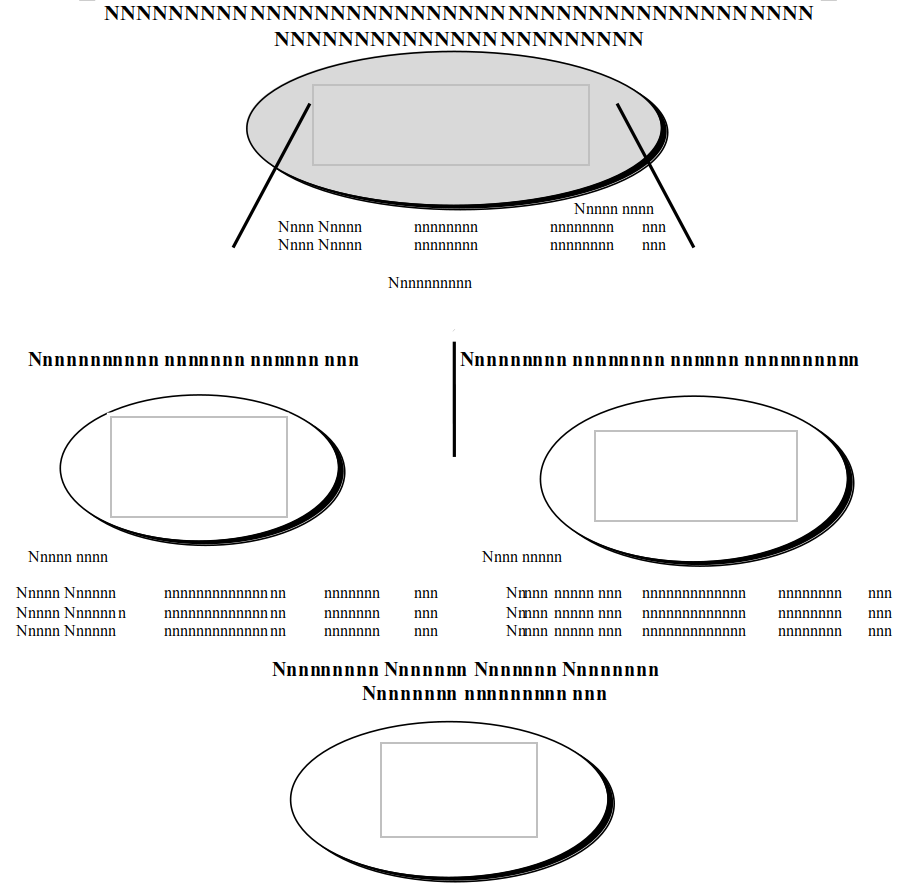
(GOOD)

(BAD)

Figure 1: Wrong increase of watermark size
after save and reload

If we go back to git master using:

git reset --hard HEAD^1

and then only change pObj->GetSnapRect() to pObj->GetSnapRect(), this test fails with the change. Try:

$ make CPPUNIT_TEST_NAME="testTdf91687" -sr CppunitTest_sw_ww8export2

If we take a look at the tdf#91687 in the Bugzilla, we see the example sw/qa/extras/ww8export/data/tdf91687.doc that contains a watermark (Figure 1) that gets bigger by save and reload! Looking more carefully to the changes, it becomes clear that rotation is important here. If we change the watermark example in order to set rotation to zero, nothing happens.

This is not limited to watermarks: Saving and re-loading any custom shape leads to such a wrong increase in size. On the other hand, this does not have any effect on the lines, rotated or not.

2.3. Fixing the Side Effects

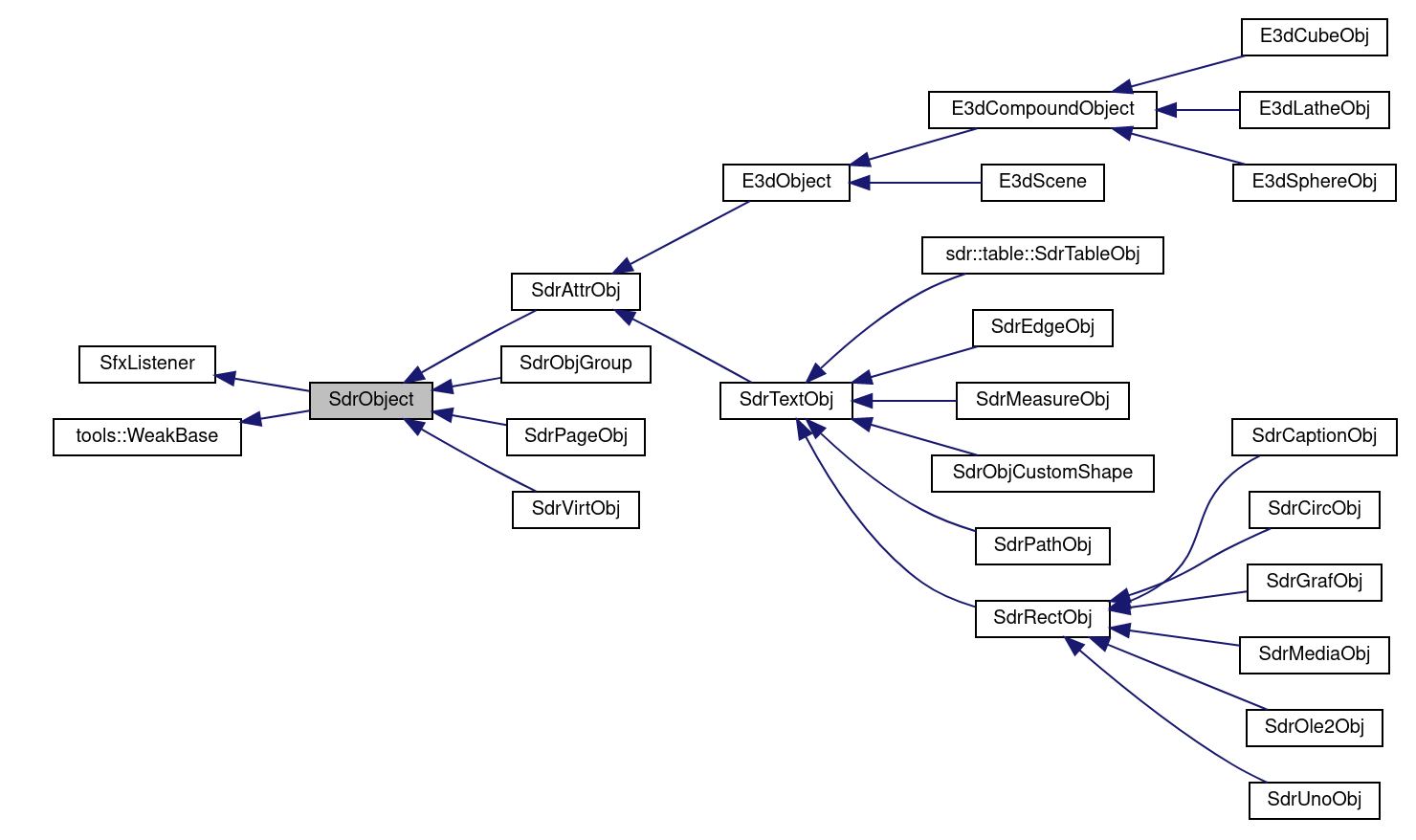
In order to fix the undesired side effects, we should make a difference between the lines and the complex shapes. So, what is the difference? If we look closely to the code, we find out that pObj object is from SdrObj class, which is abstract DrawObject. The documentation for this class can be found here:
https://docs.libreoffice.org/svx/html/classSdrObject.html

Figure 2. Class hierarchy for SdrObject

So, objects from different SdrObject subclasses are sent here, and appropriate GetSnapRect() or GetLogicRect() is called. But which method? According to the runtime polymorphism, this is determined at runtime. So without debugging, nothing becomes clear.

By setting a break-point at this modified line and stepping into the GetLogicRect() function, it becomes clear that two types of object are created for the shapes:

  • pObj is SdrObjCustomShape (x4): representing 4 ellipeses
  • pObj is SdrPathObj (x5): representing 5 lines

So, the trick would be creating a GetLogicRect() method for SdrPathObj and make it invoke GetSnapRect(). In this way, lines and custom shapes are treated differently.

We declare GetLogicRect() in include/svx/svdopath.hxx:

virtual const tools::Rectangle& GetLogicRect() const override;

and add its implementation in svx/source/svdraw/svdopath.cxx:

const tools::Rectangle &SdrPathObj::GetLogicRect() const
{
    return GetSnapRect();
}

Then we rebuild the LibreOffice by invoking make, and then start the LibreOffice from instdir/program/soffice. After loading, saving, and re-loading the example DOCX file, we see that this fix actually works!

In the third part, we are going to talk about the steps needed to get our changes merged into the LibreOffice Code. If you want to get involved in LibreOffice development, it is suggested that you join the LibreOffice development mailing list. See the instructions here.


Hossein Nourikhah is the Developer Community Architect at the The Document Foundation (TDF), the non-profit behind LibreOffice. If you need assistance getting started with LibreOffice development, you can get in touch with him:

E-Mail: hossein@libreoffice.org

IRC: hossein in the IRC channel #libreoffice-dev on the Libera.Chat network connect via webchat

Fixing an Interoperability Bug in LibreOffice: Missing Lines from DOCX (part 1/3)

By Hossein Nourikah, Developer Community Architect at The Document Foundation

In LibreOffice, interoperability is considered a very important aspect of the software. Today, LibreOffice can load and save various file formats from many different office applications from different companies across the world. But bugs are inevitable parts of every software:there are situations where the application does not behave as it should, and a developer should take action and fix it, so that it will behave as it is expected by the user.

What if you encounter a bug in LibreOffice, and how does a developer fix the problem? In these series of articles, we discuss the steps needed to fix a bug. In the end, we will provide a test and make sure that the same problem does not happen in the future.

The article is presented in three parts:

  1. Understanding the Bugs and QA
  2. Developing a Bug Fix
  3. Writing the Tests and Finishing the Task

This blog post is the first part.

1. Understanding the Bugs / QA

Bugs can be found in any software and in a broader view, every technological product. There are situations that a system behaves in a way that the user does not like or expect, and then the engineers come in, take action and fix that. It is proven that no software can be completely bug-free, because there is no exact way to describe all the aspects of a software, even mathematically using formal methods.

Although we can not avoid the bugs completely, we can improve the situation. The important thing here is to document these bugs, reproduce them using sample documents, investigate the cause(s), and hopefully fix them as soon as possible while considering the priority. The whole process of dealing with the bugs and improving the quality of the software is is called: “Quality Assurance”, or simply “QA”.

You can take a look at LibreOffice Wiki QA section and ask QA questions in the IRC channel #libreoffice-qa on the Libera.Chat network connect via webchat

1.1. Bug Report

So, you have encountered a problem in the LibreOffice! In this case, first of all you should try to report the bug to Bugzilla. If a bug is not recorded in Bugzilla, there is a little chance that it will be fixed.

So, everything starts with a bug report in TDF’s Bugzilla. A detailed explanation of what a good bug report should contain is available in the TDF Wiki: https://wiki.documentfoundation.org/BugReport

In short, a good bug report should have suitable summary for the problem, appropriate description and specific components/hardware/version for the context of the problem. Steps to reproduce the bug are important parts of every report, because a developer should be able to reproduce the bug in order to fix it.

The bug reporter should carefully describe the “actual results” and why it is different from the “expected results”. This is also important because the desired software’s behaviour is not always as obvious as it seems to be for the bug reporter.

Let’s talk about a regression bug that is recently fixed. The “NISZ LibreOffice Team” reported this bug. The National Infocommunications Service Company Ltd. (NISZ) has an active team in LibreOffice development and QA.

This is the bug title and description provided by the NISZ LibreOffice Team:

Bug 123321 – FILEOPEN | DOC, missing longer line when saved in LO (shorter line remains)

https://bugs.documentfoundation.org/show_bug.cgi?id=123321

Description:
When the attached original document gets saved in LO as doc the middle line gets its length resized.

Steps to Reproduce:

  1. Open the attached doc in LO.
  2. Save it as doc.
  3. Reload.
  4. Notice the changes.

Actual Results: The middle arrow gets smaller.
Expected Results: It should stay the same size even after saving in LO.
Reproducible: Always
User Profile Reset: No

Every bug has a number associated to it, and at TDF Bugzilla, it is referred to by its number, like tdf#123321.

1.2. Bug Confirmation

After a bug is reported, it is needed that someone else check and see If it is reproducible or not. If so, the bug is then confirmed and its status will be set to “New”. In this case, a user named Timur from the QA team of volunteers has confirmed this bug. It is needed that someone else other than the original bug reporter confirms the bug report.

Here, the bug reporter has provided several examples:

Attachments

  • The original file (39.50 KB, application/msword)
  • The saved file. (24.00 KB, application/msword)
  • Screenshot of the original and exported document side by
    side in Writer. (298.50 KB, image/png)
  • Minimized test document in docx format (19.66 KB,
    application/vnd.openxmlformats-officedocument.wordprocessingml.document)

Opening the first file, we see that it contains several shapes. 4 ellipses, 2 diagonal lines, and a vertical line. But if we look closely, we find out that the vertical line actually consists of 3 different vertical lines. This can be understood by try selecting the line, and then pressing the tab to select the other lines.

The Shapelinelength_min.docx only contains 3 overlapped vertical lines (the overlap is not important).

  • First one on the top with the length 0.17″ (Verified in Word 2007)
  • Second one in the middle with the length of 1″ (Verified in Word 2007)
  • Third one at the bottom with the length of 2.77″ (Verified in Word 2007)

When you save it in LibreOffice and reload it, the first and the third vertical lines disappear, but if you select the second one (the only visible after save and reload), you can select the two other lines by pressing “tab” button. If you look at the size of these two lines, you will see that both have the length of 0″.

By opening the examples, saving and reloading them, we can verify that the bug is present even in the latest master build.

Images showing the bug

(Good)

(Bad)

Figure 1. The visible lines in the middle become smaller after save and reload

1.3. Bisect / Bibisect

Regression bugs are special kinds of bugs. They describe a feature that was previously working well, but at some point a change in the code has caused it to stop working. They are source of disappointment for the user, but they are easier to fix for the developers compared to other bugs! Why? Because every single change to the LibreOffice code is kept in the source code management system (Git), it is possible to find that which change actually introduced the bug.

Git has a special tool for this purpose, which is call bisect. It uses a binary search to find the commit that introduced the bug. But for LibreOffice which is a huge piece of software consisting of roughly 10 million lines of code, this can take a lot of time. So, a trick is used here: bisecting with the binaries! If you have access to every built LibreOffice for the commits, you can use git bisect command to find the source for problem in a very short time: This is called bibisect!

A very detailed description is on the wiki: https://wiki.documentfoundation.org/QA/Bibisect

Aron Budea from Collabora Productivity Ltd’s core engineering team did the bibisect, and now we know the exact commit that caused the problem:

Bibisected to the following commit using repo bibisect-win32-6.0.

https://git.libreoffice.org/core/+/d72e0cadceb0b43928a9b4f18d75c9d5d30afdda

Watermark: tdf#91687 correct size in the .doc

Export:
* Watermarks saved using Writer were very small in the MSO.
  Export fUsegtextFStretch property in the Geometry Text
  Boolean Properties.
* tdf#91687: SnapRect contains size of Watermark after rotation.
  We have to export size without rotation.

Import:
* When import set height depending on used font and width.
  Text will keep the ratio. Remember the padding for export.

* added unit test
* introduced enum to avoid magic numbers for stretch and best fit
  properties.

Change-Id: 
I3427afe78488d499f13c543ca401c096161aaf34
Reviewed-on: 
https://gerrit.libreoffice.org/38979
Tested-by: Jenkins <ci@libreoffice.org>
Reviewed-by: Andras Timar <andras.timar@collabora.com>

This bug is a regression. The DOCX import/export was working well before this commit, but after that, it doesn’t work: Good catch!

In the second part of this series, we talk about how we can create a fix for the bug.


Hossein Nourikhah is the Developer Community Architect at the The Document Foundation (TDF), the non-profit behind LibreOffice. If you need assistance getting started with LibreOffice development, you can get in touch with him:

E-Mail: hossein@libreoffice.org

IRC: hossein in the IRC channel #libreoffice-dev on the Libera.Chat network connect via webchat

Coming up on July 19: Bug Hunting Session for LibreOffice 7.2 RC1

LibreOffice 7.2 is being developed by our worldwide community, and is due to be released in mid-August 2021 – see the release notes describing the new features here.

In order to find, report and triage bugs, the LibreOffice QA team is organizing a Bug Hunting Session for LibreOffice 7.2 Release Candidate 1 on Monday July 19, 2021. Builds will be available for Linux (DEB and RPM), macOS and Windows.

Mentors will be available from 07:00 UTC to 19:00 UTC for questions or help in the IRC channel #libreoffice-qa and the Telegram QA Channel. Of course, hunting bugs will be possible also on other days, as the builds of this particular version (LibreOffice 7.2.0 RC1) will be available until the beginning of August when LibreOffice 7.2 RC2 will be released. Check the Release Plan.

All details of the first bug hunting session are available on the wiki.

The round-the-world trip to fix a bug

A little story: The beauty of planet-wide collaborative work in LibreOffice

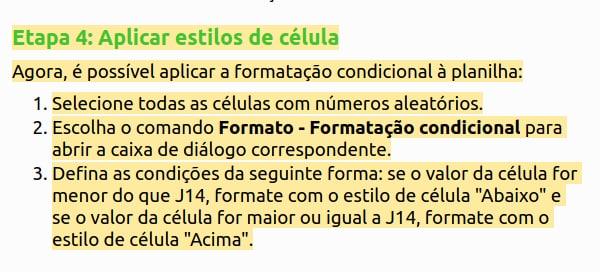
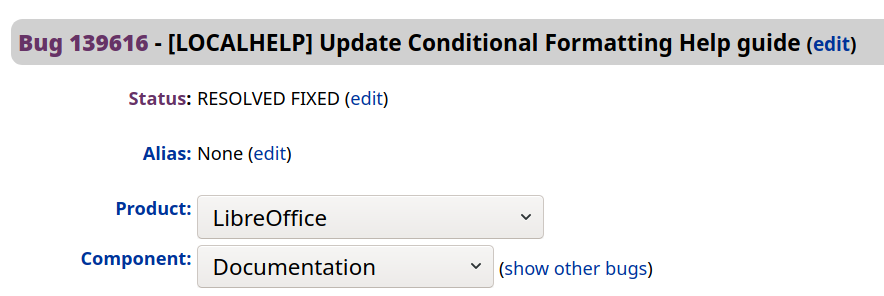
Mrs. Vera Cavalcante (@veracape), from Brazil, a long-time contributor for the Portuguese documentation on LibreOffice, was reviewing the translation of the Calc Guide and double-checking the translated text, with respect to the current user interface and the Help pages. Vera noticed that the Help pages on conditional formatting were not correct any more, and reported in the Brazilian team Telegram group (Bugzilla is still very hard for non-native English speakers).

The message hit Olivier Hallot (@ohallot) from the LibreOffice documentation coordination team (and Brazilian community member), who reported the bug in LibreOffice’s Bugzilla, for later fixing. LibreOffice’s outstanding quality depends on good quality and numerous errors reports to be submitted properly, for improvements and fixing defects. There is no point leaving a bug unreported.

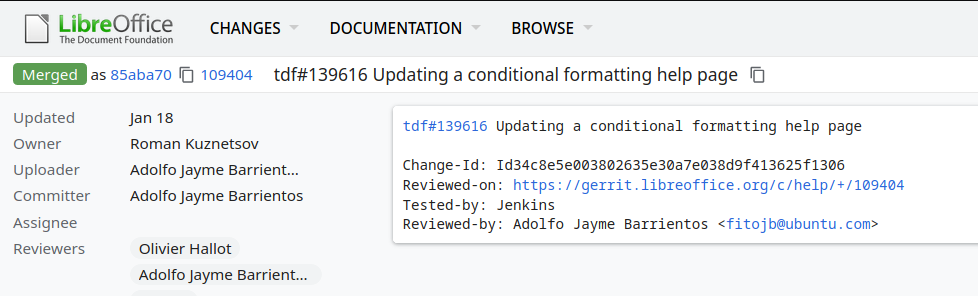
The topic was of special interest of Roman Kuznetsov (@kompilainenn) from Russia, who already wrote documentation about conditional formatting. Roman wrote the fix, and submitted a patch in Gerrit (the service that controls the code corrections in LibreOffice)…

…and Adolfo Jayme Barrientos (@fitojb) from Mexico reviewed and approved the patch for merging in the main Help code.

End result: LibreOffice’s Help page fixed!

Open Badges for top LibreOffice QA contributors

Earlier this year we announced Open Badges for contributors to LibreOffice and its various sub-projects. These are custom PNG images sent out to each recipient, containing metadata about achievements, which can be verified using an external service. Recipients can then proudly show them off, or use them as proof of activity when applying for jobs or joining other free software projects!

Today, we’re announcing Open Badges for the top QA (Quality Assurance) project contributors. These are the most active people on Bugzilla, our bug tracking tool. The winners are:

Telesto – NISZ LibreOffice Team – Mike Kaganski – Andreas Kainz – Roman Kuznetsov – Regina Henschel – Aron Budea – Seth Chaiklin – Robert Großkopf – Rizal Muttaqin – Timur – R. Green – TorrAB – Gerald Pfeifer – Kevin Suo – Jim Raykowski – Samuel Mehrbrodt – Sergio Callegari – Michael Weghorn – Ming Hua – Julien Nabet – sawakaze – Eyal Rozenberg – Thorsten Wagner – Zdeněk Crhonek – Jim Avera – Thomas Lendo – Ricky Tigg – Gabor Kelemen – Steve Fanning

Congrats to all of you! We’ve personally emailed you with the custom badge, so enjoy showing it off 🙂