Live streaming LibreOffice bug triaging – your experiences (part 1)

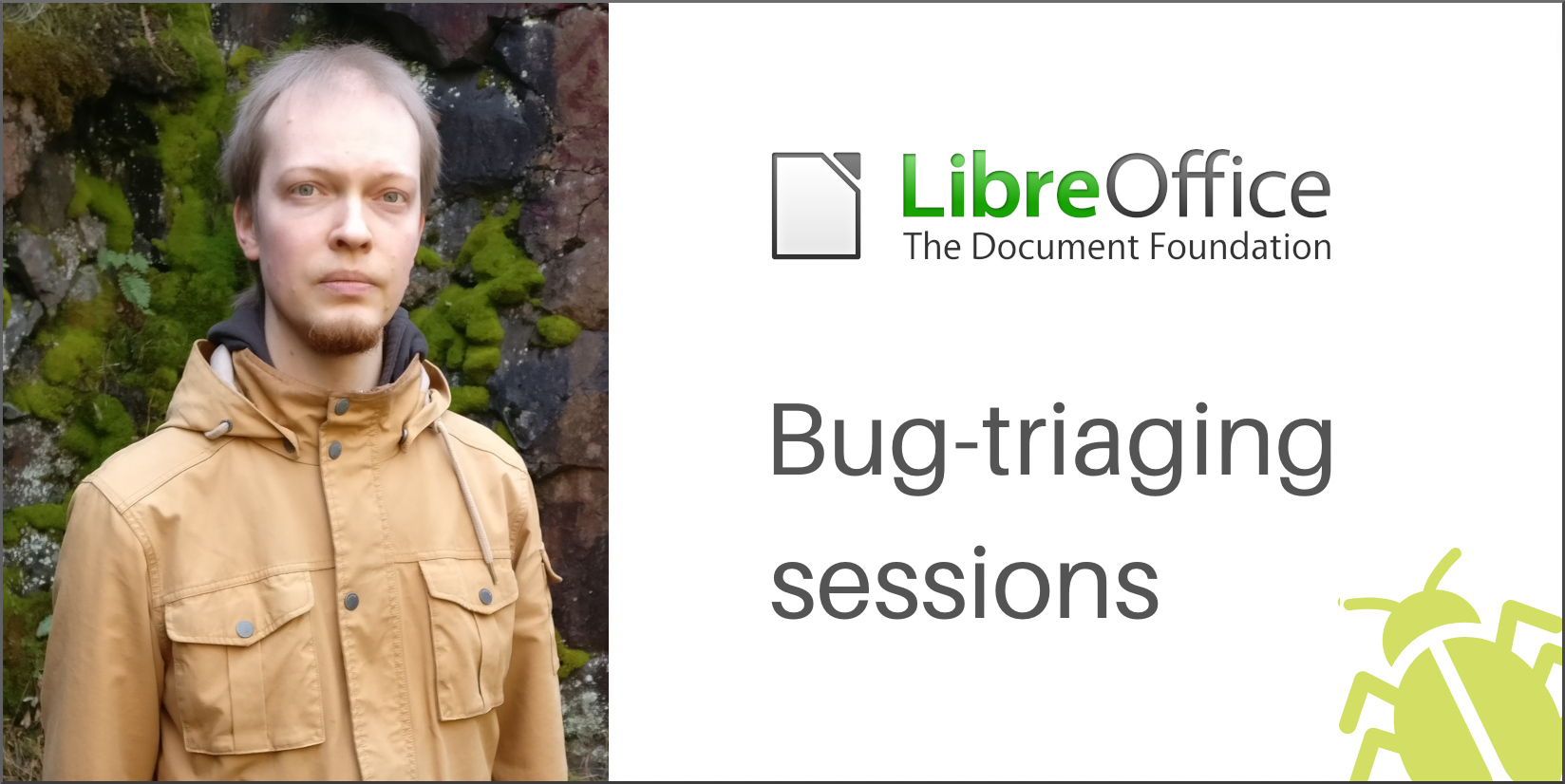
Ilmari Lauhakangas

LibreOffice’s QA (Quality Assurance) community helps to identify and fix bugs in the software. Every week, Ilmari Lauhakangas from The Document Foundation (the non-profit entity behind LibreOffice) live-streams bug triaging sessions, so that others can see how he works on bug reports, and ask him questions.

So, what do attendees think of the sessions so far? We asked some regulars – here’s what they said. First is Tammy Lawson:

I heard about the bug triaging streams after I signed up for the QA mailing list. They are an hour long, which is great, and I now understand how to take a ticket, read it, test it, research it, and triage it. I have learned different techniques on how to work with testing. It has helped in a way that I can understand how to work with a ticket. Also, I like how documentation has been provided about how to work with tickets. In addition, I like that there is an IRC chat channel to ask questions.

Next, bunk3m said:

I’ve been involved in bug reporting in open source software for some time. Until recently, I wasn’t doing more than reporting and some function testing.

Earlier this year, Ilmari asked me to bisect one of the bugs I reported. I had no idea what to do but he offered to help me learn. He spent some time giving me some direct guidance and also invited me to join the live streams to see how he and others test and verify bugs. It has been fascinating to see and learn. I feel good that I’ve been able to support an open source project that I think is valuable for everyone.

I’m a business person so I didn’t know much about testing software. I’ve never been involved at this level of detail and now have an overview and appreciation of how software is built and tested. I’ve also learned to use Git for testing purposes. I have a personal goal in 2023 to learn more about software testing and use of git so I’m excited to be helping make LibreOffice a better product while I learned a new skill.

There are many people involved in the testing. Volunteers and those working for the Document Foundation like Ilmari, Xisco and Stéphane, are very helpful and patient with my limited knowledge. They are eager to help me learn so I can be more productive. They are willing to spend some time to explain the how and why. I feel this has helped me to be able to contribute to the project.

Many thanks to Tammy and bunk3m for their contributions! Stay tuned for more feedback from the bug triaging streams soon. And in the meantime, you can join the streams – check the mailing list to see when the next one is taking place!
Welcome Stéphane Guillou, new QA Analyst for LibreOffice

Photo portrait of Stéphane Guillou

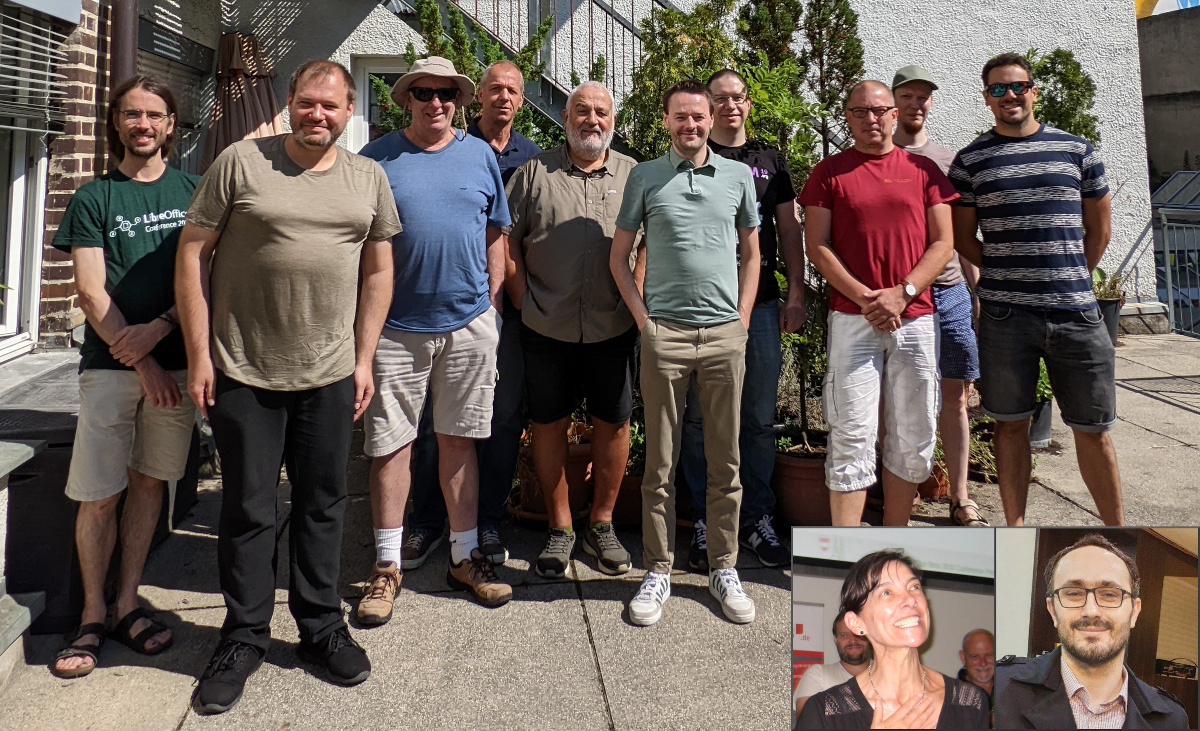
We have a new team member at The Document Foundation, the non-profit entity behind LibreOffice! (That means we’re now 13 people.) Stéphane Guillou joins us as a Quality Assurance Analyst – so let’s get to know him better:

Tell us a bit about yourself!

I am from France, with roots also in Peru, but lived for the last 10 years in Australia with my awesome little family before coming back to France. We now live in Alsace, close to the forest in the Vosges mountains.

I studied plants, ecology and sustainability before working in agricultural research. I am still very passionate about plants and the environment, but my focus has moved towards supporting researchers in their data analysis, promoting Open Science principles and offering training about FLOSS research software, which I was able to do for the last 4 years at the University of Queensland’s Library, and before that as a certified instructor of the Carpentries organisation.

I am passionate about sharing information about Open Science, and contributing data to the Commons. You can for example find me on other wonderful projects like OpenStreetMap, iNaturalist and MusicBrainz.

When I am not parenting or working, I like spending time on electronic music, amateur radio and cycling.

What’s your new role at The Document Foundation?

I am the new Quality Assurance (QA) Analyst, and a lot of my time will be spent on triaging the issues users report on Bugzilla – our bug-reporting platform. There is a lot of activity on Bugzilla, and classifying and testing the reports is fundamental for us to focus on the most pressing issues, help the work developers are doing, and keep improving the software for everyone! Part of the work will also be to analyse and summarise the wealth of data available to help us see the bigger picture and make better decisions when allocating resources.

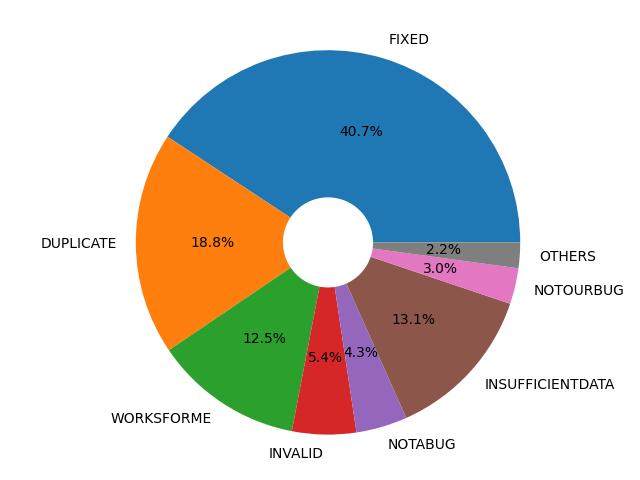
Pie chart showing the split between resolved bug statuses on Bugzilla. Four main categories are fixed (40.7%), duplicate (18.8%), insufficient data (13.1%) and works for me (12.5%).

Pie chart showing the split between resolved bug statuses on Bugzilla. Four main categories are “fixed” (40.7%), “duplicate” (18.8%), “insufficient data” (13.1%) and “works for me” (12.5%).

How did you get involved in LibreOffice, before you joined TDF?

I have used LibreOffice since it was first released in 2011, and have always liked reporting problems and helping out with the QA process in little bursts, just like I like doing with any FLOSS tool I use. I feel it’s a great way to give back to the community.

How can regular users of LibreOffice help out with the QA project?

Everyone can help our QA project by first using the software, and reporting problems when you encounter them. Have a look if the issue has been reported before, and if not, you might have found a new one! It’s important to not assume that someone has reported the issue before you. LibreOffice is a very customisable and rich office suite, so people use it in vastly different ways.

If you want to help some more, feel free to install development versions to test them, look at reports on Bugzilla to confirm issues and classify them, identify exactly when an issue arose (it’s called “bibisecting“), and share your learnings and processes with others! There is a wealth of tasks you can start on on our Wiki.

Thank you for your help building an office suite for all!

We’re really happy to have Stéphane on board! Donations from LibreOffice users help us to grow our team, maintain our infrastructure and support the communities working on LibreOffice. Support us here!

Join the LibreOffice Team as a Quality Assurance Analyst (m/f/d), 40h per week, remote

The Document Foundation (TDF) is the non-profit entity behind the world’s leading open source office suite, LibreOffice. We are truly passionate about free software, the open source culture and about bringing new companies and people with fresh ideas into our community, especially in the second decade of our project.

Quality Assurance Analyst

To improve the quality assurance process of LibreOffice, the office productivity suite for over 200 million users around the globe 🌎, we’re searching for a Quality Assurance Analyst (m/f/d) to start work as soon as possible.

The role, which is scheduled for 40 hours per week, includes among other items:

  • Help community outreach to encourage more people to join the QA team
  • Help on-boarding new QA contributors
  • Foster communication between QA and other teams, like engineering and documentation
  • Triage unconfirmed bugs that are not handled in a reasonable time
  • Categorize confirmed bugs
  • Retest old reports
  • Analyze regression bugs identified longer than a month
  • Based on bug categorization support the Board of Directors with Bugzilla metrics about possible impact of development project proposals
  • Support the Board of Directors in proper understanding of LibreOffice features that may be worth further developing by providing relevant data from Bugzilla
  • Help with informing decision-making towards improving the ODF standard and file-format interoperability in general

The role requires the following:

  • Good understanding of office suites and LibreOffice in particular from a user’s viewpoint
  • Understanding of many of the features within each component and ability to learn other features quickly
  • Understanding of Bugzilla or another bugtracking system
  • An understanding of quality assurance procedures
  • Essential understanding of Git

Bonus points if you have:

  • A firm understanding of bibisect process used in LibreOffice QA
  • Python coding and/or test automation experience
  • UX experience
  • C++ coding experience

Speaking and writing English fluently is a mandatory requirement. Another language like German, Spanish or Chinese is a bonus.

A previously established relationship within the quality assurance team as well as with other teams including development and marketing, and with the users is a plus, but it is not mandatory at the start and can be achieved during the work itself.

As always, TDF will give some preference to individuals who have previously shown a commitment to TDF, including but not limited to members of TDF. Not being a member does not exclude any applicants from consideration.

Here’s how a typical day in your new role might look like:

You start your day by looking in unconfirmed bugs. There, you read the bug description and look at the provided samples, and try to find out if the bug is reproducible or not. You try to categorize the bug and add useful information and add relevant people to the page.

You try to determine if the bug is a regression or not, and if it is, bibisect the bug and add the one who has introduced the regression.

You should be able to communicate effectively with the current QA team and also work with the new contributors and help them grow their skills where needed and encourage them to become active in different areas of the QA process. Especially for new contributors, you will introduce them not only to our community culture, but also to our variety of tools and methods including Bugzilla, bibisect and others.

Join us!

TDF welcomes applications from all suitably qualified persons regardless of their race, sex, disability, religion/belief, sexual orientation or age.

All jobs at The Document Foundation are remote jobs 🌟, where you can work from your home office or a co-working space. The work time ⌚ during the day is flexible, apart from very few fixed meetings. The role is offered as full-time, 40 hours per week. For technical reasons we are currently accepting applications only from countries where remote.com offers active payroll services.

Are you interested? Get in touch! We aim to schedule the first interview within two weeks of your application. You can also approach us anytime for an informal chat to learn about the role or in case of questions.

TDF welcomes applications from all suitably qualified persons regardless of their race, gender, disability, religion/belief, sexual orientation or age. Don’t be afraid to be different, and stay true to yourself. We like you that way!

We are looking forward to receiving your application, including information about you, when you are available for the job, and of course your financial expectations. Pointing to public repositories with your code is very helpful. Please send us an e-mail to qa.application@documentfoundation.org no later than September 1, 2022. If you haven’t received feedback by September 30, 2022, your application could not be considered.

Note: We do not accept agency resumes. Please do not forward resumes to any recruiting alias or employee.

Annual Report: LibreOffice Quality Assurance in 2021

Quality Assurance (QA) is a cornerstone of the LibreOffice project, thanks to the activity of a large number of volunteers and the feedback of many users who help in reporting bugs and regressions.

(This is part of The Document Foundation’s Annual Report for 2021 – we’ll post the full version here soon.)

In 2021, the QA team triaged thousands of bugs, bisected hundreds of regressions, and answered questions from countless bug reporters. As one of the most visible groups directly responding to end users, the QA team must be nimble and able to adapt to changes. In addition, it must deal with specific requests for help from other teams.

The QA team meets regularly on IRC on the #libreoffice-qa channel, which is the best medium for discussing bugs and regressions. The IRC channel provides an excellent opportunity to remain in close contact with team members, and to tutor new members in the art and skill of LibreOffice QA. This is bridged to the Telegram group.

During 2021, 6,804 bugs were reported by 3,022 users, which means 131 new bugs were reported every week on average.

Top 10 bug reporters

  • Telesto (571)
  • NISZ LibreOffice Team (296)
  • Regina Henschel (126)
  • Mike Kaganski (115)
  • Xisco Faulí (104)
  • Eyal Rozenberg (87)
  • Rafael Lima (66)
  • sdc.blanco (60)
  • Valek Filippov (54)
  • Colin (50)

Bug Hunting, Bibisecting

In July 2021, the QA Team organized an online Bug Hunting Session for LibreOffice 7.2. This provided the opportunity for all users, especially those with technical knowledge, to test pre-release versions and provide their feedback in the IRC channel and Telegram group. They were helped to report and confirm bugs, which led to improved stability in the final release.

Also, during 2021, the QA team performed 652 bibisects of regressions.

Top 10 Bisecters

  • Xisco Faulí (166)
  • Timur (85)
  • Aron Budea (68)
  • raal (66)
  • Buovjaga (48)
  • Telesto (46)
  • NISZ LibreOffice Team (29)
  • Justin L (23)
  • Roman Kuznetsov (23)
  • Kevin Suo (18)

Learn more about the QA project on this page, and give the team a hand!

Like what we do? Support the LibreOffice project and The Document Foundation – get involved and help our volunteers, or consider making a donation. Thank you!

Community Member Monday: Nnamani Ezinne Martina

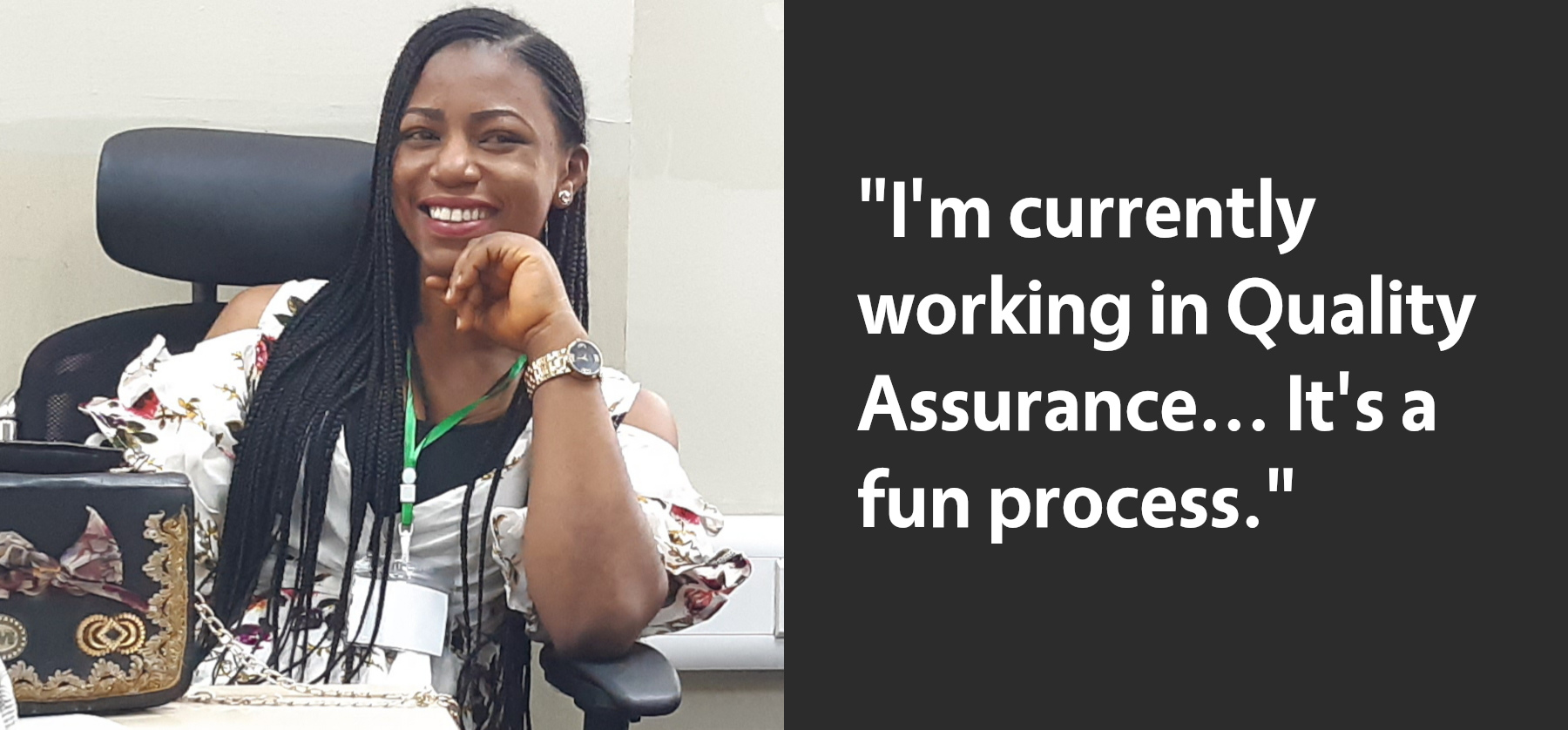
Today we’re talking to Nnamani Ezinne Martina, who helps out in LibreOffice’s Quality Assurance project and recently became a member of The Document Foundation:

Nice to meet you, Nnamani! Tell us a bit about yourself…

I was born in Awka Anambra state and I grew up there as well. But I am a native of Amagunze, a town in Nkanu-East Local Government in Enugu state. Both are in the eastern part of Nigeria.

I graduated with a bachelor’s degree in 2017 from Nnamdi Azikiwe University, Awka, Anambra state Nigeria. After my National Service year, I went into the tech space. Years later, I had the opportunity of joining Collabora Productivity and then realized how amazing Open source technology is.

I was intrigued by the strength of community contribution then I began my journey, contributing to open source technology.

What are you working on in the LibreOffice project right now?

I’m currently working in Quality Assurance. Here, I work on bug triaging; confirming newly reported bugs, retesting old bugs as well as bisecting the regressions in them. It’s a fun process. I get to tweak here and there and there and here, fishing out even the littlest bugs. It’s like moulding a tender baby to fruition. I see myself grow better every passing night!

Why did you decide to become a member of The Document Foundation?

I have always had a passion to grow better, and expand on that. And so, having contributed to TDF for a while, I realized that being a member would allow me the opportunity to interact with more community members and contribute even more.

Anything else you plan to do in the future?

I would love to have some more community members from across Africa. I plan to put the word out more, and get some more people to contribute to The Document Foundation. Thank you for the work you do.

And thanks to Nnamani for all her contributions! Learn more about LibreOffice’s QA community here.

Bug bounties: finding and fixing security holes with European Commission funds

Free and open source software (FOSS) is about much more than driving costs down, in some cases even down to zero – it’s about giving control back to users, developers and even nations. With FOSS, everyone gains the freedom to study, improve and share the software – and to use it whenever and wherever they want, without being restricted by vendor lock-in strategies.

FOSS has been widely used amongst government bodies and public services, so thanks to the coordination of their recently formed Open Source Programme Office (OSPO), the European Commission has started a series of hackathon and “bug bounty” programmes to help selected projects find (and potentially fix) security issues.

The Commission’s OSPO has set aside €200,000 to reward developers and researchers who find critical security vulnerabilities in free software projects (such as LibreOffice and Mastodon).

Rewards go from €250 up to €5000 for security bug disclosures, with 20% added on top if the researchers provide also a fix for the bug.

This will surely help to further improve the security and reliability of FOSS tools, benefiting everyone from individual users to larger governmental and public bodies, and to make FOSS known to those that haven’t yet discovered how much it has to offer.

Paolo Vecchi, from The Document Foundation’s Board of Directors, which liaised with the European Commission’s OSPO, adds:

It is a real pleasure to see that the European Commission is following up their open source software strategy 2020-2023 with concrete actions. The creation of the OSPO, which is led by very knowledgeable and passionate people, was the first step required to then progress into other programmes, like this bug bounty, which will provide the needed support for an open source ecosystem that has become the foundation of all the platforms and software we use.

The Document Foundation and our community are grateful for the opportunity that has been provided with to make LibreOffice even more secure and ready to potentially become the preferred open source office suite also within European institutions.

We encourage all developers to head to the bug bounty page and help us to make open source even more secure for all.

To learn more about security in LibreOffice, see here. We’ll post more updates about this programme on this blog and our social media – stay tuned!