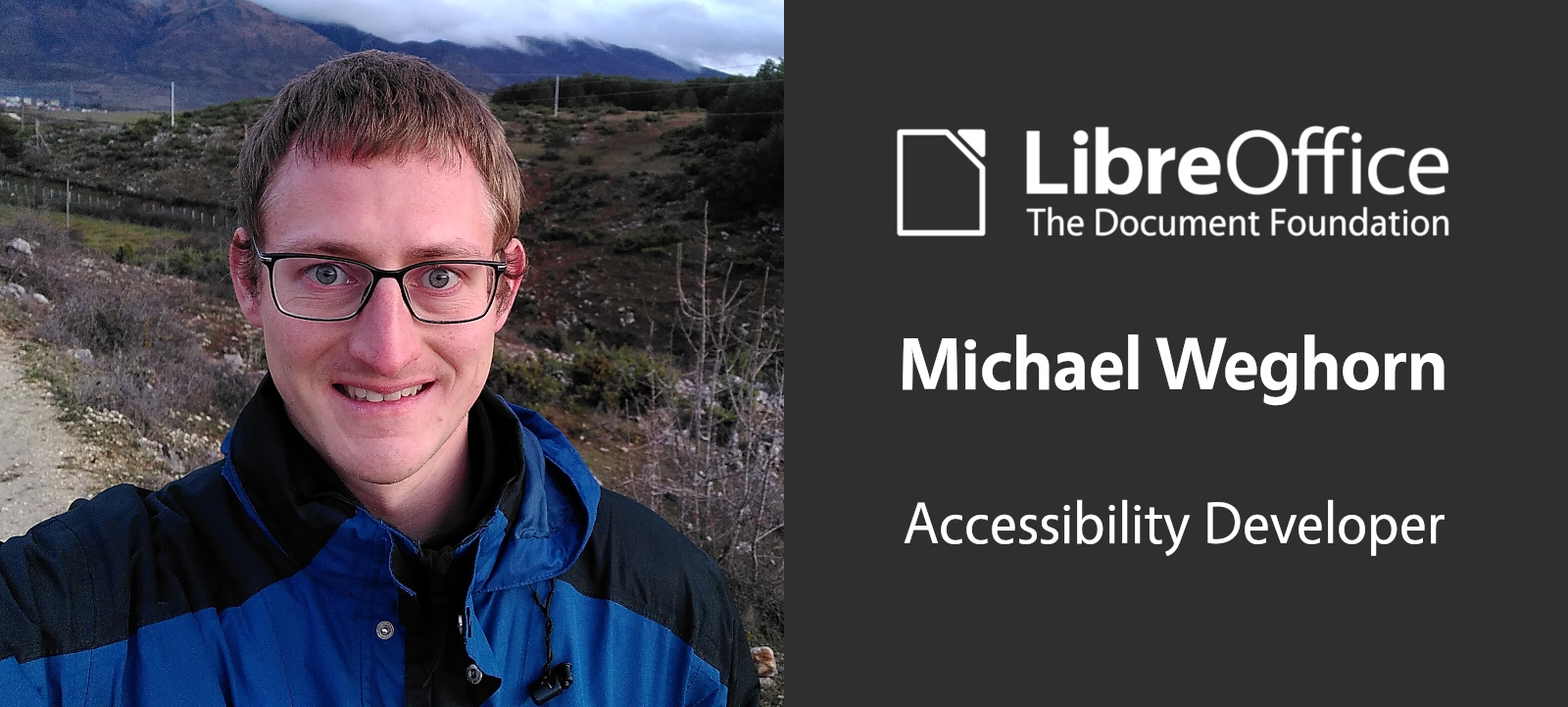
Welcome Michael Weghorn, new Developer at TDF

Michael Weghorn

The Document Foundation (TDF) is the non-profit entity behind LibreOffice, providing infrastructure and support for the community that makes the suite. Recently, TDF decided to expand its small team with two new Developers – the first (Khaled Hosny) focusing on “complex” text layout languages. Today, we welcome our second Developer, Michael Weghorn, who will initially focus on accessibility improvements. Let’s hear from him…


Tell us a bit about yourself!

I am from Germany, and have been living in Munich since moving here for my studies in computer science about 12 years ago.

I am a free and open source software enthusiast.

Before coming to TDF, I was working for the City (administration) of Munich, first being part of their Linux client team – and since 2018 with the main focus on LibreOffice development. I am also a member of the LibreOffice Engineering Steering Committee (ESC).

Besides my involvement in LibreOffice, I have also contributed a few changes to other open source projects – mostly fixes for issues that I ran into myself as a user. The possibility to do this is certainly one of the many benefits of open source software.

Besides being an open source software developer, I’m involved in a Christian church and like meeting friends, sports and reading.

You’ve been in the LibreOffice project for a while – what have you been working on so far?

I have been involved in the LibreOffice project since 2014, mostly in QA (Quality Assurance) and development.

The first code change I was working on had to do with the selection of the Java runtime on LibreOffice startup, and I was also translating German comments in the source code back then.

Since then, I have mostly been working on fixing bugs in different areas of LibreOffice. The main areas that I have been focusing on are Qt/KDE integration, the Android version and accessibility.

What’s your new role at TDF, and what will you be working on?

I’m joining TDF as a LibreOffice Developer, focusing on accessibility.

Accessibility is quite a broad topic, ranging from the accessibility of LibreOffice’s user interface to the accessibility of the documents that the program creates.

From what I have seen so far, LibreOffice has a good basis regarding accessibility. It’s also great to see recent contributions by others to further improve accessibility (eg improvements for document accessibility and PDF/UA export, the accessibility checker and accessibility on macOS), but there are certainly also areas that will benefit from getting some more attention.

My initial focus will probably be fixing problems encountered in the user interface when using LibreOffice with a screen reader.

From my experience so far, this often not only involves making changes to LibreOffice itself, but also to the corresponding screen reader or elsewhere in the accessibility software stack. Therefore, cooperation with other projects is also essential.

How can all users of LibreOffice help out?

There are different ways to get involved – for example:

  • Join the LibreOffice accessibility mailing list
  • Report accessibility issues in the Bugzilla issue tracker and set the “accessibility” keyword for accessibility-related bugs, so developers become aware and can fix them
  • Confirm already existing bug reports and add more helpful information to them
  • Test development versions of LibreOffice with assistive technology (and report bugs), so issues can be fixed before a new version is released
  • If you’re a developer: help with fixing reported bugs

There’s also an accessibility page in the wiki, which contains some more information and will be further updated in the future.


Great to have Michael on board! 😊 Follow this blog and our Mastodon and Twitter accounts for updates on his work – plus more news from the LibreOffice community.

Welcome Khaled Hosny, new Developer at TDF

Khaled Hosny

The Document Foundation (TDF) is the non-profit entity behind LibreOffice, providing infrastructure and support for the community that makes the suite. Recently, TDF decided to expand its small team with a new Developer, focusing on improving LibreOffice’s language support. This will help to make the software more accessible to hundreds of millions of people around the world.

The new Developer is Khaled Hosny, so let’s hear from him…


Tell us a bit about yourself!

I’m a software developer based in Cairo, Egypt. My area of expertise is centered around written language; fonts, text layout in general and so-called “complex” text layout in particular (I don’t like how some text layout is signaled out as being complex – all text layout is complex, but some complexity is obvious right away while others are more subtle), PDF, and so on.

I have been involved with FOSS since 2006. I started with doing Arabic localization, then Arabic fonts, and a few years later I started programming to fix Arabic bugs (I think my first patch was to fix a right-to-left UI issue for Sugar, the desktop environment for the OLPC XO laptop, if anyone still remembers it). I contributed and continue to contribute to many FOSS projects – Firefox, GNOME, HarfBuzz, XeTeX, LuaTeX, to name some.

I got involved with LibreOffice in early 2011, and I have been lurking around since then.

I’m also a type designer and font engineer. I have designed and built a few Arabic and math fonts (I can’t read much of the math notation – I was taught math in Arabic notation and I hardly remember any of that either, but I’m fascinated by the 2D nature of math typesetting).

Funnily enough, I had no formal training in any of this, I actually graduated from medical school and worked as a doctor for few years before quitting to focus on a software career (I was already deep into localization and fonts while still at medical school).

Improved glyph positioning of artificial italic text in LibreOffice 7.5

Improved glyph positioning of artificial italic text, especially combining marks – implemented by Khaled in LibreOffice 7.5


What’s your new role at TDF?

I’m joining the team as a LibreOffice developer focusing on areas of right-to-left and the aforementioned so-called “complex” text layout. These are some of the underserved areas of LibreOffice development while disproportionately affecting a very large group of (existing and potential) users.

I hope my role at TDF will help to widen the LibreOffice community, attract more people to it, and make it accessible to more users.

What will you be working on?

I will be fixing bugs and implementing features related to right-to-left text layout and user interface issues which affect languages like Arabic, Hebrew, Persian, and Urdu, as well as text layout issues involving writing systems that require more involved text layout, like Arabic script, and the Indic group of scripts.

I will be also working on fonts, PDF export (text extraction from PDF is major pain point for many scripts), and related areas.

I’m also looking forward to mentoring new developers interested in working on any of these areas.

Do you have any tips for new developers, who’re eager to get involved with the LibreOffice codebase?

LibreOffice is a large code base and can be overwhelming, so try to read any existing documentation as much as possible, don’t be afraid to ask for help, and in general be patient.


We’re really happy to have Khaled on board! Follow this blog and our Mastodon and Twitter accounts for updates on his work – plus more news from the LibreOffice community.

Outreachy and LibreOffice installer improvements: Rachael Odetayo

Rachael Odetayo

Last week, we talked to Ximena Alcaman who’s working on LibreOffice installer improvements as part of the Outreachy programme. Outreachy provides internships to people subject to systemic bias and impacted by underrepresentation in the technical industry where they are living.

Rachael Odetayo is also working on the the LibreOffice installer, and is being mentored by Marina Latini and Jussi Pakkanen, with support from sponsors SUSE and The Document Foundation. Let’s learn more about Rachael…

Tell us a bit about yourself!

My name is Rachael Odetayo and I’m from Nigeria. I studied Mass Communication at the National Open University of Nigeria. Currently, I am proud to be participating in the Outreachy internship programme. In my free time, I enjoy reading, coding, cooking, and sharing my knowledge of the Bible with others.

How did you get involved in Outreachy?

I learned about Outreachy while searching for an opportunity to hone my skills and hopefully secure a tech job. Then an alum shared the application link in a group channel. He shared his experience with Outreachy, and how the programme helped him develop his skills and eventually landed him a job in tech. I was immediately drawn to the idea behind the Outreachy internship and the support it offered to those who might have trouble breaking into the tech industry.

I applied to Outreachy, and after a rigorous selection process, I was accepted as an intern with LibreOffice.

What are you working on right now?

I am currently working on improving the LibreOffice installer for Windows. My work focuses on streamlining the installation process, making it easier and more user-friendly for Windows users. This includes improving the user interface, fixing bugs, and enhancing the overall performance of the installer.

I am excited about this project as it will have a significant impact on the experience of LibreOffice users on Windows. My goal is to simplify and improve the installation process for Windows users, but I can’t do it alone. It would be great if others could get involved and help out with this project.

Mockup installer screenshot

How can others help out?

They can assist in various ways. Windows users, for instance, can assist by testing the new installer and offering feedback on any problems or improvement they would like to see.
Software developers can assist by contributing code to fix bugs, enhance performance, or provide new functionality.

Additionally, those who are unable to contribute code or time can still aid the project by making a donation. Their assistance will go a long way in helping us achieve our goal of improving the LibreOffice installer for Windows.

After this experience, what is your opinion of Equity, Diversity and Inclusion? Did the Outreachy program give you a new perspective or is there anything you would like to highlight?

In my opinion, equity, diversity, and inclusion are extremely important in the tech industry and in society as a whole. When an environment is diverse and inclusive, problems are better solved and decisions are made faster, and as well, the needs and experiences of different people are better understood.

Did your opinion of open source change after this experience? How?

My experience with Outreachy strengthened my understanding of the value of open source in the tech industry. As an Outreachy intern, I had the opportunity to contribute to LibreOffice, which deepened my understanding of the potential of open source. I personally witnessed how people from various backgrounds and locations can come together to create something more impressive than any one of them could have done individually.

Also because open source is collaborative in nature, and allows people to freely access and modify source code, that makes it an effective avenue for driving progress and innovation in the tech industry.

Outreachy logo

Is there any contribution, experience, anecdote you would like to share from your time in the Outreachy program? Would you recommend the programme?

Yes. At the beginning of the internship, I found myself struggling to understand the technical terms my mentors use during our daily standup meetings. I was trying my best to keep up and understand what was going on, but it was like they were speaking a completely different language. One day after a particularly confusing meeting, I finally had the courage to mention it to one of my mentors (Marina). I asked if she could write a summary of our conversation in the group channel so I could review and make sense of it all. To my delight, she not only agreed but was also understanding and supportive.

From that day on, I was able to follow along. And I learned the importance of communication and asking for help. I’m grateful to have Jussi and Marina as mentors and I sincerely appreciate their hard work and effort to ensure we have a clear understanding of our tasks.

I would recommend the Outreachy program to individuals who are underrepresented in tech, including but not limited to women, people of color, people with disabilities etc. who are interested in pursuing a career in tech, and are eligible to participate in the programme.

Follow Rachael on her blog and Twitter. And stay tuned for updates on their work!

LibreOffice installer improvements coming, thanks to Ximena Alcaman, Rachael Odetayo and Outreachy

Ximena Alcaman

Today we’re talking to Ximena Alcaman, who is working on LibreOffice installer improvements as part of the Outreachy programme. Outreachy provides internships to people subject to systemic bias and impacted by underrepresentation in the technical industry where they are living.

Ximena is working alongside Rachael Odetayo on the LibreOffice installer, and is being mentored by Marina Latini and Jussi Pakkanen, with support from sponsors SUSE and The Document Foundation. Let’s learn more…

To start with, tell us a bit about yourself!

Hi! My name is Ximena but most people call me Xime and I’m from Chile. I have a degree in Business Administration, but I recently switched to the tech world to become a software developer. In my free time, I enjoy coding and trying out new technologies. I also like to learn new languages and travel to new places. When I’m not doing all that, you can probably find me in the garden or in the kitchen baking something (hopefully) delicious!

How did you get involved in Outreachy?

I came across a post about the Outreachy internships and it immediately caught my attention. At first, I wasn’t very familiar with open-source, but after doing some research, I soon realized that it was the perfect opportunity for me to gain experience and build my tech career through this internship. On top of that, the chance to be a part of a fantastic community like LibreOffice and to contribute to a product used by millions is truly exciting.

What are you working on in LibreOffice right now?

The Windows installer is a crucial component of the LibreOffice project, as it’s the primary way in which millions of users can install and use the office suite on their computers.

However, the current installer for LibreOffice is based on old code, which makes it difficult to maintain.

Our project aims to address this issue by upgrading to a more modern installer, which will make maintenance a lot easier. We’re using tools like the WiX Toolset and MSI Creator to rework the LibreOffice Windows installer. Our goal is to move away from an outdated infrastructure and upgrade to a more modern one.

Mockup installer screenshot

How can others help out with the things you’re working on?

We’re in the early stages of this project and we could definitely use help from the community. For example, we’re currently trying to localize the right pipeline for the installer and gather the necessary information to build a proper JSON file. However, gathering all the necessary information within the large LibreOffice codebase can be quite difficult. So, if community members can help us to locate the necessary files, it would be greatly appreciated! We would also welcome any testing or bug reports as we continue working on the project.

After this experience, what is your opinion of Equity, Diversity and Inclusion? Did the Outreachy program give you a new perspective or is there anything you would like to highlight?

After this, my belief in the importance of equity, diversity and inclusion has only been reinforced. The Outreachy program has been an incredible experience as it has provided me with the opportunity to work alongside people from different backgrounds and experiences. Outreachy allowed me to learn and grow in a welcoming and supportive environment, which I think is something crucial for underrepresented groups in the tech industry. I believe that having a diverse and inclusive environment is essential for innovation and creativity, and also for creating a more equitable society.

Outreachy logo

Did your opinion of open source change after this experience? How?

Before this experience, I had limited knowledge and understanding of open source, so I had the idea that it was only for advanced students from tech careers or experienced developers. However, my participation in the program has changed my perspective. Outreachy offers opportunities for people of all skill levels and backgrounds, so this made me feel more welcome and included as a newcomer in open source communities.

Is there any contribution, experience, anecdote you would like to share from your time in the Outreachy programme? Would you recommend the program?

When the contribution period started, I had doubts about my programming skills and almost waited for the next cohort to apply again. It took me about two weeks to finally contact my current mentors and I also contacted Ilmari, who kindly provided guidance and support throughout that period. I highly recommend the Outreachy programme for anyone interested in open source, as it provides valuable opportunities to get involved in open source communities and gain experience.

Follow Ximena on WordPress and Twitter. And stay tuned for our next interview, with Rachael Odetayo!

Welcome Juan José González, TDF’s new Web Technology Engineer!

Photo of Juan José

Here at The Document Foundation, the non-profit entity behind the LibreOffice community, we have many websites and services: this blog, the LibreOffice website, our wiki, the extensions website, Weblate and many more.

To improve them and keep them up-to-date, TDF now has a new Web Technology Engineer! So let’s get to know him…

Tell us a bit about yourself!

My name is Juan José and I am from México. I moved from my beautiful hometown to Guadalajara nearly thirteen years ago looking for a good job as a developer and I fell in love with the city. In Guadalajara I met my wife, my friends and many free software enthusiasts.

Since the first day, I realized that there were local communities around free software so I like to keep in contact with them, and contribute with technical talks about various topics.

I studied a masters degree in Computer Science, where I got interested in the semantic web and the automated reasoning discipline behind it. I’ve been working as a web developer for more than a decade now.

I am so happy that I found this position at The Document Foundation – I am determined to contribute as much as I can to improve our existing web sites and web apps that support the foundation’s efforts.

Were you using LibreOffice before you joined TDF?

I used LibreOffice to write the final project of my bachelor degree, I can say that LibreOffice was the first application for what I consider myself a power user (that was 10 years ago – but I have lost most of my talents sadly). I also remember writing an essay about the importance of open document formats, and my references included many people from the LibreOffice community.

This role marks my first time actively contributing to LibreOffice – so I hope I can help the project significantly.

ODF logo

What’s your new role at TDF?

I joined the Foundation as the new Web Technology Engineer, where I will dedicate my time to support, fix and improve the experience of our websites.

I believe it’s a great role since the web has become the default entry point to all people that want to interact with LibreOffice, from being an end-user, to collaborate on the software’s development. I have adopted the mission to facilitate this interaction.

What are you working on?

I am starting on the extensions site – it’s the place where you can get templates and extensions for LibreOffice. I am replying to reported issues by improving the web experience. I also want to keep an eye on the experience of the end user, taking care of both ends: extension developers and the users.

We’re really happy to have Juan José on board! LibreOffice users and community members can give him feedback and help via the website mailing list. Looking forward to seeing all the great things to come 😊

Community Member Monday: Afshin Falatooni

Afshin Falatooni

Today we’re talking to Afshin Falatooni, from the Persian-speaking LibreOffice community!

Tell us a bit about yourself…

I am from Iran, the city of Mashhad. I speak Persian (Farsi), and I love to contribute to LibreOffice! This January, I have just turned 46 years old. My favorite hobby is climbing, and if I have time, I usually go to the mountains on Fridays, which is the weekend holiday in our country.

I work as a book editor, typesetter and layout designer. I became interested in the LibreOffice project because of my job. Many editors and typesetters use Microsoft Word more than any other program, and I was one of them before I got acquainted with LibreOffice. But, now that I know the advantages of LibreOffice as a free software project, I use Writer as much as the norms of the publishing market allows me.

What are you working on in the LibreOffice project right now?

I write regularly on the Persian LibreOffice blog. My goal is to provide educational contents around LibreOffice there. Additionally, if I find a bug that is either directly or indirectly related to Persian language, in addition to reporting it to Bugzilla with the necessary screenshots and documents, I post it to the blog to make others aware of the important bugs.

We also have a Persian-speaking group in Telegram, where I answer questions as far as I can, alongside the other admin of the group.

Many years ago, I added a large collection of Persian words to OpenOffice.org project, which were likely to be written incorrectly. Using that word list, the Persian language was added as part of the OpenOffice.org auto-correction feature. The word bank continues to exist in LibreOffice, and is useful for the Persian speaking users.

Many thanks to Afshin for all his contributions 😊 All LibreOffice users are welcome to build up our native-language communities and reach more people around the world!