Help keep the Calc guide up to date

The Documentation Team Meeting will

take place in May 10th at 17:00 CET

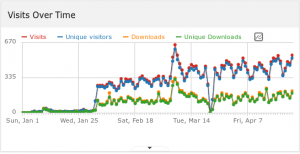
The Calc module of LibreOffice is one of its most complex and extensive applications and one of the most in-demand for documentation, as our measurements of the documentation website clearly show.

Documentation website daily visits over time, since January 1st, 2017.

The latest published Calc Guide is connected to LibreOffice release 4.1. The gap between this guide and the most recent Calc developments has widen and the current publication is outdated. (more…)

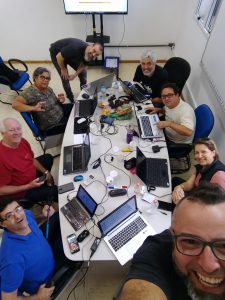
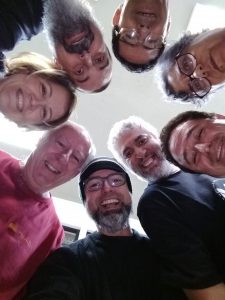
Meet the Brazilian LibreOffice 5.3 team

We can assure readers of this blog that LibreOffice 5.3 in Brazilian Portuguese did not simply sprout from the last tropical rainfall. It is the product of a team of volunteers working to make the best free office suite in Portuguese a reality.

Following the experience gained by translating the Getting Started with LibreOffice 5.0 guide, the team began to translate the Help Contents of LibreOffice 5.3 in December 2016. This task involved translating 18,000 words on our Pootle server in two months, due to all the improvements, updates and corrections that went in the software since version 5.2. The work was split into smaller tasks under the supervision of Olivier Hallot, translator leader since 2007 (during the OpenOffice.org days). The LibreOffice 5.3 user interface translation was handled by Olivier in that period.

So, the Brazilian community and the Brazilian users say thanks to Chrystina Pelizer, Túlio Macedo, Raul Pacheco da Silva and Douglas Vigliazi for the new LibreOffice 5.3 and Help system in Brazilian Portuguese.

Chrystina Pelizer “It was like a challenge for me: to actively take part in a collaborative, international software project. Learning and using the tools and techniques that volunteers use to translate the software made me feel more important and met my expectations, because they greatly reduce the effort and we get results very quickly. Also, I am very happy to be part of a project team.” Chrystina Pelizer (Florianópolis – SC)
Raul Pacheco da Silva “I always liked to be part of the LibreOffice community when my professional activities let me do so. Specifically, I like to be part of the translation projects of the software and the documentation. I use all the resources I can to fulfil my duties within the team and I don’t like to miss our weekly team call.” – Raul Pacheco da Silva (Suzano – SP)
Douglas Vigliazi “I took advantage of the fact that my professional duties are related to LibreOffice, and for me, taking part in the LibreOffice project is an opportunity to develop my professional skills, including at an international level. The translation project is one of the opportunities to contribute to the community.” – Douglas Vigliazi (Santos – SP)
Túlio Macedo “I already had translation experience with the Fedora project in Brazilian Portuguese, and that helped me a lot with using the LibreOffice toolset. The translation helped me to get to know LibreOffice in depth, in order to understand the context of the translation I was doing. I also liked very much being part of a team.” – Túlio Macedo (Brasília – DF)
Olivier Hallot “After years of personal commitment to keeping the Brazilian LibreOffice fully translated and with quality, it was a great satisfaction to assemble a team that will be able to keep the project alive by themselves, ensuring part of the translation effort of this wonderful software.” – Olivier Hallot (Rio de Janeiro – RJ)

A big hooray for the team! Click here to discover Native Language Projects in your area

Announcing the Getting Started with LibreOffice 5.2 Guide for Immediate Download

Berlin, March 6, 2017 – The Document Foundation’s Documentation Team announces the immediate availability of the new Getting Started with LibreOffice guide version 5.2. The guide was updated to include the developments of LibreOffice 5.2 and previous releases.

The Getting Started guide is an introductory text for end users on using the LibreOffice office suite. It is written for individuals as well as organizations that deploy LibreOffice as their preferred office suite tool. The text allows users to get familiar with the features and resources of LibreOffice and shorten the time to become productive in office document edition.

The guide is written in LibreOffice Writer in Open Document Format (ODF). The team worked to not only update the contents but also to clean the formatting used in the text with a double objective: One is to make the text suitable for computer aided translation (CAT) tools and the other is to generate an online version (XHTML) of the guide.

The documents composing the Guide were formatted using styles only, avoiding direct formatting that has impact on CAT tools and on HTML export. For HTML export, the underneath template of the documents was adapted to handle the unmatched formatting properties between ODT and XHTML. At the end, a unique content source was able to produce the guide in ODT, PDF and XHTML formats.

The Getting Started with LibreOffice guide, its PDF and ODT version can be downloaded or read online by navigating to the page http://documentation.libreoffice.org. The online version of the guide can be accessed through http://documentation.libreoffice.org/en/english-documentation/getting-started-guide/read-online-5-2/

About the Documentation team

The Documentation team is in charge to develop, modernize, update and enhance all form of documentation related to LibreOffice in all languages supported by LibreOffice. It includes the authoring of LibreOffice guides for all modules, the Help system modernization and contents update, and to offer ways and means for the community to contribute to the LibreOffice project. Communities interested in contributing or translating contents can get it touch with the team by sending an e-mail to documentation at libreoffice dot org

Advent Resource #10: ODF Guide for Migrations to LibreOffice

rio-grande-os-implementation-guideODF Guide, a reference document for open standards implementation” (PDF) has been published in July 2015 by Governo do Estado do Rio Grande do Sul, General Department, Department of Information Technology and Telecommunications.

The 70 page document has been edited by Gustavo Buzzati Pacheco, a long time member of the Brasilian community, and now a member of TDF Membership Committee.

After a lengthy introduction about LibreOffice, the book focuses on three key aspects of a migration: planning, execution and support. At the end, three annexes: forms (with LibreOffice), shortcut keys and training programs.

FOSDEM Call for Papers: Open Document Editors DevRoom

fosdemFOSDEM is one of the largest gatherings of Free Software contributors in the world and happens each year in Brussels (Belgium) at the ULB Campus Solbosch. In 2017, it will be held on Saturday, February 4, and Sunday, February 5.

As usual, the Open Document Editors DevRoom will be jointly organized by Apache OpenOffice and LibreOffice, on Saturday, February 4, in room 4.401 in Building K (from 10:30AM to 6:30PM). The shared devroom gives every project in this area a chance to present ODF related developments and innovations.

We are now inviting proposals for talks about Open Document Editors or the ODF document format, on topics such as code, extensions, localization, QA, UX, tools and adoption related cases. This is a unique opportunity to show new ideas and developments to a wide technical audience.

Length of talks should be limited to a maximum of 30 minutes, as we would like to have questions after each presentation, and to fit as many presenters as possible in the schedule. Exceptions must be explicitly requested and justified. You may be assigned LESS time than you request.

All submissions have to be made in the Pentabarf event planning tool: https://penta.fosdem.org/submission/FOSDEM17.

While filing your proposal, please provide the title of your talk, a short abstract (one or two paragraphs), some information about yourself (name, bio and photo, but please do remember that your profile might be already stored at Pentabarf).

To submit your talk, click on “Create Event”, then make sure to select the “Open Document Editors” devroom as the “Track”. Otherwise, your talk will not be even considered for any devroom at all.

If you already have a Pentabarf account from a previous year, even if your talk was not accepted, please reuse it. Create an account if, and only if, you don’t have one from a previous year. If you have any issues with Pentabarf, please contact ode-devroom-manager@fosdem.org.

The deadline is Monday, December 5th, 2016. Accepted speakers will be notified by Sunday, December 11th, 2016. The DevRoom schedule will be published on the same day.

Recording Permission

The talks in the Open Document Editors DevRoom will be audio and video recorded, and possibly streamed live too.

In the “Submission notes” field, please indicate that you agree that your presentation will be licensed under the CC-BY-SA-4.0 or CC-BY-4.0 license and that you agree to have your presentation recorded. For example: “If my speech is accepted for FOSDEM, I hereby agree to license all recordings, slides, and other associated materials under the Creative Commons Attribution Share-Alike 4.0 International License. Sincerely, Name”.

LibreOffice Community Weeks: Wrapping up

LibreOffice Community Weeks

We’re already in to a new Month of LibreOffice, but in October we ran a series of Community Weeks, looking at what different teams in the LibreOffice project do, and how you can help them. So firstly, here’s a reminder of the articles, and then we’ll find out what effect they had…

Documentation

Development

Quality Assurance (QA)

Design


Feedback from the teams

So what effect did the Community Weeks have on the projects? Here’s what each team had to say:

Olivier Hallot (documentation): “The Community Weeks brought more people to the realm we are working in, and I had 3 new people showing up. One is a PhD professor from a university in India, who wrote a page on a set of Calc functions, and asked for more work. Another is a New Zealand national, involved in migrations and support, who is updating our books. I also got someone on IRC, but he did not came back. So overall, the week is positive, but we need people to return after their first contributions.”

Jan Iversen (development): “The week worked well – during the last period 15 people have got their first patch merged, and will appear by name in the 5.4 release notes. I often hear “but I cannot work full-time”, so it is important to realize that while roughly 50% of the changes are done by 20-30 people, the other 50% is done by hundreds of people making 1-10 patches a year. Every change counts and is very welcome! We arrange developers days, when a group wants help, so please contact us at mentor@documentfoundation.org if you need help.”

Xisco Fauli (QA): “There were 4-5 new users who showed up on IRC during the Bug Hunting Session, who may have joined from reading the Community Week posts. Also, we hope both posts from that week will help readers to report better bugs in the future (attaching simpler samples, adding clearer steps, and so forth).”

Heiko Tietze (design): “The campaign was interesting and encouraged readers to follow links to the Design Team Blog. Even if we didn’t get more active people showing up in the design project, comments are always welcome.”

Thanks to everyone who took part. We’ll do more Community Weeks next year, so if there’s something you want us to focus on, just let us know!