Design the LibreOffice Conference 2021 logo!

Our next LibreOffice Conference will take place from September 23-25, 2021 (and it’ll be online, due to the ongoing pandemic situation). LibreOffice developers, supporters and users from around the world will share their work, ideas and suggestions. And we’ll have fun with online social events and more!

But we need a logo. For last year’s conference, we had a competition and Kukuh Syafaat from Indonesia won with this great design, which includes the openSUSE logo too, as it was a joint conference:

So, got some ideas for this year’s conference? We’d love to see them – please send them to us! And also check out the rules below. Deadline is July 27 – please send your design to mike.saunders@documentfoundation.org with the subject line “LibreOffice Conference 2021 logo submission”. The conference organisers will select the winning logo – and the winner will receive a bonus “mystery pack” of goodies and merchandise!

Rules

  • The logo should be licensed under the Creative Commons Attribution-ShareAlike 4.0 International. Attribution will be given on the conference website and other materials, but you agree that the logo can also be used without attribution where there is limited space (eg on T-shirts and stickers).
  • The design must be original and should not include any third party materials.
  • Both monochrome and colour formats are essential for submission.
  • Submissions must be in SVG format.
  • The design should reflect the LibreOffice community.
  • The logo should avoid the following things:
    • Brand names or trademarks of any kind.
    • Illustrations that may be considered inappropriate, offensive, hateful, tortuous, defamatory, slanderous or libellous.
    • Sexually explicit or provocative images.
    • Violence or weapons.
    • Alcohol, tobacco, or drug use imagery.
    • Discrimination based on race, gender, religion, nationality, disability, sexual orientation or age.
    • Bigotry, racism, hatred or harm against groups or individuals.
    • Religious, political, or nationalist imagery.
  • The logo should follow the LibreOffice Branding Guidelines.

So, let’s see your ideas! And thanks in advance for all suggestions. We plan to announce the winner at the start of September. Stay tuned!

Community Member Monday: Manuel Frassinetti

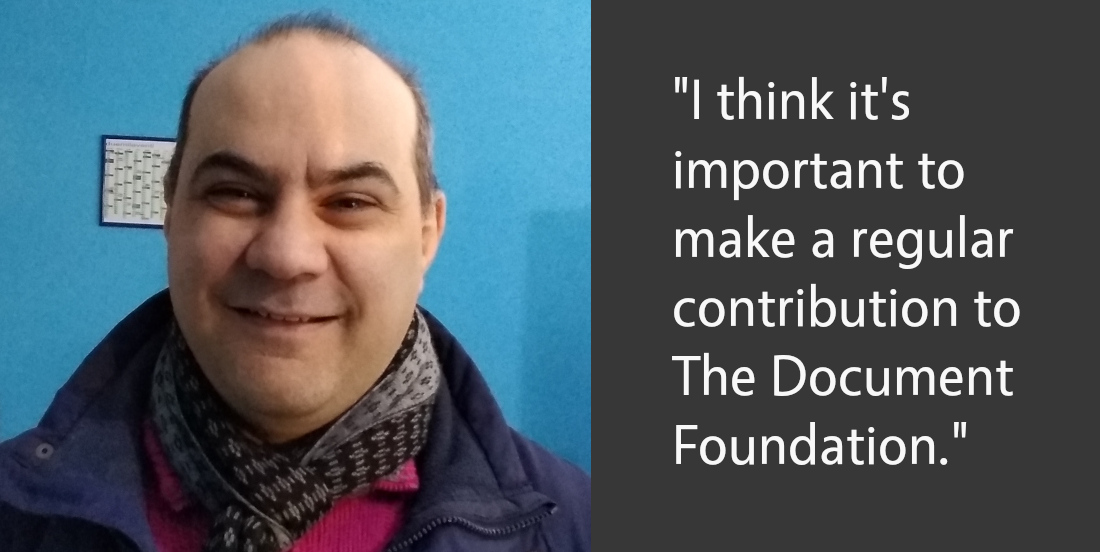
Today we’re chatting with Manuel Frassinetti from our Italian LibreOffice community, who recently became a Member of The Document Foundation, the non-profit behind LibreOffice…

Tell us a bit about yourself!

I’m from Modena, Italy and I’m still living in this city. I’m just a normal free software user – a GNU/Linux user since 2001. I moved from Debian to Ubuntu, and then returned to Debian. The first love is never forgotten! 🙂

I use free and open source software and both in private and in my work. I have a Dell series 3500 laptop, an old IBM T42 ThinkPad in private and a HP Compaq 6000 pro at work, all with Debian 10. I am very much a beginner programmer (HTML, CSS, JavaScript) and also a beginner hardware technician. For both software and hardware specializations, I have not been in the world of work since 2003, since I became a tobacconist.

I don’t like obscure software updates that last an eternity without knowing what is being updated.

What are you working on in the LibreOffice project right now?

Now I’m working on wiki pages: I translate from English to Italian.

Why did you decide to become a member of TDF?

I’m part of the Italian LibreOffice guides localization team, in particular for Base, and the wiki pages localization team from 2018. I become a TDF member in 2021 thanks to Italo Vignoli and Marina Latini. I think it’s important to make a regular contribution to the TDF project: a little every day, it’ll become a mountain one day.

Anything else you plan to do in the future?

In future, to live happy with my wife and to be healthy. About LibreOffice: I hope for better support in the database module. Right now I use Calc to do what I’d like to do with Base.

Many thanks to Manuel for his support and contributions. Everyone is welcome to discover what they can do for LibreOffice, build up skills and have fun!

Annual Report 2020: Website, blogs and social media

We use our website, blogs and social media channels to raise awareness about our work, share information and encourage new contributors to join the LibreOffice community

(This is part of The Document Foundation’s Annual Report for 2020 – the full version is here.)


Social media

In January 2020, our Twitter account had 29,340 followers; by the end of the year, we had grown this to 36,996. Our most popular tweets were for major releases, but we also tweeted customised images for “Community Member Monday” interviews with short quotes, encouraging more users to get involved with LibreOffice projects.
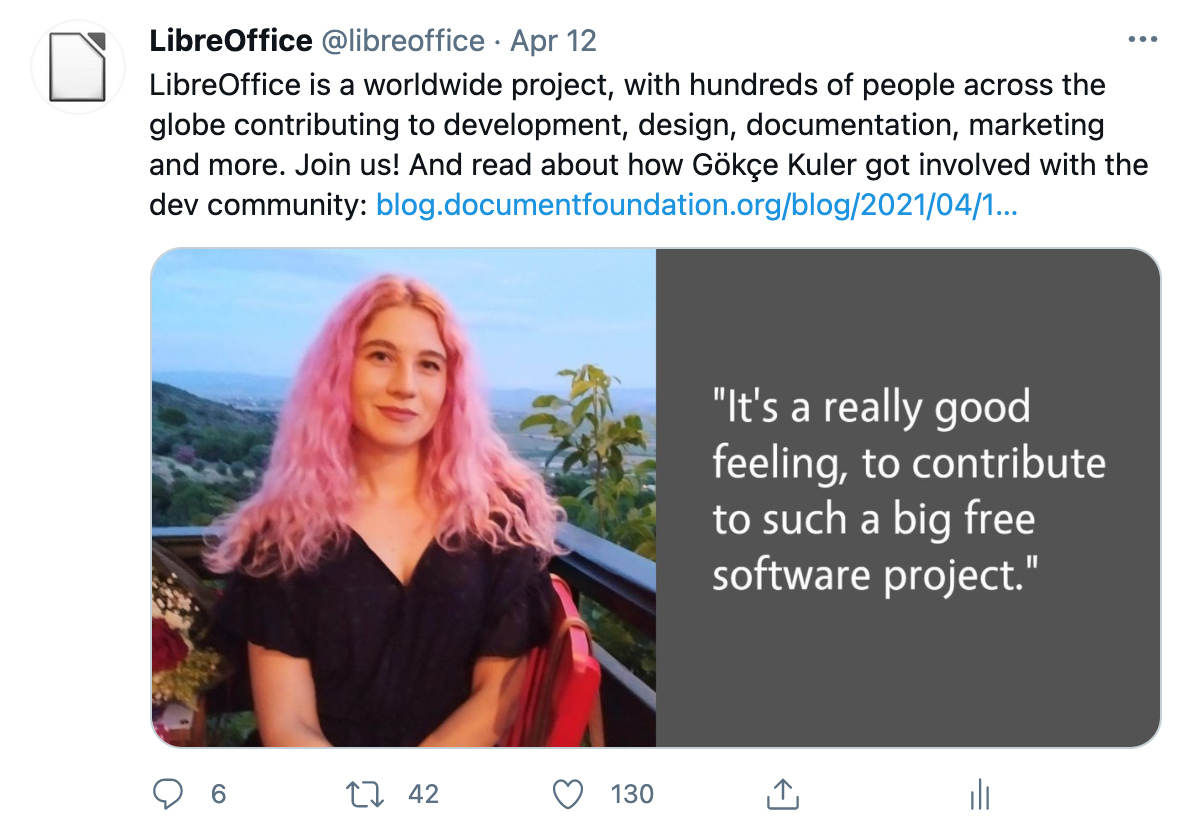
In addition, we focused not only on our own tweets, but also retweeting announcements from the LibreOffice ecosystem and community members. We liked and retweeted messages of support from end users – many of whom were surprised and thankful that a large project would show them support. To keep the content flowing, we used automatic tweeting tools to post daily LibreOffice tips, using the same content from the “Tip of the day” box in the app itself.

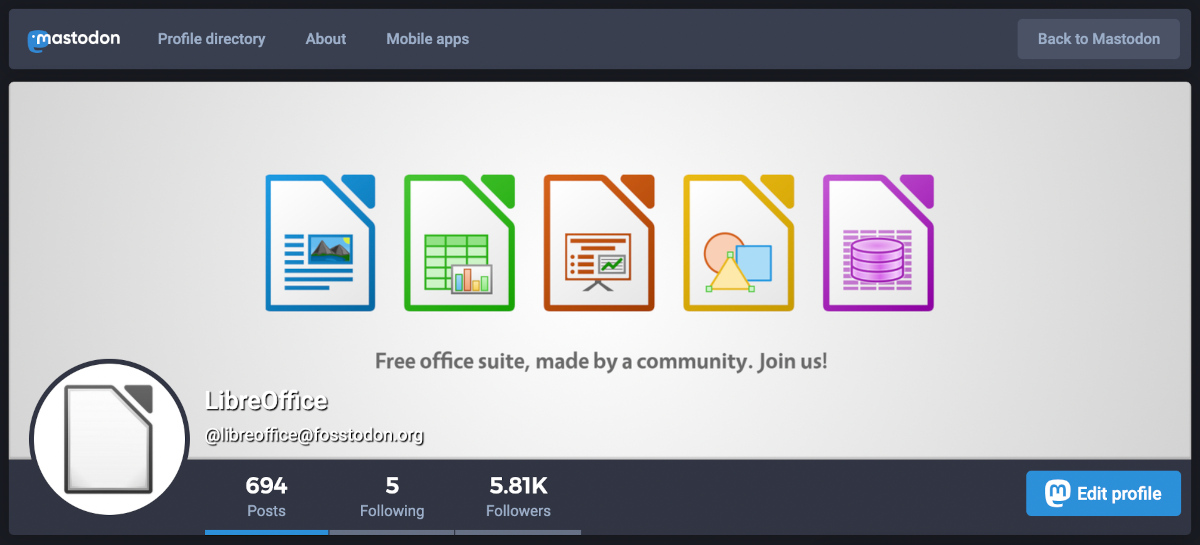
On other social media platforms, we focused on growing our account on Mastodon, a Twitter-like open source, federated and self-hosted microblogging service. In 2019 we set up https://fosstodon.org/@libreoffice and started “tooting” content, often more focused on technical users, compared to our tweets and Facebook posts. In 2020 we worked more on expanding our activities here, and from January to December, we grew our follower base from 3,297 to 4,879.
Our Facebook page growth was smaller, from 56,095 page likes to 58,516. We’ve noticed a gradual reduction in activity on Facebook over the last few years, which reflects its changing audience, and the move towards newer mobile applications. Nonetheless, Facebook still provides a good opportunity to interact with end users of LibreOffice, and every day we checked in to answer questions, get feedback, and post announcements/tips about the software.


YouTube channel

Our YouTube channel grew from 9,975 subscribers and 1,587,341 video views in January 2020 to 12,807 subscribers and 2,042,731 video views by the end of the year. The LibreOffice 7.0: New Features video (a fantastic production by the Indonesian community) amassed over 120,000 views – while the video for LibreOffice 6.4 had over 60,000. We also added some presentation videos from the LibreOffice Conference 2019.

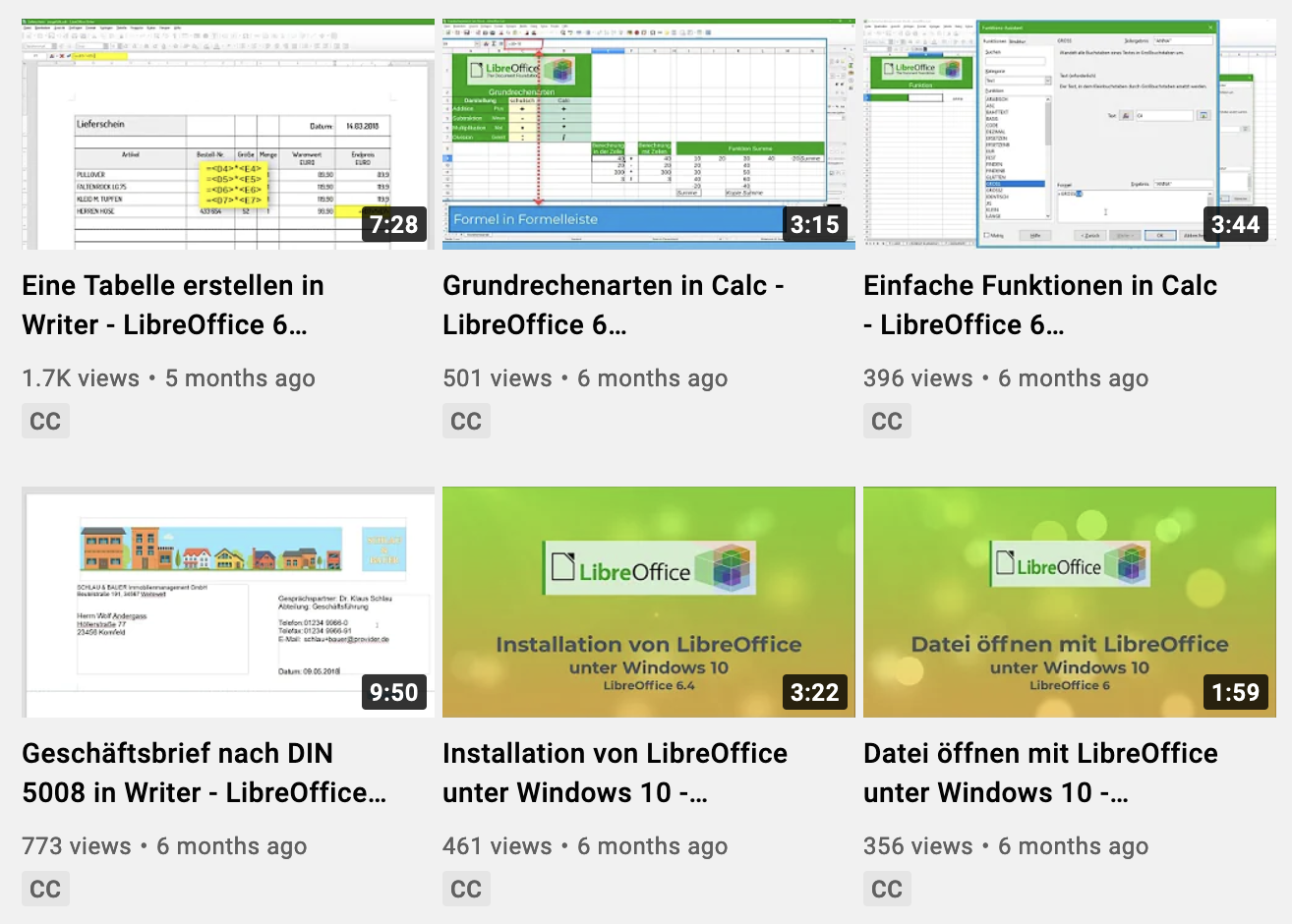
Meanwhile, our community helped out with tutorial videos – in particular Harald Berger of the German community, who produced a series of professional-looking step-by-step guides to installing and using LibreOffice.

TDF website (documentfoundation.org)

The Document Foundation’s website provides general information about the foundation (overview, statutes, code of conduct, financials and reports) and its governance (board of directors, membership committee, members, advisory board, and engineering steering committee), and about LibreOffice certification, including a list of certified developers, and professionals for migrations and trainings.

During 2020, the website was visited 146,261 times, with 196,802 page views. Continent-wise, the largest chunk of visits were from Europe (57%), followed by North America (22.8%) and Asia (12.4%). And for operating systems: the most visits were from PCs using the Windows (64.1%) operating system, followed by macOs (9.2%) and GNU/Linux (9.0%), while for browsers: Chrome had (38.4%), followed by Firefox (22.1%) and Microsoft Edge (14%).


LibreOffice website (libreoffice.org)

The LibreOffice website provides information about the office suite and the document format, the various download options, how to get help, how to contribute to the project, events where users can get to know LibreOffice, and how to make a donation to support the project and the community.

In 2020, we added a language selector to the top-right bar of the website. This was implemented in response to a demand from the native language projects: many website visitors, using languages across the world, thought that the site was only available in English.

Even though we have a dedicated page listing the native language projects and their respective websites, it’s hard to find. So we added a bar at the top, with some of the most-used languages to attract attention, and a link to a page listing all language versions of the website.

Meanwhile, work progressed on a redesign of the website. LibreOffice’s current website has been largely the same for several years, and while initially it looked fresh and modern, it needs to be updated – especially to remove clutter and complexity, and work better on mobile devices. Volunteer Christine Louie helped to push this forward, and other volunteers joined in with designs and collecting feedback from users. We hope to show the results of this work in 2021.

During 2020, the English LibreOffice website was visited 19,939,066 times, with 47,589,717 page views. Most visits were from Europe (53.4%), followed by Asia (16.7%), North America (15.8%) and South America (10.3%), from PCs using the Windows operating system (83.1%), followed by macOS (6.6%) and Linux (3.7%), and the Chrome browser (49.3%), followed by Microsoft Edge (18.4%) and Firefox (17.9%).


Blogs

TDF’s blogs (such as this one) are essential for communicating activities inside and around the project, including new releases of LibreOffice, community events and support for other free and open source initiatives. In 2020, they were used to post regular interviews with community members and provide updates from team members about documentation, marketing, QA, design and more.

Blogs were also maintained by various native language communities including Japanese, French, Spanish, German and others. Thanks to the hard work of community members, we had press releases, tips and other articles translated into many languages, and picked up by local media organisations.

These native language blogs complement the information provided by the main blog in English, and by the two blogs managed by members of the design and the quality assurance projects, which provide updates about activities for the upcoming major releases.

In 2020, the blog had 184,538 page views (146,170 unique page views). The press releases for LibreOffice 6.4 and 7.0 were the most popular posts, followed by posts for minor bugfix releases.


Like what we do? Support the LibreOffice project and The Document Foundation – get involved and help our volunteers, or consider making a donation. Thank you!

LibreOffice Documentation Team Activities in 2020

In 2020, the documentation community released many updated guidebooks, translated them into several languages, and participated in the Google Season of Docs

(This is part of The Document Foundation’s Annual Report for 2020 – the full version is here.)

New and translated guides

In January 2020, just before release of LibreOffice 6.4, the Documentation Team was proud to announce the Math Guide 6.4, an update of the previous version (4.0), updated to cover all of the innovations included in the latest release of the software. The guide was updated by Roman Kuznetsov and revised by Dave Barton from the documentation community. This was followed by the Calc Guide 6.2, a long-awaited update of the old Calc Guide 4.4.

In May, the guide to Base for LibreOffice 6.2 was released, covering, LibreOffice’s database component. It was updated by Pulkit Krishna, Dan Lewis, Jean Hollis Weber, Alain Romedenne, Jean-Pierre Ledure and Randolph Gamo. Another update in May was the Getting Started Guide 6.4 – the introductory guide for the latest LibreOffice 6.4, aimed to the general public interested to quickly get familiar with the software. It’s available as a PDF for offline reading, and ODT (OpenDocument Text) for editors and translators.

In summer, the Documentation Team announced the availability of the LibreOffice Draw Guide 6.4, the complete handbook for the drawing tool of LibreOffice. The guide was updated from the existing release (4.3) and include all the improvements developed since early 2014, when the last version of the guide was published.

Then there was the LibreOffice Calc Guide 6.4, the complete handbook for the spreadsheet tool. It was also updated from the existing release (6.2) and included all of the improvements developed in Calc since then.

In October, the Math Guide 7.0 was published – being the first guide based on LibreOffice 7.0. The effort was mostly carried by Rafael Lima and reviewed by Jean H. Weber. The new guide covers were designed by Rizal Muttaqin and Drew Jensen. The final publication was carried by Olivier Hallot. This was followed by the Calc Guide 7.0, a team effort of Steve Fanning, Gordon Bates, Kees Kriek, Annie Nguyen, Samantha Hamilton, Olivier Hallot and Jean Hollis Weber, coordinated by Felipe Viggiano.

Many guides were also translated in to various languages, thanks to our worldwide communities. For more information on their work, and the specific guides that they translated, see the “Native Language “Projects” section of this Annual Report.

Google Season of Docs

For the second year in a row, The Document Foundation was accepted as an organization in the Google Season of Docs, a programme whose goals are to give technical writers an opportunity to participate in contributing to open source projects, and to give open source projects an opportunity to engage the technical writing community.

In 2020, TDF’s documentation community offered a wide range of projects for technical writers, and extended the reach by providing projects for e-learning, mathematical documentation and code-oriented documentation.

TDF received several applications, containing important information including the technical writer’s resumés, proposals for project schedule and suggested deliverables. After a careful evaluation by the project mentors, TDF accepted the application of Ronnie Gandhi, a computer science undergraduate student enrolled at IIT Roorkee, India.

Steve Fanning, who had already worked as coordinator of the Calc Guide, served as mentor with Olivier Hallot as second mentor. Ilmari Lauhakangas and Olivier managed the administrative aspects of the project on behalf of The Document Foundation.

Ronnie worked on improving the descriptions for Calc’s functions, adding statements describing each function’s compliance with the Open Document Format for Office Applications (OpenDocument) Version 1.2 specification. Each function was also supplemented by extra use cases, illustrations and external references (where applicable).

Access the Extensive Calc Functions Description on The Document Foundation’s wiki. Thanks to Ronnie for all his work, and the mentors for assisting him on his journey.

Like what we do? Support the LibreOffice project and The Document Foundation – get involved and help our volunteers, or consider making a donation. Thank you!

Announcing the winners in the Month of LibreOffice, May 2021!

At the beginning of May, we started a new Month of LibreOffice, celebrating community contributions all across the project. We do these every six months – so how many people got sticker packs this time? Check it out…

Fantastic! This makes it the most successful Month of LibreOffice ever, slightly overtaking the results from May 2020.

Great work, everyone! Hundreds of people, all across the globe, have helped out in our projects and communities. We’re hugely thankful for your contributions – and, of course, everyone who’s listed on the wiki page can get a sticker pack, with these stickers and more:

How to claim

If you see your name (or username) on this page, get in touch! Email mike.saunders@documentfoundation.org with your name (or username) from the wiki page so that we can check, along with your postal address, and we’ll send you a bunch of stickers for your PC, laptop and other kit.

(Note: your address will only be used to post the stickers, and will be deleted immediately afterwards.) If you contributed to the project in May but you’re not on the wiki page, please let us know what you did, so that we can add you!

There is one more thing…

And we have an extra bonus: 10 contributors have also been selected at random to get an extra piece of merchandise – a LibreOffice hoodie, T-shirt, rucksack or snazzy glass mug. Here are the winners – we’ll get in touch personally with the details:

  • Michael Warner
  • Jorge Gustavo Rocha
  • Roland Kurmann
  • Astur
  • Alessandro Volturno
  • Harshita Nag
  • Érico Nogueira
  • Chris Shaw
  • Wanderer
  • MarĂ­a del Mar

Congratulations to all the winners, and a big thanks once again to everyone who took part! Your contributions keep the LibreOffice project strong. We plan to have another Month of LibreOffice in November, but everyone is welcome to see what they can do for LibreOffice at any time!

Tender to implement automated ODF filter regression testing (#202106-01)

The Document Foundation (TDF) is the charitable entity behind the world’s leading free/libre open source (FLOSS) office suite LibreOffice.

We are looking for an individual or company to implement automated ODF filter regression testing.

The default file format of LibreOffice is ODF, the Open Document Format. From time to time, there are regression bugs reported towards these filters, that involve loss of data. The respective unit tests do not provide sufficient coverage to prevent these regressions to happen.

The scope of this tender is:

  1. To implement an early warning system for such problems, to avoid them in the future and improve the overall quality of the software. As a recommended approach, we propose to use the ODFunDiff tool (https://git.libreoffice.org/odfundiff), which was developed specifically with the relevant functional and performance requirements in mind. Initial development of this tool was targetted towards LibreOffice 5.2/5.3, so updates to the code are likely necessary. Also, it may be necessary to fix some hypothetical additional non-determinism in LibreOffice, which was introduced in version 5.3
  2. Extend the crashtest report scripts (e.g. this one) with an additional report about ODF differences, which were detected during the 27,000 ODF roundtrips. This test should use last run’s ODF files as reference to compare against
  3. Raise and mention potential resource problems (like disk space) with existing infrastructure, e.g. the “crashtesting” virtual machine

Further information can be found in this presentation from a past LibreOffice Conference.

All technology standards of relevance, as well as their targeted versions for this tender should be declared or defined in the offer’s description of implementation.

A key item of the deliverables for this tender, and therefore also a decision criteria – besides qualification, references, price, and completeness of fulfilment – is extensive documentation about the approach chosen to implement the above items, covering more than just the pure implementation. We expect bidders to provide documentation on both the code and the non-code parts of this tender, e.g. methodology, structure and technical aspects. The Document Foundation will publish this under a free and open source license and make it available to the general public.

Required skills

  • Extensive knowledge of C++
  • Experience working on the LibreOffice source code

Other skills

  • English (conversationally fluent in order to coordinate and plan with members of TDF)

We use free, libre and open source (FLOSS) software for development wherever possible, and the resulting work must be licensed under the Mozilla Public License v2.0.

TDF welcomes applications from all suitably qualified persons regardless of their race, sex, disability, religion/belief, sexual orientation or age.

Bidders will get a preference for including a partner or independent developer who has not been involved in a successful tender before. For such developers, who have not yet been part of a successful tender bid, we aim on a best-effort basis, but without any guarantees whatsoever, to provide some mentoring in understanding the code base and the process in contributing to the code. We expect that time and efforts on the bidder’s side should not be part of the paid work for this tender. Please mention such need of LibreOffice development mentoring in your offer.

As always, TDF will give some preference to individuals who have previously shown a commitment to TDF, including but not limited to certified developers and/or members of TDF. Not being a member, or never having contributed before, does not exclude any applicants from consideration.

The task offered is a project-based one-off, with no immediate plans to a mid- or long-term contractual relationship. It is offered on a freelance, project basis. Individuals and companies applying can be located anywhere in the world.

When budgeting, we anticipated that this project (all items combined) to take in the region of 15 days of work. Should bidders’ assessment result in a significantly different number, please reach out to us before sending your bid, so we can clarify upfront.

TDF is looking forward to receiving your applications, your financial expectations offer in form of a fixed time fixed budget approach and the duration period for the implementation in calender weeks after the final reward of the tender, via e-mail to a committee at tender20210601@documentfoundation.org no later than June 30, 2021.

Applicants who have not received feedback by July 28, 2021 should consider that their application, after careful review, was not accepted.

All bidders are invited to ask their questions on this tender until June 23, 2021. Questions and answers will be made public in a collected and anonymized form.