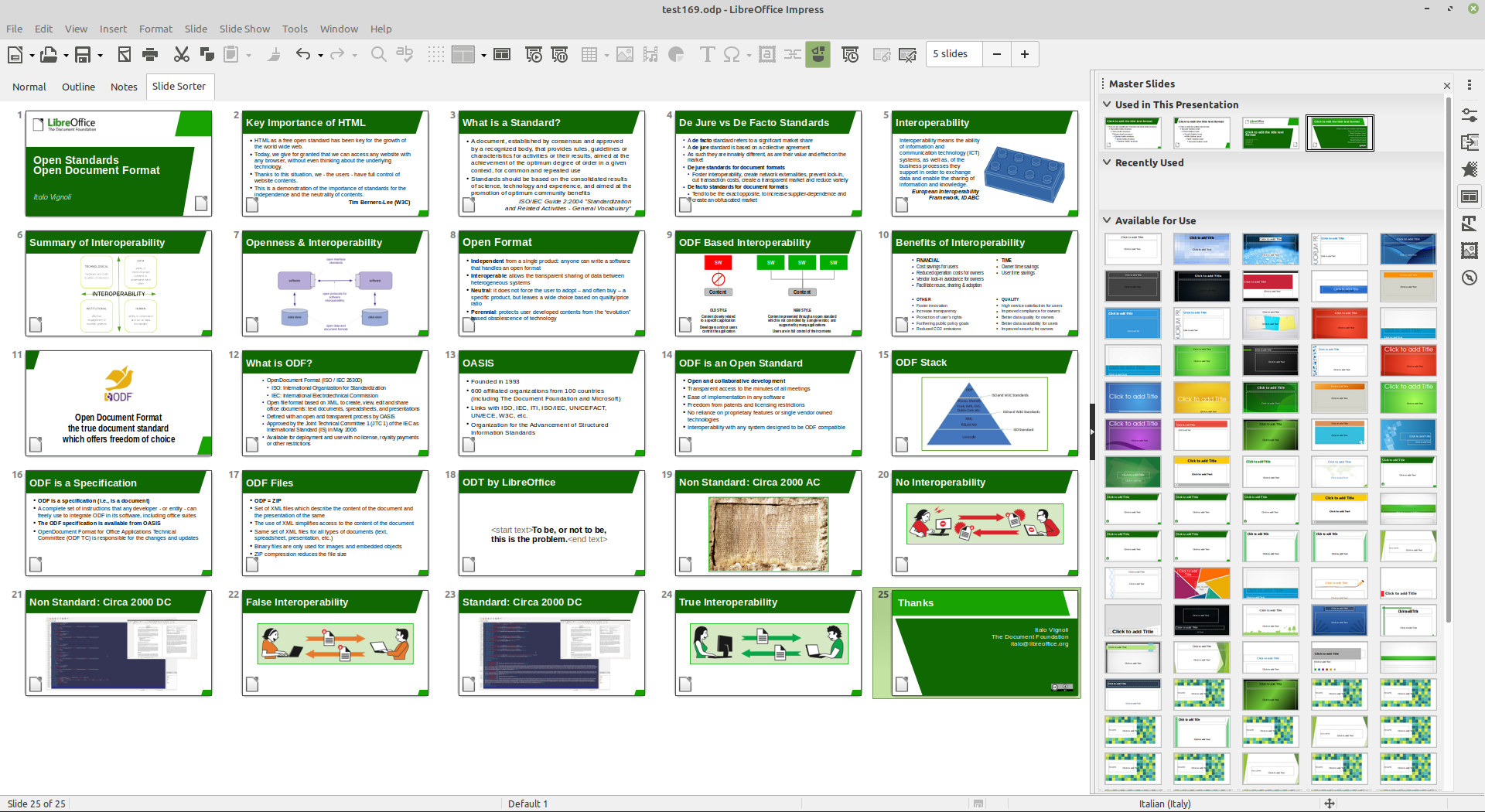
New version of LibreOffice Impress Remote for Android

We often talk about the desktop version of LibreOffice on this blog, but our community is working on mobile tools as well. For instance, the LibreOffice Impress Remote lets you interact with your slideshow presentation from your Android device – including slide previews, speaker notes, and more.

At the weekend, we released an update for the Impress Remote (version 2.4.0), with various bugfixes and updates:

  • Fix missing slide previews
  • Ongoing fixes for Bluetooth discovery
  • Fix pointer feature
  • Fix timer for certain Android versions
  • Updated translations

Note that there’s an additional permission required for the app in this release, coarse location, but it’s solely for Bluetooth discovery. The app doesn’t make any use of it – it’s just a prerequisite for doing discovery and listing nearby devices.

Additional notes: if you don’t get the proper slide count on the initial connection attempt, pause and resume should fix it. In addition, discovery of WiFi clients relies on Avahi being enabled on Linux (for Linux). If you don’t run Avahi (but still have the ports open, at least for your local network), you can manually enter the machine’s IP.

Download the new version here

(Note: an update for the iOS app will also follow.)

If you want more improvements or new features in the Impress Remote, give us a hand! We’re a volunteer-driven, community open source project, so we really appreciate all help to make the software even better. You can assist by reporting bugs, testing new releases, or helping with the code (if you have some development experience). See here to get started!

What about LibreOffice for Android?

We have the LibreOffice Viewer for Android, so you can view your documents on-the-go. Editing is an experimental feature at present, and to improve it and make it ready for full-time use, our community would appreciate some help! As mentioned, we’re a volunteer-driven open source project, so if you want the Android app to keep improving, help our community or consider funding a certified developer to work on it. That way, everyone benefits – thanks!

Event report: Google Summer of Code presentation in Ankara, Turkey

The Google Summer of Code – aka GSoC – is a global programme focused on bringing more student developers into free and open source software development. In 2019, LibreOffice was once again a participating project, and we describe the results here.

Meanwhile, Muhammet Kara from the Turkish LibreOffice community gave a presentation about GSoC on November 8 at YILDIZ Amphitheater M2, Hacettepe University (Beytepe Campus), Ankara – here’s what he had to say:

There were around 40 attendees, mostly from the Computer Science department. The best part was that they were very excited, and asked many questions – and the event took almost two hours instead of the planned 40 minutes. Many of them seemed ‘sold’ at the idea of spending the next summer (or at least one summer, sometime) working on LibreOffice or another free/libre open source software (FLOSS) project, through GSoC.

I also tried to share my adventure as a FLOSS enthusiast, from a volunteer translator to a professional developer working as part of Collabora’s LibreOffice development team. And I am glad to say that they seemed inspired of the story. 🙂

This is an after-event tweet by Hacettepe University ACM Student Chapter, with photos. Oh, and be prepared to hear more from around here regarding LibreOffice/FLOSS activities in the upcoming days. We have more activities in the planning, and hope to share soon. 😉

Thanks to Muhammet and all the participants for their work! Everyone is welcome to join our community and help to improve LibreOffice – see what you can do to make a difference.

Community Member Monday: Celia Palacios

Today we’re talking to Celia Palacios, who has recently become a member of The Document Foundation, the non-profit entity behind LibreOffice:

To start, tell us a bit about yourself!

I am a Mexican old-guard user of Linux since 2001. I studied Electronic Engineering, and I have been working in thatfield since 1989. I learnt all sorts of Linux stuff because I love to learn by myself. In addition, I love to read historical detective novels, lots of science fiction, and go to the movies with my husband.

I love philosophy, symbolism and many alternative ideas about everything. I also like to have long, friendly debates about everybody’s presumptions (or assumptions?). I try to be open-minded, specially in this times when everyone’s getting polarized Mexico about our President. I used to be an athletic gal, but now I am a total coach-potato! Thanks, Netflix!

Why did you decide to become a member of TDF?

Because LibreOffice is one the leaders in free/libre software, and it is a real example of a community with many faces and one heart. And also because people in the Spanish LibreOffice Telegram channel are so intelligent, bright, open and charming: many of them working truly to help others. That moved me deeply.

What are you working on in the LibreOffice project right now?

I am helping the Spanish documentation team. I have an idea of asking university students to help us finish the first-steps guides. If we succeed, we will have an updated introductory guide, which is really needed in Spanish.

Anything else you plan to do in the future?

It is too early to answer that without saying “in the regular places”. But it is in my plans to update every module’s guide in Spanish. And also some advanced guides/tutorials, with practical cases, for Calc and Base, specially to equal the outcomes that Microsoft Excel’s Power Business Intelligence is achieving.

Thanks to Celia for all her help and input! If you’re reading this and also want to join our friendly community, see here to get started (or visit the Spanish page). And if you’re already active in the LibreOffice project, consider becoming a member, so you can vote for TDF’s Board of Directors and help to make other important decisions:

Please confirm that you want to play a YouTube video. By accepting, you will be accessing content from YouTube, a service provided by an external third party.

YouTube privacy policy

If you accept this notice, your choice will be saved and the page will refresh.

Four more videos from the auditorium at LibreOffice Conference 2019

We’ve uploaded some more videos from our recent LibreOffice Conference 2019 in Almeria, Spain! First up, “Databases in LibreOffice” with Tamás Bunth:

Please confirm that you want to play a YouTube video. By accepting, you will be accessing content from YouTube, a service provided by an external third party.

YouTube privacy policy

If you accept this notice, your choice will be saved and the page will refresh.

Next, “Scripting LibreOffice Python macros” with Alain Romedenne:

Please confirm that you want to play a YouTube video. By accepting, you will be accessing content from YouTube, a service provided by an external third party.

YouTube privacy policy

If you accept this notice, your choice will be saved and the page will refresh.

“Custom Widget Themes” with Tomaž Vajngerl:

Please confirm that you want to play a YouTube video. By accepting, you will be accessing content from YouTube, a service provided by an external third party.

YouTube privacy policy

If you accept this notice, your choice will be saved and the page will refresh.

And the Google Summer of Code (GSoC) panel:

Please confirm that you want to play a YouTube video. By accepting, you will be accessing content from YouTube, a service provided by an external third party.

YouTube privacy policy

If you accept this notice, your choice will be saved and the page will refresh.

The Document Foundation welcomes the release to OASIS of the TC Committee Draft of ODF Version 1.3 for ratification

Editor of the new version of the ODF standard document format sponsored by the Community of ODF Specification Maintainers (COSM) *

Berlin, November 7, 2019 – The Document Foundation welcomes the release to OASIS of TC Committee Draft of ODF Version 1.3 for ratification. At the end of the process, ODF Version 1.3 will be submitted to ISO to become a standard. The final approval is expected in late 2020 or early 2021.

Editing of ODF Version 1.3 Committee Draft has been sponsored by the Community of ODF Specification Maintainers (COSM), a project launched by The Document Foundation in 2017 with the donation of a seed of euro 10,000 to get the COSM project started, plus up to euro 20,000 to match each euro donated by other stakeholders.

So far, the COSM project has been backed by Microsoft, Collabora, the UK Government Digital Services, CIB, the European Commission’s StandICT project and Open-Xchange. The money has been used to pay an editor to finalize the ODF 1.3 specification and manage it through the OASIS review and ratification process.

Major new features of ODF 1.3 are digital signature and OpenPGP-based XML encryption of documents, plus several improvements to features already available in ODF 1.2 like new polynomial and moving average regression types for charts, a new specification for number of decimal digits in number formatting, a special header/footer style for first page of documents, contextual spacing for paragraphs, additional type argument values for the WEEKDAY function, and the new text master template document type. Most of these new features have been contributed by developers at CIB, Collabora, Microsoft and The Document Foundation.

“The third revision of ODF is now well on the way to becoming a ratified standard and confirms that the crowdfunding approach TDF seeded at COSM is an effective way to have the open document standard maintained without needing a deep-pocketed international corporation behind them”, said Thorsten Behrens, TDF board member.

Tender for consultancy on implementing ODF 1.3 conformance in LibreOffice (#201911-01)

The Document Foundation (TDF), the charitable entity behind the world’s leading free office suite LibreOffice, seeks for companies or individuals to

provide consultancy on implementing ODF 1.3 conformance in LibreOffice

to start work as soon as possible. TDF is looking for an individual or company to give technical consultancy on ensuring that LibreOffice will properly implement the Open Document Format (ODF) version 1.3 for both importing and exporting. This can involve one or more of the following tasks:

Required skills

  • Extensive knowledge of C++
  • Experience working on the LibreOffice source code
  • Experience with implementing and testing the Open Document Format

We exclusively use free, libre and open source (FLOSS) software for development wherever possible, and the resulting work must be licensed under the Mozilla Public License v2.0.

Other skills

  • English (conversationally fluent in order to coordinate and plan with members of TDF)

TDF welcomes applications from all suitably qualified persons regardless of their race, sex, disability, religion/belief, sexual orientation or age.

Bidders will get a preference for including a partner or independent developer who has not been involved in a successful tender before.

As always, TDF will give some preference to individuals who have previously shown a commitment to TDF, including but not limited to certified developers and/or members of TDF. Not being a member, or never having contributed before, does not exclude any applicants from consideration.

The task offered is a project-based one-off, with no immediate plans to a mid- or long-term contractual relationship. It is offered on a freelance, project basis. Individuals and companies applying can be located anywhere in the world.

TDF is looking forward to receiving your applications for one or more of the aforementioned tasks, your financial expectations and the earliest date of your availability, via e-mail to a committee at tender20191101@documentfoundation.org no later than November 15, 2019.

Applicants who have not received feedback by November 29, 2019, should consider that their application, after careful review, was not accepted.

Additional information as per 2019-11-06: When budgeting, we anticipated that this project to take in the region of 20 (twenty) days of work