Upcoming Elections for the next Board of Directors of The Document Foundation

Dear Community,

we hereby officially announce the upcoming elections for the next Board of Directors of The Document Foundation.

As per § 7 II of our statutes, [1] the Board’s term lasts two years. The current board started its duty on February 18, 2018. Therefore, it remains in charge until the end of February 17, 2020, so the new board will be in charge the day after that, which is February 18, 2020.

That upcoming term will then (regularly) end on February 17, 2022, so the next elections of the Board of Directors will take place before.

As per § 6 III, only members of the Board of Trustees of The Document Foundation, as well as current members of any of its bodies, are eligible to be elected into the Board of Directors, and the election is overseen by the Membership Committee (§ 7 II).

The active electoral right is reserved to those who have been members of the Board of Trustees before this announcement (§ 7 II).

§ 6 III also states that members of the Board of Directors or their deputies may not be members of the Membership Committee and vice versa. This means that current members of the Membership Committee are eligible to be elected, but with the acceptance of their new role they lose their current role in the MC. For clarification, they have to step down from the Membership Committee, with effect no later than to the beginning of the new term of the Board of Directors, the minute before accepting to become a member of the Board of Directors.

There is one more notable limitation: per § 8 IV of the statutes, a maximum of 1/3 members of the Board of Directors is allowed to work on an employment basis for the same company, organization, entities, affiliates or subdivisions.

Nomination of candidates fulfilling the above requirements, as well as self nomination is welcome. In total, at least seven Board of Directors members are required, and given there are enough candidates, up to three deputies can be elected (§ 7 II). As deputies are on duty quite often, we encourage many candidates to participate.

Re-election of current members of the Board of Directors is explicitly permitted (§ 7 II).

Please send nominations and self-nominations via e-mail to elections@documentfoundation.org (which reaches the Membership Committee in private) and also (!) to board-discuss@documentfoundation.org (which is a public mailing list).

We kindly ask nominees who would like to stand for elections to provide a maximum 75 words statement on their candidacy as continuous text (so no bullet lists or multiple paragraphs). In addition, please also provide your full name, e-mail address and your corporate affiliation, if any. Specifically, please indicate all information regarding § 8 IV of the statutes.

Discussions with the candidates and questions to them as well as questions about the elections should take place on the public board-discuss@documentfoundation.org mailing list. For details on how to use the mailing list, see https://www.libreoffice.org/get-help/mailing-lists/

Eligible voters will receive further details via e-mail prior to the start of elections, including a summary of the candidates, details on how to access the voting system, and instructions on how to independently verify the vote count. Please ensure the Membership Committee has your recent and correct e-mail address on file. For questions, you can reach the Membership Committee in private at elections@documentfoundation.org

Following the time line set forth in § 7 II, requiring a 45 day advance notice, we hereby announce the following time line for the elections:

  • 2019-10-18: announcement of the elections; and start of the nomination phase
  • 2019-11-27, 24:00 CET/UTC+1: end of the nomination phase (one week before the election starts, as per § 7 II)
  • 2019-12-05, 00:00 CET/UTC+1: official start of the elections (at least 45 days after announcement of the elections, as per § 7 II)
  • 2019-12-12, 24:00 CET/UTC+1: end of the elections
  • 2019-12-13: announcement of the preliminary results and acknowledgement of role
  • 2019-12-14, 00:00 CET/UTC+1: start of the challenging phase
  • 2019-12-19, 24:00 CET/UTC+1: end of the challenging phase, followed by the official announcement of the final results

Be advised that the newly elected Board of Directors will only be in charge beginning from February 18, 2020. The current Board of Directors will however include them in the decision making process, to ease up the transition.

Challenges to this announcement with respect to the deadlines outlined have to happen no later than seven (7) days after this announcement, via e-mail to elections@documentfoundation.org (which reaches the Membership Committee in private).

Challenges to the preliminary results of the election have to happen until the deadline set forth above, via e-mail to elections@documentfoundation.org (which reaches the Membership Committee in private).

On behalf of the Membership Committee,
Gabriele Ponzo

[1] https://www.documentfoundation.org/statutes.pdf

FOSDEM 2020: Open Document Editors DevRoom Call for Papers

FOSDEM is one of the largest gatherings of Free Software contributors in the world and happens each year in Brussels (Belgium) at the ULB Campus Solbosch. In 2020, it will be held on Saturday, February 1, and Sunday, February 2.

The Open Document Editors (OFE) DevRoom is scheduled for Saturday, February 1, from 10:30AM to 7PM. Physical room has not yet been assigned by FOSDEM. The shared devroom gives all project in this area a chance to present ODF related developments and innovations.

We are now inviting proposals for talks about Open Document Editors or the ODF document format, on topics such as code, extensions, localization, QA, UX, tools and adoption related cases. This is a unique opportunity to show new ideas and developments to a wide technical audience.

Length of talks should be limited to a maximum of 20 minutes, as we would like to have questions after each presentation, and to fit as many presenters as possible in the schedule. Exceptions must be explicitly requested and justified. You may be assigned LESS time than you request.

All submissions have to be made in the Pentabarf event planning tool: https://penta.fosdem.org/submission/FOSDEM20.
While filing your proposal, please provide the title of your talk, a short abstract (one or two paragraphs), some information about yourself (name, bio and photo).

To submit your talk, click on “Create Event”, then make sure to select the “Open Document Editors” devroom as the “Track”. Otherwise your talk will not be even considered for any devroom at all.

If you already have a Pentabarf account from a previous year, even if your talk was not accepted, please reuse it. Create an account if, and only if, you don’t have one from a previous year. If you have any issues with Pentabarf, please contact ode-devroom-manager@fosdem.org.

The deadline is Saturday, November 30, 2019. Accepted speakers will be notified by Sunday, December 8th, 2019. The DevRoom schedule will be published by Tuesday, December 12, 2019.

Recording permission

The talks in the Open Document Editors DevRoom will be audio and video recorded, and possibly streamed live too.
In the “Submission notes” field, please indicate that you agree that your presentation will be licensed under the CC-BY-SA-4.0 or CC-BY-4.0 license and that you agree to have your presentation recorded. For example: “If my speech is accepted for FOSDEM, I hereby agree to license all recordings, slides, and other associated materials under the Creative Commons Attribution Share-Alike 4.0 International License. Sincerely, Name”.

October 12: International Day Against DRM 2019

Digital Restrictions Management is the practice of imposing technological restrictions that control what users can do with digital media. When a program is designed to prevent you from copying or sharing a song, reading an ebook on another device, or playing a single-player game without an Internet connection, you are being restricted by DRM. In other words, DRM creates a damaged good; it prevents you from doing what would be possible without it. This concentrates control over production and distribution of media, giving DRM peddlers the power to carry out massive digital book burnings and conduct large scale surveillance over people’s media viewing habits.

If we want to avoid a future in which our devices serve as an apparatus to monitor and control our interaction with digital media, we must fight to retain control of our media and software.

Defective by Design is a broad-based anti-DRM campaign that is targeting Big Media, unhelpful manufacturers and DRM distributors. The campaign aims to make all manufacturers wary about bringing their DRM-enabled products to market. DRM products have features built-in that restrict what jobs they can do. These products have been intentionally crippled from the users’ perspective, and are therefore “defective by design”. This campaign will identify these “defective” products, and target them for elimination.

LibreOffice monthly recap: September 2019

Here’s our summary of updates, events and activities in the LibreOffice project in the last four weeks – click the links to learn more!

  • The biggest event in September was the LibreOffice Conference 2019 which took place in Almeria, Spain. Over 100 people from across the globe met up to discuss current developments in LibreOffice, make plans for the future, and have fun. Here’s our group photo:

  • We also made a short video recap of the conference – check it out!

Please confirm that you want to play a YouTube video. By accepting, you will be accessing content from YouTube, a service provided by an external third party.

YouTube privacy policy

If you accept this notice, your choice will be saved and the page will refresh.

  • Furthermore, we’ve started uploading presentations from the conference. Here’s a playlist, starting with the opening session; use the icon at the top to switch to other videos:

Please confirm that you want to play a YouTube video. By accepting, you will be accessing content from YouTube, a service provided by an external third party.

YouTube privacy policy

If you accept this notice, your choice will be saved and the page will refresh.

  • Over in Uganda, Emmanuel Semutenga is helping young people in Kampala to improve their IT skills – using LibreOffice and other free software tools. He told us about his experiences and what advice he has for other projects with similar goals.

  • Next year’s LibreOffice Conference will be held in Nuremberg, Germany – and it’ll be a joint conference with the openSUSE project. And we need a logo! You can help us to design this logo and win a mystery box at the end… Here are the logos for the 2019 conferences, for inspiration:

  • Finally, LibreOffice celebrated its 9th birthday near the end of the month. We’d like to say a huge thanks to all users, supporters, developers and donators who’ve helped to make LibreOffice possible. Here’s to another nine years!

Keep in touch – follow us on Twitter, Facebook and Mastodon. Like what we do? Support our community with a donation – or join us and help to make LibreOffice even better!

LibreOffice 10/20 Logo Community Contest

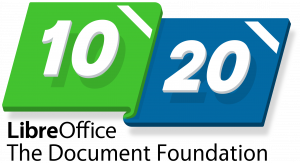
The year 2020 will be the 20th anniversary of the free office suite (OpenOffice.org was announced on July 19, 2000) and the 10th anniversary of LibreOffice (announced on September 28, 2010). We have the opportunity to celebrate both during the year, to reaffirm the fact that LibreOffice today is the leading free office suite available in the market.

For the anniversary project, we need a specific logo which celebrates the 10/20 anniversary without making a difference between the two dates, as the concept is that LibreOffice was born 20 years ago as OpenOffice.org, and evolved into LibreOffice 10 years ago.

The 10/20 logo should be easy to associate to the current LibreOffice logo (with tagline), and follow TDF design and style guides (Corporate Image) published on the wiki: https://wiki.documentfoundation.org/Marketing/Branding.

The 10/20 logo will be used for presentations, event signage, swag and gadgets (like stickers). It should be easy to recognize and read at small sizes.

The 10/20 logo must be developed with free and open source software, and released in vector-based (SVG) as well as bitmap-based (PNG, JPG) formats. The logo must be available in a squared or nearly squared format, plus other formats as appropriate.

One example of a possible implementation should also be provided with the proposal.

Intellectual property must be released under the Creative Commons Attribution-Share Alike 4.0 License (https://creativecommons.org/licenses/by-sa/4.0/), while a copyright transfer to TDF is not required.

Authors must declare in writing that they are the sole owners of all rights related to the artwork they have developed.
It should be clear that this is not a request for a mascot, and any kind of proposal which could be interpreted as a mascot will be rejected. Also, the 10/20 logo must be global and as such any reference to a regional styling approach (such as Anime or Manga) will also be rejected.

Logo proposals must be sent to: italo@libreoffice.org by November 30, 2019, at 11:59PM UTC. TDF will select the best proposal, which will be announced on December 16, 2019.

The author of the winning proposal will be announced at FOSDEM 2020, where the 10/20 logo will be displayed for the first time during a global FOSS event.

Interview with Ilmari Lauhakangas, Development Marketing

Ilmari Lauhakangas, based in Helsinki (Finland), is in charge of Development Marketing.

We have asked him a few questions, about his relationship with free software and his role in the community.

How did you become involved with free software and LibreOffice? Are you contributing to other FOSS projects?

I did localisation for FOSS projects in the early 2010s. Around 2012, I started contributing more to Retroshare, a secure communication platform, doing recruiting, translation coordination and web design.

In 2014 I began doing quality assurance for LibreOffice. People like Yousuf Philips, Joel Madero and Robinson Tryon were instrumental in making me understand the relevance of QA work. The attitude towards recruiting more contributors was spontaneous and immediate in the QA team.

I have focused on LibreOffice for the past few years.

You have been involved in the LibreOffice project for quite a long time, in QA and other areas. Can you summarize your activities?

I have: 1. somehow touched over twelve thousand reports in TDF Bugzilla, 2. improved and written technical documentation in TDF wiki, 3. improved help content, 4. done development for the web help, 5. edited content for the main website, 6. piloted the use of the translate extension for TDF wiki and guided people in its use, 7. helped new contributors get started in development, QA, documentation, design and infra, 8. recruited contributors through various channels such as VolunteerMatch.

You have explored several tools to attract new contributors. What do you think we should do as a project to keep the high level of contributions necessary for a large FOSS project such as LibreOffice?

We should make sure our technical documentation is high quality. When developers run into good documentation, they are very happy.

We should invest in improving the user experience of our web-based tools.

You are responsible for Development Marketing since September 1. How can you describe your responsibilities? Who should get in touch with you?

Basically everyone who wants to improve LibreOffice should get in touch. If you have no idea of how you could even be useful, I will help you find out, because everyone can be a part of the community and contribute! I hope to encourage strong cross-team collaboration. I want people to be credited for their work. I want us to have a safe and supporting environment for everyone to challenge themselves, try new things and learn new skills.

Technology focused high schools and universities, what should we do to grow the interest and the willingness to contribute among students?

This is more of a political question. If money and resources are lacking in education, teachers will not have time to offer structured introductions to free software projects. Likewise, if higher education is not free, students will have to work alongside their studies and will not have the energy contribute to FOSS.

On our part, we need to provide students with software they can rely on. In Finland, thirty thousand students in advanced secondary education use LibreOffice every year. If they find the software enjoyable, surely they are more inclined to contribute.