LibreOffice monthly recap: October 2019

Here’s our summary of updates, events and activities in the LibreOffice project in the last four weeks – click the links to learn more!

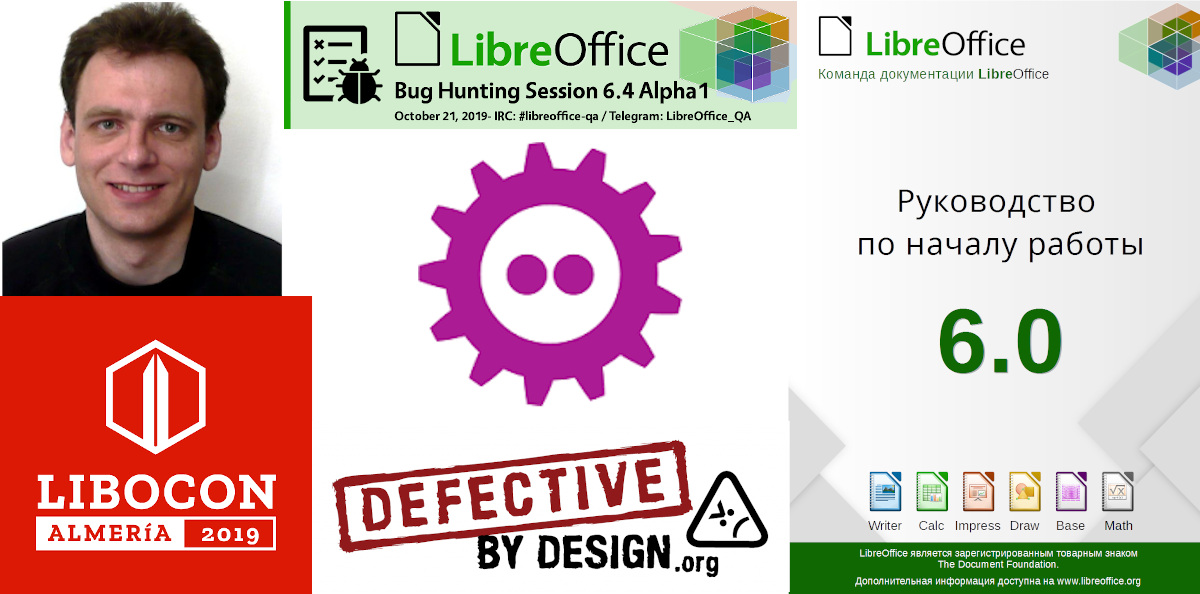
  • We kicked off the month by interviewing Ilmari Lauhakangas, aka Buovjaga, who has joined the TDF team in Development Marketing. Ilmari is a long-time member of the LibreOffice community, and has been especially active in the QA project.
  • Then we announced the LibreOffice 10/20 Logo Community Contest. The year 2020 will be the 20th anniversary of the free office suite (OpenOffice.org was announced on July 19, 2000) and the 10th anniversary of LibreOffice (announced on September 28, 2010). So to celebrate, we want a special logo for presentations, events and swag – and you can help out! See the blog post for more details…
  • Meanwhile, throughout the month we edited and uploaded more presentation videos from the LibreOffice Conference 2019 in Almeria, Spain. Check out the playlist below – use the button at the top to switch between videos. There are currently 44 presentations to explore, and some more to come! (For better audio, use headphones.)

Please confirm that you want to play a YouTube video. By accepting, you will be accessing content from YouTube, a service provided by an external third party.

YouTube privacy policy

If you accept this notice, your choice will be saved and the page will refresh.

  • On October 12, The Document Foundation supported the International Day Against DRM 2019. Digital Restrictions Management is the practice of imposing technological restrictions that control what users can do with digital media – and “Defective by Design” is a broad-based anti-DRM campaign that is targeting Big Media, unhelpful manufacturers and DRM distributors.
  • Later in the month, we had the first Bug Hunting Session for LibreOffice 6.4 (which is due to be released in February 2020). All LibreOffice users with some technical knowledge are invited to join future Bug Hunting Sessions, report any issues they find, and help to make LibreOffice 6.4 a rock-solid release!
  • Also coming up in February next year is FOSDEM, the biggest European meetup of free and open source software developers. We announced the Open Document Editors DevRoom Call for Papers, so if you want to talk about topics such as code, extensions, localization, QA, UX, tools and adoption-related cases, submit a talk (deadline is Saturday, November 30, 2019).

  • On October 17, we announced LibreOffice 6.2.8, the last version in the LibreOffice 6.2 family. All users of LibreOffice 6.2.x versions should update immediately for enhanced security, and be prepared to upgrade to LibreOffice 6.3.4 as soon as it becomes available in December.
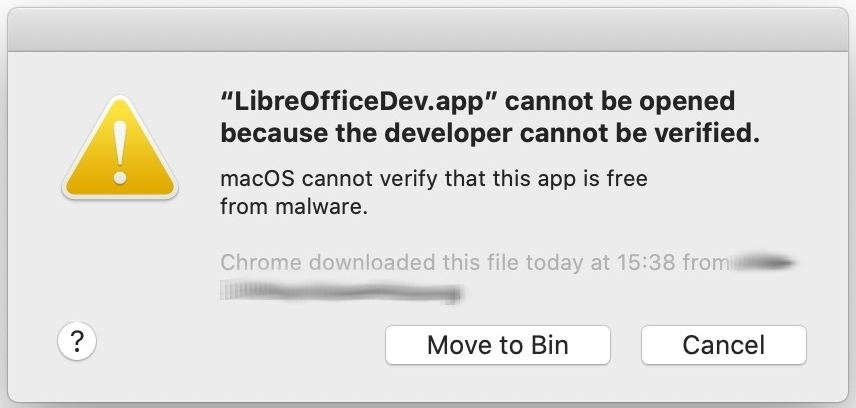
  • If you’re a macOS users and have updated to the latest macOS release (10.5, aka Catalina), and you’re having issues running LibreOffice, check out our help page. Typical messages are “macOS cannot verify the developer of LibreOffice.app”, or “LibreOffice.app was blocked from use because it is not from an identified developer” – we show you how to fix them and have LibreOffice running smoothly as usual!
Please confirm that you want to play a YouTube video. By accepting, you will be accessing content from YouTube, a service provided by an external third party.

YouTube privacy policy

If you accept this notice, your choice will be saved and the page will refresh.

Keep in touch – follow us on Twitter, Facebook and Mastodon. Like what we do? Support our community with a donation – or join us and help to make LibreOffice even better!

Community Member Monday: Petr Valach

Members of The Document Foundation help to steer the LibreOffice project and community. Today we’re talking to Petr Valach from the Czech community…

To start, tell us a bit about yourself!

I was born in Brno, but for nearly 30 years I’ve been living in Prague. I work for a software company where I am member of a mobile applications project. But IT isn’t my only hobby. I do lots of things – personally, astronomy and physics are the most important for me. There is nothing quite so interesting. And I am happy when astronomical or astronautical institutions (for example, the International Space Station) use free and open-source software.

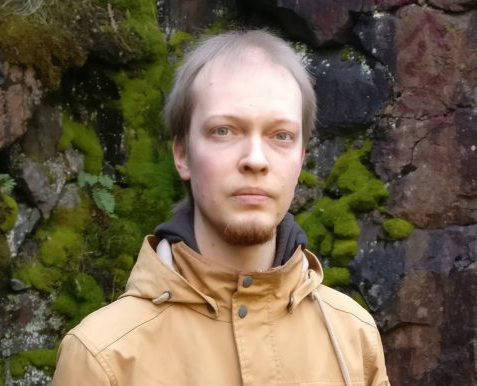
I was member of the scout movement, so scouting is one of my “hobbies” too (it’s not a hobby, but lifestyle). In the Czech Republic, there is something special, a mixture of pure scouting with the education system of our boys’ book author, Jaroslav Foglar. He lead his scout group called The Boys from Beaver River for 60 years and wrote over 20 books, which are bestsellers. Indeed, Jaroslav Foglar is the most successful author in the Czech Republic, who directly or indirectly influenced literally everybody here. I am a member of the community associated around him, and member of Foglar’s association. Recently we’ve had meetings in the Foglar group clubhouse every month.

I am a member of the editors of OpenOffice.cz (focused on LibreOffice and OpenOffice.cz) and LinuxEXPRES (focused on free and open-source software generally). I am lead editor at ExoSpace.cz, which supports these magazines and websites, the Czech community around LibreOffice, other astronomical and astronautical magazines and more.

Why did you decide to become a member of The Document Foundation (TDF)?

I think that I can improve my work by being am member of TDF. Membership gives my work more importance. And I am in connection with other people – and it is very important to be informed. So I believe that I will contribute to the foundation by membership.

What are you working on in the LibreOffice project right now?

As mentioned, I am member of the OpenOffice.cz editors and I propagate LibreOffice via ExoSpace.cz. I try to support LibreOffice via this media – I try to support members of TDF during conferences and so on. But the most important thing is that I use LibreOffice and learn more and more about it; LibreOffice is absolutely my favourite software.

Anything else you plan to do in the future?

Better Czech manual and education materials – that’s what is most needed. I like documentation work, so I will be happy if I find more time to contribute to this topic.

Thanks to Petr for all his contributions – they are really appreciated! Czech users can explore the website and get involved with our community.

Upcoming Elections for the next Board of Directors of The Document Foundation

Dear Community,

we hereby officially announce the upcoming elections for the next Board of Directors of The Document Foundation.

As per § 7 II of our statutes, [1] the Board’s term lasts two years. The current board started its duty on February 18, 2018. Therefore, it remains in charge until the end of February 17, 2020, so the new board will be in charge the day after that, which is February 18, 2020.

That upcoming term will then (regularly) end on February 17, 2022, so the next elections of the Board of Directors will take place before.

As per § 6 III, only members of the Board of Trustees of The Document Foundation, as well as current members of any of its bodies, are eligible to be elected into the Board of Directors, and the election is overseen by the Membership Committee (§ 7 II).

The active electoral right is reserved to those who have been members of the Board of Trustees before this announcement (§ 7 II).

§ 6 III also states that members of the Board of Directors or their deputies may not be members of the Membership Committee and vice versa. This means that current members of the Membership Committee are eligible to be elected, but with the acceptance of their new role they lose their current role in the MC. For clarification, they have to step down from the Membership Committee, with effect no later than to the beginning of the new term of the Board of Directors, the minute before accepting to become a member of the Board of Directors.

There is one more notable limitation: per § 8 IV of the statutes, a maximum of 1/3 members of the Board of Directors is allowed to work on an employment basis for the same company, organization, entities, affiliates or subdivisions.

Nomination of candidates fulfilling the above requirements, as well as self nomination is welcome. In total, at least seven Board of Directors members are required, and given there are enough candidates, up to three deputies can be elected (§ 7 II). As deputies are on duty quite often, we encourage many candidates to participate.

Re-election of current members of the Board of Directors is explicitly permitted (§ 7 II).

Please send nominations and self-nominations via e-mail to elections@documentfoundation.org (which reaches the Membership Committee in private) and also (!) to board-discuss@documentfoundation.org (which is a public mailing list).

We kindly ask nominees who would like to stand for elections to provide a maximum 75 words statement on their candidacy as continuous text (so no bullet lists or multiple paragraphs). In addition, please also provide your full name, e-mail address and your corporate affiliation, if any. Specifically, please indicate all information regarding § 8 IV of the statutes.

Discussions with the candidates and questions to them as well as questions about the elections should take place on the public board-discuss@documentfoundation.org mailing list. For details on how to use the mailing list, see https://www.libreoffice.org/get-help/mailing-lists/

Eligible voters will receive further details via e-mail prior to the start of elections, including a summary of the candidates, details on how to access the voting system, and instructions on how to independently verify the vote count. Please ensure the Membership Committee has your recent and correct e-mail address on file. For questions, you can reach the Membership Committee in private at elections@documentfoundation.org

Following the time line set forth in § 7 II, requiring a 45 day advance notice, we hereby announce the following time line for the elections:

  • 2019-10-18: announcement of the elections; and start of the nomination phase
  • 2019-11-27, 24:00 CET/UTC+1: end of the nomination phase (one week before the election starts, as per § 7 II)
  • 2019-12-05, 00:00 CET/UTC+1: official start of the elections (at least 45 days after announcement of the elections, as per § 7 II)
  • 2019-12-12, 24:00 CET/UTC+1: end of the elections
  • 2019-12-13: announcement of the preliminary results and acknowledgement of role
  • 2019-12-14, 00:00 CET/UTC+1: start of the challenging phase
  • 2019-12-19, 24:00 CET/UTC+1: end of the challenging phase, followed by the official announcement of the final results

Be advised that the newly elected Board of Directors will only be in charge beginning from February 18, 2020. The current Board of Directors will however include them in the decision making process, to ease up the transition.

Challenges to this announcement with respect to the deadlines outlined have to happen no later than seven (7) days after this announcement, via e-mail to elections@documentfoundation.org (which reaches the Membership Committee in private).

Challenges to the preliminary results of the election have to happen until the deadline set forth above, via e-mail to elections@documentfoundation.org (which reaches the Membership Committee in private).

On behalf of the Membership Committee,
Gabriele Ponzo

[1] https://www.documentfoundation.org/statutes.pdf

FOSDEM 2020: Open Document Editors DevRoom Call for Papers

FOSDEM is one of the largest gatherings of Free Software contributors in the world and happens each year in Brussels (Belgium) at the ULB Campus Solbosch. In 2020, it will be held on Saturday, February 1, and Sunday, February 2.

The Open Document Editors (OFE) DevRoom is scheduled for Saturday, February 1, from 10:30AM to 7PM. Physical room has not yet been assigned by FOSDEM. The shared devroom gives all project in this area a chance to present ODF related developments and innovations.

We are now inviting proposals for talks about Open Document Editors or the ODF document format, on topics such as code, extensions, localization, QA, UX, tools and adoption related cases. This is a unique opportunity to show new ideas and developments to a wide technical audience.

Length of talks should be limited to a maximum of 20 minutes, as we would like to have questions after each presentation, and to fit as many presenters as possible in the schedule. Exceptions must be explicitly requested and justified. You may be assigned LESS time than you request.

All submissions have to be made in the Pentabarf event planning tool: https://penta.fosdem.org/submission/FOSDEM20.
While filing your proposal, please provide the title of your talk, a short abstract (one or two paragraphs), some information about yourself (name, bio and photo).

To submit your talk, click on “Create Event”, then make sure to select the “Open Document Editors” devroom as the “Track”. Otherwise your talk will not be even considered for any devroom at all.

If you already have a Pentabarf account from a previous year, even if your talk was not accepted, please reuse it. Create an account if, and only if, you don’t have one from a previous year. If you have any issues with Pentabarf, please contact ode-devroom-manager@fosdem.org.

The deadline is Saturday, November 30, 2019. Accepted speakers will be notified by Sunday, December 8th, 2019. The DevRoom schedule will be published by Tuesday, December 12, 2019.

Recording permission

The talks in the Open Document Editors DevRoom will be audio and video recorded, and possibly streamed live too.
In the “Submission notes” field, please indicate that you agree that your presentation will be licensed under the CC-BY-SA-4.0 or CC-BY-4.0 license and that you agree to have your presentation recorded. For example: “If my speech is accepted for FOSDEM, I hereby agree to license all recordings, slides, and other associated materials under the Creative Commons Attribution Share-Alike 4.0 International License. Sincerely, Name”.

October 12: International Day Against DRM 2019

Digital Restrictions Management is the practice of imposing technological restrictions that control what users can do with digital media. When a program is designed to prevent you from copying or sharing a song, reading an ebook on another device, or playing a single-player game without an Internet connection, you are being restricted by DRM. In other words, DRM creates a damaged good; it prevents you from doing what would be possible without it. This concentrates control over production and distribution of media, giving DRM peddlers the power to carry out massive digital book burnings and conduct large scale surveillance over people’s media viewing habits.

If we want to avoid a future in which our devices serve as an apparatus to monitor and control our interaction with digital media, we must fight to retain control of our media and software.

Defective by Design is a broad-based anti-DRM campaign that is targeting Big Media, unhelpful manufacturers and DRM distributors. The campaign aims to make all manufacturers wary about bringing their DRM-enabled products to market. DRM products have features built-in that restrict what jobs they can do. These products have been intentionally crippled from the users’ perspective, and are therefore “defective by design”. This campaign will identify these “defective” products, and target them for elimination.

LibreOffice monthly recap: September 2019

Here’s our summary of updates, events and activities in the LibreOffice project in the last four weeks – click the links to learn more!

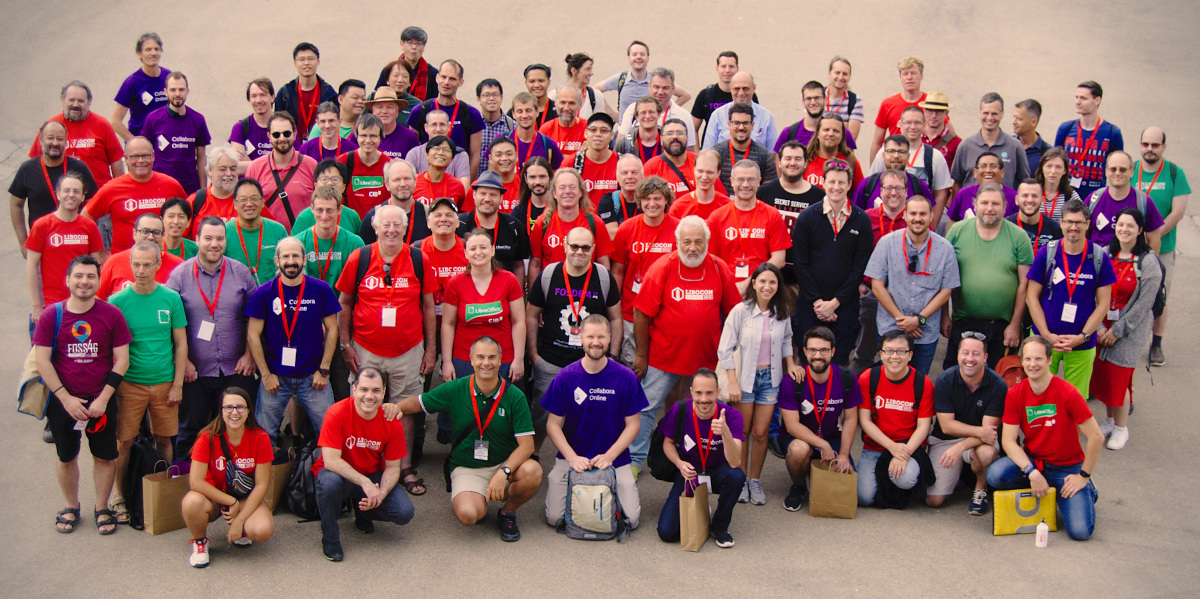
  • The biggest event in September was the LibreOffice Conference 2019 which took place in Almeria, Spain. Over 100 people from across the globe met up to discuss current developments in LibreOffice, make plans for the future, and have fun. Here’s our group photo:

  • We also made a short video recap of the conference – check it out!

Please confirm that you want to play a YouTube video. By accepting, you will be accessing content from YouTube, a service provided by an external third party.

YouTube privacy policy

If you accept this notice, your choice will be saved and the page will refresh.

  • Furthermore, we’ve started uploading presentations from the conference. Here’s a playlist, starting with the opening session; use the icon at the top to switch to other videos:

Please confirm that you want to play a YouTube video. By accepting, you will be accessing content from YouTube, a service provided by an external third party.

YouTube privacy policy

If you accept this notice, your choice will be saved and the page will refresh.

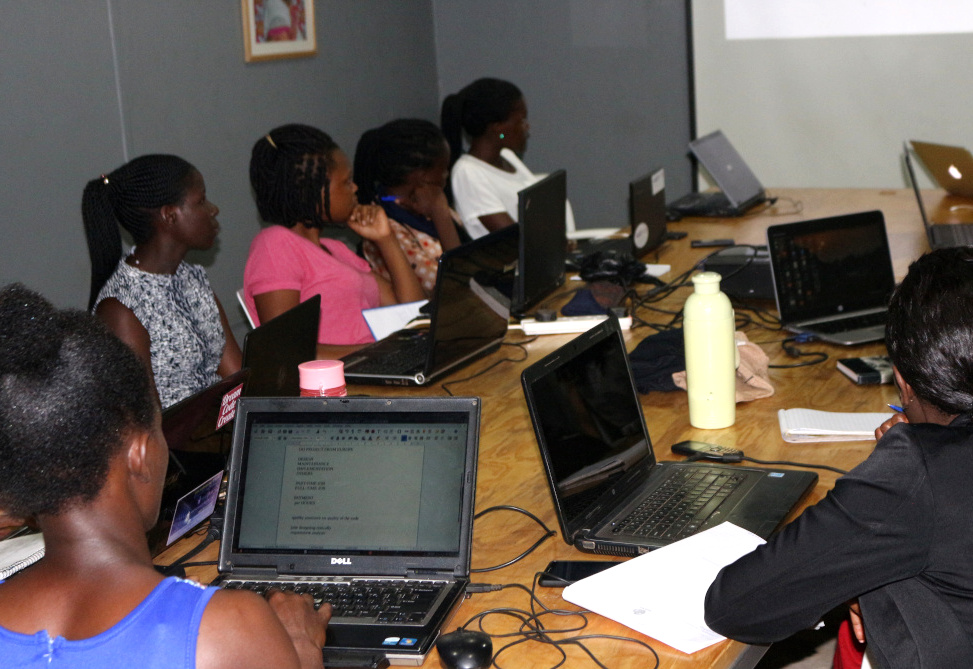
  • Over in Uganda, Emmanuel Semutenga is helping young people in Kampala to improve their IT skills – using LibreOffice and other free software tools. He told us about his experiences and what advice he has for other projects with similar goals.

  • Next year’s LibreOffice Conference will be held in Nuremberg, Germany – and it’ll be a joint conference with the openSUSE project. And we need a logo! You can help us to design this logo and win a mystery box at the end… Here are the logos for the 2019 conferences, for inspiration:

  • Finally, LibreOffice celebrated its 9th birthday near the end of the month. We’d like to say a huge thanks to all users, supporters, developers and donators who’ve helped to make LibreOffice possible. Here’s to another nine years!

Keep in touch – follow us on Twitter, Facebook and Mastodon. Like what we do? Support our community with a donation – or join us and help to make LibreOffice even better!