openSUSE + LibreOffice Virtual Conference Extends Call for Papers

The organizers of the openSUSE + LibreOffice Virtual Conference are extending the Call for Papers to August 4.

Participants can submit talks for the live conference past the original deadline of July 21 for the next two weeks.

The conference is scheduled to take place online from Oct. 15. – 17.

The length of the talks that can be submitted are either a 15-minute short talk, a 30-minute normal talk and/or a 60-minute work group session. Organizers believe shortening the talks will keep attendees engaged for the duration of the online conference.

The conference will have technical talks about LibreOffice, openSUSE, open source, cloud, containers and more. Extra time for Questions and Answers after each talk is possible and the talks will be recorded. The conference will schedule frequent breaks for networking and socializing.

The conference will be using a live conferencing platform and will allow presenters with limited bandwidth to play a talk they recorded should they wish not to present a live talk. The presenter will have the possibility to control the video as well as pause, rewind and fast-forward it.

Attendees can customize their own schedule by adding sessions they would like to participate in once the platform is ready. More information about the platform will be available in future news articles.

Organizers have online, live conference sponsorship packages available. Interested parties should contact ddemaio (at) opensuse.org for more information.

A new virtual meeting of the Hispanic Community was held

Daniel Armando Rodriguez writes:

Yesterday, in the Ibero-American afternoon/evening, the Hispanic LibreOffice Community gathered for the third consecutive month, with panelists who covered different topics related to the office suite.

The event was broadcast live on YouTube. The activity began at 16:00 UTC, extended for just over 6 hours and featured speakers from 6 nationalities, recognized for their participation and collaboration in the project.

  • Italo Vignoli, from Italy, one of the founding members of TDF provided a complete overview of the Open Document Format.
  • Olivier Hallot, from Brazil, another of the founding members presented different Translation Tools.
  • Rafael Espinar, from Spain, spoke with Antonio Caba and Francisco Rueda about the impact of migration.
  • Xiomara Céspedes, from Costa Rica, presented Migration at the University of Costa Rica.
  • Paul Janzen, from Paraguay, gave a talk on the Migration Experiences of the Philadelphia School in Paraguay.
  • Ameck Bozo, from Venezuela, gave a detailed tour of the creation of a Dashboard in Calc.
  • José Gatica, from Chile, presented the Migration of a vulnerable school.
  • Klaibson Ribeiro, from Brazil, presented LibreOffice Online.
  • Gustavo Pacheco, also from Brazil, spoke about the importance of participating as a member of TDF.

This was, of course, an open event – free and aimed at anyone interested in learning more about LibreOffice. Also, we thank our friend Servio from the Latin Community of Free Technologies, who managed the live broadcast through YouTube. All the talks are available in the LibreOffice Hispano channel – here’s a playlist:

Please confirm that you want to play a YouTube video. By accepting, you will be accessing content from YouTube, a service provided by an external third party.

YouTube privacy policy

If you accept this notice, your choice will be saved and the page will refresh.

New Czech translation of Getting Started Guide 6.4

Zdenek Crhonek from the Czech LibreOffice community writes:

The Czech translation of the LibreOffice 6.4 Getting Started guide is now available! The history behind this book is quite long: first, another team translated the version 4.2 guide in 2014, but they never fully finished it (didn’t do corrections, publishing etc.) Then they started to update for version 5.1, but never finished the translation. I was not part of the team in these days, so this is what I’ve found out from the mailing lists. Thanks to the CAT (computer-assisted translation) tool OmegaT, we could used their old translations and build upon it. In 2020 we started translation again with version 6.0, but we quickly jumped to version 6.4 and followed the documentation team’s updates.

The translation was a team effort – a big thanks to:

  • Anna Benc
  • Eliška Rolfová
  • Lucie Studená
  • Marcela Tomešová
  • Miloš Šrámek
  • Petr Kuběj
  • Petr Valach
  • Roman Toman
  • Vendula Crhonková
  • Zdeněk Crhonek
  • Zuzana Kašparová
  • Zuzana Pitříková

Great work! Everyone is welcome to join our documentation community. It’s a great way to build up skills for a potential future career in technical writing…

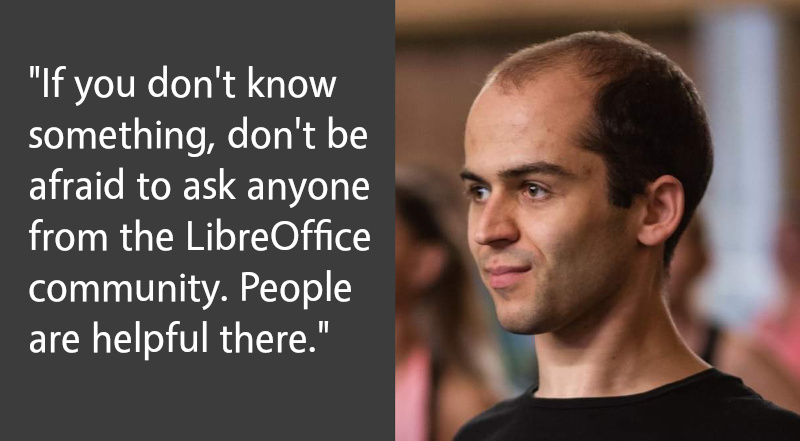
Community Member Monday: Khairul Aizat Kamarudzzaman

Today we’re talking to Khairul Aizat Kamarudzzaman from our Malaysian community. He’s a long-time fan of free and open source software, and is helping with LibreOffice advocacy and marketing…

To start off, tell us a bit about yourself!

I’m from Kuala Lumpur, Malaysia. I started exploring and using FOSS way back in 2004 (Debian, Red Hat, the BSD family and sticking with Ubuntu till today) when I was studying at the university. From there I started exploring and contributing to Ubuntu, which you can find here, and I was accepted to be an Ubuntu Member, Kubuntu Membes (merits as Ubuntu contributor). Finally I was appointed to be part of the Asia Oceania Membership Board.

A a FOSS community member, I work in a few IT companies in Malaysia and was one of the engineers working at Open Source Competency Centre (OSCC) under Malaysian Administrative Modernisation and Management Planning Unit (MAMPU). Now I own my own IT company, namely Informology Sdn Bhd. Not stopping there, I continue actively being a FOSS enthusiast in Malaysia. When the cloud computing era came, I was involved by leading Malaysia OpenStack User Group, and I’ve recently been exploring and leading the Endless OS user group for Malaysia.

What are you working on in the LibreOffice project right now?

I started the LibreOffice Malaysia Group on Facebook, and I’m planning with the group to finish the LibreOffice Malay translation as soon as possible, with guidance from the Indonesian LibreOffice translation team – so that we can have Malay language support in LibreOffice and Collabora Office.

Why did you decide to become a member of The Document Foundation?

It’s in line with what I’ve done since I started using FOSS: open source advocacy targeted at students, teachers, government staff and the open Source community members in Malaysia. I especially focused on Linux, and office automation like LibreOffice and Collabora Office as an alternative to Microsoft Office. Then, last year in 2019, I managed to participate in the Gnome Asia Summit 2019 in Surabaya, Indonesia where I met a lot of FOSS enthusiasts who are advocating and spreading open source in Indonesia, along with a few awesome TDF members (Ahmad Haris), TDF Board member (Franklin Weng) and GNOME Foundation Staff.

So I asked myself… since I already pitching the Open Document Format (ODF) since I was in OSCC, why not start contributing more to LibreOffice by doing translations? So I challenged myself by applying to become a TDF member, with advice from Ahmad Haris and Franklin Weng.

Anything else you plan to do in the future?

Keep spreading and marketing LibreOffice in Malaysia – especially in the government and educational sectors. Give these sectors LibreOffice as an alternative, by not using piracy and a cracked version of Microsoft Office.

Maybe the LibreOffice Malaysia group can suggest to TDF to host the LibreOffice Conference in Malaysia one day in the future!

Thanks Khairul! And indeed to everyone in the Malaysian LibreOffice community. Your work is essential to help spread awareness of LibreOffice across the globe.

Join the LibreOffice community today! Have fun and build up your skillset…

LibreOffice 7.0 RC1 Bug Hunting Session

LibreOffice 7.0 is being developed by our worldwide community, and is due to be released in early August 2020 – see the release notes describing the new features here.

In order to find, report and triage bugs, the LibreOffice QA team is organizing the second Bug Hunting Session for LibreOffice 7.0 on Monday July 6, 2020. Tests will be performed on the first Release Candidate version, which will be available on the pre-releases server the day of the event. Builds will be available for Linux (DEB and RPM), macOS and Windows.

Mentors will be available from 07:00 UTC to 19:00 UTC for questions or help in the IRC channel #libreoffice-qa and the Telegram QA Channel. Of course, hunting bugs will be possible also on other days, as the builds of this particular Release Candidate (LibreOffice 7.0.0 RC1) will be available until mid July. Check the Release Plan.

During the day there will be a dedicated session to test the new SKIA Graphics Engine integration from 14:00 and 16:00 UTC.

All details of the first bug hunting session are available on the wiki. LibreOffice is a volunteer-driven community project, so please help us to test – we appreciate it!

Calc Guide 6.4 is Released! – Download Now!

The LibreOffice Documentation Team announces the release of the LibreOffice Calc Guide 6.4, the complete handbook for the spreadsheet tool of LibreOffice. The guide was updated from the existing release 6.2 and include all the improvements developed since then.

LibreOffice Calc is the spreadsheet module of LibreOffice, capable of creating and edit complex spreadsheets, from simple calculations to ‘What if…’ manner by changing some of the data and observing the results without having to retype the entire spreadsheet or sheet. Other features provided by Calc include

  • Functions, which can be used to create formulas to perform complex calculations on data.
  • Database functions to arrange, store, and filter data.
  • Dynamic charts, including a wide range of 2D and 3D charts.
  • Macros for recording and executing repetitive tasks; scripting languages supported include LibreOffice Basic, Python, BeanShell, and JavaScript.
  • Ability to open, edit, and save Microsoft Excel spreadsheets.
  • Import and export of spreadsheets in multiple formats, including HTML, CSV, PDF, and PostScript.

The release of the Guide is an effort of the documentation team of the LibreOffice Community, a group of skilled individuals that contributes to create the best reference guides for all LibreOffice modules, including word processor, spreadsheet, presentation, drawing, database and math equations.

“This guide achieves a very important milestone for the whole LibreOffice community since Calc documentation is the most demanded by the end user. I’m sure this great work will be very much appreciated.” said Daniel Rodriguez, Member of The Document Foundation Board of Directors.

“Building on the great work that went on during 2019 to complete the major update necessary to align the Calc Guide with LibreOffice 6.2, the update to 6.4 was a more modest task. However, I am delighted that the Team has completed this task because it gives an excellent platform for the subsequent update to 7.0 . From a personal perspective it was an enjoyable challenge and I was delighted to have a chance to make a useful contribution during our period of lockdown in the UK. Many thanks to all those who contributed to this update, especially Leo Moons, Kees Kriek, Gordon Bates, Drew Jensen and Randolph Gamo” said Steve Fanning, Calc Guide Coordinator.

Steve Fanning picture
Steve Fanning
Randolph Gamo picture
Randolph Gamo

The Calc Guide 6.4 is available in PDF for download from the new Extension website, at the following address: https://extensions.libreoffice.org/en/extensions/show/876.

The source files in Open Document Format (ODT)can be downloaded from this address: https://wiki.documentfoundation.org/Documentation/Publications#LibreOffice_Calc_Guide .

And indeed, the documentation community appreciates help in all languages – plus, contributing is a good way to build up skills for a possible career in technical writing. See here to get started!