Community Member Monday: Ravi Dwivedi

Today we’re chatting with Ravi Dwivedi, a free software supporter who recently joined our marketing community

To start, tell us a bit about yourself!

I am from India, and I recently received my masters degree (M.Math) in mathematics from the Indian Statistical Institute in Kolkata. I am looking forward to doing a PhD in mathematics. My hobbies include listening to music, reading novels, playing chess, and meeting new people.

I campaign that software must respect users’ freedom. We call such a software free software, where ‘free’ refers to freedom and not price. In Indian languages, we call it “swatantra/mukt software” to remove the confusion. Free Software gives users the freedom to run, study, modify, share and improve the software. If the software lacks any of these freedoms, it is called non-free/proprietary software.

In my computing, I use only free software, except for some blobs in my phone. I volunteer for the Free Software Community for India. (FSCI). FSCI is not a registered organization, but a community of free software activists. It is also a non-hierarichal group. I raise awareness on why free software is important and the dangers of non-free/proprietary software.

I also raise awareness about the importance of digital privacy, and try my best to avoid privacy-invading technologies – and this means I usually have an amount of inconvenience for my freedom and privacy. Although I work on the issues of free software, I do care about other issues in society and actively look for opportunities to meet people who care about these issues. I believe in the power of collaboration.

I am an associate member of Indian Pirates, a group of people who would like to be a political party some day, with the goal of protecting the human rights of citizens. Within the groups FSCI and Indian Pirates, there is no leader, boss or hierarchy. I embrace the nonhierarchial structure of these groups, otherwise groups become(or, are liable to become) dictatorship of a few people.

What are you doing to spread the word about Free Software in India?

I hangout in FSCI chat groups. FSCI is very active in promoting free software, guiding people to switch to free software, providing technical support as well.

I am personally a part of the following activities by FSCI:

  • Convincing educational institutes to use Free Software and providing technical support to help them switch (see this page). Open letter to Kerala teachers is a part of this campaign. This is a hard and lifelong change that we are trying to bring and therefore, we need more volunteers. Snehal, who is from our group, could switch his department to fully free software for teaching.
  • Organizing Software Freedom Camp Diversity Edition 2021: We are trying to reach people from underrepresented (in the free software community) or underprivileged backgrounds. The main goal is to teach people about ethical issues in technology, and integrate them in our community. In the camp, people meet other like-minded people and interact with them. The learners participate in many activities in the camp and this makes it fun place. They also contribute to free software via technical (like programming) or non-technical means (like translations or organizing events).
  • Crowdfunding for fixing a problem with XMPP-matrix bridge: Matrix-XMPP bridge has a limitation that XMPP users miss messages posted in the groups hosted on matrix when they were offline. Sunday Nkwuda and Olatunji Ajayi, with help from team formed by Pirate Praveen, including me, are planning to fix the problem. Please help us to raise funds, so that we can fix the limitation. Check the fundraiser here.
  • With free software, users can fix the bugs themselves and share the modification with others, so that everyone benefits. With non-free software, we would have to beg the developer to fix the bridge. We need to actively think in terms of fixing things ourselves and building this attitude.
  • Privacy Yathra campaign: Promotes and raises awareness about privacy in India. The website is not up yet, but should be up this month. The website is here.

FSCI does a lot of other activities which I am not a part of. We run many services: poddery.com and diasp.in are our Matrix, XMPP, Diaspora service, Gitlab instance, Jitsi Meet, https://fund.fsci.in etc.

What are the challenges you face in convincing people?

There are many challenges. A lot of people do not get convinced about switching to free software or protecting their privacy.

I meet people on streets, trains, buses and wherever I find the opportunity – and I talk about the issue of free software and privacy. Usually, I try to understand what issues other people care about, and then relate digital privacy and free software with their issue.

For example, once a bookseller told me how people have stopped buying from physical bookstores, especially in COVID times, and instead buy books online from Amazon. I understood their issues and I told them that I never bought from Amazon even once (after June 2020) because ordering from Amazon puts me under surveillance. This way, I related the issues of privacy and free software with the ones they already care about. This is one good way to explain people.

Even when people don’t care, I tell them about these issues because it might be their first trigger, and they might need several triggers to consider the idea. I hope to raise some questions in people’s minds rather than convincing them. Also, I need to remind myself time and again that we cannot convince everyone that they should care for privacy. Apparently, it is a hard change to bring in today’s world and therefore, even small changes (like convincing and installing a few free software apps in their device) requires a lot of hard work.

You recently joined the LibreOffice community. How/why did you decide to join, and how’s your experience been so far?

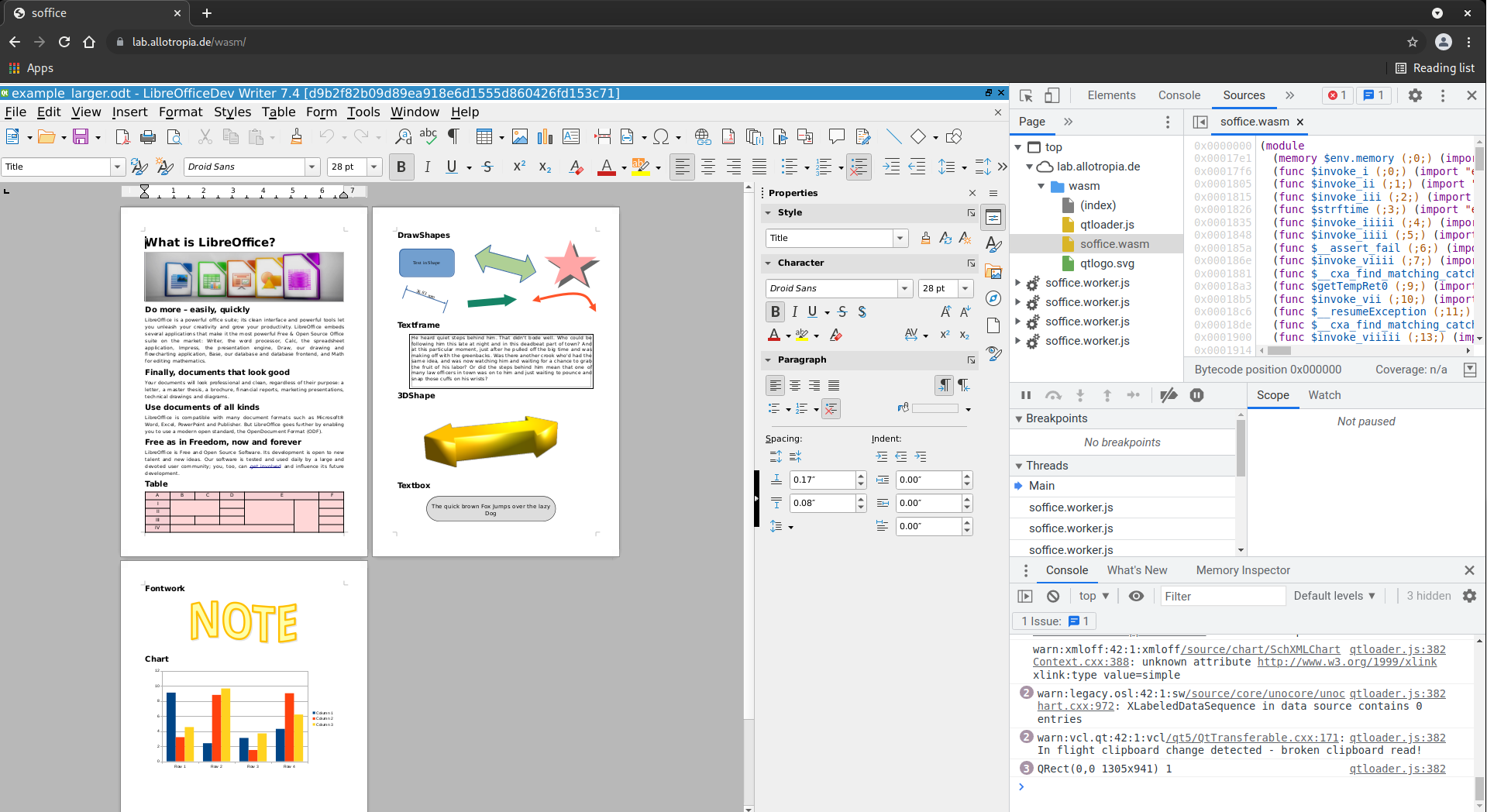
I personally use LibreOffice as my office suite for all the work, as I am a devotee of free software. I also promote LibreOffice when I guide people to switch to free software. Further, I make my slides for talks in LibreOffice Impress, and tell the audience that the slides are made using LibreOffice which respects user’s freedom.

I think the LibreOffice community is doing very good work, and therefore I wanted to share some LibreOffice flyers with some college group, on my Mastodon and my website. Before doing that, I wanted to remove the term ‘open source’ with ‘freedom-respecting’ because personally, I don’t promote the term ‘open source’. Then I contacted Mike Saunders. We had some email exchanges and Mike gave me the idea of joining the LibreOffice Marketing team.

I found the LibreOffice community inclusive and welcoming, so I feel at home. Promoting LibreOffice also serves my broader goal of spreading free software. Therefore, I decided to help LibreOffice in marketing. Thanks a lot!

What else are you planning to do?

As of now, FSCI is planning to announce public meetings which help people switch to Free Software. It is similar to GNU/Linux installfests. We haven’t done this yet. We are planning to have our first session soon. I personally believe that even if people understand the dangers of non-free software and realize that they should switch to free software, they have some inertia. This type of meetings are aimed at breaking that inertia.

Currently, the adoption and awareness of free software is concentrated highly in a few Indian states, like Kerala. I am also planning to reach people in other areas of India too.

How can others help with Free Software adoption / spreading the word in India?

The most important part for free software adoption is to replace as much proprietary software you can with free software in your own computing. Then convince others to switch to free software.

Please visit fsci.in, and join our chat groups mentioned at the bottom of the page. Feel free to join and discuss. Help us with maintaining the services and other activities that we already do. You can start your own initiatives. One important aspect of community is that if you do the activism alone, you can easily get demotivated. Meeting like-minded people acts as a psychological boost. This is one reason I am able to boycott non-free software successfully.

Further, our goal (as FSCI) is not only creating more free software users but creating functional free software communities which are inclusive, welcoming and respectful.

I believe, we also need to have more free software businesses like libretech.shop, which sells free software powered laptops and mobiles.

Thanks for your time, Ravi! Finally, how can we reach you?

The contact page of my personal website lists the ways you can get in touch with me. You can also send me an email via ravi at ravidwivedi.in. Looking forward to hearing from you!

LibreOffice project and community recap: November 2021

Here’s our summary of updates, events and activities in the LibreOffice project last month – click the links to learn more!

  • Although the pandemic is still limiting in-person events, members of the French-speaking community met at the Open Source Experience 2021 in Paris. They had a booth with materials and information about LibreOffice.

  • Meanwhile, Bayram Çiçek, who’s helping to implement new features in LibreOffice as part of the Google Summer of Code, told us about his work and why he recently became a Member of The Document Foundation.

Keep in touch – follow us on Twitter, Facebook and Mastodon. Like what we do? Support our community with a donation – or join us and help to make LibreOffice even better!

Tender to optimize text layout performance for print and PDF export (#202112-01)

The Document Foundation (TDF) is the charitable entity behind the world’s leading free/libre open source (FLOSS) office suite LibreOffice.

We are looking for an individual or company to optimize text layout performance for print and PDF export.

The text layout performance as currently implemented in LibreOffice has lots of issues. All over the codebase text shaping is done over and over again, although it consumes quite some compute cycles. Text shaping is done each time for measuring the text, measuring parts of text, finding line breaks, drawing text on screen. Especially for more involved scripts than Latin, this is problematic. The above issues are especially problematic for printing or PDF export. The time to export a PDF or print a Latin text has doubled since the Harfbuzz implementation.

It’s up to the bidder how to solve the problem. Some possible solutions could be:

  • retaining shaping results much longer
  • improving the wasteful OutputDevice API
  • implement caching

The scope of this tender is to fix at least the following issues:

Further reference can be found at:

All technology standards of relevance, as well as their targeted versions for this tender should be declared or defined in the offer’s description of implementation.

A key item of the deliverables for this tender, and therefore also a decision criteria – besides qualification, references, price, and completness of fullfilment – is extensive documentation about the approach chosen to implement the above items, covering more than just the pure implementation. We expect bidders to provide documentation on both the code and the non-code parts of this tender, e.g. methodology, structure and technical aspects.

The Document Foundation will publish this under a free and open source license and make it available to the general public.

Required skills

  • Extensive knowledge of C++
  • Experience working on the LibreOffice source code

Other skills

  • English (conversationally fluent in order to coordinate and plan with members of TDF)

We use free, libre and open source (FLOSS) software for development wherever possible, and the resulting work must be licensed under the Mozilla Public License v2.0.

TDF welcomes applications from all suitably qualified persons regardless of their race, sex, disability, religion/belief, sexual orientation or age.

Bidders will get a preference for including a partner or independent developer who has not been involved in a successful tender before. For such developers, who have not yet been part of a successful tender bid, we aim on a best-effort basis, but without any guarantees whatsoever, to provide some mentoring in understanding the code base and the process in contributing to the code. We expect that time and efforts on the bidder’s side should not be part of the paid work for this tender. Please mention such need of LibreOffice development mentoring in your offer.

As always, TDF will give some preference to individuals who have previously shown a commitment to TDF, including but not limited to certified developers and/or members of TDF. Not being a member, or never having contributed before, does not exclude any applicants from consideration.

The task offered is a project-based one-off, with no immediate plans to a mid- or long-term contractual relationship. It is offered on a freelance, project basis. Individuals and companies applying can be located anywhere in the world.

When budgeting, we anticipated that this project (all items combined) to take in the region of 30 days of work. Should bidders’ assessment result in a significantly different number, please reach out to us before sending your bid, so we can clarify upfront.

TDF is looking forward to receiving your applications, your financial expectations offer in form of a fixed time fixed budget approach and the duration period for the implementation in calender weeks after the final reward of the tender, via e-mail to a committee at tender20211201@documentfoundation.org no later than January 21, 2022.

Applicants who have not received feedback by February 18, 2022 should consider that their application, after careful review, was not accepted.

All bidders are invited to ask their questions on this tender until January 14, 2022. Questions and answers will be made public in a collected and anonymized form.

Winners in the Month of LibreOffice, November 2021!

At the start of November, we revved up a new Month of LibreOffice, celebrating community contributions all across the project. We do these every six months – so how many people got sticker packs this time? Check it out…

Awesome work, everyone! Hundreds of people, all across the globe, have helped out in our projects and communities. We’re hugely thankful for your contributions – and, of course, everyone who’s listed on the wiki page can get a sticker pack, with these stickers and more:

How to claim

If you see your name (or username) on this page, get in touch! Email mike.saunders@documentfoundation.org with your name (or username) from the wiki page so that we can check, along with your postal address, and we’ll send you a bunch of stickers for your PC, laptop and other kit.

(Note: your address will only be used to post the stickers, and will be deleted immediately afterwards.) If you contributed to the project in November but you’re not on the wiki page, please let us know what you did, so that we can add you!

There is one more thing…

And we have an extra bonus: 10 contributors have also been selected at random to get an extra piece of merchandise – a LibreOffice hoodie, T-shirt, rucksack or snazzy glass mug. Here are the winners – we’ll get in touch personally with the details:

  • Marcela Tomešová
  • Sabyasachi Bhoi
  • Radish
  • Andrew Pitonyak
  • giors_00
  • Vasudev Narayanan
  • Ezinne
  • GrahamLees
  • psidiumcode
  • Annabelle Wübbelsmann

Congratulations to all the winners, and a big thanks once again to everyone who took part! Your contributions keep the LibreOffice project strong. We plan to have another Month of LibreOffice next May, but everyone is welcome to see what they can do for LibreOffice at any time!

TDF Board of Directors election, 2021 – Third live Q+A session video

The election for The Document Foundation’s Board of Directors is running, and we have live Q+A sessions with the candidates. Yesterday, we posted a video from the second session and now we have recording of the third session (PeerTube version coming soon too) – timestamps for specific topics:

  • 02:50 – Introduction round
  • 29:20 – LibreOffice documentation
  • 37:30 – Expenses and reimbursements
  • 45:30 – Idea for members voting on technical decisions
  • 1:07:20 – How to attract and retain members
  • 1:19:20 – Projects in schools
  • 1:33:20 – LibreOffice Online, the ecosystem, and LibreOffice Technology

Please confirm that you want to play a YouTube video. By accepting, you will be accessing content from YouTube, a service provided by an external third party.

YouTube privacy policy

If you accept this notice, your choice will be saved and the page will refresh.

All TDF members should have received an email, with instructions on how to vote – the process ends on Monday, 2021-12-13, 24:00 CET/UTC+1.