LibreOffice Asia Conf 2025 – Panel: Lessons from Open Source Business, Part I

LibreOffice Asia Conference logo

Jiajun Xu writes:

The annual community event LibreOffice Asia Conference was held on December 13-14 2025 in Tokyo, Japan. One of the sessions was a panel discussion titled “Lessons from Open Source Business,” moderated by Franklin Weng, featuring three company leaders from different countries sharing how they run their businesses with open source tools. This article covers the first part of the panel: the business introductions.

(Note: photo credits: Tetsuji Koyama, CC BY 4.0)

Business Introductions

Germany: Lothar Becker and .riess applications

Lothar Becker

The first to present was Lothar Becker from Germany, Managing Director and owner of “.riess applications.” The company primarily operates in Europe, providing consulting services based on open source solutions.

Lothar described himself as not being development-oriented, but rather focused on client relationships and consulting — a personal trait that has shaped the company’s direction. As a consulting firm, a defining feature of .riess’s business model is that it does not charge for technical support or long-term support licensing fees. Instead, they productize their expertise as consulting services. This means .riess operates on a people- and time-based revenue model, which does not lend itself to the kind of exponential revenue scaling that SaaS companies achieve through near-zero marginal costs.

Regarding market positioning, Lothar noted that .riess has extensive experience in desktop-oriented open source solutions. “This was the direction we set 20 years ago. At the time, every company in Europe was focused on the server side and the operating system side, while very few were working on the desktop. By not following the crowd, we carved our own path. It wasn’t easy, but it turned out to be the right decision,” Lothar said.

.riess has served many notable clients, including internationally renowned companies such as JP Morgan Chase and the Deutsche Bundesbank. They have also been involved in large-scale government migration projects, including those in Schleswig-Holstein and the Free State of Thuringia (Freistaat Thüringen). In the Schleswig-Holstein case, 25,000 client endpoints were migrated from Microsoft Office to LibreOffice. The project established a resilient support structure: the government’s existing IT service provider, Dataport, handled first- and second-level support, while .riess provided third-level support focusing on strategic consulting, macro migration, and interoperability issues.

Development and bug fixing were handled by another open source partner, Allotropia. This collaborative model demonstrates how small open source service companies can participate in large government migration projects by partnering with others, each contributing their specific expertise. Beyond major clients, .riess has also helped many smaller clients adopt online collaborative office suites and other open source solutions.

Taiwan: Kevin Lin and OSSII

Kevin Lin

The next speaker was Kevin Lin from OSSII (Open Source Software Integral Institute) in Taiwan. Founded in 2003, OSSII’s core business includes LibreOffice-related product development and system integration, Nextcloud customization and deployment, and open source solution consulting services. Kevin noted that his core role is to serve as a bridge between the government, enterprises, and the open source community, while helping clients stay grounded and avoid unrealistic expectations: open source is powerful, but making effective use of it still requires proper planning and professional support.

OSSII is focused on localized office productivity solutions built on open source software. On the desktop side, “OxOffice” is a LibreOffice-based office suite customized with various features tailored to the needs of Taiwanese enterprises and government agencies.

For online collaboration, “OxOffice Online” is an online editor derived from Collabora Online. Together with “ODFWeb”, an online collaboration platform customized from Nextcloud that provides full-text search, data sharing, and file permission management, these components form a complete open source document collaboration ecosystem. Kevin also demonstrated real-world customer deployments, proving that the solution works reliably in large-scale environments.

It’s worth noting that OSSII has maintained a close partnership with the Taiwanese government for over a decade. After the government established policies to promote the Open Document Format (ODF) standard, the open source community helped with advocacy while OSSII provided technical solutions centered on LibreOffice, contributing as much source code as possible back to the community. Kevin showed the Ministry of Digital Affairs’ “ODF Application Tools” page, with its source code publicly shared on GitHub — a prime example of collaboration between government, enterprise, and the open source community.

Finally, Kevin reiterated his company’s role as a bridge: OSSII connects communities and open source projects on one side with enterprises, government, and end users on the other, facilitating exchange and interaction through operations, development, integration, and training. OSSII’s vision is to open up Taiwan’s traditionally closed software ecosystem, reduce dependence on major vendors, and support digital sovereignty while maintaining a healthy business environment.

Indonesia: Ahmad Haris and STIA & Nenggala

Ahmad Haris

The third speaker was Ahmad Haris from Indonesia, who serves as Vice President at STIA and founder of Nenggala. Rather than talking about a vision and mission statements, he preferred to let his case studies speak for themselves.

Haris joked that government officials sometimes refer to him as a “technology magician” because they always come to him with all sorts of challenges—often with deadlines of just three to four weeks. The largest government project he handled at STIA was building a biometric-based criminal record database for the Indonesian Attorney General’s Office, capable of connecting to cameras and surveillance systems, enabling real-time facial recognition matching against criminal records. This system is expected to be deployed to every city in Indonesia within the next few years.

What stands out is that Haris has never successfully “sold” LibreOffice as a standalone offering. Instead, his approach is to embed LibreOffice within backend systems to handle document generation – so users don’t even know they’re using LibreOffice. He even plans to try getting clients to use Linux on the desktop next: not by pushing it, but by building it first, showing that it works well, and then saying, “It’s up to you whether you want to use it.”

Nenggala has only three full-time employees including Haris himself, yet they have built an impressive array of tools: a secure communication system based on the Matrix protocol, used by the election commission during the last presidential election and serving over 300,000 users; task management based on Planka; and SymbiotOS, a hardened mobile device solution based on GrapheneOS with high privacy and security standards — even capable of running Debian on a phone via KVM.

However, not every project is profitable. During the COVID-19 pandemic, they built a remote learning solution using BigBlueButton and Moodle, but rural elementary schools simply couldn’t afford to pay. Haris just couldn’t bring himself to charge them, and in some cases even donated servers.

Haris also shared an important practice: when his team uses open source projects, they don’t simply fork and rebrand—they actively contribute back upstream. For example, when they adopted the support management system Zammad, they discovered that an Indonesian language translation was missing. His teammate Rania Amina completed the full localization and pushed it upstream. Rania has since become the Indonesian language maintainer for the project.

Moderator’s Summary

After the three business introductions, Franklin provided a comparative summary of the three speakers’ business styles:

  • Kevin’s OSSII started in the OpenOffice.org era and has remained focused on LibreOffice and Nextcloud. They have their own products, development capabilities, and do customization—a well-rounded, all-in-one type.
  • Lothar’s .riess applications traces its origins back even further, having been the first commercial service partner for StarOffice and later OpenOffice.org. Today, they have chosen to focus purely on services: no products, no licensing fees, no development — a highly focused consulting model.
  • Haris leverages open source technologies across different business models. His two companies differ in approach: STIA is project-oriented, while Nenggala is more product-oriented. Both do development and customization, but with different emphases.

Despite their different paths, Franklin pointed out several clear commonalities. First, all three started by participating in open source communities and gradually developed their skills in development, community leadership, or business operations along the way. Second, scaling remains a challenge for these companies; none of them has more than ten employees. Being small companies, they always need to collaborate with other partners, operating in a “fight as a group” mode. Finally, all three have extensive experience working with government clients, helping public sector organizations migrate to and adopt open source solutions.

Welcome Vissarion Fisikopoulos, new LibreOffice developer focusing on Base

Photo of Vissarion

LibreOffice Base is the database component of the suite, and hasn’t seen a lot of development activity in recent years. So The Document Foundation – the non-profit behind the software – wants to change that! Following Neil Roberts, we now have a second new developer, Vissarion Fisikopoulos, so let’s hear from him…

Tell us a bit about yourself!

Hi everyone, I’m Vissarion, a software engineer and researcher based in Athens, Greece, and I’m very happy to have joined The Document Foundation to work on LibreOffice Base. My background combines scientific computing, databases, and open-source development, and I’ve been a long term contributor to several open source projects like MySQL, Boost C++ libraries and GeomScale. I am active in open source communities, and I speak regularly about open source development at conferences such as FOSDEM.

What’s your new role at TDF, and what will you be working on?

My new role at TDF is to work on LibreOffice Base and databases more broadly, with a focus on Base itself and the ways database functionality connects with the rest of LibreOffice.
In practice, that means working mostly in C++, fixing bugs, improving code quality, and helping implement features across Base’s frontend and backend.

How can all users of LibreOffice help you in this work?

Users can help a lot in this work!

Clear bug reports, reproducible test cases, feedback on real-world Base workflows, and testing development versions are all extremely valuable, because they help turn vague problems into issues that can actually be fixed.

And beyond that, contributions through QA, documentation, translations, and newcomer-friendly developer tasks all help strengthen the project as a whole.

So if you use LibreOffice Base, or if you care about databases and open source office software in general, your feedback and participation can genuinely help to shape the work ahead.

Thanks Vissarion – we’re looking forward to your work!

LibreOffice at Document Freedom Day in Noida, India

LibreOffice at Document Freedom Day in Noida, India

Ravi Dwivedi from the Indian LibreOffice community writes:

On the 29th of March 2026, we celebrated Document Freedom Day in Noida India. Thanks for Essentia.dev for the venue and sflc.in for sponsoring snacks and the cake. sflc.in is a donor-supported legal services organisation in India.

The event featured a few talks on free software such as OpenStreetMap, Prav and KDE, and also a lawyer told us how they manage all their clients’ data with free software and keeping their privacy in mind. In addition, we distributed LibreOffice merch at the sticker table.

Participants also played a fun game of guessing free software. Finally, the Document Freedom Day cake was cut followed by a group photo.

We thank all the participants and speakers who made the event possible.

LibreOffice at Document Freedom Day in Noida, India

LibreOffice at Document Freedom Day in Noida, India

LibreOffice at Document Freedom Day in Noida, India

LibreOffice at Document Freedom Day in Noida, India

LibreOffice at the Chemnitzer Linux-Tage 2026

Linux-Tage banner

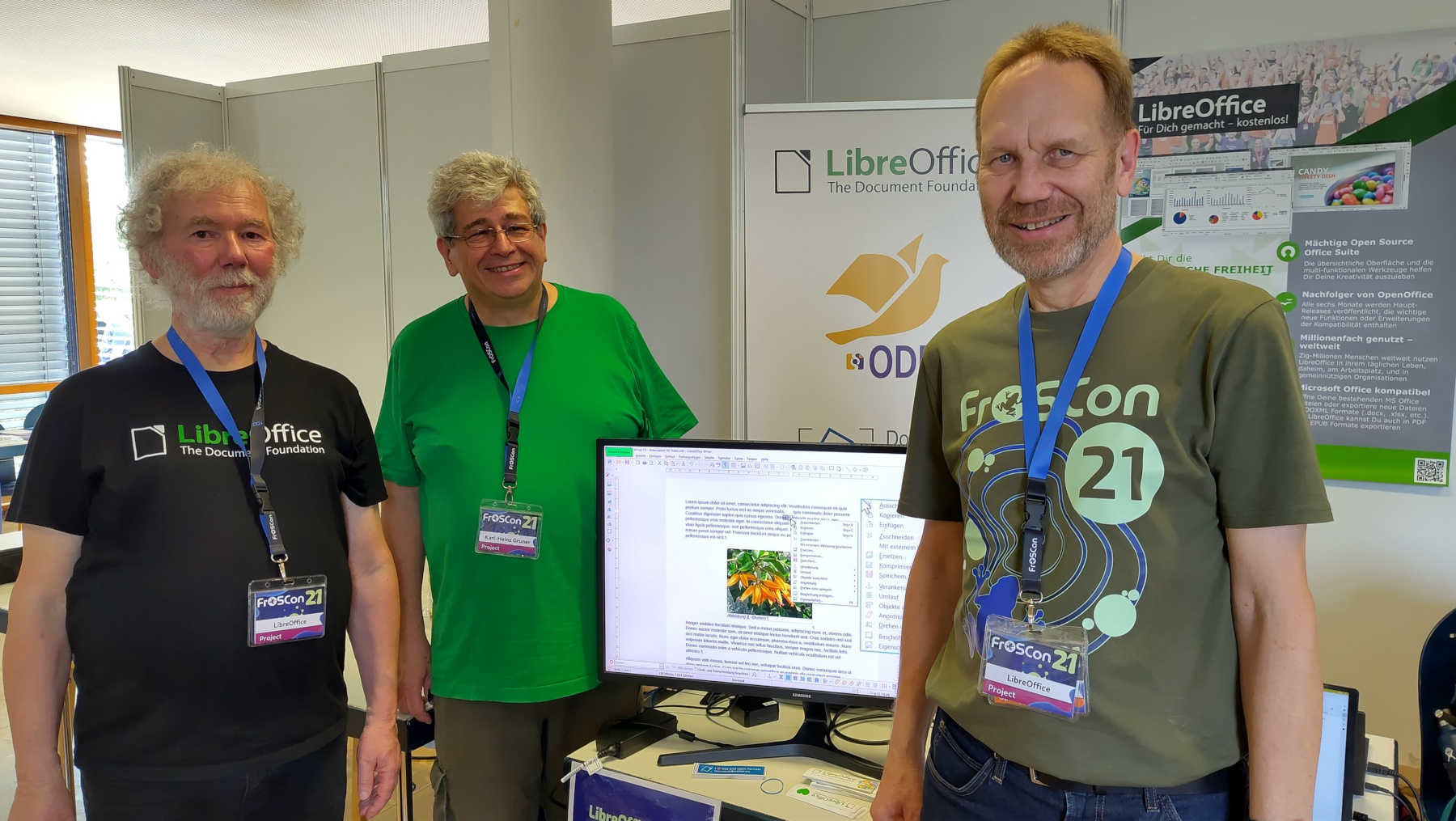
The Chemnitzer Linux-Tage (English page) is a yearly event in Germany for fans of free and open source software. This year, the LibreOffice project was present, as Karl-Heinz Gruner describes:

LibreOffice had an information booth at the event. Stickers and flyers were very popular. An excerpt from their extensive video tutorials was shown, including a summary of the new features in the current version.

Many questions were answered and tips were provided across all components. Enthusiastic feedback demonstrated the broad user community. Suggestions for contributing and expanding the community, such as user documentation, should attract new members over time and strengthen the active community.

We plan to be at many more events this year, including the Augsburger Linux-Infotag 2026 in early May, so see you there – and keep an eye on this blog!

Say hello to Neil Roberts, new LibreOffice developer focusing on scripting support

Photo of Neil Roberts

The Document Foundation, the non-profit entity behind LibreOffice, has a new developer in its team. Neil Roberts started work this month and will initially focus on LibreOffice’s scripting support. Let’s hear from him…

Tell us a bit about yourself!

I’m from the UK but I escaped to France after the Brexit vote and I’ve been living here in Lyon ever since. I got into programming when I was little, mostly by programming in BASIC on an Amstrad CPC. At the time I thought it was cool that you could sometimes see the source code in BASIC of software that you bought on cassette tape. Later my older brother got me into Linux and I loved that you could see the source code of absolutely everything. I’ve been a big fan ever since, and I always have some programming side project on the go.

I started my career at a small open source consultancy working on Clutter – which at the time was a project meant to bring revolutionary animated user interfaces inspired by the iPhone into the GNOME space. It is still used inside GNOME Shell today. Eventually that small consultancy got acquired by Intel where I moved onto working on the graphics drivers in Mesa.

I got into LibreOffice development last year after I was trying to help proof-read my wife’s master’s thesis and I ran into a small user interface bug. I made a patch to fix it and it gave me the opportunity to interact with the amazing LibreOffice community. I was very pleasantly surprised with the warm welcome and the encouragement to continue making more contributions. I have been hooked on it ever since.

Aside from tech, I like to ride my bike around the city and complain about cars. I usually have a knitting project with me at all times for when I want to relax. I’m also quite active in the Esperanto community.

What’s your new role at TDF, and what will you be working on?

I am in the scripting role, which means I will be helping to make life easier for people writing macros and extensions using the UNO API with any of the supported languages such as Python, JavaScript, Basic, C++ etc. Aside from BASIC, which has a very nice built-in editor and debugger, I think it’s still quite awkward to develop macros in the other languages – so I think one of the main tasks would be to improve the UI and user experience when writing in Python.

How can all users of LibreOffice help you in this work?

I think that filing bugs in Bugzilla to report issues that people are having with macro and extension development would be really helpful, including wish-list ideas of things that would be nice to have. I am very happy to discuss ideas on Bugzilla, the mailing list or in the Telegram group.

Otherwise, code contributions are very welcome of course. I hope to be able to give back the same warm welcome with code review and mentorship that I received when I made my first contribution.

Thanks Neil, and welcome on board!