Insights from the InstallFest 2024 conference in Prague

InstallFest 2024

Our Czech community reports back from a recent event…

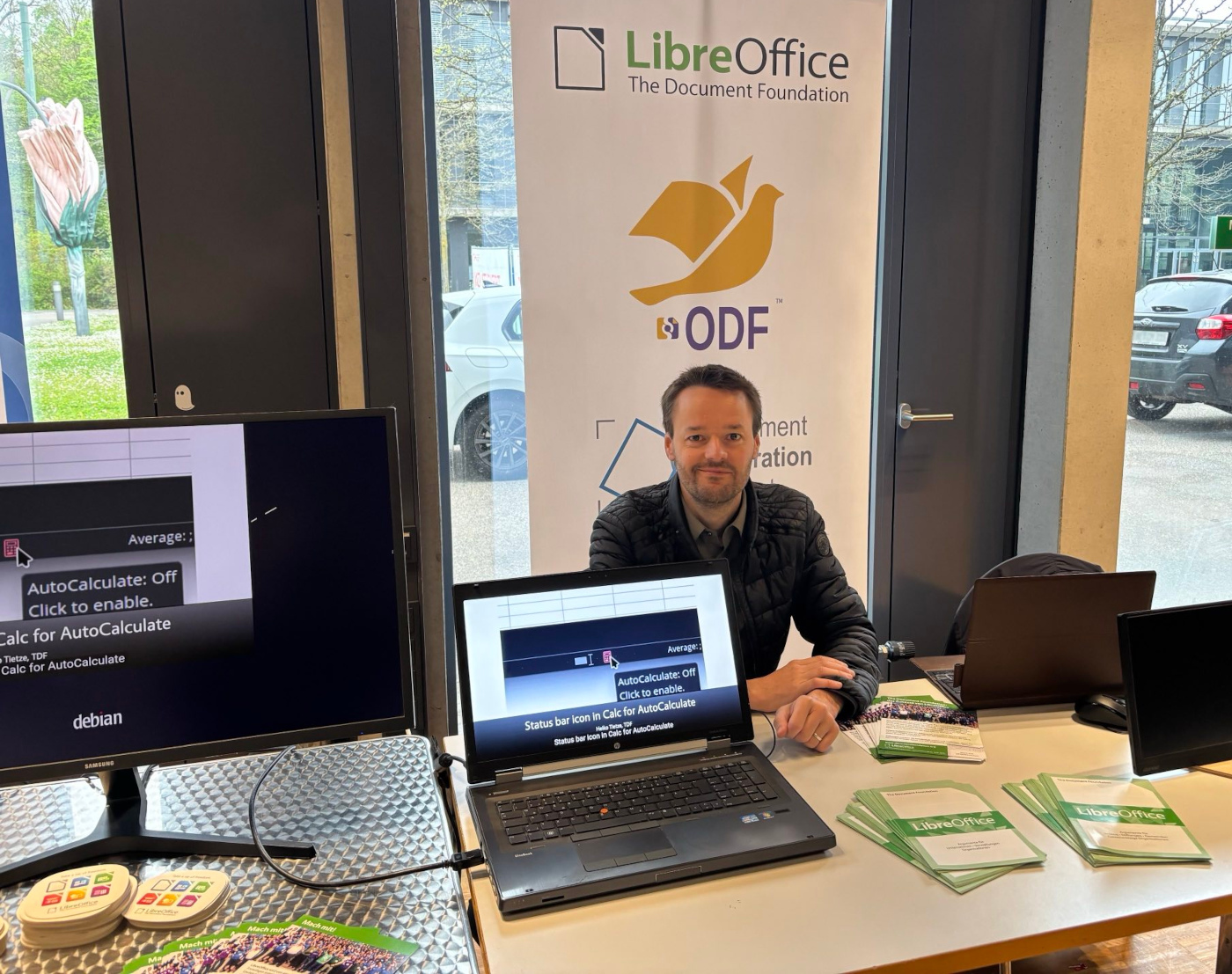
For the third time, the LibreOffice project had its own booth at InstallFest 2024, and here we present our experiences from the event.

On the weekend of 16th and 17th March 2024, the InstallFest 2024 conference took place at the Faculty of Electrical Engineering of the Czech Technical University in Prague. The conference was held after a two‑year break and under the direction of a new team led by Jan Langmaier. This year, according to the organisers’ estimates, about 300 visitors attended, making InstallFest a successful follow‑up to previous editions. Unfortunately, higher participation is limited by the space capacity of the chosen venue.

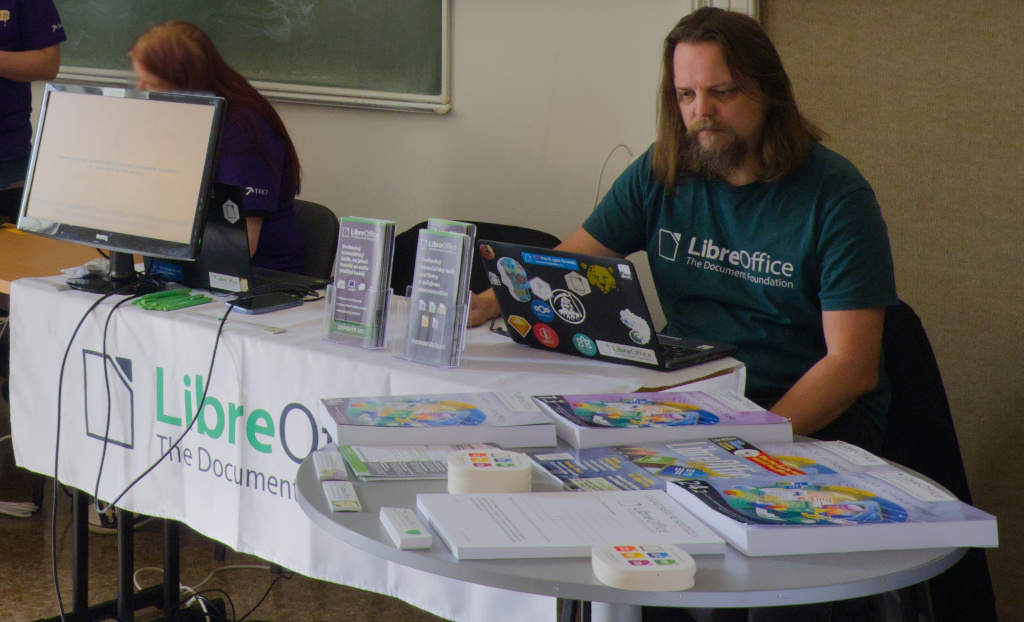
The lack of space also affected the LibreOffice booth, which had to be a bit aside from the main event. On the other hand, anyone heading to one of the main lecture halls could not miss us – our exclusive position made us unmissable. Even so, there were far fewer visitors at our booth than in previous years.

Feedback gained at InstallFest

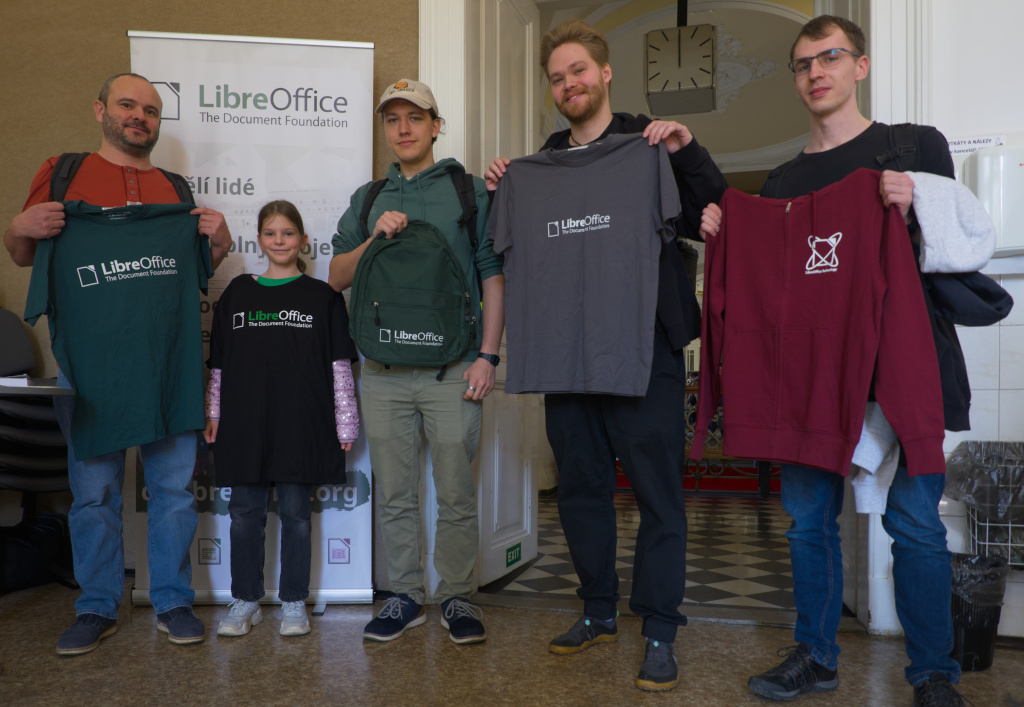
Conferences of this type appeal mainly to the younger generation, who must not be absent. It is therefore not surprising that young people from primary or secondary school are well represented among the visitors at the LibreOffice stand. This year, however, this was significantly more disproportionate than at other times – it can even be said that young people dominated. We always interviewed them, asking what they use LibreOffice for, how long they have been using it, whether it is used at school, where they go, and whether their classmates know about the suite.

The answers were generally similar. LibreOffice tends to be used by young people for basic tasks such as writing texts, creating presentations for school and so on. Those who create presentations in Impress for school assignments have to convert their presentations to PPTX format. Surprisingly, we’ve had good feedback on compatibility with this format, although it is of course problematic.

InstallFest 2024

Very few visitors know about the cloud or mobile versions of LibreOffice, but there are some. We were surprised that one high school student reported using the cloud‑based, non‑paid version of OnlyOffice; after learning about the circumstances (ie that this software is in Russian hands and thus subject to EU sanctions), he understood why the institute he was working with (apparently a non‑profit of some sort) did not want to purchase the paid version of OnlyOffice. It simply cannot.

Many visitors would welcome some changes in LibreOffice’s user interface. While some prefer the traditional toolbar layout, others prefer a Microsoft Office‑like look and feel – either for personal taste or for ease of transition from Microsoft Office. LibreOffice allows you to use different interfaces, but this option is hidden in the menus. Visitors would appreciate if, when LibreOffice is first launched, a wizard were displayed to guide the newcomer through the various setup and customisation options, including user interface selection.

We received a request from one tutor to allow multiplication of a combinational number by a combinational number in LibreOffice Calc, and also to simplify the notation of simple arithmetic operations such as multiplication and division. Currently this has to be done using verbally defined functions, so he would welcome the ability to use simple symbols typed from the keyboard.

InstallFest 2024

Although it would seem that office software cannot attract the attention of youngsters, one ninth-grader stayed with us for perhaps an hour. Obviously he was the record holder.

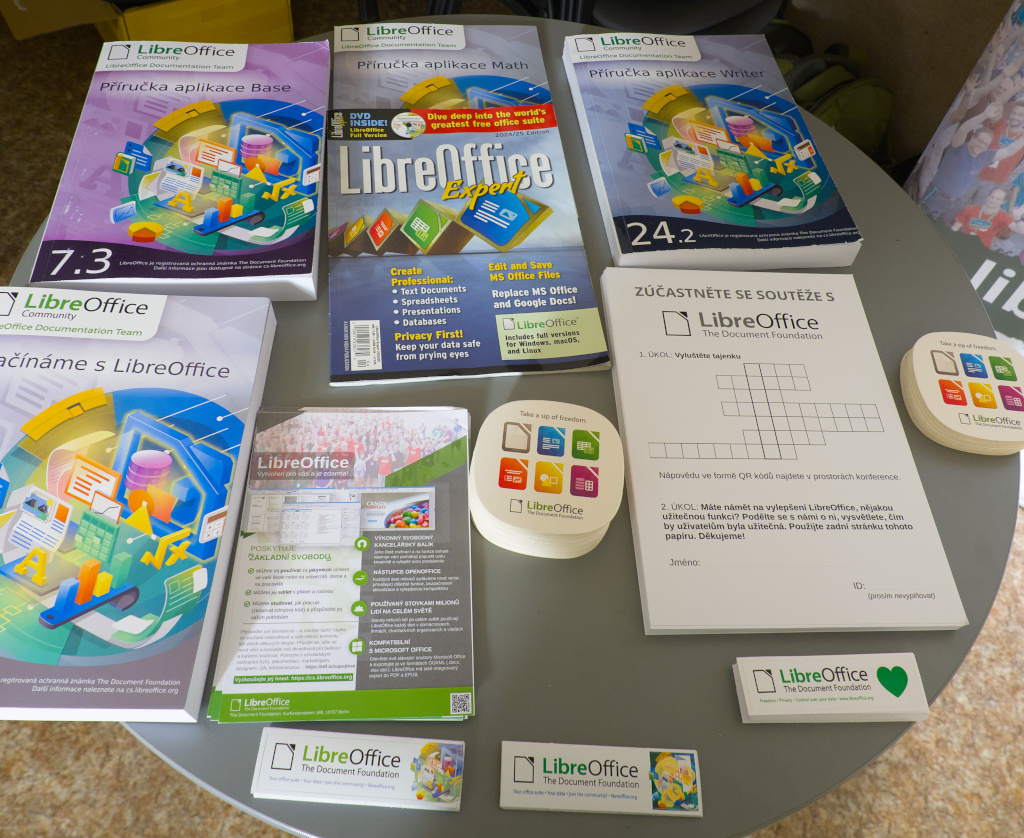
Zdenek Crhonek has a huge part in translating the LibreOffice manuals into Czech. These manuals are translated by a whole bunch of volunteers, and we displayed their covers here.
Traditionally, Collabora Online, the cloud version of LibreOffice, which is now very stable and usable and with a really extensive arsenal of features, attracted a lot of interest.

There were many interesting meetings of people who often only know each other from the virtual world; that’s what these conferences are for. A regular visitor to our booth is Ladislav Sieger, PhD., from the Faculty of Electrical Engineering CTU. He always has a problem to solve, an observation, or a comment.

After party

A very interesting opportunity (and meeting) was a visit to the basement of Strahov’s dormitories, where the SH Bastlíři (translated “DYI makers”) created their own facilities, a workshop that is available to (almost) everyone. Here you can come across a server rack on the ceiling of the toilet, a circular machine, a 3D printer and other interesting things. The visit to these premises was followed by a dinner at a nearby restaurant, where the participants from among the organizers (including speakers, technical staff, exhibitors) were taken by a chartered bus (!).

InstallFest 2024

Conclusion

The new organising team has done its task well. If there were problems, we are not aware of them; that is, they were of a completely minor nature. For us, the biggest problem was with the location of the stand; perhaps this played a role in the rather low attendance of interested people. Although we probably had the most space of all in the end and did not have to make any space constraints, we may not have reached as many visitors as we could have.

However, the other perspective should also be taken into account. Although LibreOffice plays a primary role in the world of open‑source software, it is considered a utility that does not attract as much visitor interest. Therefore, we have tentatively agreed with the organisers to change that next time on our side, and they have promised to help us.

Anyway, those who visited our booth hopefully took something away with them (besides stickers and leaflets), especially thanks to Zdeněk, who maintains a lively communication with LibreOffice’s front‑line staff and has information literally first‑hand. He can thus provide far more insider insight than one Czech community member alone on the stand could in previous years.

All of the talks were filmed and the recordings are available on YouTube.

Community Member Monday: Adam Seskunas

Adam Seskunas

Tell us a bit about yourself!

My name is Adam Seskunas and I currently live in San Diego, California. In my free time I enjoy outdoor activities, hiking, backpacking in the Sierra, rock climbing and surfing with my daughter Sofia. I have a degree in Computer Science from the University of Maryland Global Campus, and I’m an open source software enthusiast.

What are you working on in the LibreOffice project right now?

Currently I’m working on my first “Difficulty Interesting” Easy Hack, a nice description of which can be found on this page.

The Easy Hack involves the ASCII filter for LibreOffice Writer and the way it handles the output of tables. True to its name, the Easy Hack has been interesting! It’s been challenging and rewarding at the same time. I’d like to thank Hossein Nourikhah for providing the code pointers and background information, and Michael Weghorn for help in code review.

Why did you choose to join the project, and how was the experience?

I’ve been using LibreOffice ever since I became interested in using Linux, when I was studying for my Computer Science degree, but I never had considered contributing. It’s such a large project, and I had no experience with C++. I just happened to see an advert on VolunteerMatch for bug testing, and answering the ad got me in contact with Ilmari Lauhakangas.

Ilmari would meet with me bi-weekly and he taught me how to verify bugs in Bugzilla and eventually got me into developing. Overall, joining the project been a fantastic experience, from Ilmari’s mentorship to all the people involved – everyone’s been great. I’d highly recommend it to anyone.

Anything else you plan to do in the future?

My plan is to apply and hopefully get accepted to do Google Summer of Code for LibreOffice. I’ve been talking to Hossein about ideas and I’m excited to get my application written and submitted.

What does LibreOffice really need now?

I’d say more contributors. There’s a robust community of contributors, but any project could use more. It’s a great way to meet people and gain some experience. I’d encourage anyone reading this and thinking about contributing to check out the wiki. There’s great information there and you can help in many different ways, not just development.

Many thanks to Adam for all his contributions! Every LibreOffice user is welcome to get involved and find out what they can do in our community 👍

German state moving 30,000 PCs to LibreOffice

German state moving 30,000 PCs to LibreOffice

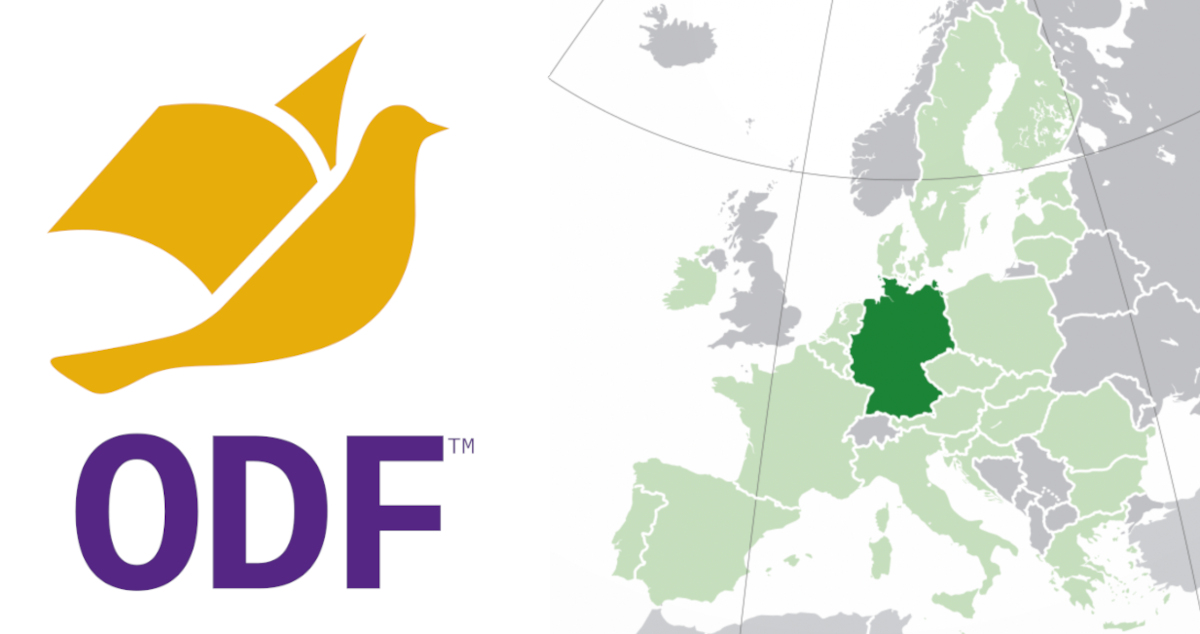
Following a successful pilot project, the northern German federal state of Schleswig-Holstein has decided to move from Microsoft Windows and Microsoft Office to Linux and LibreOffice (and other free and open source software) on the 30,000 PCs used in the local government. As reported on the homepage of the Minister-President:

Independent, sustainable, secure: Schleswig-Holstein will be a digital pioneer region and the first German state to introduce a digitally sovereign IT workplace in its state administration. With a cabinet decision to introduce the open-source software LibreOffice as the standard office solution across the board, the government has given the go-ahead for the first step towards complete digital sovereignty in the state, with further steps to follow.

The term digital sovereignty is very important here. If a public administration uses proprietary, closed software that can’t be studied or modified, it is very difficult to know what happens to users’ data:

We have no influence on the operating processes of such [proprietary] solutions and the handling of data, including a possible outflow of data to third countries. As a state, we have a great responsibility towards our citizens and companies to ensure that their data is kept safe with us and we must ensure that we are always in control of the IT solutions we use and that we can act independently as a state.

This follows on from the finding by the European Data Protection Supervisor (EDPS) that the European Commission’s use of Microsoft 365 breaches data protection law.

In addition, there is this question: Why should local governments use taxpayers’ money to buy proprietary, closed software from a single vendor? With LibreOffice and free software, administrations have much more choice where to get the software and support, and can fund local developers to make improvements. In addition, local governments can maintain full control of the software, study its source code, make changes they require and deploy it entirely on their own infrastructure. Learn more about “Public Money, Public Code”.

So we welcome the decision in Schleswig-Holstein to move its IT administration to free and open source software, for all the benefits it brings, both for the local government and the almost three million citizens of the state.

Full statement from the State Chancellery here (in German)

LibreOffice project and community recap: March 2024

Nepali LibreOffice community meeting

Here’s our summary of updates, events and activities in the LibreOffice project in the last four weeks – click the links to learn more…

TDF Board of Directors, 2024 - 2026

LibreOffice community at FOSDEM 2024

LibreOffice 24.2 cake

LibreOffice 24.2 Writer and Calc Guides

  • Also in docs news: in the middle of the month, we talked to Dione Maddern about her experiences joining the LibreOffice project. Thanks to Dione for all her contributions!

Dione Maddern

Czech LibreOffice Writer Guide 24.2

  • Later in the month, we celebrated Document Freedom Day, which raises awareness of how open standards and open document formats provide us with the freedom to read and write as we wish.

Document Freedom Day banner

  • March saw two updates to LibreOffice: 24.2.2 and 7.6.6. All users of these branches are recommended to get the latest versions.

LibreOffice donate banner

Globe

Keep in touch – follow us on Mastodon, X (formerly Twitter), Bluesky, Reddit and Facebook. Like what we do? Support our community with a donation – or join our community and help to make LibreOffice even better!

European Commission’s use of Microsoft 365 breaches data protection law for EU institutions and bodies

The European Data Protection Supervisor (EDPS) has found that the European Commission (Commission) has breached several provisions of Regulation (EU) 2018/1725, the EU data protection law for EU institutions (EUIs), in its use of Microsoft 365, including those relating to the transfer of personal data outside the EU and the European Economic Area (EEA). The EDPS is imposing corrective measures on the Commission.

In particular, the Commission has failed to provide adequate safeguards to ensure that personal data transferred outside the EU/EEA are afforded the same level of protection as that guaranteed within the EU/EEA.
Furthermore, in its contract with Microsoft, the Commission did not sufficiently specify the types of personal data to be collected and for what explicit and specified purposes when using Microsoft 365. The Commission’s breaches as data controller also relate to data processing, including the transfer of personal data, carried out on its behalf.

The EDPS has therefore decided to order the Commission to suspend, with effect from 9 December 2024, all data flows resulting from the use of Microsoft 365 to Microsoft, its subsidiaries and sub-processors located in countries outside the EU/EEA that are not covered by an adequacy decision.

In effect, the EDPS has confirmed what we have been arguing for years, namely that the only individual productivity solutions that also guarantee data protection and support the concept of Europe’s digital sovereignty – technological independence from the commercial decisions of high-tech companies, especially from the US – are FOSS solutions such as LibreOffice combined with a standard, open and independent data format such as the Open Document Format.

The EDPS, though, has also decided to order the Commission to bring the processing operations resulting from its use of Microsoft 365 into compliance with the EU Regulation 2018/1725. The Commission has until 9 December 2024 to demonstrate compliance with both orders.

The EDPS considers that the corrective measures it imposes (described in the document annex [1]) are appropriate, necessary and proportionate in light of the seriousness and duration of the infringements found.
Many of the infringements found concern all processing operations carried out by the Commission, or on its behalf, when using Microsoft 365, and impact many individuals.

Unfortunately, all the remedies identified by the EDPS relate to Microsoft 365, and therefore do not address the root of the problem by suggesting the use of FOSS solutions such as LibreOffice and the only truly standard, open and independent document format, the Open Document Format.

It is highly likely that Microsoft’s solution will be the usual ‘sticking plaster’ that hides the problem without addressing it, and that the lobbyists – who I am sure are already at work – will make it look appropriate in the eyes of politicians.

And if we continue to protest, knowing that we will not be heard because we do not have the same firepower as the lobbyists of the big US hi-tech companies who are present in Brussels with hundreds of professionals, we will always hear the same thing: “They all do the same…”.

[1] https://www.edps.europa.eu/press-publications/press-news/press-releases/2024/european-commissions-use-microsoft-365-infringes-data-protection-law-eu-institutions-and-bodies_en