LibreOffice 64-bit progress, and support for Amazon Linux 2023

CPU on a motherboard

LibreOffice has been available for Linux since we started the project in 2010. The official builds from The Document Foundation (the non-profit entity behind LibreOffice) are designed to be self-contained and distribution agnostic – that is, they should work on as many distributions as possible.

To achieve this, we test on various Linux distributions, and now we consider Amazon Linux 2023 as another platform supported by LibreOffice. Amazon has provided resources for regular and automated CI (continuous integration) testing of LibreOffice builds against Amazon Linux 2023, including crash-testing runs, via the AWS Open Source Credits programme.

As part of this, and for the general benefit of other users, TDF has started to provide 64-bit ARM Linux builds (aarch64) in RPM format. We’ve worked on improving 64-bit ARM support for various platforms in recent years, including for Windows and on Apple silicon Macs, given that the chips are becoming increasingly used in desktops and servers.

64-bit ARM chips commonly power cloud infrastructure, where LibreOffice is often used in headless (non-GUI) tasks, such as batch conversions of large numbers of documents. But some users run LibreOffice graphically too. With the updates we’ve been working on, LibreOffice is now available on more infrastructure and can be deployed on Amazon Elastic Compute Cloud (Amazon EC2). If there’s anything else users would like to see, submit an enhancement request and let us know!

LibreOffice project and community recap: September 2025

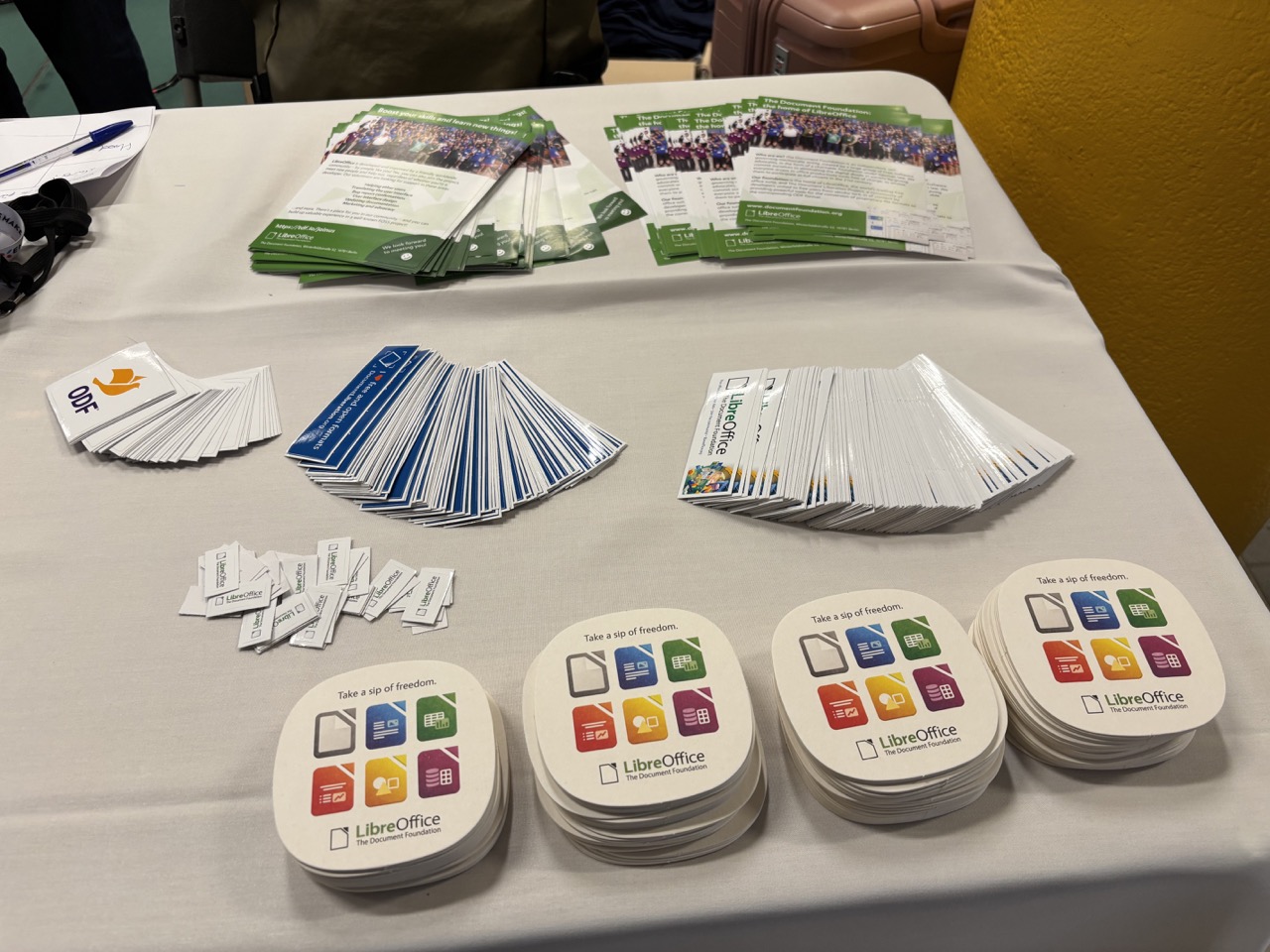
LibreOffice Conference 2025 merchandise

Here’s our summary of updates, events and activities in the LibreOffice project in the last four weeks – click the links to learn more…

  • At the start of the month, the LibreOffice Conference 2025 took place in Budapest, Hungary. We had talks, workshops, fun social events and more. Thanks to all who attended 😊 See the schedule for information about the talks (and links to the slides, where available).

Please confirm that you want to play a YouTube video. By accepting, you will be accessing content from YouTube, a service provided by an external third party.

YouTube privacy policy

If you accept this notice, your choice will be saved and the page will refresh.

LibreOffice 25.2 logo

Guidebook cover

  • The Annual Report of The Document Foundation describes the foundation’s activities and projects, especially in regard to LibreOffice and the Document Liberation Project. We’ve been posting sections of the 2024 report here on the blog, and now the full version is available.

TDF Annual Report 2024 cover

  • Companies around the world use LibreOffice to reduce costs, improve their privacy, and free themselves from dependence on single vendors. We talked to Flotte Karotte, a German company with 50 employees that recently made a generous donation to support the LibreOffice project and community.

Photo of food being delivered

Open Source Conference 2025 logo

  • We spoke to Devansh Varshney, who added histogram chart support to LibreOffice and is working on improvements to the Basic IDE.

Devansh Varney photo

Suraj Bhattarai

Montage of photos from LibreOffice events

Bundesheer logo

Keep in touch – follow us on Mastodon, X (formerly Twitter), Bluesky, Reddit and Facebook. Like what we do? Support our community with a donation – or join our community and help to make LibreOffice even better!

🇨🇺 LibreOffice in Latin America: heading to Havana for the 2025 Latin American Congress

From October 6 to 9, Havana, Cuba, will host the Latin American LibreOffice 2025 Conference, a meeting that will bring together contributors, developers, universities, and governments from the region to celebrate and strengthen free software.

This year, the Latin American conference will be held as part of the IV International Congress on Digital Transformation (Cibersociedad 2025) in Havana, Cuba. This integration reinforces LibreOffice’s crucial role in the digital transformation of Latin American communities, promoting open innovation, technological sovereignty, and collaboration between countries.

The event will take place at the iconic Hotel Nacional de Cuba and will feature an intense program of lectures, panels, and workshops dedicated to LibreOffice, its communities, and institutional adoption initiatives.

🌍 A meeting that connects communities and governments

The opening ceremony will pay tribute to Cuban volunteer Carlos Parra, who passed away in 2022.

It was thanks to his dedication, articulation, and love for the community that the opportunity arose to hold the Latin American LibreOffice Congress in Cuba—a dream he helped make possible.

Carlos was the link between the Cuban community and The Document Foundation, and his contribution will remain as a legacy of collaboration and commitment to digital freedom.

During the event, Adlair Cerecedo-Méndez will present the experience of Office GobMX, the LibreOffice-based suite developed by the Mexican government. Other highlights include the panel “LibreOffice is freedom,” with Olivier Hallot, founding member of The Document Foundation and Documentation Coordinator for the LibreOffice Project, as well as discussions on government migration, extensions, technical quality, and the rebirth of the Cuban community — with participation from Gustavo Pacheco (Brazil), Mauricio Baeza (Mexico), and Xisco Faulí (Spain).

🧑‍🏫 Training and academic innovation

At the University of Information Sciences (UCI), the event will open space for young people and educators with the “LibreOffice and Universities” lab, led by Gustavo Pacheco, and the “Creating my first extension” workshop, conducted by Mauricio Baeza — a practical opportunity for those who want to learn how to expand LibreOffice and contribute technically to the project.

💬 Regional meetings and plans for 2026

The congress will close with meetings between Latin American members of the LibreOffice community, addressing:

  • the 2026 events calendar (including esLibre and the next Latin American Congress);
  • academic projects such as Google Summer of Code and Outreachy;
  • and new partnerships with other free software communities, such as GNOME Latam.

These sessions reflect the collective commitment to strengthening collaboration between countries and consolidating a more active presence for Latin America within The Document Foundation.

💪 An event driven by volunteers

The Congreso Latinoamericano de LibreOffice is an event organized entirely by volunteers, who dedicate their time, energy, and knowledge to make this initiative possible. Our special recognition and thanks go to Daniel Rodriguez (Argentina), Gastón Hannay (Uruguay), Omar Correa (Cuba), Gustavo Pacheco (Brazil), and Juan González (Mexico), who have been working tirelessly to make every detail of this edition possible.

We also express our sincere gratitude to the University of Computer Sciences (UCI) and the Cibersociedad 2025 organization for opening their doors and sharing their infrastructure—including rooms, laboratories, and technical support—making it possible to hold the Latin American LibreOffice Congress within their event.

This partnership reinforces the spirit of academic collaboration and the joint commitment to digital transformation in Latin America.

The Document Foundation (TDF), in its mission to promote LibreOffice and strengthen its global community, supports and sponsors these activities, enabling the participation of volunteers from different countries.

This support allows members of the Latin American community to meet in person, exchange experiences, and strengthen the international collaboration that sustains the project.

🌎 Freedom, collaboration, and the future

The LibreOffice Latin American Congress in Cuba is more than a technical event—it is a reunion of the Latin American community, united by ideals of freedom, solidarity, and technological sovereignty.

LibreOffice is, above all, a project made by people, for people. And this congress is living proof that collaboration can cross borders, languages, and generations.

📅 Date: October 6-9, 2025

📍 Location: Hotel Nacional de Cuba – Havana

🌐 More information: latam.conference.libreoffice.org

The artificial complexity of OOXML files (the DOCX case)

The complexity of the OOXML format is linked to its design and was deliberately created to make the format more difficult for non-Microsoft software developers to implement. Compatibility issues are caused by a veritable “maze” of tags used even for the simplest content, which binds users to the Microsoft ecosystem in the first example of standard-based lock-in.

The DOCX case

To demonstrate the difference in complexity between the XML schemas of Writer and Word text documents in the ODF and OOXML formats, I used two classic English theatre plays: William Shakespeare’s Hamlet and Oscar Wilde’s The Importance of Being Earnest. I downloaded the text versions of these works from Project Gutenberg — a library of classic texts for which US copyright has expired — and deleted the introductions and conclusions added by Project Gutenberg, without making any other changes.

I then repeated this process for both documents.

I copied all the text and pasted it, without any formatting, into two newly created blank documents. For Writer, I used the template that I usually use for unstructured documents; for Word, I did not use a template. This means that, in Writer, the XML schema contains information about the template (margins, paragraph and font formatting), but this does not increase its complexity.

To perform the analysis, I duplicated and renamed the two files, replacing the original extension with “ZIP”, and then decompressed them to create two folders containing all the files of the respective XML schemas.

The LibreOffice folder contained three subfolders and six files with the same names as those in the ODS file examined last week, as would be expected of a standard aiming to simplify life for developers and users. All the content is actually in the content.xml file, while the other files contain instructions for displaying the text document correctly.

The Microsoft 365 folder contains three subfolders and the [Content_Types].xml file, as with the XLSX file examined last week. One of the subfolders has a different name, but this is related to the application and does not increase complexity. Opening the [Content_Types].xml file provides information about the other files, including those in the subfolders.

In this case, the content is in the document.xml file inside the Word folder, which contains folders and files that differ completely from those in the XLSX file. Again, there is no technical reason for this difference in the XML schemas of the two files other than to make their internal structures different and more complex.

Let’s now analyse William Shakespeare’s Hamlet and then Oscar Wilde’s The Importance of Being Earnest.

Here is the PDF of Hamlet:

hamlet


The difference in complexity between the document.xml and content.xml files is striking when you compare their lengths: the content.xml file has 6,802 lines, while the document.xml file has 60,245 lines, compared to a text document of 5,566 lines.

Let us now compare the two files’ XML schemas from the beginning to the end of the introduction.

CONTENT.XML

<office:body>
<office:text text:use-soft-page-breaks=”true”>
<office:forms form:automatic-focus=”false” form:apply-design-mode=”false”/>
<text:sequence-decls>
<text:sequence-decl text:display-outline-level=”0″ text:name=”Illustration”/>
<text:sequence-decl text:display-outline-level=”0″ text:name=”Table”/>
<text:sequence-decl text:display-outline-level=”0″ text:name=”Text”/>
<text:sequence-decl text:display-outline-level=”0″ text:name=”Drawing”/>
<text:sequence-decl text:display-outline-level=”0″ text:name=”Figure”/>
</text:sequence-decls>
<text:p text:style-name=”P1″>THE TRAGEDY OF HAMLET, PRINCE OF DENMARK</text:p>
<text:p text:style-name=”P1″/>
<text:p text:style-name=”P1″>by William Shakespeare</text:p>
<text:p text:style-name=”P1″/>
<text:p text:style-name=”P1″>Contents</text:p>
<text:p text:style-name=”P1″/>
<text:p text:style-name=”P1″><text:s/>ACT I</text:p>
<text:p text:style-name=”P1″><text:s/>Scene I. Elsinore. A platform before the Castle</text:p>
<text:p text:style-name=”P1″><text:s/>Scene II. Elsinore. A room of state in the Castle</text:p>
<text:p text:style-name=”P1″><text:s/>Scene III. A room in Polonius’s house</text:p>
<text:p text:style-name=”P1″><text:s/>Scene IV. The platform</text:p>
<text:p text:style-name=”P1″><text:s/>Scene V. A more remote part of the Castle</text:p>
<text:p text:style-name=”P1″/>
<text:p text:style-name=”P1″><text:s/>ACT II</text:p>
<text:p text:style-name=”P1″><text:s/>Scene I. A room in Polonius’s house</text:p>
<text:p text:style-name=”P1″><text:s/>Scene II. A room in the Castle</text:p>
<text:p text:style-name=”P1″/>
<text:p text:style-name=”P1″><text:s/>ACT III</text:p>
<text:p text:style-name=”P1″><text:s/>Scene I. A room in the Castle</text:p>
<text:p text:style-name=”P1″><text:s/>Scene II. A hall in the Castle</text:p>
<text:p text:style-name=”P1″><text:s/>Scene III. A room in the Castle</text:p>
<text:p text:style-name=”P1″><text:s/>Scene IV. Another room in the Castle</text:p>
<text:p text:style-name=”P1″/>
<text:p text:style-name=”P1″><text:s/>ACT IV</text:p>
<text:p text:style-name=”P1″><text:s/>Scene I. A room in the Castle</text:p>
<text:p text:style-name=”P1″><text:s/>Scene II. Another room in the Castle</text:p>
<text:p text:style-name=”P1″><text:s/>Scene III. Another room in the Castle</text:p>
<text:p text:style-name=”P1″><text:s/>Scene IV. A plain in Denmark</text:p>
<text:p text:style-name=”P1″><text:s/>Scene V. Elsinore. A room in the Castle</text:p>
<text:p text:style-name=”P1″><text:soft-page-break/><text:s/>Scene VI. Another room in the Castle</text:p>
<text:p text:style-name=”P1″><text:s/>Scene VII. Another room in the Castle</text:p>
<text:p text:style-name=”P1″/>
<text:p text:style-name=”P1″><text:s/>ACT V</text:p>
<text:p text:style-name=”P1″><text:s/>Scene I. A churchyard</text:p>
<text:p text:style-name=”P1″><text:s/>Scene II. A hall in the Castle</text:p>
<text:p text:style-name=”P1″/>
<text:p text:style-name=”P1″>Dramatis Personæ</text:p>
<text:p text:style-name=”P1″/>
<text:p text:style-name=”P1″>HAMLET, Prince of Denmark</text:p>
<text:p text:style-name=”P1″>CLAUDIUS, King of Denmark, Hamlet’s uncle</text:p>
<text:p text:style-name=”P1″>The GHOST of the late king, Hamlet’s father</text:p>
<text:p text:style-name=”P1″>GERTRUDE, the Queen, Hamlet’s mother, now wife of Claudius</text:p>
<text:p text:style-name=”P1″>POLONIUS, Lord Chamberlain</text:p>
<text:p text:style-name=”P1″>LAERTES, Son to Polonius</text:p>
<text:p text:style-name=”P1″>OPHELIA, Daughter to Polonius</text:p>
<text:p text:style-name=”P1″>HORATIO, Friend to Hamlet</text:p>
<text:p text:style-name=”P1″>FORTINBRAS, Prince of Norway</text:p>
<text:p text:style-name=”P1″>VOLTEMAND, Courtier</text:p>
<text:p text:style-name=”P1″>CORNELIUS, Courtier</text:p>
<text:p text:style-name=”P1″>ROSENCRANTZ, Courtier</text:p>
<text:p text:style-name=”P1″>GUILDENSTERN, Courtier</text:p>
<text:p text:style-name=”P1″>MARCELLUS, Officer</text:p>
<text:p text:style-name=”P1″>BARNARDO, Officer</text:p>
<text:p text:style-name=”P1″>FRANCISCO, a Soldier</text:p>
<text:p text:style-name=”P1″>OSRIC, Courtier</text:p>
<text:p text:style-name=”P1″>REYNALDO, Servant to Polonius</text:p>
<text:p text:style-name=”P1″>Players</text:p>
<text:p text:style-name=”P1″>A Gentleman, Courtier</text:p>
<text:p text:style-name=”P1″>A Priest</text:p>
<text:p text:style-name=”P1″><text:soft-page-break/>Two Clowns, Grave-diggers</text:p>
<text:p text:style-name=”P1″>A Captain</text:p>
<text:p text:style-name=”P1″>English Ambassadors.</text:p>
<text:p text:style-name=”P1″>Lords, Ladies, Officers, Soldiers, Sailors, Messengers, and Attendants</text:p>

It is a reasonably complex XML file. After the initial instructions on the sequence of content, the text of the tragedy can easily be located alongside the sequence of the five acts and the descriptions of the dramatis personae.

DOCUMENT.XML

<w:body>
<w:p xmlns:wp14=”http://schemas.microsoft.com/office/word/2010/wordml” wp14:paraId=”73C9069B” wp14:textId=”09294AE1″>
<w:r w:rsidR=”0C2508E9″>
<w:rPr/>
<w:t>THE TRAGEDY OF HAMLET, PRINCE OF DENMARK</w:t>
</w:r>
</w:p>
<w:p xmlns:wp14=”http://schemas.microsoft.com/office/word/2010/wordml” w:rsidP=”03F02A92″ wp14:paraId=”3AA342A9″ wp14:textId=”00E76CB9″>
<w:pPr>
<w:pStyle w:val=”Normal”/>
</w:pPr>
<w:r w:rsidR=”0C2508E9″>
<w:rPr/>
<w:t xml:space=”preserve”> </w:t>
</w:r>
</w:p>
<w:p xmlns:wp14=”http://schemas.microsoft.com/office/word/2010/wordml” w:rsidP=”03F02A92″ wp14:paraId=”1B479704″ wp14:textId=”129900F6″>
<w:pPr>
<w:pStyle w:val=”Normal”/>
</w:pPr>
<w:r w:rsidR=”0C2508E9″>
<w:rPr/>
<w:t>by William Shakespeare</w:t>
</w:r>
</w:p>
<w:p xmlns:wp14=”http://schemas.microsoft.com/office/word/2010/wordml” w:rsidP=”03F02A92″ wp14:paraId=”6C6F02DD” wp14:textId=”1D8A204F”>
<w:pPr>
<w:pStyle w:val=”Normal”/>
</w:pPr>
<w:r w:rsidR=”0C2508E9″>
<w:rPr/>
<w:t xml:space=”preserve”> </w:t>
</w:r>
</w:p>
<w:p xmlns:wp14=”http://schemas.microsoft.com/office/word/2010/wordml” w:rsidP=”03F02A92″ wp14:paraId=”1F7D25FF” wp14:textId=”4619853B”>
<w:pPr>
<w:pStyle w:val=”Normal”/>
</w:pPr>
<w:r w:rsidR=”0C2508E9″>
<w:rPr/>
<w:t xml:space=”preserve”> </w:t>
</w:r>
</w:p>
<w:p xmlns:wp14=”http://schemas.microsoft.com/office/word/2010/wordml” w:rsidP=”03F02A92″ wp14:paraId=”50471715″ wp14:textId=”708F3004″>
<w:pPr>
<w:pStyle w:val=”Normal”/>
</w:pPr>
<w:r w:rsidR=”0C2508E9″>
<w:rPr/>
<w:t xml:space=”preserve”> </w:t>
</w:r>
</w:p>
<w:p xmlns:wp14=”http://schemas.microsoft.com/office/word/2010/wordml” w:rsidP=”03F02A92″ wp14:paraId=”7E2BE7BA” wp14:textId=”48A7F848″>
<w:pPr>
<w:pStyle w:val=”Normal”/>
</w:pPr>
<w:r w:rsidR=”0C2508E9″>
<w:rPr/>
<w:t xml:space=”preserve”> </w:t>
</w:r>
</w:p>
<w:p xmlns:wp14=”http://schemas.microsoft.com/office/word/2010/wordml” w:rsidP=”03F02A92″ wp14:paraId=”5B16A927″ wp14:textId=”10A9E3F9″>
<w:pPr>
<w:pStyle w:val=”Normal”/>
</w:pPr>
<w:r w:rsidR=”0C2508E9″>
<w:rPr/>
<w:t>Contents</w:t>
</w:r>
</w:p>
<w:p xmlns:wp14=”http://schemas.microsoft.com/office/word/2010/wordml” w:rsidP=”03F02A92″ wp14:paraId=”429A556E” wp14:textId=”6416D4DB”>
<w:pPr>
<w:pStyle w:val=”Normal”/>
</w:pPr>
<w:r w:rsidR=”0C2508E9″>
<w:rPr/>
<w:t xml:space=”preserve”> </w:t>
</w:r>
</w:p>
<w:p xmlns:wp14=”http://schemas.microsoft.com/office/word/2010/wordml” w:rsidP=”03F02A92″ wp14:paraId=”1C38A773″ wp14:textId=”4F3F8ED2″>
<w:pPr>
<w:pStyle w:val=”Normal”/>
</w:pPr>
<w:r w:rsidR=”0C2508E9″>
<w:rPr/>
<w:t>ACT I</w:t>
</w:r>
</w:p>
<w:p xmlns:wp14=”http://schemas.microsoft.com/office/word/2010/wordml” w:rsidP=”03F02A92″ wp14:paraId=”59328897″ wp14:textId=”21C9F129″>
<w:pPr>
<w:pStyle w:val=”Normal”/>
</w:pPr>
<w:r w:rsidR=”0C2508E9″>
<w:rPr/>
<w:t>Scene I. Elsinore. A platform before the Castle</w:t>
</w:r>
</w:p>
<w:p xmlns:wp14=”http://schemas.microsoft.com/office/word/2010/wordml” w:rsidP=”03F02A92″ wp14:paraId=”30C9E582″ wp14:textId=”0A7616FF”>
<w:pPr>
<w:pStyle w:val=”Normal”/>
</w:pPr>
<w:r w:rsidR=”0C2508E9″>
<w:rPr/>
<w:t>Scene II. Elsinore. A room of state in the Castle</w:t>
</w:r>
</w:p>
<w:p xmlns:wp14=”http://schemas.microsoft.com/office/word/2010/wordml” w:rsidP=”03F02A92″ wp14:paraId=”5EAB6C01″ wp14:textId=”70B75214″>
<w:pPr>
<w:pStyle w:val=”Normal”/>
</w:pPr>
<w:r w:rsidR=”0C2508E9″>
<w:rPr/>
<w:t>Scene III. A room in Polonius’s house</w:t>
</w:r>
</w:p>
<w:p xmlns:wp14=”http://schemas.microsoft.com/office/word/2010/wordml” w:rsidP=”03F02A92″ wp14:paraId=”232393A3″ wp14:textId=”069440B2″>
<w:pPr>
<w:pStyle w:val=”Normal”/>
</w:pPr>
<w:r w:rsidR=”0C2508E9″>
<w:rPr/>
<w:t>Scene IV. The platform</w:t>
</w:r>
</w:p>
<w:p xmlns:wp14=”http://schemas.microsoft.com/office/word/2010/wordml” w:rsidP=”03F02A92″ wp14:paraId=”65E1A75F” wp14:textId=”1E769B73″>
<w:pPr>
<w:pStyle w:val=”Normal”/>
</w:pPr>
<w:r w:rsidR=”0C2508E9″>
<w:rPr/>
<w:t>Scene V. A more remote part of the Castle</w:t>
</w:r>
</w:p>
<w:p xmlns:wp14=”http://schemas.microsoft.com/office/word/2010/wordml” w:rsidP=”03F02A92″ wp14:paraId=”6C6D2F5C” wp14:textId=”13700863″>
<w:pPr>
<w:pStyle w:val=”Normal”/>
</w:pPr>
<w:r w:rsidR=”0C2508E9″>
<w:rPr/>
<w:t xml:space=”preserve”> </w:t>
</w:r>
</w:p>
<w:p xmlns:wp14=”http://schemas.microsoft.com/office/word/2010/wordml” w:rsidP=”03F02A92″ wp14:paraId=”339DBFF3″ wp14:textId=”4AF718C4″>
<w:pPr>
<w:pStyle w:val=”Normal”/>
</w:pPr>
<w:r w:rsidR=”0C2508E9″>
<w:rPr/>
<w:t>ACT II</w:t>
</w:r>
</w:p>
<w:p xmlns:wp14=”http://schemas.microsoft.com/office/word/2010/wordml” w:rsidP=”03F02A92″ wp14:paraId=”774AAE76″ wp14:textId=”3F8EE2B8″>
<w:pPr>
<w:pStyle w:val=”Normal”/>
</w:pPr>
<w:r w:rsidR=”0C2508E9″>
<w:rPr/>
<w:t>Scene I. A room in Polonius’s house</w:t>
</w:r>
</w:p>
<w:p xmlns:wp14=”http://schemas.microsoft.com/office/word/2010/wordml” w:rsidP=”03F02A92″ wp14:paraId=”526BCABF” wp14:textId=”441F6801″>
<w:pPr>
<w:pStyle w:val=”Normal”/>
</w:pPr>
<w:r w:rsidR=”0C2508E9″>
<w:rPr/>
<w:t>Scene II. A room in the Castle</w:t>
</w:r>
</w:p>
<w:p xmlns:wp14=”http://schemas.microsoft.com/office/word/2010/wordml” w:rsidP=”03F02A92″ wp14:paraId=”6A1841AB” wp14:textId=”1FBE8D34″>
<w:pPr>
<w:pStyle w:val=”Normal”/>
</w:pPr>
<w:r w:rsidR=”0C2508E9″>
<w:rPr/>
<w:t xml:space=”preserve”> </w:t>
</w:r>
</w:p>
<w:p xmlns:wp14=”http://schemas.microsoft.com/office/word/2010/wordml” w:rsidP=”03F02A92″ wp14:paraId=”577B4504″ wp14:textId=”1BF167DB”>
<w:pPr>
<w:pStyle w:val=”Normal”/>
</w:pPr>
<w:r w:rsidR=”0C2508E9″>
<w:rPr/>
<w:t>ACT III</w:t>
</w:r>
</w:p>
<w:p xmlns:wp14=”http://schemas.microsoft.com/office/word/2010/wordml” w:rsidP=”03F02A92″ wp14:paraId=”2724CC9A” wp14:textId=”293764E9″>
<w:pPr>
<w:pStyle w:val=”Normal”/>
</w:pPr>
<w:r w:rsidR=”0C2508E9″>
<w:rPr/>
<w:t>Scene I. A room in the Castle</w:t>
</w:r>
</w:p>
<w:p xmlns:wp14=”http://schemas.microsoft.com/office/word/2010/wordml” w:rsidP=”03F02A92″ wp14:paraId=”04FF9ABE” wp14:textId=”30F918C2″>
<w:pPr>
<w:pStyle w:val=”Normal”/>
</w:pPr>
<w:r w:rsidR=”0C2508E9″>
<w:rPr/>
<w:t>Scene II. A hall in the Castle</w:t>
</w:r>
</w:p>
<w:p xmlns:wp14=”http://schemas.microsoft.com/office/word/2010/wordml” w:rsidP=”03F02A92″ wp14:paraId=”338872C6″ wp14:textId=”1F0AFFE6″>
<w:pPr>
<w:pStyle w:val=”Normal”/>
</w:pPr>
<w:r w:rsidR=”0C2508E9″>
<w:rPr/>
<w:t>Scene III. A room in the Castle</w:t>
</w:r>
</w:p>
<w:p xmlns:wp14=”http://schemas.microsoft.com/office/word/2010/wordml” w:rsidP=”03F02A92″ wp14:paraId=”46D240C2″ wp14:textId=”3D28AE8B”>
<w:pPr>
<w:pStyle w:val=”Normal”/>
</w:pPr>
<w:r w:rsidR=”0C2508E9″>
<w:rPr/>
<w:t>Scene IV. Another room in the Castle</w:t>
</w:r>
</w:p>
<w:p xmlns:wp14=”http://schemas.microsoft.com/office/word/2010/wordml” w:rsidP=”03F02A92″ wp14:paraId=”64F40DC7″ wp14:textId=”16C2A388″>
<w:pPr>
<w:pStyle w:val=”Normal”/>
</w:pPr>
<w:r w:rsidR=”0C2508E9″>
<w:rPr/>
<w:t xml:space=”preserve”> </w:t>
</w:r>
</w:p>
<w:p xmlns:wp14=”http://schemas.microsoft.com/office/word/2010/wordml” w:rsidP=”03F02A92″ wp14:paraId=”4B538D6F” wp14:textId=”7CB11368″>
<w:pPr>
<w:pStyle w:val=”Normal”/>
</w:pPr>
<w:r w:rsidR=”0C2508E9″>
<w:rPr/>
<w:t>ACT IV</w:t>
</w:r>
</w:p>
<w:p xmlns:wp14=”http://schemas.microsoft.com/office/word/2010/wordml” w:rsidP=”03F02A92″ wp14:paraId=”2508ABE7″ wp14:textId=”4925909D”>
<w:pPr>
<w:pStyle w:val=”Normal”/>
</w:pPr>
<w:r w:rsidR=”0C2508E9″>
<w:rPr/>
<w:t>Scene I. A room in the Castle</w:t>
</w:r>
</w:p>
<w:p xmlns:wp14=”http://schemas.microsoft.com/office/word/2010/wordml” w:rsidP=”03F02A92″ wp14:paraId=”5ABD1B8F” wp14:textId=”68A02D9E”>
<w:pPr>
<w:pStyle w:val=”Normal”/>
</w:pPr>
<w:r w:rsidR=”0C2508E9″>
<w:rPr/>
<w:t>Scene II. Another room in the Castle</w:t>
</w:r>
</w:p>
<w:p xmlns:wp14=”http://schemas.microsoft.com/office/word/2010/wordml” w:rsidP=”03F02A92″ wp14:paraId=”57D2E145″ wp14:textId=”08927478″>
<w:pPr>
<w:pStyle w:val=”Normal”/>
</w:pPr>
<w:r w:rsidR=”0C2508E9″>
<w:rPr/>
<w:t>Scene III. Another room in the Castle</w:t>
</w:r>
</w:p>
<w:p xmlns:wp14=”http://schemas.microsoft.com/office/word/2010/wordml” w:rsidP=”03F02A92″ wp14:paraId=”2BA12E96″ wp14:textId=”1E35C8BC”>
<w:pPr>
<w:pStyle w:val=”Normal”/>
</w:pPr>
<w:r w:rsidR=”0C2508E9″>
<w:rPr/>
<w:t>Scene IV. A plain in Denmark</w:t>
</w:r>
</w:p>
<w:p xmlns:wp14=”http://schemas.microsoft.com/office/word/2010/wordml” w:rsidP=”03F02A92″ wp14:paraId=”4DF8BEC9″ wp14:textId=”67676CF3″>
<w:pPr>
<w:pStyle w:val=”Normal”/>
</w:pPr>
<w:r w:rsidR=”0C2508E9″>
<w:rPr/>
<w:t>Scene V. Elsinore. A room in the Castle</w:t>
</w:r>
</w:p>
<w:p xmlns:wp14=”http://schemas.microsoft.com/office/word/2010/wordml” w:rsidP=”03F02A92″ wp14:paraId=”17EE90DC” wp14:textId=”708C9696″>
<w:pPr>
<w:pStyle w:val=”Normal”/>
</w:pPr>
<w:r w:rsidR=”0C2508E9″>
<w:rPr/>
<w:t>Scene VI. Another room in the Castle</w:t>
</w:r>
</w:p>
<w:p xmlns:wp14=”http://schemas.microsoft.com/office/word/2010/wordml” w:rsidP=”03F02A92″ wp14:paraId=”3302F704″ wp14:textId=”2ADB2A66″>
<w:pPr>
<w:pStyle w:val=”Normal”/>
</w:pPr>
<w:r w:rsidR=”0C2508E9″>
<w:rPr/>
<w:t>Scene VII. Another room in the Castle</w:t>
</w:r>
</w:p>
<w:p xmlns:wp14=”http://schemas.microsoft.com/office/word/2010/wordml” w:rsidP=”03F02A92″ wp14:paraId=”0F7C9E68″ wp14:textId=”5D706618″>
<w:pPr>
<w:pStyle w:val=”Normal”/>
</w:pPr>
<w:r w:rsidR=”0C2508E9″>
<w:rPr/>
<w:t xml:space=”preserve”> </w:t>
</w:r>
</w:p>
<w:p xmlns:wp14=”http://schemas.microsoft.com/office/word/2010/wordml” w:rsidP=”03F02A92″ wp14:paraId=”1091F950″ wp14:textId=”2EE5201C”>
<w:pPr>
<w:pStyle w:val=”Normal”/>
</w:pPr>
<w:r w:rsidR=”0C2508E9″>
<w:rPr/>
<w:t>ACT V</w:t>
</w:r>
</w:p>
<w:p xmlns:wp14=”http://schemas.microsoft.com/office/word/2010/wordml” w:rsidP=”03F02A92″ wp14:paraId=”6E162B67″ wp14:textId=”10199C37″>
<w:pPr>
<w:pStyle w:val=”Normal”/>
</w:pPr>
<w:r w:rsidR=”0C2508E9″>
<w:rPr/>
<w:t>Scene I. A churchyard</w:t>
</w:r>
</w:p>
<w:p xmlns:wp14=”http://schemas.microsoft.com/office/word/2010/wordml” w:rsidP=”03F02A92″ wp14:paraId=”1A2FA647″ wp14:textId=”683EF1FA”>
<w:pPr>
<w:pStyle w:val=”Normal”/>
</w:pPr>
<w:r w:rsidR=”0C2508E9″>
<w:rPr/>
<w:t>Scene II. A hall in the Castle</w:t>
</w:r>
</w:p>
<w:p xmlns:wp14=”http://schemas.microsoft.com/office/word/2010/wordml” w:rsidP=”03F02A92″ wp14:paraId=”62A90ACE” wp14:textId=”156F1611″>
<w:pPr>
<w:pStyle w:val=”Normal”/>
</w:pPr>
<w:r w:rsidR=”0C2508E9″>
<w:rPr/>
<w:t xml:space=”preserve”> </w:t>
</w:r>
</w:p>
<w:p xmlns:wp14=”http://schemas.microsoft.com/office/word/2010/wordml” w:rsidP=”03F02A92″ wp14:paraId=”557F5426″ wp14:textId=”05194972″>
<w:pPr>
<w:pStyle w:val=”Normal”/>
</w:pPr>
<w:r w:rsidR=”0C2508E9″>
<w:rPr/>
<w:t xml:space=”preserve”> </w:t>
</w:r>
</w:p>
<w:p xmlns:wp14=”http://schemas.microsoft.com/office/word/2010/wordml” w:rsidP=”03F02A92″ wp14:paraId=”011BF8B2″ wp14:textId=”175BE494″>
<w:pPr>
<w:pStyle w:val=”Normal”/>
</w:pPr>
<w:r w:rsidR=”0C2508E9″>
<w:rPr/>
<w:t xml:space=”preserve”> </w:t>
</w:r>
</w:p>
<w:p xmlns:wp14=”http://schemas.microsoft.com/office/word/2010/wordml” w:rsidP=”03F02A92″ wp14:paraId=”4BB65B79″ wp14:textId=”7256A412″>
<w:pPr>
<w:pStyle w:val=”Normal”/>
</w:pPr>
<w:r w:rsidR=”0C2508E9″>
<w:rPr/>
<w:t xml:space=”preserve”> </w:t>
</w:r>
</w:p>
<w:p xmlns:wp14=”http://schemas.microsoft.com/office/word/2010/wordml” w:rsidP=”03F02A92″ wp14:paraId=”1EEEFC18″ wp14:textId=”2D4F2D20″>
<w:pPr>
<w:pStyle w:val=”Normal”/>
</w:pPr>
<w:r w:rsidR=”0C2508E9″>
<w:rPr/>
<w:t>Dramatis Personæ</w:t>
</w:r>
</w:p>
<w:p xmlns:wp14=”http://schemas.microsoft.com/office/word/2010/wordml” w:rsidP=”03F02A92″ wp14:paraId=”69D361D6″ wp14:textId=”0A66ADE7″>
<w:pPr>
<w:pStyle w:val=”Normal”/>
</w:pPr>
<w:r w:rsidR=”0C2508E9″>
<w:rPr/>
<w:t xml:space=”preserve”> </w:t>
</w:r>
</w:p>
<w:p xmlns:wp14=”http://schemas.microsoft.com/office/word/2010/wordml” w:rsidP=”03F02A92″ wp14:paraId=”7198BA63″ wp14:textId=”0ECB601B”>
<w:pPr>
<w:pStyle w:val=”Normal”/>
</w:pPr>
<w:r w:rsidR=”0C2508E9″>
<w:rPr/>
<w:t>HAMLET, Prince of Denmark</w:t>
</w:r>
</w:p>
<w:p xmlns:wp14=”http://schemas.microsoft.com/office/word/2010/wordml” w:rsidP=”03F02A92″ wp14:paraId=”7A30698D” wp14:textId=”2A3EE787″>
<w:pPr>
<w:pStyle w:val=”Normal”/>
</w:pPr>
<w:r w:rsidR=”0C2508E9″>
<w:rPr/>
<w:t>CLAUDIUS, King of Denmark, Hamlet’s uncle</w:t>
</w:r>
</w:p>
<w:p xmlns:wp14=”http://schemas.microsoft.com/office/word/2010/wordml” w:rsidP=”03F02A92″ wp14:paraId=”7D437DFF” wp14:textId=”0C3AFC43″>
<w:pPr>
<w:pStyle w:val=”Normal”/>
</w:pPr>
<w:r w:rsidR=”0C2508E9″>
<w:rPr/>
<w:t>The GHOST of the late king, Hamlet’s father</w:t>
</w:r>
</w:p>
<w:p xmlns:wp14=”http://schemas.microsoft.com/office/word/2010/wordml” w:rsidP=”03F02A92″ wp14:paraId=”663C7E0E” wp14:textId=”4F1E93F2″>
<w:pPr>
<w:pStyle w:val=”Normal”/>
</w:pPr>
<w:r w:rsidR=”0C2508E9″>
<w:rPr/>
<w:t>GERTRUDE, the Queen, Hamlet’s mother, now wife of Claudius</w:t>
</w:r>
</w:p>
<w:p xmlns:wp14=”http://schemas.microsoft.com/office/word/2010/wordml” w:rsidP=”03F02A92″ wp14:paraId=”1EE14B03″ wp14:textId=”567F43B4″>
<w:pPr>
<w:pStyle w:val=”Normal”/>
</w:pPr>
<w:r w:rsidR=”0C2508E9″>
<w:rPr/>
<w:t>POLONIUS, Lord Chamberlain</w:t>
</w:r>
</w:p>
<w:p xmlns:wp14=”http://schemas.microsoft.com/office/word/2010/wordml” w:rsidP=”03F02A92″ wp14:paraId=”7A4F8A78″ wp14:textId=”39759F7E”>
<w:pPr>
<w:pStyle w:val=”Normal”/>
</w:pPr>
<w:r w:rsidR=”0C2508E9″>
<w:rPr/>
<w:t>LAERTES, Son to Polonius</w:t>
</w:r>
</w:p>
<w:p xmlns:wp14=”http://schemas.microsoft.com/office/word/2010/wordml” w:rsidP=”03F02A92″ wp14:paraId=”11E371D7″ wp14:textId=”36CD515A”>
<w:pPr>
<w:pStyle w:val=”Normal”/>
</w:pPr>
<w:r w:rsidR=”0C2508E9″>
<w:rPr/>
<w:t>OPHELIA, Daughter to Polonius</w:t>
</w:r>
</w:p>
<w:p xmlns:wp14=”http://schemas.microsoft.com/office/word/2010/wordml” w:rsidP=”03F02A92″ wp14:paraId=”2D438C1E” wp14:textId=”7211E8E5″>
<w:pPr>
<w:pStyle w:val=”Normal”/>
</w:pPr>
<w:r w:rsidR=”0C2508E9″>
<w:rPr/>
<w:t>HORATIO, Friend to Hamlet</w:t>
</w:r>
</w:p>
<w:p xmlns:wp14=”http://schemas.microsoft.com/office/word/2010/wordml” w:rsidP=”03F02A92″ wp14:paraId=”4E6B50D6″ wp14:textId=”559117D7″>
<w:pPr>
<w:pStyle w:val=”Normal”/>
</w:pPr>
<w:r w:rsidR=”0C2508E9″>
<w:rPr/>
<w:t>FORTINBRAS, Prince of Norway</w:t>
</w:r>
</w:p>
<w:p xmlns:wp14=”http://schemas.microsoft.com/office/word/2010/wordml” w:rsidP=”03F02A92″ wp14:paraId=”1B5B4955″ wp14:textId=”599A64FC”>
<w:pPr>
<w:pStyle w:val=”Normal”/>
</w:pPr>
<w:r w:rsidR=”0C2508E9″>
<w:rPr/>
<w:t>VOLTEMAND, Courtier</w:t>
</w:r>
</w:p>
<w:p xmlns:wp14=”http://schemas.microsoft.com/office/word/2010/wordml” w:rsidP=”03F02A92″ wp14:paraId=”32BA9096″ wp14:textId=”6E8C2728″>
<w:pPr>
<w:pStyle w:val=”Normal”/>
</w:pPr>
<w:r w:rsidR=”0C2508E9″>
<w:rPr/>
<w:t>CORNELIUS, Courtier</w:t>
</w:r>
</w:p>
<w:p xmlns:wp14=”http://schemas.microsoft.com/office/word/2010/wordml” w:rsidP=”03F02A92″ wp14:paraId=”60FD9B45″ wp14:textId=”2F2E3956″>
<w:pPr>
<w:pStyle w:val=”Normal”/>
</w:pPr>
<w:r w:rsidR=”0C2508E9″>
<w:rPr/>
<w:t>ROSENCRANTZ, Courtier</w:t>
</w:r>
</w:p>
<w:p xmlns:wp14=”http://schemas.microsoft.com/office/word/2010/wordml” w:rsidP=”03F02A92″ wp14:paraId=”0CC7985B” wp14:textId=”56DED383″>
<w:pPr>
<w:pStyle w:val=”Normal”/>
</w:pPr>
<w:r w:rsidR=”0C2508E9″>
<w:rPr/>
<w:t>GUILDENSTERN, Courtier</w:t>
</w:r>
</w:p>
<w:p xmlns:wp14=”http://schemas.microsoft.com/office/word/2010/wordml” w:rsidP=”03F02A92″ wp14:paraId=”775EA68F” wp14:textId=”089F9982″>
<w:pPr>
<w:pStyle w:val=”Normal”/>
</w:pPr>
<w:r w:rsidR=”0C2508E9″>
<w:rPr/>
<w:t>MARCELLUS, Officer</w:t>
</w:r>
</w:p>
<w:p xmlns:wp14=”http://schemas.microsoft.com/office/word/2010/wordml” w:rsidP=”03F02A92″ wp14:paraId=”4E2AEAC2″ wp14:textId=”34855F77″>
<w:pPr>
<w:pStyle w:val=”Normal”/>
</w:pPr>
<w:r w:rsidR=”0C2508E9″>
<w:rPr/>
<w:t>BARNARDO, Officer</w:t>
</w:r>
</w:p>
<w:p xmlns:wp14=”http://schemas.microsoft.com/office/word/2010/wordml” w:rsidP=”03F02A92″ wp14:paraId=”6DB5A437″ wp14:textId=”146C2E48″>
<w:pPr>
<w:pStyle w:val=”Normal”/>
</w:pPr>
<w:r w:rsidR=”0C2508E9″>
<w:rPr/>
<w:t>FRANCISCO, a Soldier</w:t>
</w:r>
</w:p>
<w:p xmlns:wp14=”http://schemas.microsoft.com/office/word/2010/wordml” w:rsidP=”03F02A92″ wp14:paraId=”389BDBAC” wp14:textId=”0B30EC2E”>
<w:pPr>
<w:pStyle w:val=”Normal”/>
</w:pPr>
<w:r w:rsidR=”0C2508E9″>
<w:rPr/>
<w:t>OSRIC, Courtier</w:t>
</w:r>
</w:p>
<w:p xmlns:wp14=”http://schemas.microsoft.com/office/word/2010/wordml” w:rsidP=”03F02A92″ wp14:paraId=”12730B2E” wp14:textId=”60DC1BFE”>
<w:pPr>
<w:pStyle w:val=”Normal”/>
</w:pPr>
<w:r w:rsidR=”0C2508E9″>
<w:rPr/>
<w:t>REYNALDO, Servant to Polonius</w:t>
</w:r>
</w:p>
<w:p xmlns:wp14=”http://schemas.microsoft.com/office/word/2010/wordml” w:rsidP=”03F02A92″ wp14:paraId=”7FA85C5A” wp14:textId=”3D66976B”>
<w:pPr>
<w:pStyle w:val=”Normal”/>
</w:pPr>
<w:r w:rsidR=”0C2508E9″>
<w:rPr/>
<w:t>Players</w:t>
</w:r>
</w:p>
<w:p xmlns:wp14=”http://schemas.microsoft.com/office/word/2010/wordml” w:rsidP=”03F02A92″ wp14:paraId=”2F38E070″ wp14:textId=”309A60BF”>
<w:pPr>
<w:pStyle w:val=”Normal”/>
</w:pPr>
<w:r w:rsidR=”0C2508E9″>
<w:rPr/>
<w:t>A Gentleman, Courtier</w:t>
</w:r>
</w:p>
<w:p xmlns:wp14=”http://schemas.microsoft.com/office/word/2010/wordml” w:rsidP=”03F02A92″ wp14:paraId=”53493710″ wp14:textId=”48B3D2A5″>
<w:pPr>
<w:pStyle w:val=”Normal”/>
</w:pPr>
<w:r w:rsidR=”0C2508E9″>
<w:rPr/>
<w:t>A Priest</w:t>
</w:r>
</w:p>
<w:p xmlns:wp14=”http://schemas.microsoft.com/office/word/2010/wordml” w:rsidP=”03F02A92″ wp14:paraId=”611C5F94″ wp14:textId=”22FB27D4″>
<w:pPr>
<w:pStyle w:val=”Normal”/>
</w:pPr>
<w:r w:rsidR=”0C2508E9″>
<w:rPr/>
<w:t>Two Clowns, Grave-diggers</w:t>
</w:r>
</w:p>
<w:p xmlns:wp14=”http://schemas.microsoft.com/office/word/2010/wordml” w:rsidP=”03F02A92″ wp14:paraId=”577DC4BA” wp14:textId=”2FD3CAA0″>
<w:pPr>
<w:pStyle w:val=”Normal”/>
</w:pPr>
<w:r w:rsidR=”0C2508E9″>
<w:rPr/>
<w:t>A Captain</w:t>
</w:r>
</w:p>
<w:p xmlns:wp14=”http://schemas.microsoft.com/office/word/2010/wordml” w:rsidP=”03F02A92″ wp14:paraId=”0BAF6209″ wp14:textId=”35658011″>
<w:pPr>
<w:pStyle w:val=”Normal”/>
</w:pPr>
<w:r w:rsidR=”0C2508E9″>
<w:rPr/>
<w:t>English Ambassadors.</w:t>
</w:r>
</w:p>
<w:p xmlns:wp14=”http://schemas.microsoft.com/office/word/2010/wordml” w:rsidP=”03F02A92″ wp14:paraId=”260F5D8D” wp14:textId=”0FC10ABC”>
<w:pPr>
<w:pStyle w:val=”Normal”/>
</w:pPr>
<w:r w:rsidR=”0C2508E9″>
<w:rPr/>
<w:t>Lords, Ladies, Officers, Soldiers, Sailors, Messengers, and Attendants</w:t>
</w:r>
</w:p>

This XML file contains a lot of repetition. Is it really necessary to include the same information about the schema and style for every line of content, including empty ones? I doubt it personally, but since I am not a technician, I am willing to listen to reasons from those who argue that this content is essential and not artificial complexity.

Let’s see if the same thing happens with Oscar Wilde’s ‘The Importance of Being Earnest’. Here is the PDF:

earnest


In this case, the artificial complexity of the Word document is less apparent, as the content.xml file has 3,974 lines compared to a text document of 3,885 lines, and the document.xml file has 8,610 lines. Therefore, we have gone from a file that is almost ten times longer in terms of the number of lines to a file that is just over twice as long. This difference can be explained by comparing the first lines of the two files’ XML schemas (only those with content).

CONTENT.XML

<text:p text:style-name=”P1″>The Importance of Being Earnest</text:p>
<text:p text:style-name=”P1″>A Trivial Comedy for Serious People</text:p>
<text:p text:style-name=”P1″>THE PERSONS IN THE PLAY</text:p>
<text:p text:style-name=”P1″>John Worthing, J.P.</text:p>
<text:p text:style-name=”P1″>Algernon Moncrieff</text:p>
<text:p text:style-name=”P1″>Rev. Canon Chasuble, D.D.</text:p>
<text:p text:style-name=”P1″>Merriman, Butler</text:p>
<text:p text:style-name=”P1″>Lane, Manservant</text:p>
<text:p text:style-name=”P1″>Lady Bracknell</text:p>
<text:p text:style-name=”P1″>Hon. Gwendolen Fairfax</text:p>
<text:p text:style-name=”P1″>Cecily Cardew</text:p>
<text:p text:style-name=”P1″>Miss Prism, Governess</text:p>
<text:p text:style-name=”P1″>THE SCENES OF THE PLAY</text:p>
<text:p text:style-name=”P1″>ACT I. Algernon Moncrieff’s Flat in Half-Moon Street, W.</text:p>
<text:p text:style-name=”P1″>ACT II. The Garden at the Manor House, Woolton.</text:p>
<text:p text:style-name=”P1″>ACT III. Drawing-Room at the Manor House, Woolton.</text:p>
<text:p text:style-name=”P1″>TIME: The Present.</text:p>
<text:p text:style-name=”P1″>LONDON: ST. JAMES’S THEATRE</text:p>
<text:p text:style-name=”P1″>Lessee and Manager: Mr. George Alexander</text:p>
<text:p text:style-name=”P1″>February 14th, 1895</text:p>
<text:p text:style-name=”P1″>John Worthing, J.P.: Mr. George Alexander.</text:p>
<text:p text:style-name=”P1″>Algernon Moncrieff: Mr. Allen Aynesworth.</text:p>
<text:p text:style-name=”P1″>Rev. Canon Chasuble, D.D.: Mr. H. H. Vincent.</text:p>
<text:p text:style-name=”P1″>Merriman: Mr. Frank Dyall.</text:p>
<text:p text:style-name=”P1″>Lane: Mr. F. Kinsey Peile.</text:p>
<text:p text:style-name=”P1″>Lady Bracknell: Miss Rose Leclercq.</text:p>
<text:p text:style-name=”P1″>Hon. Gwendolen Fairfax: Miss Irene Vanbrugh.</text:p>
<text:p text:style-name=”P1″>Cecily Cardew: Miss Evelyn Millard.</text:p>
<text:p text:style-name=”P1″>Miss Prism: Mrs. George Canninge.</text:p>
<text:p text:style-name=”P1″>FIRST ACT</text:p>
<text:p text:style-name=”P1″>SCENE</text:p>
<text:p text:style-name=”P1″>Morning-room in Algernon’s flat in Half-Moon Street. The room is</text:p>
<text:p text:style-name=”P1″>luxuriously and artistically furnished. The sound of a piano is heard</text:p>
<text:p text:style-name=”P1″>in the adjoining room.</text:p>
<text:p text:style-name=”P1″>[Lane is arranging afternoon tea on the table, and after the music has</text:p>
<text:p text:style-name=”P1″>ceased, Algernon enters.]</text:p>
<text:p text:style-name=”P1″>ALGERNON.</text:p>
<text:p text:style-name=”P1″>Did you hear what I was playing, Lane?</text:p>
<text:p text:style-name=”P1″>LANE.</text:p>
<text:p text:style-name=”P1″>I didn’t think it polite to listen, sir.</text:p>
<text:p text:style-name=”P1″><text:soft-page-break/>ALGERNON.</text:p>
<text:p text:style-name=”P1″>I’m sorry for that, for your sake. I don’t play accurately—any one can</text:p>
<text:p text:style-name=”P1″>play accurately—but I play with wonderful expression. As far as the</text:p>
<text:p text:style-name=”P1″>piano is concerned, sentiment is my forte. I keep science for Life.</text:p>
<text:p text:style-name=”P1″>LANE.</text:p>
<text:p text:style-name=”P1″>Yes, sir.</text:p>
<text:p text:style-name=”P1″>ALGERNON.</text:p>
<text:p text:style-name=”P1″>And, speaking of the science of Life, have you got the cucumber</text:p>
<text:p text:style-name=”P1″>sandwiches cut for Lady Bracknell?</text:p>
<text:p text:style-name=”P1″>LANE.</text:p>
<text:p text:style-name=”P1″>Yes, sir. [Hands them on a salver.]</text:p>
<text:p text:style-name=”P1″>ALGERNON.</text:p>
<text:p text:style-name=”P1″>[Inspects them, takes two, and sits down on the sofa.] Oh! . . . by the</text:p>
<text:p text:style-name=”P1″>way, Lane, I see from your book that on Thursday night, when Lord</text:p>
<text:p text:style-name=”P1″>Shoreman and Mr. Worthing were dining with me, eight bottles of</text:p>
<text:p text:style-name=”P1″>champagne are entered as having been consumed.</text:p>
<text:p text:style-name=”P1″>LANE.</text:p>
<text:p text:style-name=”P1″>Yes, sir; eight bottles and a pint.</text:p>
<text:p text:style-name=”P1″>ALGERNON.</text:p>
<text:p text:style-name=”P1″>Why is it that at a bachelor’s establishment the servants invariably</text:p>
<text:p text:style-name=”P1″>drink the champagne? I ask merely for information.</text:p>
<text:p text:style-name=”P1″>LANE.</text:p>
<text:p text:style-name=”P1″>I attribute it to the superior quality of the wine, sir. I have often</text:p>
<text:p text:style-name=”P1″>observed that in married households the champagne is rarely of a</text:p>
<text:p text:style-name=”P1″>first-rate brand.</text:p>
<text:p text:style-name=”P1″><text:soft-page-break/>ALGERNON.</text:p>
<text:p text:style-name=”P1″>Good heavens! Is marriage so demoralising as that?</text:p>

DOCUMENT.XML

<w:t>The Importance of Being Earnest</w:t>
<w:t>A Trivial Comedy for Serious People</w:t>
<w:t>THE PERSONS IN THE PLAY</w:t>
<w:t>John Worthing, J.P. Algernon Moncrieff Rev. Canon Chasuble, D.D. Merriman, Butler Lane, Manservant Lady Bracknell Hon. Gwendolen Fairfax Cecily Cardew Miss Prism, Governess</w:t>
<w:t>THE SCENES OF THE PLAY</w:t>
<w:t>ACT I. Algernon Moncrieff’s Flat in Half-Moon Street, W.</w:t>
<w:t>ACT II. The Garden at the Manor House, Woolton.</w:t>
<w:t>ACT III. Drawing-Room at the Manor House, Woolton.</w:t>
<w:t>TIME: The Present.</w:t>
<w:t>LONDON: ST. JAMES’S THEATRE</w:t>
<w:t>Lessee and Manager: Mr. George Alexander</w:t>
<w:t>February 14th, 1895</w:t>
<w:t>John Worthing, J.P.: Mr. George Alexander. Algernon Moncrieff: Mr. Allen Aynesworth. Rev. Canon Chasuble, D.D.: Mr. H. H. Vincent. Merriman: Mr. Frank Dyall. Lane: Mr. F. Kinsey Peile. Lady Bracknell: Miss Rose Leclercq. Hon. Gwendolen Fairfax: Miss Irene Vanbrugh. Cecily Cardew: Miss Evelyn Millard. Miss Prism: Mrs. George Canninge.</w:t>
<w:t>FIRST ACT</w:t>
<w:t>SCENE</w:t>
<w:t>Morning-room in Algernon’s flat in Half-Moon Street. The room is luxuriously and artistically furnished. The sound of a piano is heard in the adjoining room.</w:t>
<w:t>[Lane is arranging afternoon tea on the table, and after the music has ceased, Algernon enters.]</w:t>
<w:t>ALGERNON. Did you hear what I was playing, Lane?</w:t>
<w:t>LANE. I didn’t think it polite to listen, sir.</w:t>
<w:t>ALGERNON. I’m sorry for that, for your sake. I don’t play accurately—any one can play accurately—but I play with wonderful expression. As far as the piano is concerned, sentiment is my forte. I keep science for Life.</w:t>
<w:t>LANE. Yes, sir.</w:t>
<w:t>ALGERNON. And, speaking of the science of Life, have you got the cucumber sandwiches cut for Lady Bracknell?</w:t>
<w:t>LANE. Yes, sir. [Hands them on a salver.]</w:t>
<w:t>ALGERNON. [Inspects them, takes two, and sits down on the sofa.] Oh! . . . by the way, Lane, I see from your book that on Thursday night, when Lord Shoreman and Mr. Worthing were dining with me, eight bottles of champagne are entered as having been consumed.</w:t>
<w:t>LANE. Yes, sir; eight bottles and a pint.</w:t>
<w:t>ALGERNON. Why is it that at a bachelor’s establishment the servants invariably drink the champagne? I ask merely for information.</w:t>
<w:t>LANE. I attribute it to the superior quality of the wine, sir. I have often observed that in married households the champagne is rarely of a first-rate brand.</w:t>
<w:t>ALGERNON. Good heavens! Is marriage so demoralising as that?</w:t>

While the content.xml file retains all the line breaks (hard returns) of the text document, the document.xml file “reinterprets” the text, reconstructing all the paragraphs even when this makes no sense, as with lists of characters and the actors who play them. It also adds punctuation that does not exist in the text file, such as commas to replace hard returns. This is why the file is shorter than the “Hamlet” file, but it introduces an arbitrary “simplification” that does not respect the original document.

Until today, I was convinced that the XML schema of OOXML files was unnecessarily complex for the reasons I have explained at length on several occasions. However, it is not only unnecessarily complex, but also unnecessarily “creative” (always complicating the lives of developers and users).

Conclusions

Unfortunately, the reality is what I have explained several times, without going into technical detail. This has been confirmed by more technical analyses of XLSX and DOCX files, and I believe it will also be confirmed by next week’s PPTX file analysis. Microsoft has created an unnecessarily complex and incomprehensibly creative file format, which complicates the lives of developers and users more than I thought.

Indeed, while it is challenging to manage artificial complexity, it is arguably impossible to manage “creativity” that reinterprets the contents of a document by inventing paragraphs where it might make sense — albeit with a faithful format — and where it makes no sense, as with lists.

Perhaps, in my personal opinion, “creativity” was introduced to make it difficult for companies based in countries where reverse engineering is not illegal to emulate the OOXML format, as I don’t believe “creative” reverse engineering is possible, even with the help of AI.

Users should protect their rights by choosing an open standard format, such as ODF, which gives them control over their content and everything that this entails, including privacy protection, proper management of sensitive data and the ability to decide what to share and with whom.

This is a format whose development process, characteristics, and version are known; whose description corresponds to what happens on the user’s PC; and which faithfully reproduces the contents of the displayed document. It is a format that enables even less experienced users to identify and, in many cases, solve problems.

In short, it is the only open and standard document format that we would all like to have, but which only a minority use due to a lack of knowledge about the reality of the OOXML format, and the messianic trust that too many users place in Microsoft. This leads them to believe that there cannot be a commercial strategy behind a document format that is hostile to users’ interests.

LibreOffice Podcast, Episode #5 – Accessibility in Free and Open Source Software

LibreOffice strives to be accessible for people with special needs or limitations, such as visual impairment or limited motor abilities. How does the software work towards this? What accessibility features are in the pipeline? And how can all users help out? We talk to Michael Weghorn about these topics – and more. (This episode is also available on PeerTube.)

Please confirm that you want to play a YouTube video. By accepting, you will be accessing content from YouTube, a service provided by an external third party.

YouTube privacy policy

If you accept this notice, your choice will be saved and the page will refresh.

Austria’s military switches from Microsoft Office to LibreOffice

Logo of Bundesheer

Like we’re seeing in Schleswig-Holstein, Denmark and many other government bodies and organisations, the Austrian military (Bundesheer) has migrated 16,000 PCs from Microsoft Office to LibreOffice.

As Heise reports, the main reasons behind the switch are to:

  • strengthen digital sovereignty
  • maintain independence of IT infrastructure
  • ensure that data is processed in-house

The initial plan to move to LibreOffice was formed in 2020, and detailed planning and training of internal developers for improvements began in 2022. In 2023, a company in Germany was contracted to provide technical support and additional development.

The Austrian military’s migration reflects a growing demand for independence from single vendors. With free and open source software like LibreOffice, anyone can study and modify the source code to make improvements specifically for their setup and workflow. Government bodies and organisations can free themselves from vendor lock-in, spending taxpayer’s money on local companies to provide support and further development – rather than paying for license fees from overseas companies.

At the recent LibreOffice Conference 2025, representatives from the Austrian armed forces gave a talk about their switch from Microsoft Office, highlighting some of the new features and improvements that they have sponsored:

Presentation slide of improvements in LibreOffice, such as notes pane, and import of pivot table protected sheets

Click here to view the slides