Meeting the Taiwanese community

I have just visited Taiwan to attend COSCUP, meet representatives of the Taiwanese government and the local community, and run a certification session. Generally speaking, it was a very positive trip, because I was able to get a grasp of the activities at every level. Taiwan is definitely one of the strongholds of The Document Foundation.
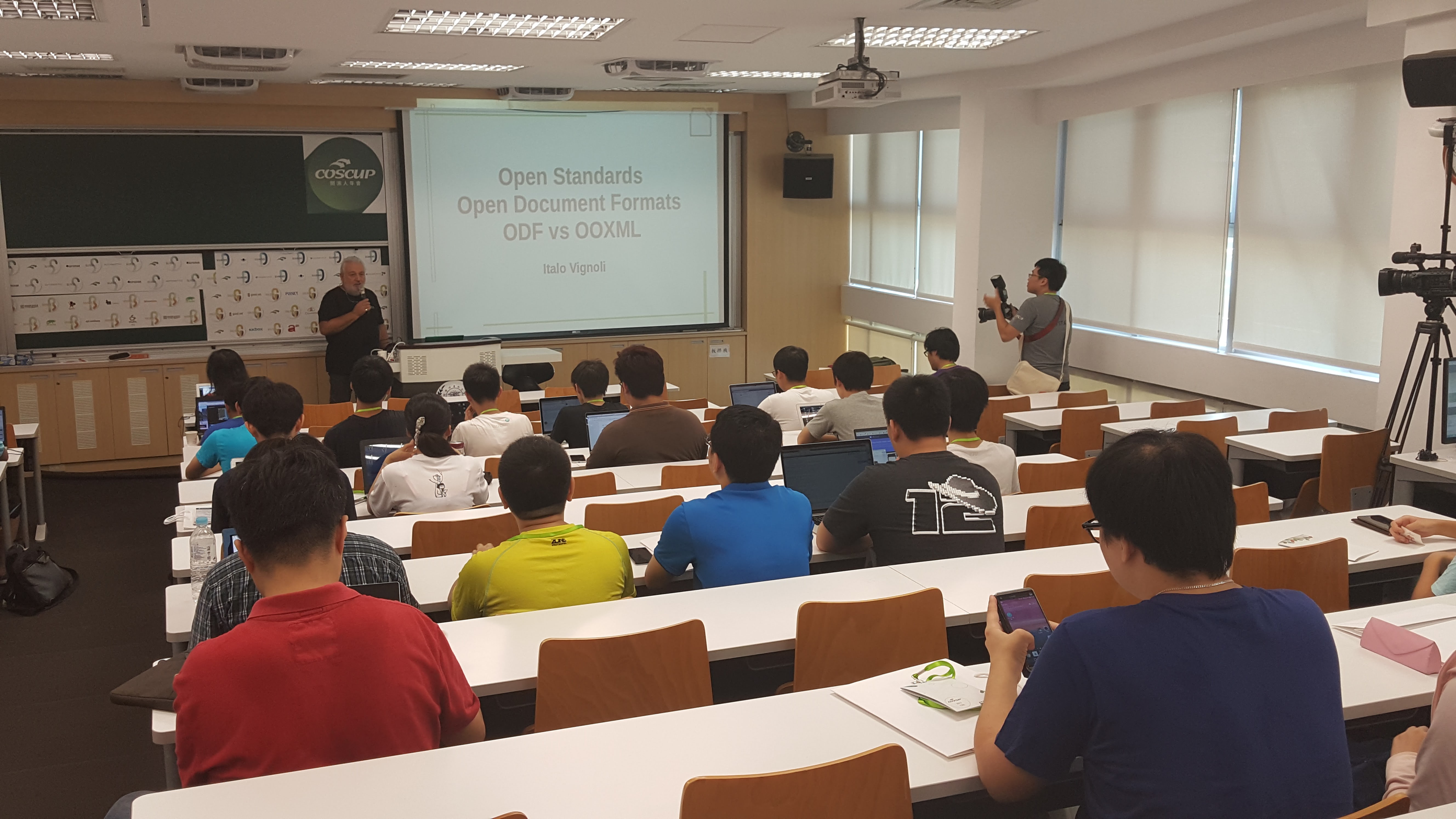
COSCUP is the annual conference held by the Taiwanese Open source community since 2006. This year, the event has returned to its original location at the National Taiwan University on August 5/6, with a number of community managed tracks. ODF and LibreOffice were featured during the first day, when I was able to present about the advantages of ODF over OOXML to a large audience of Taiwanese people – mostly young students – who asked several questions. Taiwan is one of the countries moving to ODF, so the topic is rather hot.

The meeting with representatives of the Taiwanese government, led by Digital Minister Audrey Tang, was organized on Monday, August 7, in the early afternoon. During the meeting, we discussed the situation of the migrations to ODF in Europe, together with the opportunities and the challenges faced by every government. I learned about the digital strategy of the Taiwanese government, and about the investments they are doing to introduce open source software to the next generations of citizens. Digital Minister Audrey Tang asked about the evolution of LibreOffice in the cloud.
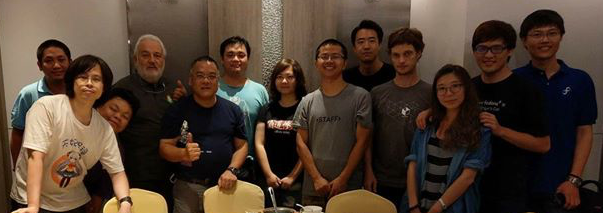
The meeting with the Taiwanese LibreOffice community spanned over a couple of events: a dinner on Saturday night, during which I had the opportunity to taste some real Chinese and Taiwanese dishes (which are rather different from their European equivalents), and a meetup on Monday night, during which I could talk about ODF vs OOXML, to provide some competitive marketing background on the topic. Moving from OOXML to ODF is not easy, not even in countries where the decision is backed by the government like Taiwan. It is therefore important that all community members know the differences between the two document formats and the advantages of ODF in term of interoperability and costs over OOXML.

I would like to take the opportunity of thanking LibreOffice Taiwanese community for the organization of my presence in the island, and congratulate the Taiwanese government for their comprehensive digital strategy to support not only open source software and open standards but also the education of a new generation of digital citizens.
TDF 2016 Annual Report has been published

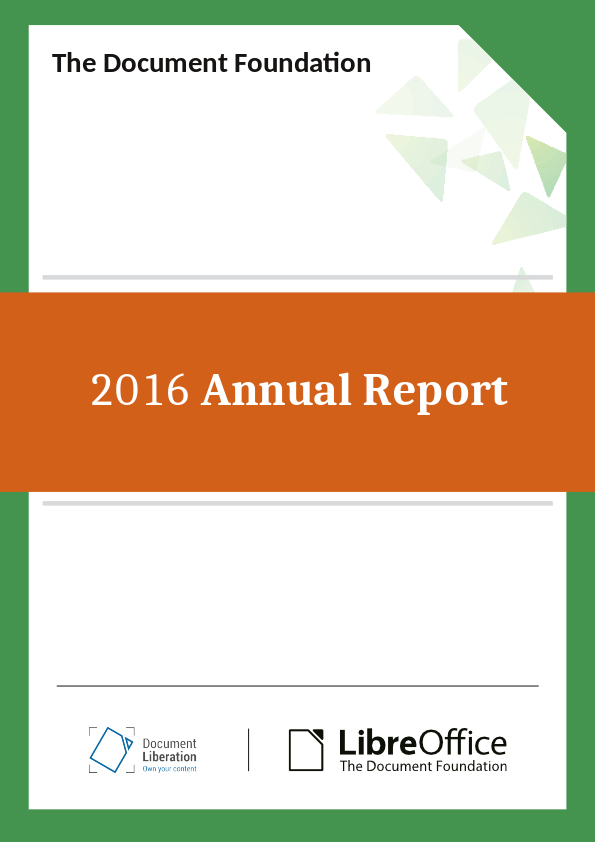
The Annual Report of The Document Foundation for the year 2016 is now available as a PDF document, in three different versions: English Low Resolution, English High Resolution, and German.

Documents can be downloaded from the following links:

English Low Resolution (7.4MB): https://tdf.io/ar2016low
English High Resolution (22.7MB): https://tdf.io/ar2016high
German: https://wiki.documentfoundation.org/File:TDF2016AnnualReportDE.pdf

The annual report is also available for print-on-demand on Lulu, at the following address: http://www.lulu.com/shop/the-document-foundation/annual-report-2016/paperback/product-23265884.html.

New page added: questions and answers about donations

The Document Foundation is very grateful to all contributions to LibreOffice, both in terms of time and money (donations). For the latter, we occasionally receive questions on various topics: the cost of donations, confirmation emails, refunds and rejected credit cards.

Usually we answer these individually, but now we’ve created a dedicated page on this blog with a list of questions and answers:

Click here to view the page

In addition, it can be accessed via the Donate menu in the top-right of the blog. We hope this helps anyone who has issues donating – and once again, a big thank you to everyone who has donated!

Job Search for a Development Mentor

The Document Foundation (TDF), the charitable entity behind the world’s leading free office suite LibreOffice, seeks an individual – or individuals part (or full) time – to be:

a Development Mentor

to start work as soon as possible. The role requires the following:

  • Self-starting, remote working experience
  • Experience contributing to FLOSS communities
  • C++ or LibreOffice coding experience
  • Excellent communication skills

The role is a for a minimum of 10 hours per week, and includes amongst other items:

Supporting existing mentors in the LibreOffice community including:

  • Building relationships between existing mentors and new contributors
  • Identifying and onboarding new contributors
    1. Affirming and encouraging their contribution
    2. Building initial relationships with them
    3. Encouraging them to join IRC to meet the team
    4. Introducing them to domain experts for deeper learning
  • Helping to educate new contributors by
    1. Positively reviewing their code contributions
    2. Introducing them to our tooling & culture
  • Attracting new contributors by promoting the project

Previous experience with such tasks is highly welcome, so is using free software. Speaking and writing English reasonably well is a mandatory requirement.

The work time during the day is flexible, apart from some fixed times when availability is required (e.g. during meetings, which usually take place at 14:00 or 15:00 UTC once per week).

TDF welcomes applications from all suitably qualified persons regardless of their race, sex, disability, religion/belief, sexual orientation or age.

As always, TDF will give some preference to individuals who have previously shown a commitment to TDF, including but not limited to members of TDF. Not being a member, or never having contributed before, does not exclude any applicants from consideration.

TDF is looking forward to receiving your applications, including curriculum vitae, your financial expectations, and the earliest date of your availability, via e-mail to Florian Effenberger at floeff@documentfoundation.org no later than April 11, 2017. You can encrypt your message via PGP/GnuPG.

If you haven’t received feedback by May 16, 2017, your application could not be considered.

International Women’s Day: #BeBoldForChange

March 8 is the International Women’s Day. The theme for 2017 is #BeBoldForChange.

Amongst the members of The Document Foundation there are only 19 women (10% of the total number): Belinda Dibra (Albania), Christina Roßmanith (Germany), Chrystina Pelizer (Brasil), Eliane Domingos de Sousa (Brasil), Ellen Pape (Germany), Emma Pietrafesa (Italy), Gülşah Köse (Turkey), Irmhild Rogalla (Germany), Jean Hollis Weber (Australia), Jona Azizaj (Albania), Katarina Behrens (Czech Republic,), Marina Latini (Italy), Priyanka Gaikwad (India), Regina Henschel (Germany), Rosemary Sebastian (India), Sigrid Carrera (Germany), Sonia Montegiove (Italy), Sophie Gautier (France) and Vinaya Mandke (India).

Marina Latini is the current ChairWoman of the Board of Directors, while Katharina Behrens is a member of the Membership Committee.

Women active in the LibreOffice and Document Liberation communities are definitely more than 19. They should apply for membership, not only to be recognized for their contributions but also to elect and be elected to the Board of Directors and the Membership Committee. They can find the application form on the website: http://www.documentfoundation.org/governance/members/application/.

February 2017: a record month for donations

February 2017 has been a record month for donations to The Document Foundation, with 8,556 people supporting the project from every geography. The record has been sparked by the announcement of LibreOffice 5.3 at the very end of January 2017. The new release has been covered in online and print media with an unprecedented number of articles, which have focused on the exciting new features.