Community Member Monday: Rania Amina

To start with, tell us a bit about yourself!

Hi! I live in the Special Region of Yogyakarta, Indonesia, and work remotely on PT Sakti Kinerja Kolaborasindo (the office is in Bogor, West Java) as UI and Graphic Designer. Aside from being an active member of the Indonesian LibreOffice community, I am also one of the founders of the Gimpscape ID community (a design community focused on open source applications). Regarding hobbies – hmm, I have an interest in ancient manuscripts (Malay manuscripts), Kamen Rider, and really always enjoy detective, mystery, adventure, and comedy-themed drama films.

You can find me on Instagram, Twitter and Telegram.

Why did you decide to become a member of The Document Foundation?

The first reason is, because Ahmad Haris (he’s my boss in the office) “sudo’d” me to apply for membership 🙂 But to be honest, I was indeed very interested in becoming a member since the LibreOffice Conference Indonesia in Surabaya about two years ago.

By becoming a member, I think I can do things related to contributing to LibreOffice better than before. Being a member is a responsibility, in my opinion. Because it means I have to do my best from time to time for the LibreOffice community, both in Indonesia and outside. LibreOffice will get better if the community ecosystem is also good. Well, one of the tasks of members (in my mind) is to ensure that these communities can actively give feedback to LibreOffice, so that they can grow and develop better.

What are you working on right now?

At the moment I am still improving the LibreOffice Theme Changer extension (which I presented some time ago at FOSDEM), occasionally helping with translations, QA, managing Indonesian LibreOffice social media (Instagram, Twitter, and the blog), and inviting community members to learn how to be active contributors. For example, I invited two female members to work on two sets of icons named that we named Srikandi and LibreKids. Making these two icons is a form of learning to contribute to LibreOffice in terms of design.

When there isn’t too much work (both at office or at the university), I usually take time to create a video tutorial related to LibreOffice or other FOSS that I upload on my YouTube channel.
In addition, I and many other Asians (Haris, Frank, Shinji, Naruhiko, DaeHyun, and others) are currently spreading the spirit of Open Document format in the Asian region, through the LibreOffice Asia League.

Anything else you plan to do in the future? What does LibreOffice really need?

I really wanted to realize the LibreOffice for Kids task with Marina Latini – I heard she was one of the people who was also working on this topic. One of the reasons why LibreOffice is still less popular in Indonesia, compared to similar applications, is this: since elementary school, children have already been introduced to proprietary office applications.

I know that change cannot happen overnight, but if it does not start from now it will not happen for a thousand years. Therefore, with the presence of LibreOffice for Kids, I personally hope that this will be the first step to make next generation more familiar with LibreOffice.

One more thing, and with all respect and thanks to all LibreOffice developers: I think LibreOffice needs a team of marketing volunteers who can compare LibreOffice in order to compete with others. LibreOffice has great features that are very powerful, but it will be useless if not many people know about it. Short infographics or interesting videos about features, or working on a task with LibreOffice, will help a lot.

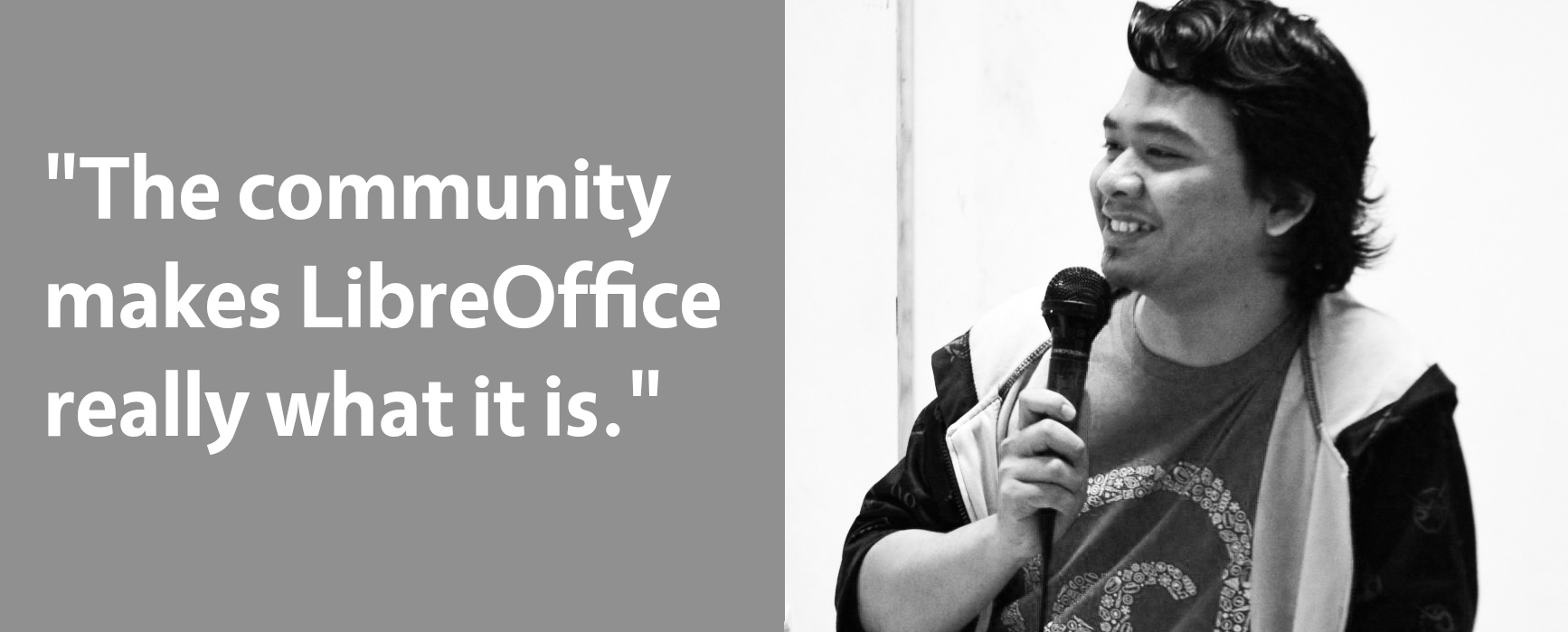
However, it should be underlined, that to be able to do this community support is needed, because it is the community that makes LibreOffice really what it is.
Indeed, as Rania says, everyone is welcome to join our community and help to make LibreOffice even stronger. See what you can do for LibreOffice – we look forward to meeting you!

Hispanic LibreOffice community meets online

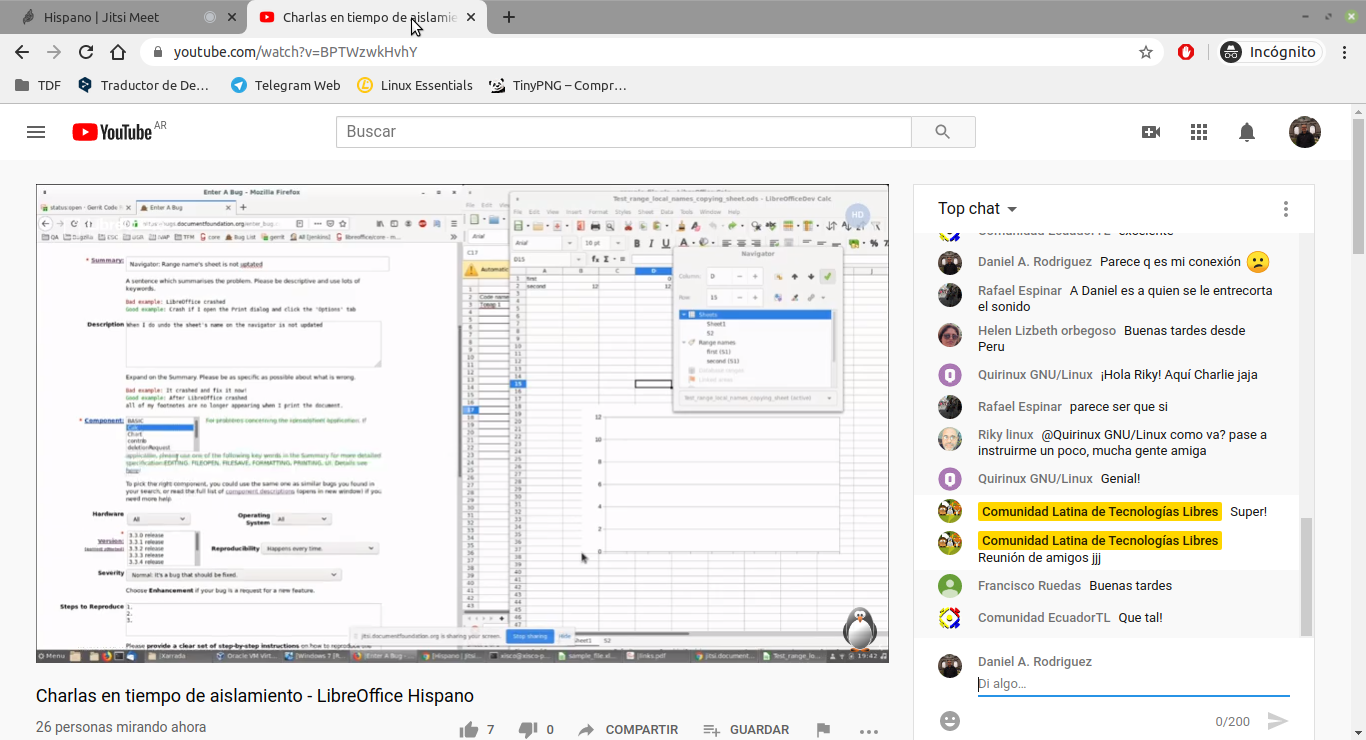
LibreOffice communities around the world love to meet in person, share ideas, work on the software, and have a good time. Of course, “real life” meetings have been difficult in recent months, so communities are going online instead. Daniel A. Rodriguez, LibreOffice contributor based in Argentina and TDF Board member, tells us about an online meetup at the weekend:

On Saturday, the Hispanic LibreOffice community held an online event via TDF’s Jitsi instance, and streamed on YouTube. The event started 17:00 UTC and last almost 4 hours. More that 35 people took part, which benefited from the presence of several members who are well-recognised for their participation and collaboration in the project:

  • Celia Palacios, from Mexico, told us about the work of the documentation team.
  • Mauricio Baeza, also from the Aztec land, talked about the potential of macros using Python.
  • Xisco Fauli, from Spain, explained how quality control is applied to software in the development stages.
  • Ismael Fanlo, another Spaniard, presented pivot tables.
  • Gustavo Pacheco, from Brazil, talked about becoming a member and invited everyone to apply.

Meanwhile, I gave a tour of the collaboration possibilities presented by the project. This was, of course, an open event – free and aimed at anyone interested in the FOSS office suite per excellence. The event took place on Saturday May 16th on our Jitsi server. Also, thanks to our friend Servio from the open-source Latin community, we had a live broadcast through YouTube, now available as recording.

Thanks to everyone who took part! LibreOffice benefits enormously from the work of communities around the globe. If you’re reading this and want to boost LibreOffice in your country or language, check out our native-language projects and give us a hand!

Month of LibreOffice, May 2020 – Two weeks in!

Two weeks ago, we started a new Month of LibreOffice, saying thanks to contributors from our worldwide community. Everyone who helps out with our projects this month can claim a cool sticker pack at the end – and also has a chance to win a hoodie, T-shirt or mug!

So far 259 sticker packs have been awarded – click the link to see if your name/username is in the list. If not, read on and find out what you can do, to take part!

How to get your stickers

There are many ways you can help out – and you don’t need to be a developer. For instance, you can be a…

  • Handy Helper, answering questions from users on Ask LibreOffice. We’re keeping an eye on that site so if you give someone useful advice, you can claim your shiny stickers.
  • First Responder, helping to confirm new bug reports: go to our Bugzilla page and look for new bugs. If you can recreate one, add a comment like “CONFIRMED on Windows 10 and LibreOffice 6.4.3”.
  • Drum Beater, spreading the word: tell everyone about LibreOffice on Twitter or Mastodon! Just say why you love it or what you’re using it for, add the #libreoffice hashtag, and at the end of the month you can claim your stickers.
  • Globetrotter, translating the user interface: LibreOffice is available in a wide range of languages, but its interface translations need to be kept up-to-date. Or maybe you want to translate the suite to a whole new language? Get involved here.
  • Docs Doctor, writing documentation: Whether you want to update the online help or add chapters to the handbooks, here’s where to start.

We’ll be posting regular updates on this blog and our Mastodon and Twitter accounts over the next two weeks – stay tuned!

LibreOffice is a hot target for the Google Season of Docs 2020

For the second year in a row, The Document Foundation has been accepted as an organization in the Google Season of Docs, a programme whose goals are to give technical writers an opportunity to participate in contributing to open source projects, and to give open source projects an opportunity to engage the technical writing community.
This year we offer a wide range of projects for technical writers, and we’re extending the reach by providing projects for e-learning, mathematical documentation and code-oriented documentation.

During the programme, technical writers will spend a few months working closely with the LibreOffice community, bringing their technical writing expertise to the project’s documentation, and at the same time learning about the open source project and new technologies. Similarly, LibreOffice documentation team members will work with the technical writers to improve the project’s documentation and processes.

LibreOffice is an advanced office suite covering many areas of knowledge, from maths and sciences, engineering, financials, editing, drawing, printing and more. LibreOffice is also an application that is used cross-industry – so it’s a very rich opportunity for technical writing.

Olivier Hallot, LibreOffice’s documentation coordinator, will lead the GSoD project, supported by Ilmari Lauhakangas and members of the LibreOffice documentation team.

All information about the Google Seasons of Docs is on the GSoD website. An outline of the project’s different steps is available on the GSoD timeline. The next deadline is June 8, as we we need to find interested technical writers to discuss our ideas, which are summarized on the following TDF wiki page. The list includes some of our project’s permanent challenges, but should not be limited to these items. Technical writers must read the technical writer page of the programme.

LibreOffice contributors who are interested in becoming a mentor for the GSoD project should get in touch with Olivier Hallot by sending him a message. We look forward to hearing from you!

Community Member Monday: Marco Marinello

Today we’re talking to Marco Marinello from the Italian LibreOffice community, who recently became a member of The Document Foundation, the non-profit entity behind LibreOffice…

Tell us a bit about yourself!

I live in Bolzano, which is a small city in the northernmost part of Italy. My main interests are robotics and computer technology. In my spare time I often enjoy going for a ride with the bike, which I use almost every day to get around. In the summer I spend my holidays sailing with my family and some friends.

Why did you decide to become a member of TDF?

During SFScon – the Free Software Conference in Bolzano – I met Marina Latini, former Chairperson of the Board. We talked about the work I did on LibreOffice Online, and she encouraged me to send the application and become a member of TDF.

I share the values of TDF, and I love working on something that’s useful for everyone.

What exactly are you working on right now?

Mostly, I’m working on the documentation for LibreOffice Online, but I’m even submitting some changes. Documenting features that have already been implemented well is the first goal which I have set myself.

Anything else you plan to do in the future?

If I became more skilled in C++, I would like to get more involved with developing LibreOffice. I think a solid and compact group of members who really care about the product and the strategies is the strength of TDF.

Thanks to Marco for all his contributions! Everyone is welcome to join our friendly community, develop skills and meet new people. We look forward to meeting you!

The New Getting Started Guide 6.4

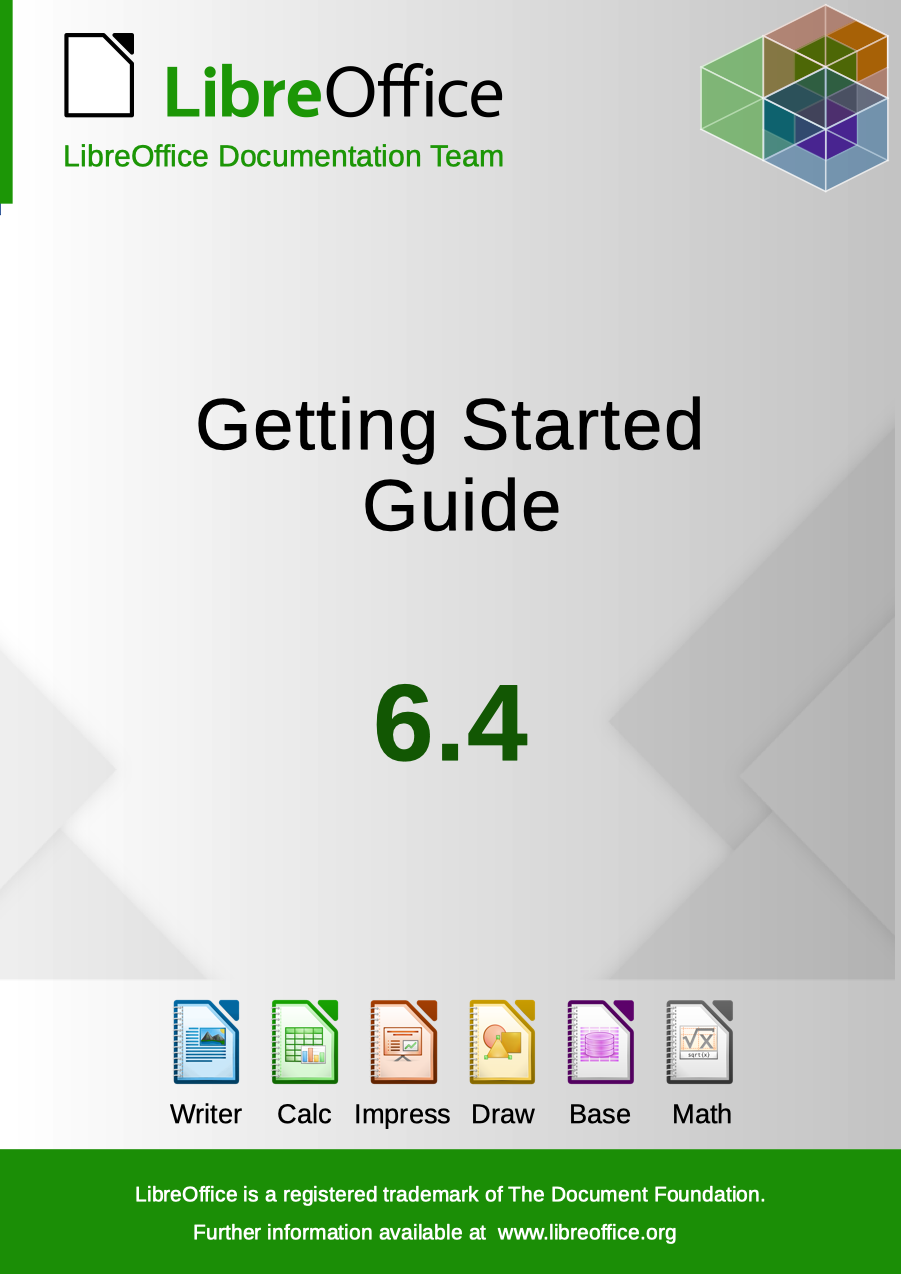
The LibreOffice Documentation Team proudly announces the immediate availability of the LibreOffice Getting Started Guide 6.4, the introductory guide for the latest LibreOffice 6.4, aimed to the general public interested to quickly get familiar with the software.

The Guide was updated from the existing release 6.0 and includes an introductory documentation of the most common features of the free office suite and includes information on word processing, spreadsheets computing and charting, presentations, drawings, database management, equations and also macro programming. The update includes the changes in several components of the suite and new features introduced since release 6.0.

The Guide also introduces extensive information on the LibreOffice way of producing professional documents by using the rich set of formatting styles and correct document file format such as the Open Document Format. Needless to say, the Guide was edited, reviewed and assembled using LibreOffice 6.4.

The Getting Started 6.4 guide is the result of the collaborative work of Andrew Jensen, Claire Wood, Dan Lewis, Kees Kriek, Steve Fanning, Pulkit Krishna, Roman Kuznetsov and was reviewed and assembled by Jean Hollis Weber. A big thanks to them for all their work!

LibreOffice has extensive documentation in many languages, thanks to our worldwide community.

Download it

You can also get individual chapters via this page.

Everyone is welcome to join our documentation team! It’s a great way to build up experience in a large and well-known open source project, especially if you’re interested in a career in technical writing one day.