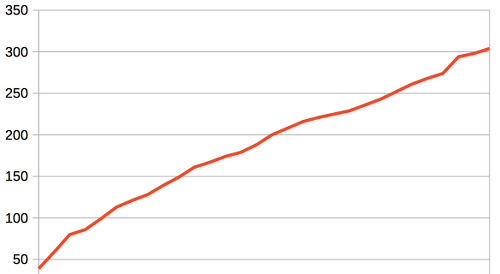
February 2017 has been a record month for donations to The Document Foundation, with 8,556 people supporting the project from every geography. The record has been sparked by the announcement of LibreOffice 5.3 at the very end of January 2017. The new release has been covered in online and print media with an unprecedented number of articles, which have focused on the exciting new features.
Category: Community
57 video presentations from LibreOffice Conference 2016
It has taken a while, but we’ve finally edited and uploaded the last batch of presentations (for which we have video) from last year’s LibreOffice Conference in Brno, Czech Republic. You can see all of the videos in the embedded playlist below – click the list button in the top-left corner to navigate through the videos.
Alternatively, scroll on for a full list of presentations. You can do a search in your browser for topics of interest (eg “ODF” or “LibreOffice Online”), or for presenters. Happy viewing, and we look forward to seeing you at this year’s conference in Rome!
Please confirm that you want to play a YouTube video. By accepting, you will be accessing content from YouTube, a service provided by an external third party.
If you accept this notice, your choice will be saved and the page will refresh.
Full list of presentations:
- State of the Project (Florian Effenberger, Michael Meeks, Italo Vignoli)
- LibreOffice and Ubuntu: A personal tale (Bjoern Michaelsen)
- LibreOffice powered by CIB (Thorsten Behrens)
- LibreOffice and Collabora (Michael Meeks)
- Development mentoring – what’s next? (Jan Iversen)
- VCL OpenGL backend performance improvements (Tomaž Vajngerl)
- More Songs About Building and Foot (Stephan Bergmann)
- Integrate your applications with LO using LOKDocView (Pranav Kant)
- Layercake – from UNO code to Writer Core (Bjoern Michaelsen)
- Screenshotting your way through the codebase (Katarina Behrens, Armin Le Grand)
- The Future of OpenCL in LibreOffice (Tor Lillqvist)
- Too Many VCLPlugs (Caolán McNamara)
- MS Office interoperability and automated bisection of regressions (Miloš Šrámek)
- UX of the Area Fill style dialog (Heiko Tietze)
- How users operate LibreOffice Draw (Heiko Tietze)
- UI Hacking explained, episode 2: Revenge of sfx2 dispatch API (Katarina Behrens)
- What could be done by volunteers to make LibreOffice more accessible? (Jean-Philippe Mengual)
- Collaborative editing using LibreOfficeKit (Miklos Vajna)
- Unifying LibreOffice Low Level Text Layout (Khaled Hosny, Akash Jain)
- Improved digital signature handling in LibreOffice (Miklos Vajna)
- Calc Beyond Cells (Eike Rathke)
- Advocating LibreOffice – talking to the press (Mike Saunders)
- Calc Tiled Rendering in LibreOffice Online (Ashod Nakashian)
- Where are women in LibreOffice? (Jona Azizaj)
- LibreOffice with a female touch (Katarina Behrens)
- The difficulties of creating a community (Anxhelo Lushka, Redon Skikuli)
- Competitive marketing strategies for LibreOffice (Italo Vignoli)
- Answering Non Technical Questions (Italo Vignoli)
- How to increase participation to make the project more inclusive (Jona Azizaj, Katarina Behrens, Marina Latini)
- Central config management of LibreOffice in Windows Server environment (Andras Timar)
- ODF Normalization (Alexander Mayer)
- Saving ODF XML of change-tracking as a sequence of pre-defined changes (Svante Schubert, Thorsten Behrens)
- ODF/LibreOffice Migration in Taiwan – Progress, Problems and What Next (Franklin Weng)
- LibreOffice and ODF, adoption by Paulista State University (Valdir Barbosa)
- #LibrexTutti: migration of Public Institute for Deaf in Rome (Sonia Montegiove, Emma Pietrafesa)
- LibreDifesa: Italian Defence chose LibreOffice (Sonia Montegiove)
- Convincing organizations to contribute (Eric Ficheux)
- Something About LibreOffice Macros (Franklin Weng)
- GenLang – new l10n tools, a vision (Jan Iversen)
- Tools for Translators (Christian Lohmaier)
- Documentation Workshop (Olivier Hallot)
- Localization community in Taiwan: challenges (Jeff Huang)
- Hidden gems in Draw / Impress (Armin Le Grand)
- Graphic design with LibreOffice and LibreLogo (László Németh)
- Lightning Talks
- This year’s Coverity, crashtesting and fuzzing data (Caolán McNamara)
- Bibisect On Demand (Bjoern Michaelsen)
- Validate me! Safeguarding standards-conformance for LibreOffice (Thorsten Behrens)
- LibreOffice Online and ownCloud/Nextcloud (Jan Holešovský)
- LibreOffice Online Deep Dive (Ashod Nakashian)
- An Introduction to LibreOffice Online thru Collabora Cloudsuite (Olivier Hallot)
- Connect, Embed, Integrate – LibreOffice as a building block (Samuel Mehrbrodt, Thorsten Behrens)
- Diving into Extension Development (Samuel Mehrbrodt)
- User-specific configuration management for office extensions (Florian Haftmann)
- Testing ODF software online (Jos Van den Oever)
- GSoC (Google Summer of Code) Student Panel
- UX & development interaction (Jan Holešovský)
LibreOffice contributor interview: Stanislav Horáček
Next up in our regular series of interviews with LibreOffice developers and contributors is Stanislav Horáček, who helps with localization in the Czech native language community.
Where are you from, and what is your nickname on IRC?
I am from the Czech Republic, and you can find me on IRC using the nicknames “horacek” or “strepon”.
Do you work for a LibreOffice-related company or just contribute in your spare time?
Just in my spare time – and that’s why there is a gap between my plans and reality 🙂
How did you get involved with LibreOffice?
Several years ago, I tried to set up custom page numbering in Writer, which was described in the built-in Help – but the Help page was written in half Czech, half English. Because I was glad that I discovered the solution of my problem, I decided to complete the page translation. As I found translating quite relaxing, that page was just a beginning…
What areas of the project do you normally work on?
Czech localization mainly; plus some corrections or bug reports for issues that I find when translating. Some time in the future, I would also like to go deeper into coding of extensions. They can be extremely helpful and it’s a pity that they are not widely promoted currently. For instance, I see a nice opportunity to use LibreOffice as a convenient front-end to another tools.
What was your initial experience of contributing to LibreOffice like?
From the beginning, I met helpful and encouraging people and I really appreciate that most of the discussions are constructive, with facts more important than feelings. I think these are the most precious properties that the community has; they made LibreOffice become my number one open source project. On the other hand, whenever I see a lack of them, I image that one more potential contributor could be demotivated…
Moreover, LibreOffice has a great advantage in that it is so widespread. I was – and still I am – impressed that you can really easily make improvements which will appear on screens of millions of people.
Which is your preferred text editor?
For LibreOffice related stuff, I use a universal text editor called Geany. But in general, I like also specialized editors or IDEs.
What do you do when you’re not working on LibreOffice?
I would say my hobbies are typically Czech, like beer drinking 🙂 You can also see me during the holidays in some of the European mountains, amongst lots of other Czech tourists. And who knows, maybe one day contributing to free software will be our national interest as well…
Thanks Stanislav. And to anyone reading this who wants to help out with translation and localisation of LibreOffice, get involved! Your contributions can make a huge difference, and will help to bridge digital divides across the globe.
Updates from events: Turkey, Taiwan and Japan
Today marks five years since The Document Foundation (TDF) was legally incorporated in Berlin, Germany. We want to celebrate this anniversary by highlighting some recent activities and events from our Native Language Projects. These communities have been instrumental to the growth of TDF and LibreOffice, and are one of our most important assets.
Turkey
The Turkish community recently attended the Academic Informatics Conference 2017 in Aksaray, from 8 to 10 of February, with several LibreOffice related activities.
A general presentation was done by Muhammet Kara and Gökhan Gurbetoğlu in the first session (first half of the first day).
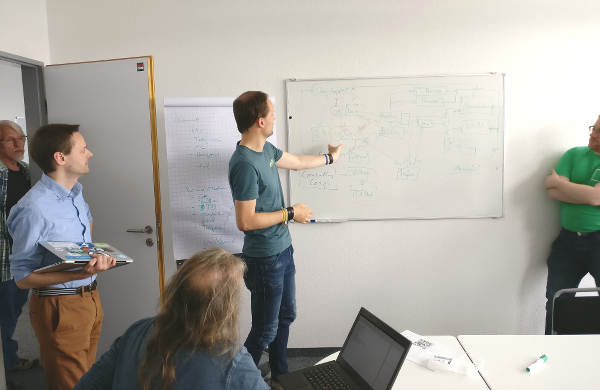
In the second half of the first day, the attendees were introduced to the LibreOffice development environment, and the tools used in the process (Gerrit, Vim, Git…). The attendees were walked through the process of joining the LibreOffice community, and building the LibreOffice source code for the first time.
Attendees who had relatively older computers were provided with SSH access to a 32-core machine, courtesy of TUBITAK ULAKBIM. The last session (first half of the second day) was held like a hackfest. Questions from attendees were answered by the speakers.
LibreOffice community members were pleased to see that the participants were eager to learn about the software, and together they established a WhatsApp group for further communication. A more detailed presentation about LibreOffice development activities in Turkey was given by Gülşah Köse and Muhammet Kara on the last day (morning) of the conference.
Taiwan
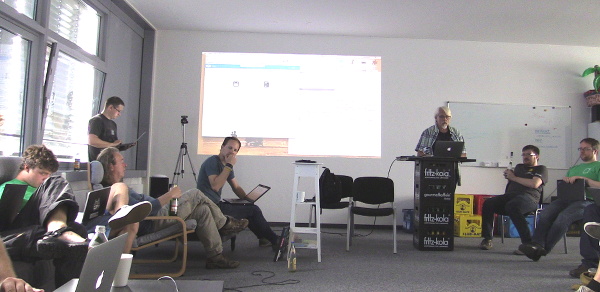
The first LibreOffice QA Sprint in Taiwan – organized by Software Liberty Association Taiwan and supported by two professors of the Department of Computer Science and Engineer, National Cheng-Kung University: Professor Joseph Chung-Ping Young and Alvin Wen-Yu Su – was held in Tainan City on December 17, 2016. In this four-hour sprint the attendees found and reported many issues. Attendees were students, teachers, employees of enterprises and governments, LibreOffice developers and lecturers, and all four TDF members in Taiwan.
Early in the afternoon, a live video-session with Italo Vignoli, one of the core members of The Document Foundation, gave most of the attendees exposure to the international community for the first time.
Han Lu, a student in NCKU, summarized the issues found by attendees. After the summary, Franklin Weng explained how to report bugs on the LibreOffice Bugzilla. Also, Cheng-Chia Tseng introduced the Pootle translation platform for LibreOffice and gave some tips on how to translate LibreOffice.
Japan
LibreOffice Kaigi 2016.12, Japan’s annual LibreOffice conference, was organized in early December 2016 with great success! The word Kaigi is the Japanese word 会議, which means conference. The name means not only Japanese regional, but also Japanese users-specific.
Around 25 people gathered and enjoyed several talks (migration to Open Document Format in Taiwan, by Franklin Weng, LibreOffice/ODF and styles, maintaining Math and Japanese translation), along with a few lightning talks and a panel discussion.
Celebrating “I Love Free Software Day” 2017
LibreOffice is free software. This means that it’s totally free of charge to download and use – a benefit that many people appreciate. But free software is about much more than just saving money; it’s about having freedom to control our own computers and devices. Free software is incredibly important for digital freedoms, security, privacy and civil rights. All together, free software is a movement.
So what defines free software, compared to proprietary software? The Free Software Foundation outlines four key freedoms that we should have as users of the software. Here’s a summary:
- The freedom to run the program as you wish, for any purpose
- The freedom to study how the program works, and change its source code
- The freedom to redistribute copies so you can help your friends and colleagues
- The freedom to distribute copies of your modified versions to others, so that they can benefit
Fundamental to this is the license under which the software is made available. LibreOffice is released under the Mozilla Public License Version 2.0, a free and open source license that lets everyone share the program – and gives everyone the right to study how it works and modify it.
The importance of freedom
Free software is essential to the success of LibreOffice. Because of the license it uses, anyone can join our community and help to improve the software. The low cost of ownership means that developing countries can reap the benefits of LibreOffice without having to spend large amounts of money. And no company can take LibreOffice and lock it up as proprietary, closed software forever.
Now, most LibreOffice users are not software developers. And they may ask: “Apart from the low cost, how do I benefit from LibreOffice being free software?” The best response to this is: with free software, you control your computer. With proprietary, closed software – where you can’t study how it works or modify it – the software controls you. Sure, some proprietary software may look tempting in terms of technical features, but without the four freedoms listed above, you don’t truly have control of your software, your computer and your data. Someone else does.
One common misconception is that free software means no money for developers. This simply isn’t true! While the software itself is free to download, many companies make money by providing extra services on top: documentation, technical support, and bespoke features. Look at our certified developers, for instance, and then consider all of the companies making money around the GNU/Linux ecosystem. You can develop free software, help make the world a better place, and still earn a good living as well!
A big thank you
Of course, LibreOffice is just one example of a well-known free software project. Others include GNU/Linux, Firefox and KDE – but there are thousands more. Today we celebrate the vibrant, rich and active communities around the web that are working hard to provide us with all of this great software – so we’d like to say a big thank you to all LibreOffice developers, and indeed everyone else working on free and open source projects.
Keep up the great work!

LibreOffice 5.3 triggers a record of donations
In this case, one image is better than 1,000 words, as the histogram represents donations during the first 10 days of each month, since May 2013, and doesn’t need any further comment. LibreOffice 5.3 has triggered 3,937 donations in February 2017, 1,800 more than in March 2016, and over 2,000 – sometimes over 3,000 – more than any other month. Donations are key to the life and the development of the project. Thanks, everyone.