Behind the scenes at TDF: L10N and NLP

Towards the end of the year, The Document Foundation would like to share achievements in 2014 with our community and our generous donours, to whom we’d like to express our sincerest gratitude and thanks for their incredible and wonderful support and their invaluable contributions!

Sophie Gautier is in charge of our L10N and NLP projects at The Document Foundation, and gives you insight into this key part of our project:

_SDS5526L10n – NLPs status quo

I would like to give a brief overview of the many things that happened or are in the pipe either on the Localization project (L10n) or on the Native Language projects (NLPs). For the latter, it is not always easy to know what is going on locally, but we tend to get more and more feedback from these groups which is really great.

So, on the Localization side, several new languages were added to Pootle these last months, more Indic languages, for example. Translating UI and Help is a very huge task, and when you think it is finished, there is still some work to do for the next version. For example, currently, the teams are in the starting blocks to translate the 4.4.x new features strings and the various enhancements that have been provided by the Design team. Also the change of file format to .ui means that the l10n teams had to translate again all the dialogs. Fortunately, this change is of great help because the dialogs adapt to the length of the strings (no need anymore to count the characters in the word to fit the space), but we are also able to display those dialogs in Glade, allowing to see the strings in context, which is something all localizers are dreaming of! All in all, that makes many new words for both UI and Help projects. And this is not the only translation projects we handle via Pootle, there is also the Website, Impress for Android and iOS, sometimes AskBot projects.

Dedicated to newcomers of the l10n project, two guides have been written; one concerning how to use Pootle, the second one on the structure of .po files (for example, it shows how to distinguish variables or which xml tags are used). There was absolutely no documentation on the structure contents by the past and one had to guess what he had to translate or not. And it is very easy to break a build when tags miss or mismatch, so this brings some relief to the developers too.

Thanks to our Brazilian friends several of the help articles concerning new functions have been completed. We are also working on porting the translation of the help files on the wiki. This is a difficult task because we do not want to complicate the translation task on one hand, but we want to simplify the help maintenance and open it to non-technical contributors on the other hand, which is currently impossible. Some technical issues have still to be resolved, but we are optimistic that we will be able to set it in a near future. As a work in progress also, we hope to push the migration to a new version of Pootle, with an integrated translation memory.

On the Native Language projects side, we are happy to see more and more contributors to the local projects and really good news coming from several of them, like the Italian community or the Japanese and Chinese ones. They not only contribute to their local projects, but you can find those members active in QA, development or documentation.

One of the major tasks handled this year by these teams was the translation and adaptation of the new website design. During the year, the website itself was translated on Pootle and the content by website owners. This gives a uniformed design to all the language sites bringing more quality and a professional look and feel to our project.

One way to measure the growth of activities in these projects is how we all together manage the press releases. Once the text is fixed by the marketing project, the native language projects translate them and send them back to the marketing team for distribution to the press in their countries. We are now able to release in almost 9 languages for each major release. It is also something really exciting to see how the developers, the quality assurance, native language, design and marketing projects interact during the last month before the release. Of course it happens also all time between two or three of them, but the communication has improved between all of them.

Another great thing that has happened recently while in heavy discussion since some times, is the Planet in all languages. It is really impressive to see all those languages mixed in one thread but that you can filter by the language you prefer. There is currently ten languages available covering several blog writers.

Always trying to be as transparent as possible and to bring as much information to the community as we can, the Annual Report due as a TDF official document to the Berlin authorities, has been translated into English and is available to the Native Language projects for their own use, to inform either on the product and the community.

On the local side, TDF has supported several hackfests and numerous events have been organized all over the world by the Native Language Projects. And we are really happy that the Danish team is organizing the next international LibreOffice conference in Aarhus.

To reflect all this effervescence, we have set a Big Thank You page on the wiki, where all L10n and NLPs contributors are invited to add their name. But that’s not all, we have also a world map, detailing the skills of the contributor in addition to his location. And stay tuned, more is coming!

Create a Template for LibreOffice, and get a free T-shirt

The Document Foundation launches a competition to increase the number of document templates bundled with the upcoming major release of Libreoffice, open to designers, artists, and creatively talented users.

Deadline for submission, to be included in LibreOffice 4.4, is January 4, 2015. Templates submitted after this deadline will be considered for later LibreOffice major and minor releases, like LibreOffice 4.5 or LibreOffice 4.4.1.

Templates will be selected by the members of the LibreOffice Design Team, and may be edited before the inclusion. Authors of the templates bundled with LibreOffice 4.4 will get a free T-shirt either at LibreOffice booth at FOSDEM on Saturday January 31, or Sunday February 1, 2015, or by post after FOSDEM, and will be credited with a mention on http://www.libreoffice.org/about-us/credits/. They will also have a chance to meet LibreOffice developers and the design team during and after the show.

To be considered for inclusion, templates must meet the following conditions:

  • They are an original work, and are not converted from existing templates.
  • They are licensed under Creative Commons CC0.
  • They are based only on fonts bundled with LibreOffice (Caladea, Carlito, DejaVu, Gentium, Liberation, Libertine G, Open Sans, PT Serif, Source Code, Source Sans).
  • They are based on LibreOffice styles, and not on direct element formatting. Styles must be created according to the expected use of the template.
  • They contain only a minimum of text (ideally, no text at all), as they will not be translated for LibreOffice 4.4. Because of that, language must be en_us.

To participate, either upload the template on TDF wiki or send it by email to templatecontest@libreoffice.org, and we will add it to the list. Templates will be collected here: https://wiki.documentfoundation.org/Design/Whiteboards/Templates_for_LibreOffice_4.4.

Please specify the category and/or the intended use of the template, and the license of the template. You can send any number of templates, provided that all of them meet the above conditions.

For more information about creating templates, please check here: https://help.libreoffice.org/Writer/Creating_a_Document_Template and
here: http://lodahl.blogspot.ae/2014/12/making-good-and-solid-templates.html.

As an example, categories of templates could be: books of various types, address/phone books, business cards, calendars, curriculum vitae/resumes, essays, expense reports, letters, lists, records and reports of various types, schedules, etc.

Be creative ! We look forward to bundle your template designs !

Behind the scenes at TDF: Quality Assurance (QA)

Towards the end of the year, The Document Foundation would like to share achievements in 2014 with our community and our generous donours, to whom we’d like to express our sincerest gratitude and thanks for their incredible and wonderful support and their invaluable contributions!

As a start, Robinson Tryon, who is in charge of Quality Assurance (QA) since August, and summarizes the efforts in this important area:robinson-in-brussels

Hi all,

I’m Robinson Tryon and I’m a QA Engineer for The Document Foundation. I became quite interested in computers in high school and got my first taste of Free Software playing around with RedHat Linux on a spare machine.

In college I started to study computer science in earnest, and found myself very interested in the topics of human-computer interaction and computing freedom. I can’t remember who first introduced me to the Free Software Foundation, but I have fond memories from my undergraduate years of attending annual membership meetings at MIT and thinking of how I’d like to get a job where I could spend my time working on Free Software.

In the years since I graduated with a degree in computer science, I’ve been fortunate to be able to work with a number of different organizations and labs on Free Software projects. I’ve worked on a multimedia engine used to create training simulations for doctors and first-responders, tools for teaching non-technical people how to use programs such as git and ssh, and a series of web-based games designed to help libraries, museums, and other organizations crowd-source metadata for images and video in their collections. I was very excited to join the Document Foundation this year and bring my experience to the LibreOffice project.

My first contributions to LibreOffice came early-on in 2010 when the project was just starting out. The renewed energy and community-focus espoused by the leaders heartened me, and the reduced barriers to contribution sounded very promising. I tested out new builds and made a few small edits to the wiki, but didn’t get seriously involved until a couple of years later. Up until that point, I was just a user.

When I was still in college, I remember running Sun’s OpenOffice.org off of a Knoppix LiveCD. I desperately wanted to find an alternative to running MS-Office to type up all of my papers and reports, and just using a text editor wasn’t quite cutting it. Although I wasn’t always able to work on my own desktop computer in my dorm room, carrying around a Knoppix CD made it possible for me to boot-up and run a Free Software office suite on the public cluster machines.

By the time LibreOffice had its first release, I had upgraded from the CD and could carry around Free Software programs on a USB stick, ready to be run on any computer. I currently carry a USB stick with builds of LibreOffice for Windows, GNU/Linux, and Mac. My thinking is that if a friend ever needs a hand opening documents on a computer, it’d be great for me to have the right tool ready to go for them. In fact, using LibreOffice to help out a friend is what got me very involved with LibreOffice and the QA Team.

A friend of mine had a large number of documents in proprietary formats (word processing, spreadsheet, etc..) and reading through the LibreOffice documentation I found out that the suite has some excellent tools for conversion of documents from one format to another, including the ability to bulk-convert via the command line one hundred documents as easily as one document. While I was doing my research, I started to chat with contributors to the LibreOffice project, I attended a couple of QA Meetings, and before I knew it was an active member of the QA Team!

When I first started out contributing to LibreOffice, I focused on some basic bug triage tasks and filled-in missing pages on the TDF wiki. As my understanding of the project and its members grew, I was able to make contributions to Bugzilla, to the BSA, and MediaWiki, and was able to help set up tools such as ownCloud. I currently work on a large number of different QA tasks for LibreOffice, including generating binary-bisection or “bibisect” repositories, improving and updating QA documentation on the TDF wiki, and overseeing the implementation of improvements to Bugzilla. Right now I’m gaining experience as a Release Engineer for LibreOffice.

In addition to the technical tasks I undertake for LibreOffice, I work on LibreOffice outreach — both in the US and abroad. Although we have a large number of active users, only a small fraction of them are active contributors. We are always looking to expand the number of contributors in each of our teams, and are excited about getting more people involved in QA through our BugHunting sessions and LibreFests.

A LibreFest is usually a one or two-day event in which various LibreOffice teams may participate. LibreFests, just like hackfests, are typically held in person, as that’s the best way for us to collaborate with and teach new contributors. When the QA Team participates in a LibreFest, users are asked to perform basic or advanced bug triage, to bibisect regressions, and to file new bugs that they observe. With experienced LibreOffice team members present, users feel much more comfortable stepping outside their comfort zone and taking on QA tasks that they wouldn’t try to tackle by themselves.

In our BugHunting sessions, we spend a weekend (usually Fri-Sun) testing the latest builds of a new Release Branch. One of the tools we use to test the builds is MozTrap — a test case management system that help to ensure greater reliability and consistency. Through extensive use of LibreOffice, we hope to shake-out any obvious bugs and squash them before going further in with the release process.

Speaking of BugHunting sessions, this weekend (Dec 19-21), we’ll be having a BugHunting session for the upcoming 4.4 Release Branch. We’ve worked to make it easy for newcomers to participate. To join in, or just for more information, see: https://wiki.documentfoundation.org/BugHunting_Session_4.4.0_RC1

LibreOffice 4.4.0 bug hunting sessionIf you’re looking for a way to participate in LibreOffice, or just curious about what we do in QA, please stop by our mailing list or our IRC channel. There’s so much more that we do that can’t be contained in a single blog post, and we’d love to tell you all about it!

The Document Foundation announces LibreOffice 4.3.5

Coverity Scan Project LibreOffice OverviewBerlin, December 18, 2014 – The Document Foundation announces LibreOffice 4.3.5, the fifth minor release of LibreOffice 4.3 “fresh” family, which is a stable release of the more advanced version of the software, targeted to individual and enterprise users. LibreOffice 4.3.5 contains over 70 bug fixes.

The Document Foundation suggests to deploy LibreOffice 4.3.5 in enterprises and large organizations when backed by professional support by certified individuals (a list is available at http://www.documentfoundation.org/certification/) capable of providing value added support.

People interested in technical details can find change logs for LibreOffice 4.3.5 here: https://wiki.documentfoundation.org/Releases/4.3.5/RC1 (fixed in RC1) and https://wiki.documentfoundation.org/Releases/4.3.5/RC2 (fixed in RC2).

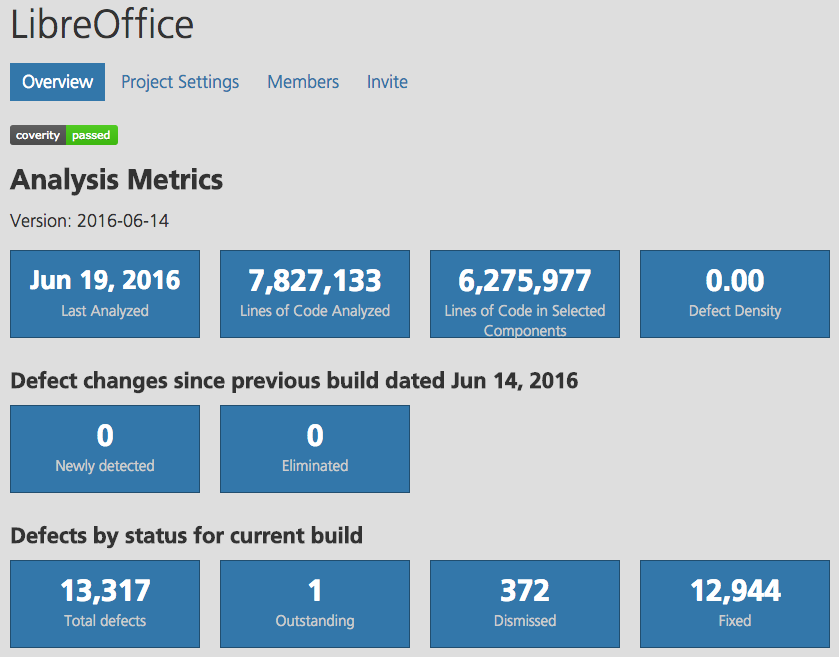
The image on the left provides the updates figures about LibreOffice source code as provided by the Coverity Scan Service on December 14, 2014. To learn about LibreOffice and Coverity Scan, you can read this blog post.

Download LibreOffice

LibreOffice 4.3.5 “Fresh” and LibreOffice 4.2.8 “Still” are immediately available for download from the following link: http://www.libreoffice.org/download/.

LibreOffice users, free software advocates and community members can support The Document Foundation with a donation at http://donate.libreoffice.org.

TDF announces the second and final LibreOffice 4.4 bug hunting session from December 19 to December 21

The Document Foundation (TDF) announces the second LibreOffice 4.4 bug hunting session, which will happen from December 19 to December 21, 2014, immediately after the availability of the first release candidate of the new major release (with the final release planned for the end of January 2015).

Details of the second LibreOffice 4.4 bug hunting session are available on TDF wiki at https://wiki.documentfoundation.org/BugHunting_Session_4.4.0_RC1. A list of LibreOffice 4.4 features that have to be checked for bugs and regressions is also on TDF wiki: https://wiki.documentfoundation.org/ReleaseNotes/4.4.

To participate, it will be necessary to download LibreOffice 4.4 RC1 for Windows, MacOS or Linux from http://www.libreoffice.org/pre-releases. Filing bugs will be extremely easy, thanks to the help of experienced volunteers who will be around on the QA mailing list (libreoffice-qa@lists.freedesktop.org) and IRC channel (irc://irc.freenode.net/#libreoffice-qa).

The Document Foundation announces LibreOffice 4.2.8

Berlin, December 12, 2014 – The Document Foundation announces LibreOffice 4.2.8 “Still”, the eight – and definitely the last – minor release of the most solid version of the software, ready for enterprise deployments and conservative users.

LibreOffice 4.2.8 solves a Calc sort problem and includes several fixes for the RTF import filter. Change logs with a complete list of all the fixes are available on the wiki: https://wiki.documentfoundation.org/Releases/4.2.8/RC1 (fixed in RC1) and https://wiki.documentfoundation.org/Releases/4.2.8/RC2 (fixed in RC2).

LibreOffice 4.2.8 is available from http://www.libreoffice.org/download/.

LibreOffice users, free software advocates and community members can support The Document Foundation with a donation at http://donate.libreoffice.org. Money is used to grow the project both at global and local level.