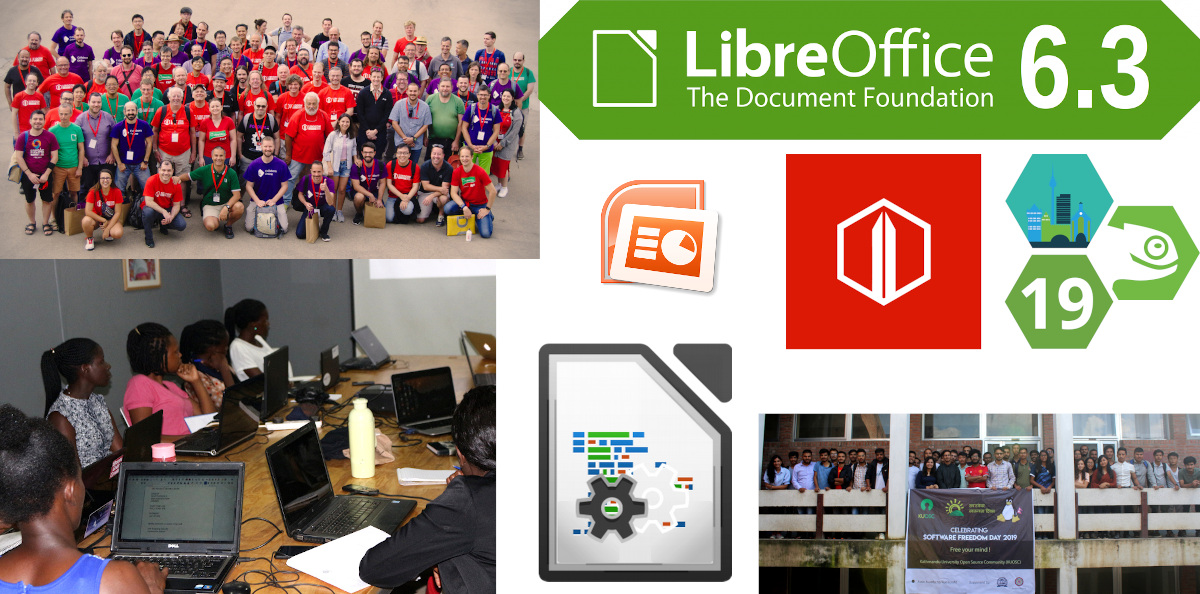
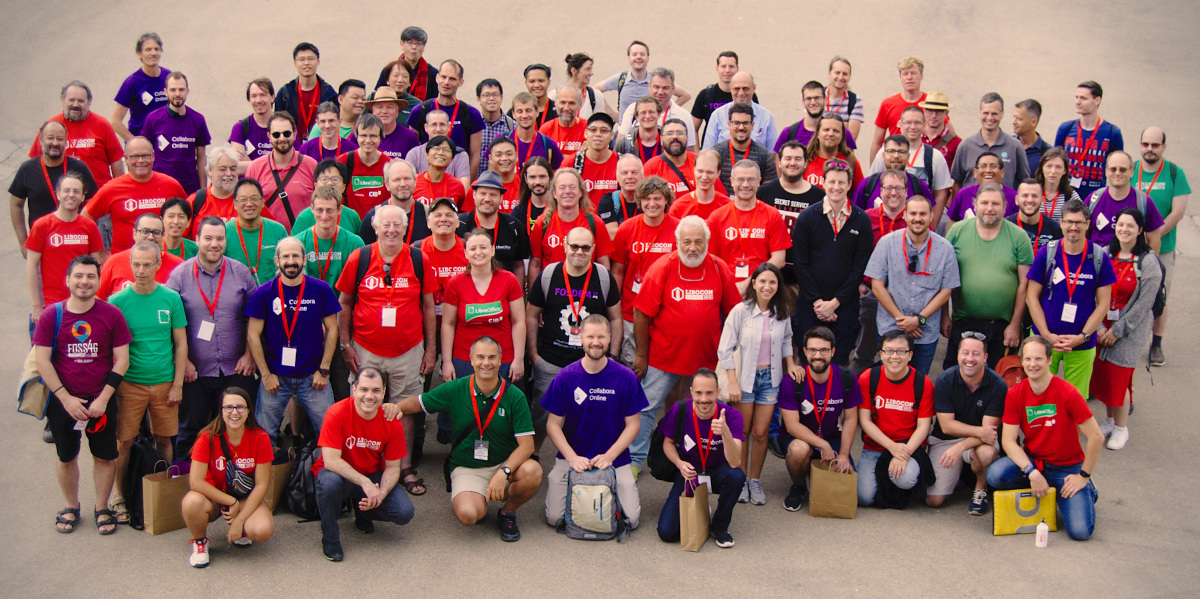
The LibreOffice Conference 2020 will be an event to remember, for a couple of reasons: it will be the 10th in a series of successful conferences, and it will celebrate the 10th anniversary of the LibreOffice project and the 20th of the FOSS office suite. In 2020, The Document Foundation will be on stage at many FOSS events around the world, and the LibreOffice Conference will be the most important of the year. Organizing this conference is a unique opportunity for FOSS communities, because the event will make the history of free open source software.
So far, LibreOffice Conferences have been organized in Paris, October 2011; Berlin, October 2012; Milan, September 2013; Bern, September 2014; Aarhus, September 2015; Brno, September 2016; Rome, October 2017; Tirana, September 2018, and Almeria, September 2019.
The Call for Location for LibreOffice Conference 2020 is open until June 30, 2019. TDF’s Board of Directors wants to to give next year’s event organizers the opportunity to attend this year’s conference in Almeria, Spain, September 11 to 13, 2019, to familiarize with the community and the structure of the event. For historical and practical reasons, the LibreOffice Conference takes place between September and November, with a preference for September.
More details about LibOCon 2020 Call for Locations are available on the original blog post.
Berlin, May 23, 2019 – The Document Foundation (TDF) announced today that Adfinis SyGroup – a Swiss FOSS company headquarted in Bern, with offices in Basel, Zurich and Crissier (Vaud) – has joined the project’s Advisory Board.
Adfinis SyGroup is using LibreOffice for office productivity, in addition to providing professional consultancy to customers with SLA contracts to support migrations from proprietary software to LibreOffice. The company has helped to organize the LibreOffice Conference in 2014, when the event was hosted by the Bern University, is contributing patches to the source code, and is also hosting various TDF servers and buildbots on their infrastructure.
More recently, Adfinis SyGroup has helped Collabora to start porting LibreOffice to Apple iOS to allow drafting and editing ODF standard documents on Apple iPads. The underlying base of the software is LibreOfficeKit, which uses the LibreOffice code base to do tiled rendering. On top of that, a HTML/JS solution builds the UI for platforms using VCL under the hood.
“Adfinis SyGroup has been a friend of The Document Foundation since forever, and has recently increased its involvement in the LibreOffice project with the port to Apple iOS. We share the same vision about FOSS as a key element for the future of technology and innovation, and open standards as the only available road to true interoperability”, says Marina Latini, TDF Chairwoman.
“Our support for LibreOffice is part of our strategy to not only use FOSS software, but actively enable its improvement, strengthening the ecosystem and through that making the solution usable for more people. We are working closely with our partner Collabora as they invest in the iOS port, as well as helping branded LibreOffice products to gain more market share in the enterprise environment. By convincing more corporate and government organizations to choose an enterprise subscription for a branded LibreOffice we help to fund resources to further improve the product and project. We’re looking forward to contribute our many years of experience as part of the FOSS community, as well as our strong network to enterprise customers, to the TDF Advisory Board in order to contribute to one of the most important FOSS projects”, says Nicolas Christener, Adfinis SyGroup CEO and CTO.
TDF Advisory Board’s (AB) primary function is to represent supporters of the project, and to provide the Board of Directors (BoD) with advice, guidance and proposals. In addition, the AB is at the kernel of the LibreOffice ecosystem, and as such is key to the further development of the project.
Thanks to your generous donations, and contributions from our ecosystem of certified developers, we released two major releases of LibreOffice in 2018: 6.0 on January 31, and version 6.1 on August 8.
In addition, 14 minor releases were also made available throughout the year, for the 5.4, 6.0 and 6.1 branches. Meanwhile, several Bug Hunting Sessions were held in preparation for the new major releases. These typically took place on a single day between set times, so that experienced developers and QA engineers could help new volunteers to file and triage bugs via the IRC channels and mailing lists. The Bug Hunting Sessions for LibreOffice 5.4 were held on April 27, May 28 and July 3 – while those for LibreOffice 6.2 took place on October 22, November 19 and December 21.
LibreOffice 6.0
On January 31, LibreOffice 6.0 was officially released after six months of development. This included a new ePUB filter, for saving documents as eBooks, while support for opening QuarkXPress documents was added as well. Other new features included: a revamped special characters dialog; OpenPGP support for signing and encryption on all desktop platforms; a brand new web browser-based help system; and better flexibility when using custom dictionaries.
In addition, LibreOffice 6.0 lets users perform mail merge operations using data from tables inside Writer itself, while in Calc, new commands were added to select unprotected cells on protected or unprotected sheets. Impress was also improved thanks to 10 new templates, designed for home and business use. This video summarises the improvements:
Please confirm that you want to play a YouTube video. By accepting, you will be accessing content from YouTube, a service provided by an external third party.
If you accept this notice, your choice will be saved and the page will refresh.
LibreOffice 6.1
Later in the year, on August 8, LibreOffice 6.1 was made available. This release included many new features such as Colibre, a new icon theme for Windows based on Microsoft’s icon design guidelines, which makes the office suite visually appealing for users coming from the Microsoft environment.
The image handling engine was reworked to be significantly faster and smoother thanks to a new graphic manager and an improved image lifecycle, with some advantages also when loading documents in Microsoft’s proprietary formats.
Then there was the reorganization of Draw menus with the addition of a new Page menu, for better UX consistency across the different modules, along with a major improvement for Base, only available in experimental mode: the old HSQLDB database engine has been deprecated, though still available, and the new Firebird database engine is now the default option (users are encouraged to migrate files using the migration assistant from HSQLDB to Firebird, or by exporting them to an external HSQLDB server).
Finally, Online Help pages were enriched with text and example files to guide the users through various features, and are now easier to localize. Check out the other short video:
Please confirm that you want to play a YouTube video. By accepting, you will be accessing content from YouTube, a service provided by an external third party.
If you accept this notice, your choice will be saved and the page will refresh.
This was all possible thanks to your donations! Support our community today, so we can keep improving LibreOffice, organising events and sharing knowledge. Thank you!
Berlin, May 22, 2019 – The Document Foundation announces LibreOffice 6.2.4, the fourth bug and regression fixing release of the LibreOffice 6.2 family, targeted at tech-savvy individuals: early adopters, technology enthusiasts and power users.
LibreOffice’s individual users are helped by a global community of volunteers: https://www.libreoffice.org/get-help/community-support/. On the website and the wiki there are guides, manuals, tutorials and HowTos. Donations help us to make all of these resources available.
LibreOffice users are invited to join the community at https://www.libreoffice.org/community/get-involved/, to improve LibreOffice by contributing back in one of the following areas: development, documentation, infrastructure, localization, quality assurance, design or marketing.
Enterprise Deployments
LibreOffice 6.2.4 represents the bleeding edge in term of features for open source office suites, and as such is not optimized for enterprise class deployments, where features are less important than robustness. Users wanting a more mature version can download LibreOffice 6.1.6, which includes some months of back-ported fixes.
Organizations looking for an enterprise class application backed by support and service level agreements (SLA) should source a LibreOffice LTS (Long Term Supported) version from those TDF Advisory Board members who provide this product (https://www.documentfoundation.org/governance/advisory-board/).
Sourcing software and/or services from the ecosystem of certified professionals represents the best support option for enterprises deploying LibreOffice on a large number of desktops. In fact, these activities are contributed back to the project under the form of improvements to the software and the community, and trigger a virtuous circle which is beneficial to users and all other stakeholders.
Availability of LibreOffice 6.2.4
LibreOffice 6.2.4 is immediately available from the following link: https://www.libreoffice.org/download/. Minimum requirements for proprietary operating systems are Microsoft Windows 7 SP1 and Apple macOS 10.9. Builds of the latest LibreOffice Online source code are available as Docker images: https://hub.docker.com/r/libreoffice/online/.
LibreOffice Online is fundamentally a server service, and should be installed and configured by adding cloud storage and an SSL certificate. It might be considered an enabling technology for the cloud services offered by ISPs or the private cloud of enterprises and large organizations.
LibreOffice users, free software advocates and community members can support The Document Foundation with a donation at https://www.libreoffice.org/donate.
OW2con 2019 is the annual open source event bringing together the OW2 community, technology experts, software architects, IT project managers and decision-makers from around the world. The conference will be hosted by the Orange Gardens Innovation Center, Paris-Châtillon, on June 12-13, 2019.
The central theme of OW2con 2019 is: “Open Source Toward Industry Maturity”. Indeed, with open source becoming mainstream, IT developers, vendors, users and even open source organisations such as OW2 have to adapt. Today, open source projects are becoming increasingly competitive and all IT developers, vendors and users must have an open source strategy.
During OW2con 2019, The Document Foundation and LibreOffice Online will be presented during two different talks:
Breakout Session – Adding LibreOffice To Your Online Solution, managed by Michael Meeks (Collabora), Philippe Hemmel (Arawa) and Thorsten Behrens (CIB), on Wednesday June 12, from 1:45pm to 3:45pm.
LibreOffice Online can be integrated into cloud solutions, as in the case of Nextcloud, ownCloud, Pydio and Seafile. The software is 100% open source and can be the perfect solution for GDPR issues in organizations. During the session it will be possible to get an overview of the application, and ask both technical and business-related questions.
Talk – Introducing The Document Foundation, by Simon Phipps (TDF/OSI), on Thursday June 13, from 9:45am to 10:00am.
The Document Foundation is one of OW2’s newest Affiliate organisations, and is a global charity based in Germany that works to promote open source productivity tools. Its flagship project, LibreOffice, is available across major desktop platforms and continues the fourth decade of impact from the code that started life as Star Writer on CP/M.
More information about OW2con 2019 are available on the event website: https://www.ow2con.org/view/2019/.
Learn C++ features with the help of LibreOffice developers! We’re running regular workshops which focus on a specific topic, and are accompanied by a real-time IRC meeting. For the next one, the topic is Binary Search Trees. Start by watching this presentation:
Please confirm that you want to play a YouTube video. By accepting, you will be accessing content from YouTube, a service provided by an external third party.
Then join us for a discussion via our #libreoffice-dev IRC channel. You can ask experienced LibreOffice developers questions, and learn more about the language. We look forward to meeting you!