LibreOffice happy to work with Coverity Scan results

Spending part of my time to LibreOffice QA, I look over the web page displaying all the commits for LibreOffice code (1) from time to time.
The last months, I saw an large amount of commits related to ‘Coverity’. I remembered that name from years back, in the old OpenOffice.org project.
To explain: Coverity is a project that runs all kind of automated code checks, discovering typical but often hidden programming errors. Memory leaks, but also errors that may cause little, not so often encountered errors for the users. The reports from Coverity are a valuable contribution to – among others – the LibreOffice development process.

The work on using the Coverity reports for LibreOffice is done by a variety of LibreOffice developers, some on the building and testing, others on the other work to fix the issues. In the first months many hundred improvements have been made, making LibreOffice more robust, better. There are still some few thousand issues left however 🙂 So pls get in contact if you like to help with these improvements.

Again it’s lovely to see that core and volunteer developers work together to get thousands of improvements in the LibreOffice code.
Of course in this special case it only can be done with to the work of the Coverity team, that helps open source projects to become more stable and improve quality. Thanks a lot for that!

Impress Remote for Android: video and how-to instructions

Impress Remote for Android is one of the coolest features introduced by LibreOffice 4.0. With version 4.0.1, it is compatible with every platform – Linux, MacOS and Windows – and works like a charm.

In order to install and operate the Impress Remote you must first download it from Google Play on your Android smartphone, and then follow a simple procedure, which is described in this wiki page and also in this video:

[youtube http://www.youtube.com/watch?v=hM5H4fUxq4M&w=640&h=360]

If you like the Impress Remote for Android, please remember that The Document Foundation is a not for profit entity which lives thanks to the work of many volunteers, but also thanks to donations, which support infrastructure, marketing and community development.

Waving TDF Long Tail

TDF Long Tail

In 2012, developers hacking LibreOffice code have been around 320, with a majority of volunteers and a minority of people paid by companies such as SUSE, RedHat and Canonical (plus a multitude of smaller organizations such as Lanedo, which is also a member of our Advisory Board and builds a significant part of its business by providing development related value added services on top of LibreOffice code).

The graphic visualization of the individual commits has the shape of a “long tail“. The pie is an explosion of the work done by the top 33 hackers with 100+ commits: 16 volunteers, and 17 paid developers (11 from SUSE, 5 from RedHat and one from Canonical). At TDF, we do not have “paid volunteers” because we love transparency and truth.

If you are not familiar with the importance of the “long tail”, especially for free software projects, you might get some interesting insights from the following TED speech, by Clay Shirky:

[youtube http://www.youtube.com/watch?v=sPQViNNOAkw?rel=0&w=640&h=480]

Clay Shirky has inspired the work of Chris Anderson on the long tail (article, book and blog) with his 2003 essay “Power Laws, Weblogs and Inequality“, which is a very interesting reading.

Searching for infrastructure sponsors

One of the most valueable assets of The Document Foundation, the charitable entity behind LibreOffice, clearly is its infrastructure. It provides the grounds where the community develops, markets, designs, improves and offers its free office suite for download.

That’s why it comes to no surprise that the infrastructure budget is one of the largest spendings. As of today, we spend about 700 € per month on infrastructure, which is more than 50% of our regular monthly operations budget – quite a lot for a foundation of our size.

The last months, the community has grown rapidly, and so we will also have an upward trend with regards to infrastructure, with costs growing more and more.

Therefore, we would like to take the opportunity to ask for infrastructure sponsors. Internet service providers, webhosters, universities and corporations can contribute to the success of LibreOffice. You can support the further development and growth of the community and the product, by sponsoring the use of dedicated machines for LibreOffice purposes.

Due to our setup, we specifically look for dedicated machines (“rented root servers”) that we can use. Virtual servers or shared webhosting unfortunately won’t fit.

As a rough estimation, here are some technical details on what would be desirable:

  • Quadcore CPU
  • 32 GB RAM, ideally with ECC
  • two hard disks with 1,5 TB/each for RAID1; smaller SSDs also welcome
  • one dedicated IPv4 address
  • one IPv6 subnet (/64 or larger)
  • automated reset service
  • remotely bootable rescue system
  • no extra fees for traffic (we approximately use between 2 and 5 TB on an average machine and month); forced traffic shaping after a certain threshold is fine
  • ideally, 1 Gbit/s bandwith instead of 100 Mbit/s

Support of any kind towards our infrastructure efforts is highly welcome, and we would like to thank everyone for their contributions!

If you would like to support our efforts, or have further questions, feel free to ask our infrastructure team at hostmaster@documentfoundation.org or ping Florian directly.

On behalf of the whole LibreOffice community and my infrastructure colleagues, thank you very much!

The Document Foundation announces LibreOffice 3.5.7

Berlin, October 18, 2012 – The Document Foundation announces LibreOffice 3.5.7, the seventh and possibly last version of the free office suite’s 3.5 family, which solves additional bugs and regressions, and offers stability improvements over LibreOffice 3.5.6.

The Document Foundation suggests all users to upgrade from previous versions to LibreOffice 3.5.7.

LibreOffice 3.5.7 is available for immediate download from the following link: http://www.libreoffice.org/download/.

Change logs are available at http://wiki.documentfoundation.org/Releases/3.5.7/RC1 and http://wiki.documentfoundation.org/Releases/3.5.7/RC2.

Extensions for LibreOffice are available from the following link: http://extensions.libreoffice.org/extension-center.

When downloading the software, you might consider about donating some money to The Document Foundation for the development of LibreOffice and the growth of the community, by accessing our donation page at http://donate.libreoffice.org.

The Document Foundation announces LibreOffice 3.6.2

Berlin, October 4, 2012 – The Document Foundation (TDF) announces LibreOffice 3.6.2, for Windows, MacOS and Linux, solving bugs and regressions and further improving the stability of the program for corporate deployments. The best free office suite ever is quickly becoming the de facto standard for migrations to free office suites, thanks to the quickly growing feature set and the improved interoperability with proprietary software.

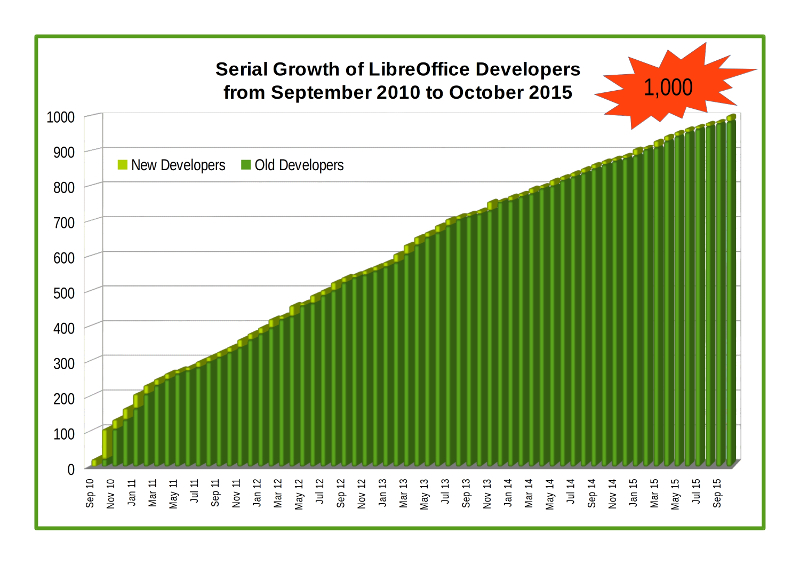
The growing number of LibreOffice adoptions by private and public enterprises is a demonstration of the improvements brought to the legacy code by TDF, thanks to over 500 developers who are focusing on stability and quality (in addition to new exciting features).

The latest public administration to migrate has been the city of Limerick, Ireland’s third largest city, where LibreOffice is now used on all 450 desktops in use at the city’s six main locations including the three public libraries, the fire department, the municipal museum and the City Gallery of Art.

The community behind LibreOffice will gather in Berlin for the second LiboCon from October 17 to October 19. During three days, company representatives and volunteers will discuss their experiences, learning from each other in the true spirit of the community.

Registration for the conference end on October 8, Registration for the conference ends on October the 8th. If you want to join in, please register at this address: http://conference.libreoffice.org/registration.

LibreOffice 3.6.2 is available for immediate download from the following link: http://www.libreoffice.org/download/. Extensions for LibreOffice are available from the following link: http://extensions.libreoffice.org/extension-center.

Change logs are available at http://download.documentfoundation.org/libreoffice/src/bugfixes-libreoffice-3-6-2-release-3.6.2.1.log (fixed in 3.6.2.1) and http://download.documentfoundation.org/libreoffice/src/bugfixes-libreoffice-3-6-2-release-3.6.2.2.log (fixed in 3.6.2.2).

The infographics offers a representation of the growth of the developers community over the last 12 months, in addition to the growth of downloads from TDF mirror system.

Some TDF Numbers as of September 2012

You can download the Hybrid PDF at the following link: TDF Infographics September 2012 – Hybrid PDF.