The new major release provides a wealth of new features, plus a large number of interoperability improvements
Berlin, 22 August 2024 – LibreOffice 24.8, the new major release of the free, volunteer-supported office suite for Windows (Intel, AMD and ARM), macOS (Apple and Intel) and Linux is available from our download page. This is the second major release to use the new calendar-based numbering scheme (YY.M), and the first to provide an official package for Windows PCs based on ARM processors.
LibreOffice is the only office suite, or if you prefer, the only software for creating documents that may contain personal or confidential information, that respects the privacy of the user – thus ensuring that the user is able to decide if and with whom to share the content they have created. As such, LibreOffice is the best option for the privacy-conscious office suite user, and provides a feature set comparable to the leading product on the market. It also offers a range of interface options to suit different user habits, from traditional to contemporary, and makes the most of different screen sizes by optimising the space available on the desktop to put the maximum number of features just a click or two away.
The biggest advantage over competing products is the LibreOffice Technology engine, the single software platform on which desktop, mobile and cloud versions of LibreOffice – including those provided by ecosystem companies – are based. This allows LibreOffice to offer a better user experience and to produce identical and perfectly interoperable documents based on the two available ISO standards: the Open Document Format (ODT, ODS and ODP), and the proprietary Microsoft OOXML (DOCX, XLSX and PPTX). The latter hides a large amount of artificial complexity, which may create problems for users who are confident that they are using a true open standard.
End users looking for support will be helped by the immediate availability of the LibreOffice 24.8 Getting Started Guide, which is available for download from the Bookshelf. In addition, they will be able to get first-level technical support from volunteers on user mailing lists and the Ask LibreOffice website.
New Features of LibreOffice 24.8
PRIVACY
- If the option Tools ▸ Options ▸ LibreOffice ▸ Security ▸ Options ▸ Remove personal information on saving is enabled, then personal information will not be exported (author names and timestamps, editing duration, printer name and config, document template, author and date for comments and tracked changes)
WRITER
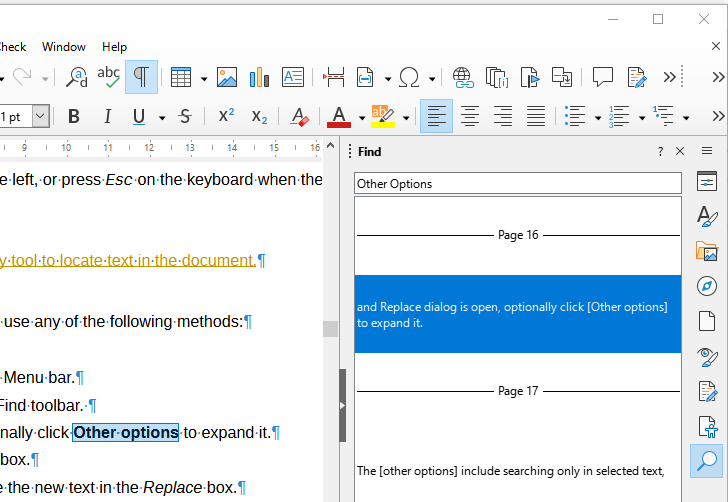
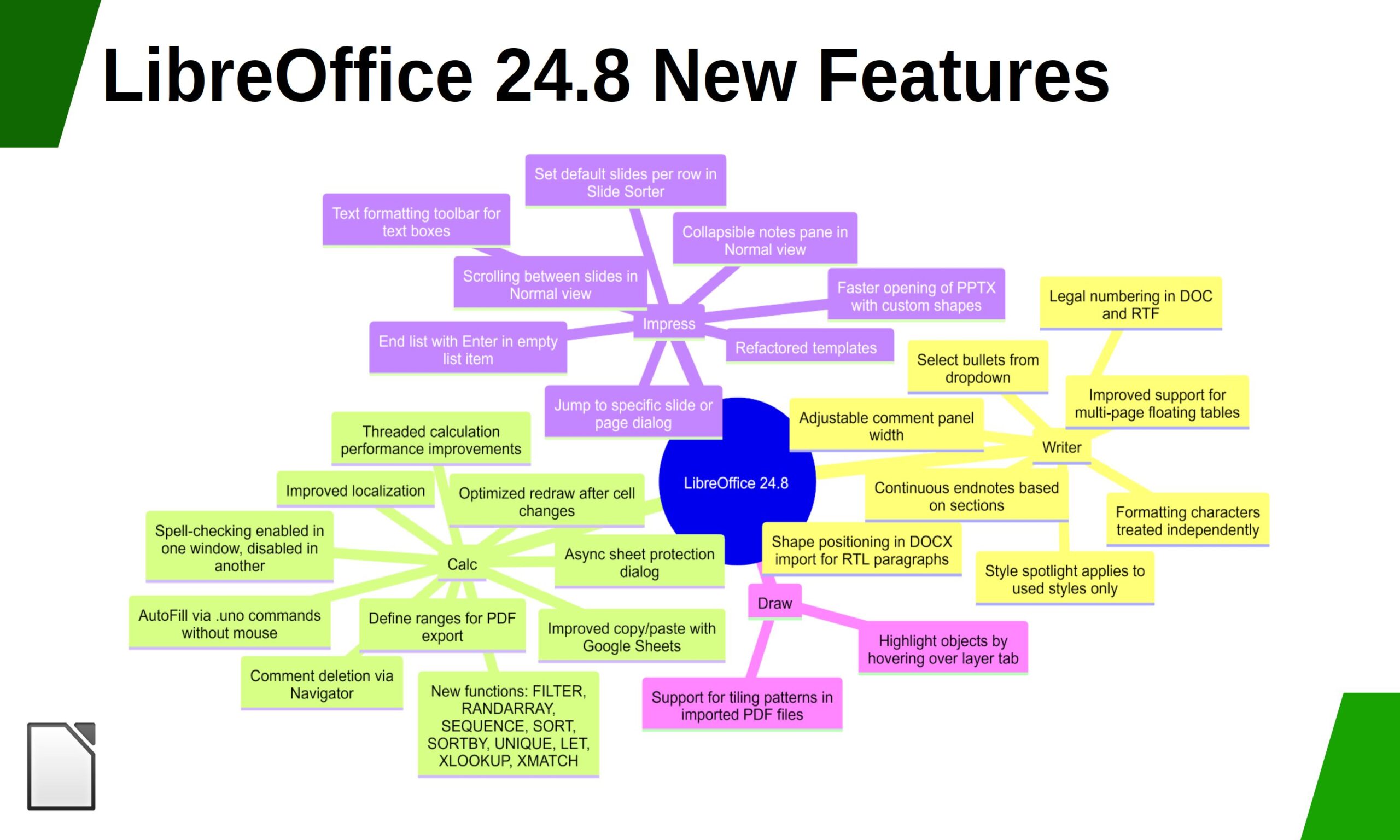
- UI: handling of formatting characters, width of comments panel, selection of bullets, new dialog for hyperlinks, new Find deck in the sidebar
- Navigator: adding cross-references by drag-and-drop items, deleting footnotes and endnotes, indicating images with broken links
- Hyphenation: exclude words from hyphenation with new contextual menu and visualization, new hyphenation across columns, pages or spreads, hyphenation between constituents of a compound word
CALC
- Addition of FILTER, LET, RANDARRAY, SEQUENCE, SORT, SORTBY, UNIQUE, XLOOKUP and XMATCH functions
- Improvement of threaded calculation performance, optimization of redraw after a cell change by minimizing the area that needs to be refreshed
- Cell focus rectangle moved apart from cell content
- Comments can be edited and deleted from the Navigator’s right-click menu
IMPRESS & DRAW
- In Normal view, it is now possible to scroll between slides, and the Notes are available as a collapsible pane under the slide
- By default, the running Slideshow is now immediately updated when applying changes in EditView or in PresenterConsole, even on different Screens
CHART
- New chart types “Pie-of-Pie” and “Bar-of-Pie” break down a slice of a pie as a pie or bar sub-chart respectively (this also enables import of such charts from OOXML files created with Microsoft Office)
- Text inside chart’s titles, text boxes and shapes (and parts thereof) can now be formatted using the Character dialog
ACCESSIBILITY
- Several improvements to the management of formatting options, which can be now announced properly by screen readers
SECURITY
- New mode of password-based ODF encryption
INTEROPERABILITY
- Support importing and exporting OOXML pivot table (cell) format definitions
- PPTX files with heavy use of custom shapes now open faster
A video showcasing the most significant new features is available on YouTube and PeerTube.
Contributors to LibreOffice 24.8
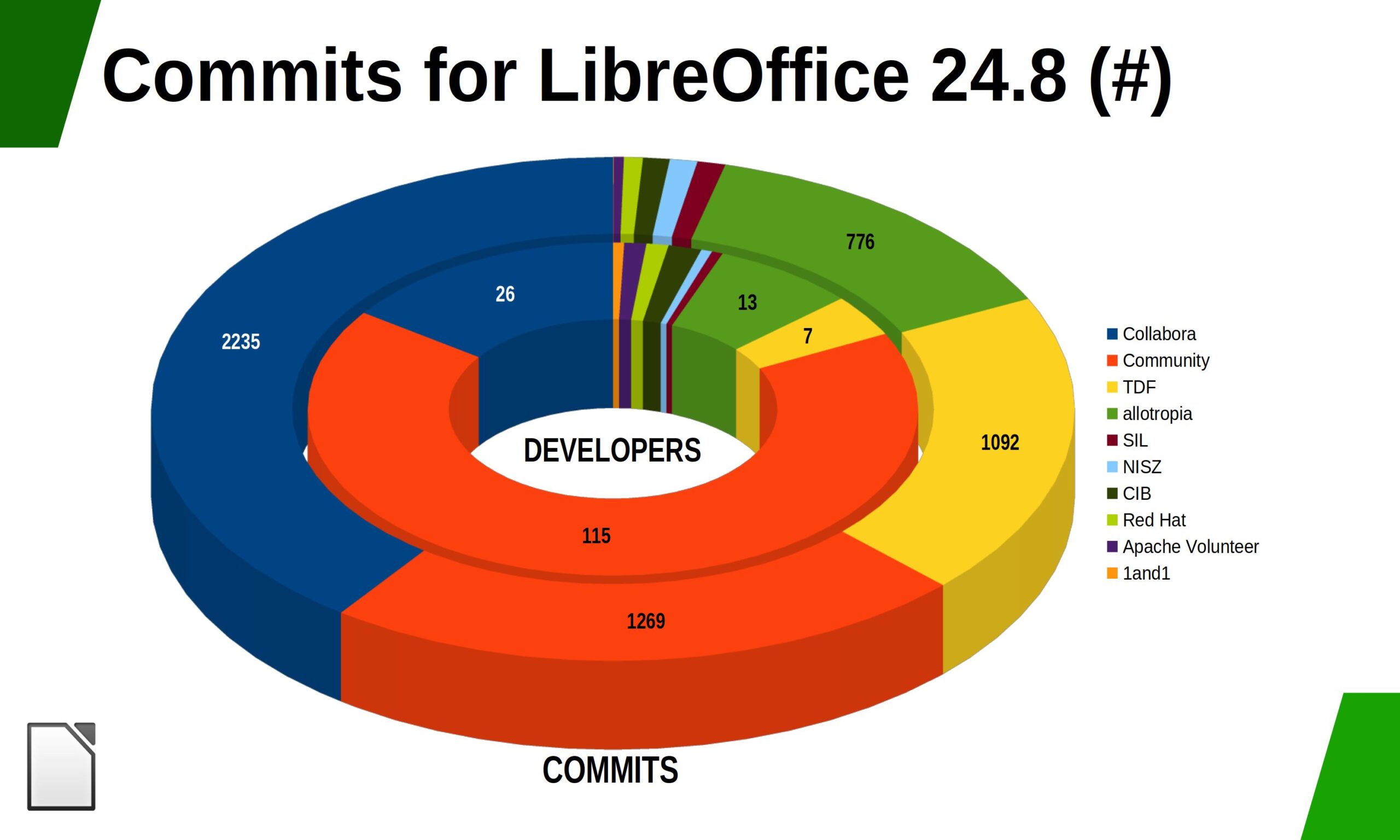
There are 171 contributors to the new features of LibreOffice 24.8: 57% of code commits come from the 49 developers employed by companies on TDF’s Advisory Board – Collabora, allotropia and Red Hat – and other organisations, another 20% from seven developers at The Document Foundation, and the remaining 23% from 115 individual volunteer developers.
An additional 188 volunteers have committed localized strings in 160 languages, representing hundreds of people actually providing translations. LibreOffice 24.8 is available in 120 languages, more than any other desktop software, making it available to over 5.5 billion people in their native language. In addition, over 2.4 billion people speak one of these 120 languages as a second language (L2).
LibreOffice for Enterprises
For enterprise-class deployments, TDF strongly recommends the LibreOffice Enterprise family of applications from ecosystem partners – for desktop, mobile and cloud – with a wide range of dedicated value-added features and other benefits such as SLAs: LibreOffice in Business.
Every line of code developed by ecosystem companies for enterprise customers is shared with the community on the master code repository and improves the LibreOffice Technology platform. Products based on LibreOffice Technology are available for all major desktop operating systems (Windows, macOS, Linux and ChromeOS), mobile platforms (Android and iOS) and the cloud.
Migrations to LibreOffice
The Document Foundation has developed a migration protocol to help companies move from proprietary office suites to LibreOffice, based on the deployment of an LTS (long-term support) enterprise-optimised version of LibreOffice plus migration consulting and training provided by certified professionals who offer value-added solutions consistent with proprietary offerings. Reference: professional support page.
In fact, LibreOffice’s mature code base, rich feature set, strong support for open standards, excellent compatibility and LTS options from certified partners make it the ideal solution for organisations looking to regain control of their data and break free from vendor lock-in.
Availability of LibreOffice 24.8
LibreOffice 24.8 is available on our download page. Minimum requirements for proprietary operating systems are Microsoft Windows 7 SP1 [1] and Apple MacOS 10.15. LibreOffice Technology-based products for Android and iOS are listed on this page.
For users who don’t need the latest features and prefer a version that has undergone more testing and bug fixing, The Document Foundation maintains the LibreOffice 24.2 family, which includes several months of back-ported fixes. The current release is LibreOffice 24.2.5.
LibreOffice users, free software advocates and community members can support The Document Foundation with a donation on our donate page.
[1] This does not mean that The Document Foundation suggests the use of this operating system, which is no longer supported by Microsoft itself, and as such should not be used for security reasons.
Release Notes: wiki.documentfoundation.org/ReleaseNotes/24.8
Press Kit with Images: nextcloud.documentfoundation.org/s/JEe8MkDZWMmAGmS