LibreOffice project and community recap: January 2025

LibreOffice project and community recap banner

LibreOffice 25.2 – our next major release – is due to arrive next week! But while you’re waiting, here’s our summary of updates, events and activities in the LibreOffice project in the last four weeks – click the links to learn more…

Hazard screenshot

Calc Guide cover

Czech Getting Started guide cover

localwriter screenshot

FOSDEM logo

Document Freedom Day logo

Keep in touch – follow us on Mastodon, X (formerly Twitter), Bluesky, Reddit and Facebook. Like what we do? Support our community with a donation – or join our community and help to make LibreOffice even better!

Document Freedom Day: Empowering the Digital World with Open Standards

Every year, on the last Wednesday of March, advocates of free and open technologies come together to celebrate Document Freedom Day (DFD). In 2025, the Document Freedom Day will happen on March 26, and will be driven by the LibreOffice community.

Today, Document Freedom Day – together with Software Freedom Day (SFD, celebrated in September) and Hardware Freedom Day (HFD, celebrated in April) – is coordinated by the Digital Freedom Foundation (DFF). This global event raises awareness about the importance of open standards and accessible formats in the digital age, empowering individuals, organizations, and governments to embrace freedom in how they create, share, and preserve information.

But what exactly is Document Freedom Day, and why is it so crucial in today’s world? Let’s explore its significance, the challenges posed by proprietary formats, and how embracing open standards can create a more inclusive, transparent, and resilient digital future.

What is Document Freedom Day?

Document Freedom Day was established by the Free Software Foundation Europe (FSFE) to promote the use of open standards for documents, and transferred to the Digital Freedom Foundation in 2016. It is a day dedicated to advocating for formats and tools that ensure documents can be accessed, edited, and shared by anyone, without restrictions or reliance on specific software or vendors.

At its core, Document Freedom Day celebrates the idea that information should be accessible to all. It highlights the need for transparency and interoperability in digital documents, ensuring that no one is excluded or locked into using a particular platform due to proprietary constraints.

The Problem with Proprietary Formats

Proprietary formats come with significant drawbacks. They are typically controlled by a single company or entity, meaning that access to these formats can be restricted or even revoked at any time. This lack of control over how information is stored and accessed poses numerous challenges:

  1. Vendor Lock-In: Proprietary formats often force users to rely on specific software, limiting their choices and tying them to a single vendor. This can lead to long-term costs, as organizations may have to pay for updates, licensing fees, or migration to alternative platforms.
  2. Inaccessibility: Over time, older proprietary formats may become obsolete, making it difficult or impossible to access historical data. This is especially problematic for governments, libraries, and archives that need to preserve information for future generations.
  3. Lack of Transparency: Proprietary formats often hide how data is stored, making it harder to verify, analyze, or integrate with other systems. This lack of transparency can lead to inefficiencies and mistrust.
  4. Exclusion: Individuals who cannot afford expensive software or who use alternative platforms may find themselves excluded from accessing or sharing documents.

The Power of Open Standards

Open standards offer a solution to these challenges by providing formats that are publicly available and free from restrictive licensing. They are designed to be:

  • Interoperable: Open standards enable seamless communication between different software and systems, allowing users to share and access information across platforms.
  • Accessible: They ensure that anyone, regardless of their tools or financial resources, can access and use the information.
  • Future-Proof: Open standards are often maintained by global communities or non-profit organizations, ensuring their longevity and adaptability.
  • Transparent: By making the technical details publicly available, open standards allow developers to innovate and improve upon existing formats.

Prominent examples of open standards include the Open Document Format (ODF) for text documents, the Portable Document Format (PDF/A) for archiving, and Web standards like HTML and CSS. These formats demonstrate how openness can foster innovation and inclusivity.

One notable milestone in the history of open standards is the adoption of the Open Document Format (ODF) as an official OASIS standard in 2005. ODF was designed to provide a universal, vendor-neutral format for office documents, ensuring that users could create, edit, and share files without being tied to proprietary software. Its standardization marked a significant step forward in the global movement toward greater document freedom.

Why Document Freedom Matters

Document freedom is not just a technical issue; it is a matter of rights, equity, and sustainability. Here are a few reasons why it matters:

  1. Empowering Individuals. When people have control over their documents, they gain the freedom to choose the tools that work best for them. Open standards ensure that individuals can access and share information without being constrained by expensive or restrictive software.
  2. Promoting Innovation. By removing barriers created by proprietary formats, open standards encourage competition and creativity. Developers can build new tools and applications that work with existing formats, driving technological progress.
  3. Ensuring Long-Term Preservation. For governments, libraries, and cultural institutions, preserving historical records is a critical responsibility. Open standards ensure that documents remain accessible over time, regardless of changes in technology or vendor policies.
  4. Fostering Inclusivity. Open standards create a level playing field, enabling people from diverse economic and technological backgrounds to participate in the digital world. This inclusivity is essential for bridging the digital divide.

How to Get Involved in Document Freedom Day

Participating in Document Freedom Day is easy and impactful. Here are some ways to contribute:

  • Spread Awareness: Share information about the importance of open standards on social media, blogs, or community forums. Use hashtags like #DocumentFreedomDay or #OpenStandards to amplify your message.
  • Advocate for Change: Encourage your organization or government to adopt open standards for documents and data. Highlight the benefits of interoperability, accessibility, and long-term sustainability.
  • Host Events: Organize workshops, webinars, or hackathons to educate others about open standards and free software. If you are planning to organize an event with your local community, please get in touch with us by writing to media@documentfoundation.org. We can help you with sending stickers on LibreOffice and Open Document Format. And don’t forget to register your event so that it appears on the events map, using the form on this page: https://digitalfreedoms.org/en/dfd.
  • Support Open Projects: Contribute to open-source projects or donate to organizations that promote document freedom and digital rights.
  • Evaluate Your Tools: Have a closer look at the software and formats you use. Whenever possible, choose tools that support open standards.

A Vision for the Future

Document Freedom Day is more than just a celebration; it is a call to action. It reminds us of the importance of building a digital world where everyone can participate, innovate, and thrive without unnecessary barriers. On March 26, the LibreOffice community will organize a virtual event with a presentation about the importance of open document standards for digital sovereignty (technological independence from US companies), followed by an open discussion. We will provide details about this virtual event, which will be repeated during the day to allow people from all time zones to participate, around mid-March.

As we face challenges like rapid technological change, increasing reliance on digital communication, and the need for greater inclusivity, the principles of openness and freedom become ever more critical. By embracing open standards, we can create a future where information is a shared resource, accessible to all and preserved for generations to come.

So, this Document Freedom Day, take a moment to reflect on how you interact with digital information. Advocate for openness, educate others, and join the global community working to make document freedom a reality. Together, we can ensure that the digital world remains a space of opportunity and equality for everyone.

Meet the LibreOffice community at FOSDEM 2025 in Brussels!

FOSDEM logo

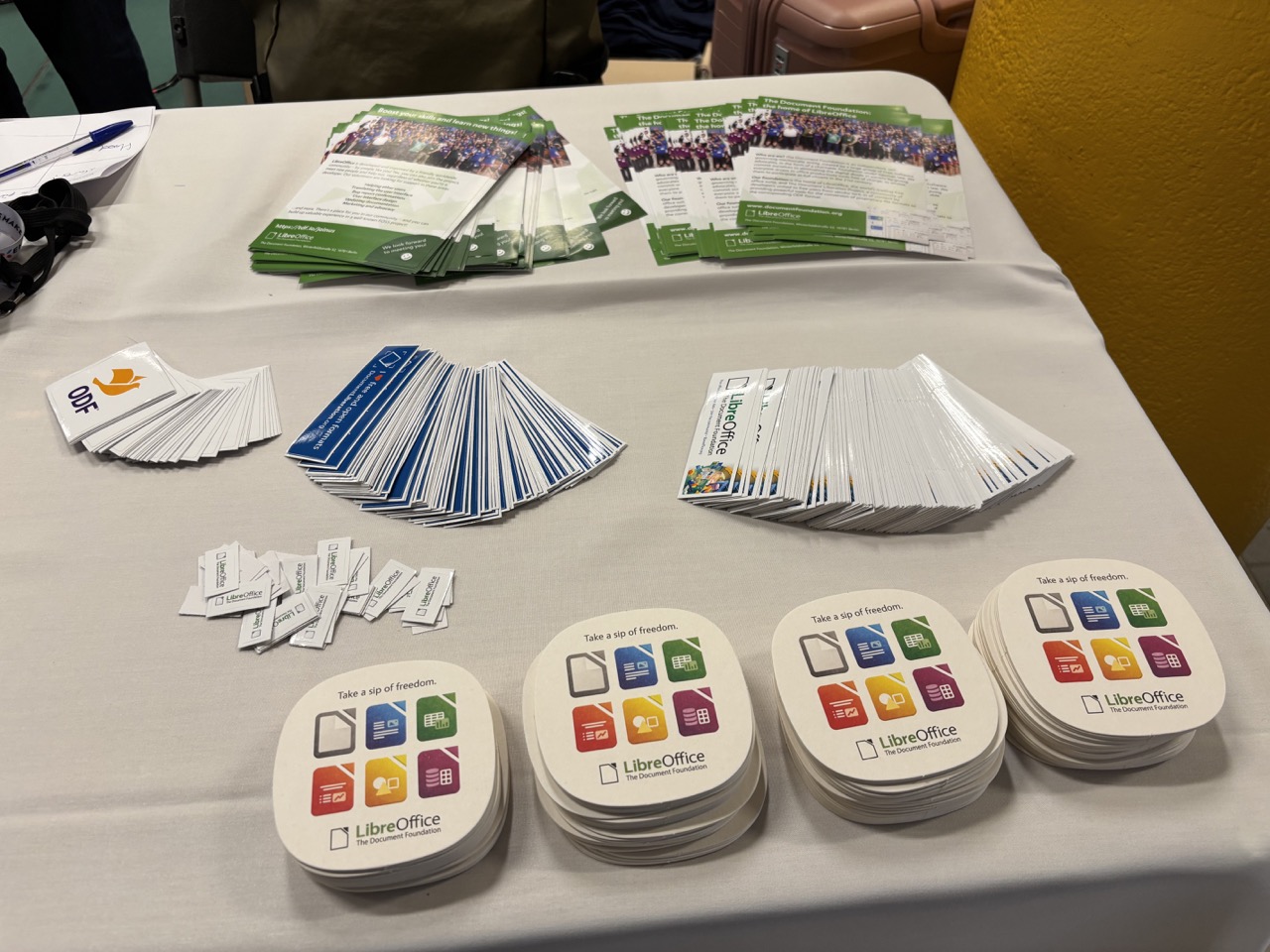
FOSDEM is one of the largest meetups for free and open source software projects, and it takes place every year in Brussels at the ULB Solbosch campus. This year it’ll be on 1 and 2 February – and, of course, LibreOffice and The Document Foundation will be there! Our stand will be in in K level 1, so come by and have a chat, grab some merchandise (stickers, pens, flyers, beer/coffee mats), and support us with a donation if you like 😊

LibreOffice stand at FOSDEM

We also have the LibreOffice devroom on the first day, with 20 talks and presentations about the software, technology and community.

See you there!

localwriter: An optional LibreOffice Writer extension for local generative AI

localwriter screenshot

LibreOffice is a privacy-oriented office suite that runs on your own computer and doesn’t include AI features out-of-the-box. But we know that many users are interested in combining AI tools with the suite, so we talked to John Balis who is working on a (fully optional!) LibreOffice extension called localwriter. Here’s what he had to say…

What does the extension do?

Localwriter is a libreoffice writer extension to allow for inline generative editing with local inference. It can be used with any language model supported by Ollama or text-generation-webui. This extension adds two powerful commands to LibreOffice Writer:

  • Extend Selection – Uses a language model to predict what comes after the selected text. There are a lot of ways to use this. Some example use cases for this include, writing a story or an email given a particular prompt, adding additional possible items to a grocery list, or summarizing the selected text.
  • Edit Selection – A dialog box appears to prompt the user for instructions about how to edit the selected text, then the selected text is replaced by the edited text. Some examples for use cases for this include changing the tone of an email, translating text to a different language, and semantically editing a scene in a story.

When did you start working on it?

I started working on localwriter in July 2024, because I wanted an AI tool to assist with my writing that would benefit from the intrinsic advantages in terms of availability (can’t lose access), confidentiality (doesn’t leak data), and integrity (no surprise model version changes) that come with using a fully open source local AI stack instead of a third-party API. I feel it is really important to embrace learning to benefit from artificial intelligence without sacrificing agency, and this software follows from that line of thinking.

What are the current limitations, and what’s coming next?

localwriter currently only supports LibreOffice Writer, although Calc support is in development and will be offered in the next release. Another limitation is that it does not support streaming, and does not offer a “Chat with document” feature.

How can others help to improve it?

There are a ton of open feature requests in the repository from several users, which should be really easy for an experienced LibreOffice extension developer to complete. I can easily set up anyone interested with a task to work on. Tests would be welcome, as currently it doesn’t have any tests. Also, donating to me helps me allocate my own time towards development.

Get the extension here

Czech translation of LibreOffice Getting Started Guide 24.8

Czech LibreOffice Getting Started Guide cover

Zdeněk Crhonek (aka “raal”) from the Czech LibreOffice community writes:

The Czech team has finished its translation of the LibreOffice Getting Started Guide 24.8. As usual it was a team effort, with translations by Petr Kuběj, Zdeněk Crhonek and Radomír Strnad; localized pictures from Roman Toman; and technical support from Miloš Šrámek. Thanks to all the team for their work!

The Czech translation of the Getting Started Guide 24.8 is available for download here.

The team will continue working on a translation of the Math Guide 24.8. We always looking for new translators and correctors. Join us!

Stanislav Horáček cleaned up the bookshelf page and he added an online version of the Math Guide. More online versions are to come.

Great work everyone! 😊

Hazard: A LibreOffice Impress template to play Jeopardy-like games

Hazard LibreOffice template screenshot

Marcial Machado recently posted on Reddit about his “fully-featured LibreOffice Impress template for creating Jeopardy-style games. Just add your questions and categories, and you’re good to go!” So let’s find out more…

What does the template do?

At its core, the template is meant to emulate what a game of Jeopardy is like. You can click on any of the squares on the game board and it will send you to the slide with the associated question, where you can either return to the board in the case of a misclick, or reveal the answer to the question. Returning to the board from the revealed answer slide will erase the square you clicked on to clearly show which questions are left to be answered.

You can also use the green and red arrows at the top to give and remove points to up to 6 teams in increments of 100, in order to keep track of everyone’s correctly- and incorrectly-guessed answers. Once the board’s cleared, you can click the pink button at the bottom right to clearly display the top three teams and the points they earned. I made sure to include details on how to edit, and use, the template in the first two slides!

Why did you develop it?

The simple reason for why I developed this template was because: I use LibreOffice, I wanted a Jeopardy presentation that worked in LibreOffice, and I couldn’t find one. The more verbose reason is that there is a comparative dearth of visually-appealing presentation templates in the OPT world than there is in the PPTX world; this is no fault of the creators of OPT templates, but rather because the proprietary nature of something like PowerPoint incentivizes templates made for profit, whereas most people who create LibreOffice Impress templates do it out of interest.

This necessarily means that there are just less people making LibreOffice Impress templates in total, without mentioning the much smaller userbase LibreOffice has compared with Microsoft Office. Now, some PowerPoint files do work in Impress, and the work done by the dev team and contributors is commendable, but a converted document is still a converted document. Formatting might be slightly off, and macros are almost always a bust. Since I realized I wanted this Jeopardy project to exist, and realizing my own frustration with the fact that such a project didn’t exist already, I went ahead and tried it out myself, and then released it to the public!

Hazard LibreOffice template screenshot

Do you have any tips for other people interested in creating templates in LibreOffice?

I have a few:

  • Focus on a problem you, yourself, have. You’ll be much more eager to bring a project to completion and to a high level of quality if you have a vetted interest in the final product.
  • Tell yourself that no one, ever, is going to make what you want to be made. The problem with a community of like-minded contributors is that everyone thinks everyone else is likely to fix the problem they have, so there’s a huge diffusion of responsibility; think of walking past some trash on the sidewalk and thinking, “someone else will pick that up eventually.” No! You be the one who throws it in the trash! In the same way, once you realize there’s an issue you can fix, or you can learn how to fix, be the one to fix it – no one else is gonna fix it for you!
  • Be patient. Like, really patient. Because no one is gonna fix this problem for you, you have all the time in the world to get it right. Read some documentation, go to some forums, sit on it a few days. Maybe get some feedback. Depend on time and on others to both find motivation and create a better end-product. The Jeopardy template I ended up releasing was the third completed project I made!

Get the template from here