
What are we doing in the LibreOffice project? Where are we going, and how can all users (yes, even non-programmers) help to improve the software? We answered these questions – and more – at the recent Grazer Linuxtage event.
What are we doing in the LibreOffice project? Where are we going, and how can all users (yes, even non-programmers) help to improve the software? We answered these questions – and more – at the recent Grazer Linuxtage event.
Ravi Dwivedi from the Indian LibreOffice community writes:
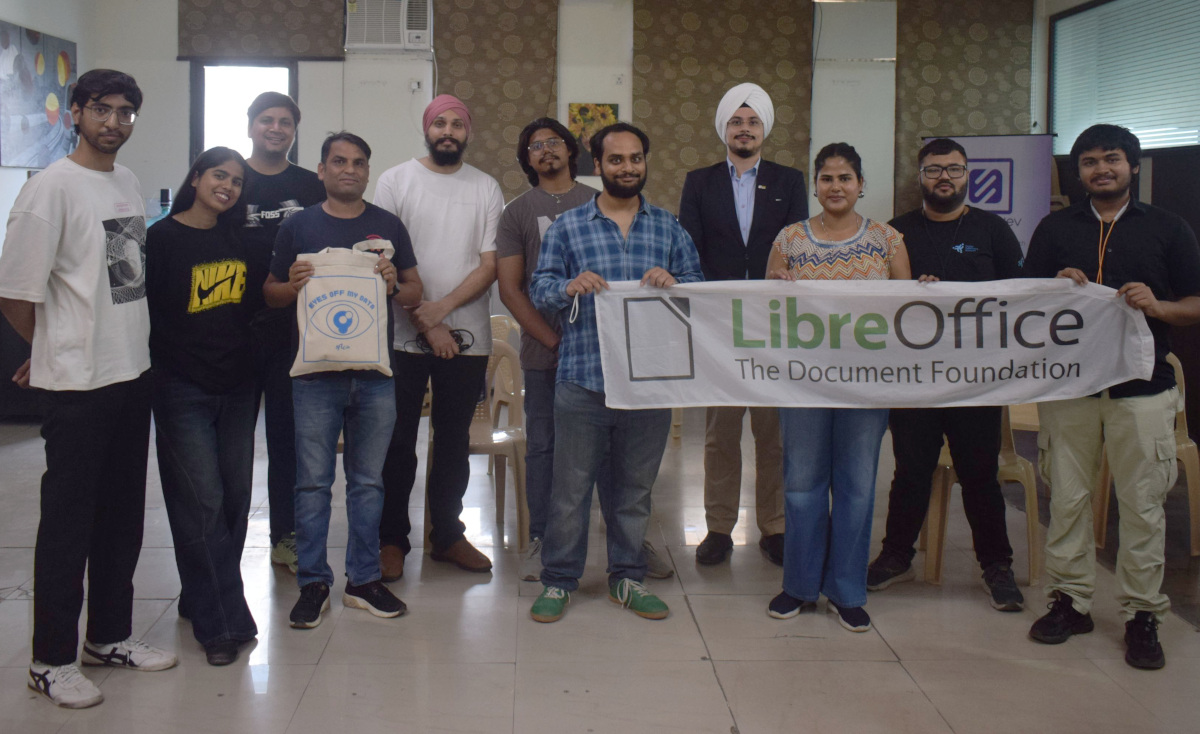
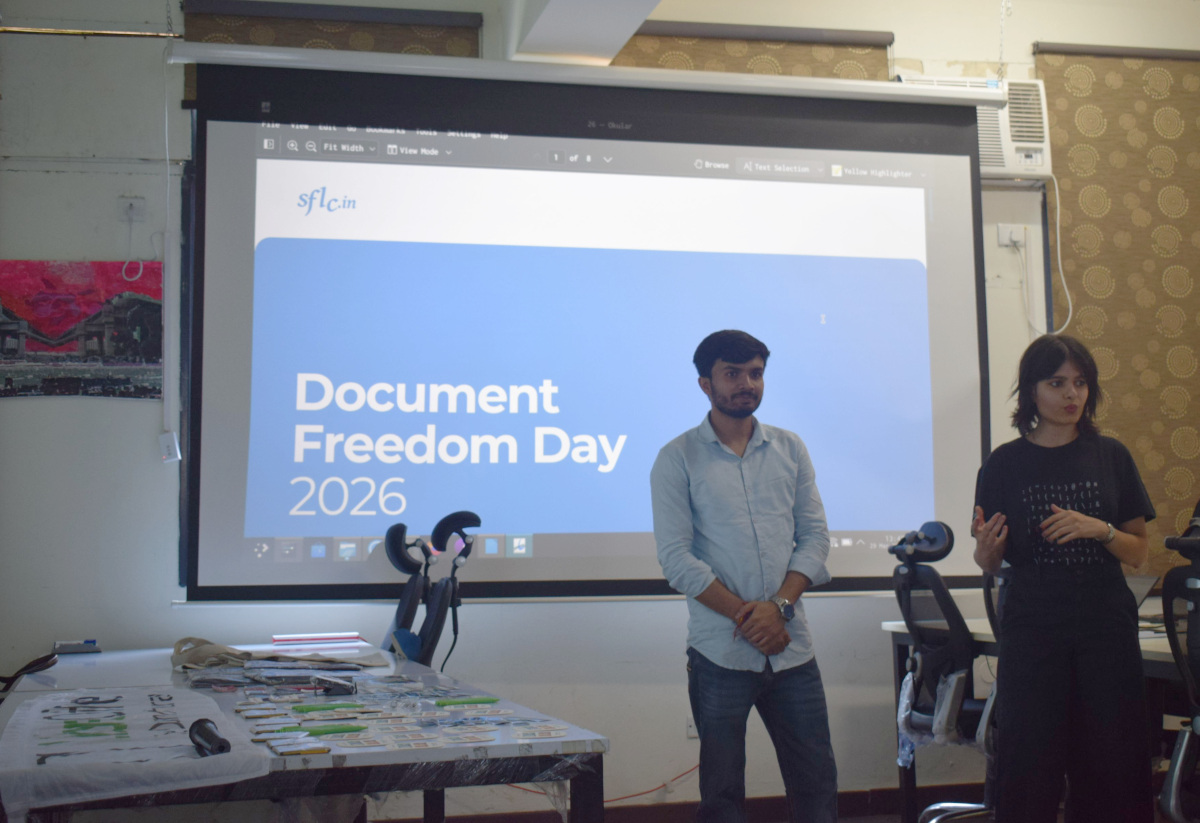
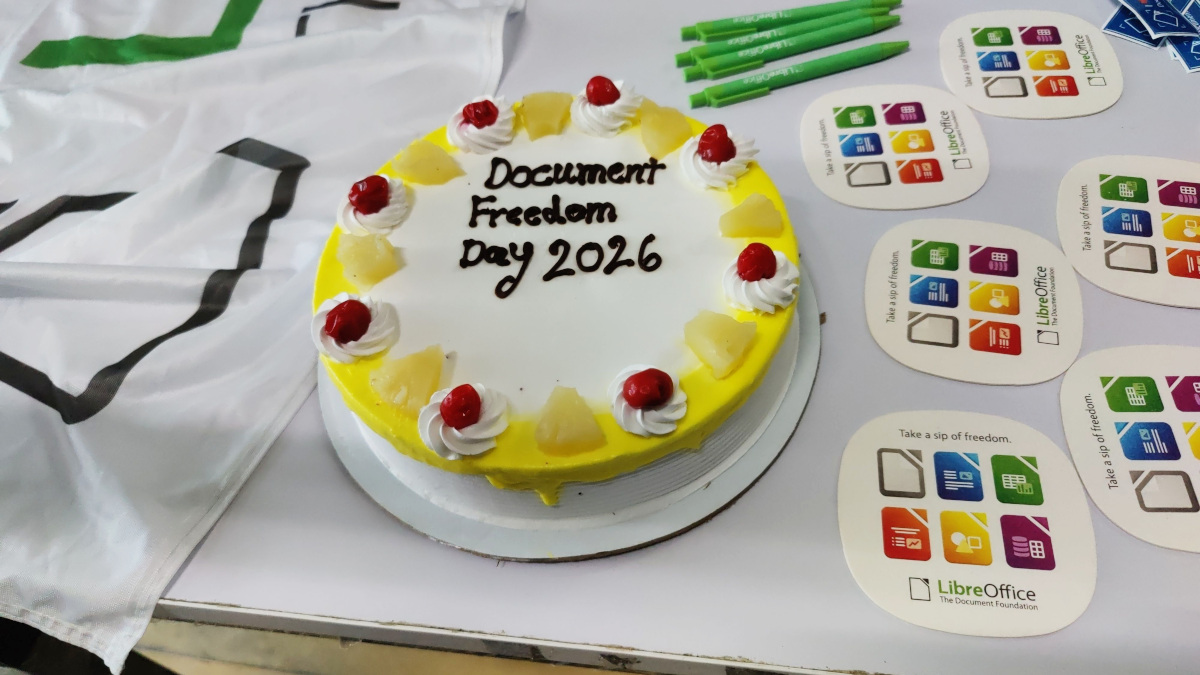
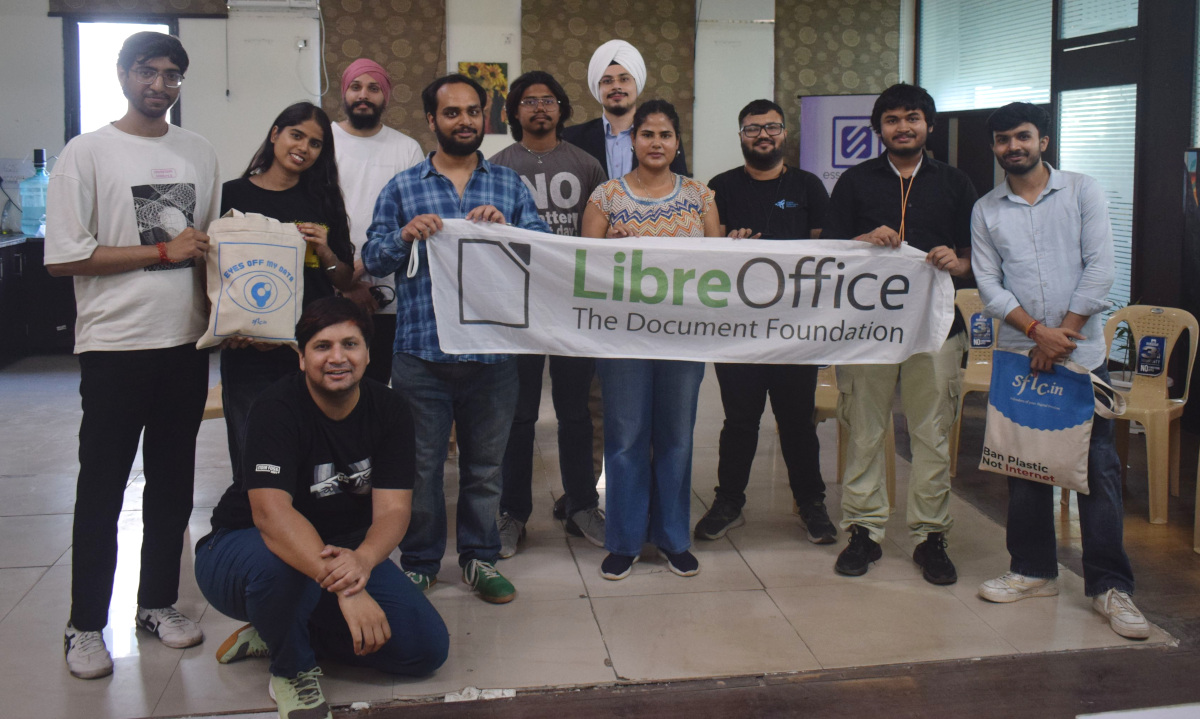
On the 29th of March 2026, we celebrated Document Freedom Day in Noida India. Thanks for Essentia.dev for the venue and sflc.in for sponsoring snacks and the cake. sflc.in is a donor-supported legal services organisation in India.
The event featured a few talks on free software such as OpenStreetMap, Prav and KDE, and also a lawyer told us how they manage all their clients’ data with free software and keeping their privacy in mind. In addition, we distributed LibreOffice merch at the sticker table.
Participants also played a fun game of guessing free software. Finally, the Document Freedom Day cake was cut followed by a group photo.
We thank all the participants and speakers who made the event possible.
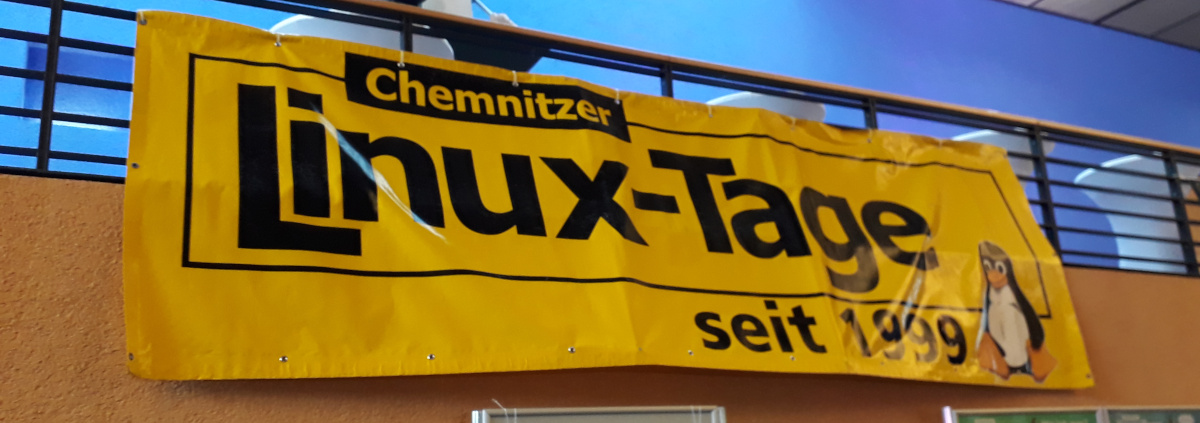
The Chemnitzer Linux-Tage (English page) is a yearly event in Germany for fans of free and open source software. This year, the LibreOffice project was present, as Karl-Heinz Gruner describes:
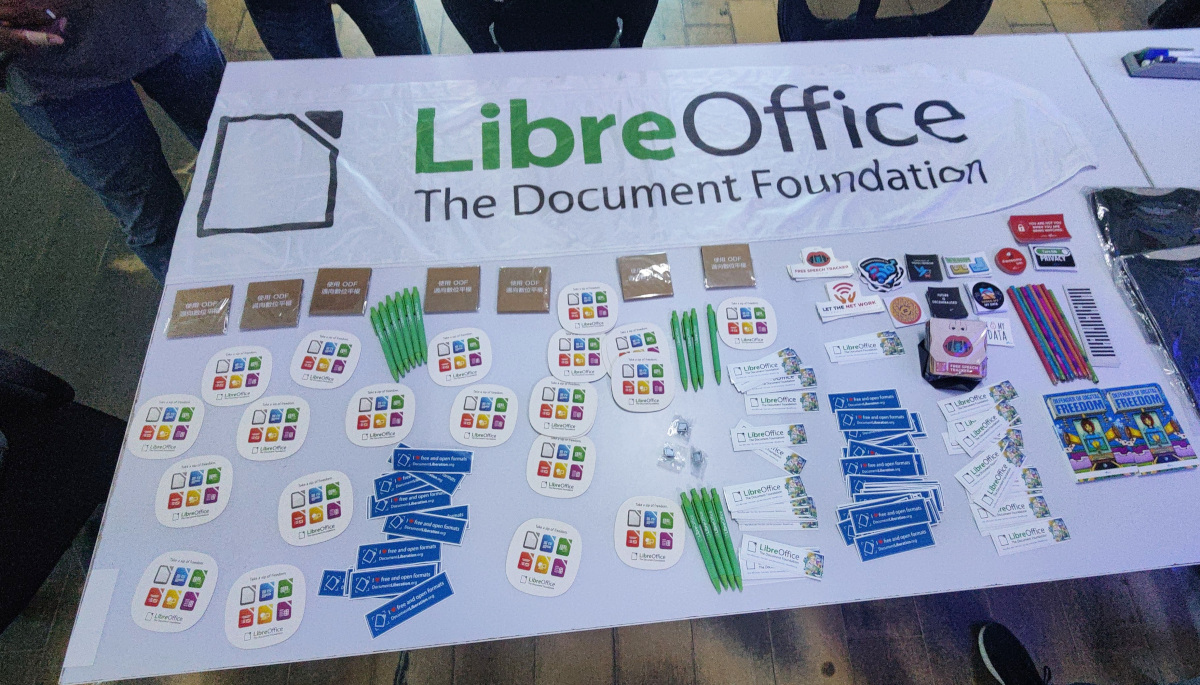
LibreOffice had an information booth at the event. Stickers and flyers were very popular. An excerpt from their extensive video tutorials was shown, including a summary of the new features in the current version.
Many questions were answered and tips were provided across all components. Enthusiastic feedback demonstrated the broad user community. Suggestions for contributing and expanding the community, such as user documentation, should attract new members over time and strengthen the active community.
We plan to be at many more events this year, including the Augsburger Linux-Infotag 2026 in early May, so see you there – and keep an eye on this blog!
 Yes, we should have published this blog post some time ago. We would like to thank Mike Kaganski, who was affected by the recent suspension of membership, for reminding us so politely of our oversight: mikekaganski.wordpress.com/2026/04/05/the-post-they-managed-to-avoid/.
Had we published the post earlier, we would probably have avoided some of the anger expressed in certain messages. However, this would not have changed the situation, which might feel like an unfairness to some, even though it isn’t.
You are absolutely right to point out that your personal conduct was not the issue. You have all contributed generously and honestly to this project, and some of you still do, for which we are very grateful. What happened does not reflect on your integrity as people or as developers.
The problem is that once elected, several of your company’s representatives acted in ways that put in serious danger the status of TDF as a non-profit organisation.
The foundation could not treat this as individual issues to be assessed on a case-by-case basis. We had to address the vulnerability of having trustees whose primary institutional loyalty lies with an organisation other than TDF.
This is not guilt by association in a moral sense, but recognition that the foundation’s governance structures have consequences regardless of individual intentions.
Even if a board member votes in good faith in their employer’s interests, this creates a conflict of interest that the foundation cannot manage retrospectively on a case-by-case basis once the damage has been done.
We had to improve the governance structures and rules of each of the bodies that form TDF in order to prevent any further damage that could be caused by overlapping loyalties. This affected everyone, including you.
Regardless of the structural changes needed to protect the foundation, the code and the community, these will remain shared assets to which everyone is welcome to contribute.
The post that we should have written, and which we are writing today, is as follows:
We are grateful to you. We are sorry that this is the outcome. We are not saying that you are bad people, bad contributors or bad members of our community.
The Document Foundation and the LibreOffice project are open by definition and principle to all developers. Our doors have never been closed to any of you, and they never will be.
The technical excellence and enthusiasm for teamwork that you have demonstrated time and again are the cornerstones of our joint achievements.
However, we must tell you that the structure was flawed and the harm was real. We could not correct the structure without this consequence also temporarily affecting people who did not deserve it.
Sadly, what has happened is an example of the kind of unfairness that often follows structural changes, and you are fully entitled to feel like victims of this unfairness.
 Over the past week, a number of articles have appeared in the media and comments have been posted on forums containing questions – some explicitly stated and others implied – directed at The Document Foundation.
We have done our best to gather all these questions and provide a response that clarifies The Document Foundation’s position regarding the claims made in a couple of online posts and the resulting inferences drawn by readers who are only partially informed of the facts. Some of the questions may sound weird such as the one about all developers having left the project, which is not true but is a clear consequence of the intentionally biased framing provided by some people to damage The Document Foundation and LibreOffice.
With this Q&A document, we aim to provide clarity, although much of this information has already been provided in the past on this very blog, and all the data cited is available on The Document Foundation’s website (specifically, organisation, governance, ledger and annual report), on TDF dashboard (data relating to development and related activities) and on TDF Matomo site (data relating to downloads).
Q. What has happened to employees of ecosystem companies?
The Membership Committee at The Document Foundation has temporarily suspended the status of TDF member of employees of ecosystem companies, based on the rule set by the new Community Bylaws as a consequence of the two failed financial audits due to ecosystem-related conflict of interest issues around tenders and trademarks and other issues. The Community Bylaws now foresee that TDF membership is not possible during the period of time during which legal disputes of certain scope last between their employer and The Document Foundation.
The scope is defined by the Community Bylaws as “Members involved in legal claims for endangering the Foundation, e.g. by means of putting the charitable status at risk, or misusing TDF’s funds, or by damaging any of TDF’s assets, or by attempting to do any of these”. In other words, they do not cover any potential legal dispute, but only the most severe cases that endanger the core of the foundation, which have been identified and documented by several independent external financial auditors and lawyers.
Although TDF membership of the group of developers has been suspended, they are still members of the Engineering Steering Committee, are part of other groups in the community, participate in mailing lists and forums, are welcomed at TDF events, and if not covered by the company would receive the same travel refunding as every other member of the community.
Q. Why such a strong rule such as the suspension of TDF membership?
The rule has been introduced to prevent the reproduction of the problem related to the wrong behaviour of board members, including affiliates of ecosystem companies, while sitting on the foundation’s BoD, which has been acknowledged and confirmed in writing by independent auditors both in 2023 and 2024. This wrong behaviour dates back to 2020, although the authorities have requested the first audit only in 2023.
In fact, ecosystem companies representatives have repeatedly attempted to postpone or avoid the solution (in the way recommended by legal counsels) of the two legal issues related to the free use of the trademark to sell on online stores and the conflict of interest in the tendering process where company affiliates were at the same time ranking tenders, a point of technical contact, and overseeing TDF staff in charge of executing these tenders (regulated in the board’s rules of procedure), while the companies were potential winners of tenders, thus creating the problem that can lead to the complete loss of non-profit status.
All attempts to introduce rules to prevent the recurrence of the problematic conducts were unsuccessful in the past, including milder remedies such as those in the Conflict of Interest Policy in 2021, suggested by TDF lawyers and required to handle conflicts properly, e.g. by enforcing abstention from discussion of own matters, which were not approved by past boards which included also representatives of the commercial ecosystem.
On the contrary, the past boards even attempted to introduce a policy to restrict the freedom of expression of the members of staff (TDF’s paid team), as this team proactively pointed out the issues with trademarks and tenders.
So, after every possible adjustment to the governance structure was attempted, and every alternative solution to the strong rule of the suspension of TDF membership was explored, the only option left was the suspension of TDF membership.
Q. Why a legal proceeding against Collabora?
The Document Foundation has not sued any company, and it neither sued board members personally.
There are legal consultations between TDF lawyers and Collabora lawyers about situations in the past where Collabora representatives elected to the Board of Directors of The Document Foundation and with a clear Conflict of Interest have taken decision in the interest of the company and not in the interest of the non-profit foundation, creating the risk of loss of non-profit status to the foundation itself.
Q. What will happen to LibreOffice now that all developers have left the project, according to some people?
Based on Git data from the last 12 months, the 8 developers employed by The Document Foundation have contributed 4077 patches (37%), while the 47 employed by Collabora have contributed 4763 patches (43%), and the 221 volunteer developers (75%) have contributed 1871 patches (17%). So, it does not look that only Collabora employees write LibreOffice code, although they are indeed significant contributors.
According to the same Git data, in the top 20 Git contributors there are 8 TDF developers and 11 Collabora developers, with a rather balanced situation. Also, data are not considering the two new developers just hired by TDF, who have just started contributing and therefore have contributed just a few patches.
All the numbers can be checked by everyone by accessing the public TDF dashboard about development and all related activities and the public Matomo analytics. Based on numbers, the claim that all development work is done by Collabora is not confirmed.
TDF is also looking into hiring further developers currently to work on more areas of the code, and most importantly, share their knowledge with the community and the general public via blog posts, documentation, video recordings, hackfests, conference workshops and more.
Q. What about the principle of meritocracy that should inspire FLOSS projects?
We have published a blog post about our sense of meritocracy. If Collabora’s sense of meritocracy is counting patches instead of looking at the big picture and contributing to the future development of the project, then we are in completely different leagues. This could be accepted in the last century, not today, in front of the challenges we face (competition from Microsoft) and the opportunities we have (move to digital sovereignty).
Developers are instrumental for FLOSS, as much as they are instrumental for proprietary software, but this does not automatically mean that they have the right to rule FLOSS projects despite the provisions of the law. Of course, this applies to all FLOSS contributors. If the F in FLOSS refers to freedom, in a community where one group of contributors has an edge it would be difficult to talk about freedom.
Q. What about the re-opening of the LibreOffice Online repository at TDF?
The decision to move the LibreOffice Online repository to the “attic” was taken by a Board of Directors where representatives of developers had the majority of votes. It was not a decision suggested by community members, and it was not a decision representing the will of the majority of the community.
The act of taking LOOL source code from the attic was requested by members of the community, and the BoD acted accordingly. There was even an open letter to revive the repository: community.documentfoundation.org/t/open-letter-for-revive-lool-add-your-1-if-you-agree/9142
Of course, we can understand that the decision is not in line with every stakeholder’s point of view, but when you are in a community you have to respect what the members want and also work with them at the best possible outcome. In addition, the simple re-opening of an online repository cannot be a threat to Collabora, as both LibreOffice Online and Collabora Online and any other cloud office suite need other software and infrastructure to become a viable solution.
In fact, the discussion about the development of LibreOffice Online and a strategy for the future has yet to start at The Document Foundation, and everyone is invited to contribute.
Q. Why TDF is not supporting ecosystem companies selling enterprise optimized versions of LibreOffice?
TDF has always mentioned the enterprise optimized version of LibreOffice provided by ecosystem companies, especially when announcing new versions as all press release were featuring a paragraph about enterprise deployments with a link to the webpage where there was a direct mention of ecosystem companies. With reference to this specific topic, TDF is limited in advertising commercial products by the strict non-profit regulations.
Additionally, TDF had a prominent “Business user?” button on the download page (see e.g. the web archive links for www.libreoffice.org/download/download-libreoffice/), which was pointing directly to the ecosystem, from a website that was used tens of thousand times per day.
On the other hand, The Document Foundation had to stick to the promised made to all contributors at the time of the incorporation, and summarized by the Next Decade Manifesto (www.documentfoundation.org/media/tdf-manifesto.pdf), which was approved by all project founders before creating TDF as a legal entity. One of its principles is “To eliminate the digital divide in society by giving everyone access to office productivity tools free of charge to enable them to participate as full citizens in the 21st century”.
Q. Why has the Community Edition tagline disappeared?
The Document Foundation has decided to try to help ecosystem companies by implementing a marketing plan with actions targeted to the support of enterprise optimized versions of the software, always keeping in mind that the non-profit law provides for certain restrictions.
During the discussion phase, there were different options for a tagline to be added to the software name, to make the distinction between the community and the enterprise versions easier to spot, and “personal” was one of them as much as “community”. There were some mock ups of the different taglines, but none of them was implemented in the product.
The tagline Community Edition was voted by the majority of BoD members, who had a choice between Advance, Community and Rolling (and this confirms that Personal was not even one of the final choices). The votes can be checked here: community.documentfoundation.org/t/vote-libreoffice-7-1-tag-label/8898.
After a few years, it was entirely clear to everyone that the tagline Community Edition was not effective, because to educate enterprises you need a lot more than a tagline: first, you need a packaged product which looks like competitor’s products to the eyes of potential customers; second, you need sales people knocking regularly at their doors; third, you need a sound and aggressive marketing strategy.
Even FLOSS software who have added proprietary clauses to their OSI compliant licenses in order to have enterprises pay for their products have failed. The task is difficult to impossible, and even one of the most brilliant (and focused on this issue) FLOSS managers – Drupal’s and Acquia’s Dries Buytaert – has been trying for years to connect the dots in order to get results and has not been entirely successful (according to his blog posts).
Q. What about sales for profit on online store by a not for profit? Why this does not represent a risk for non-profit status?
The Document Foundation is a charitable organization, but has an associated business unit (with specific accounting rules) to manage those activities which cannot be managed by the charitable organizations such as sales in stores, sales of merchandise, and the likes. TDF pays both VAT and corporate taxes on these sales, and this can be checked by accessing the ledgers which are published on a monthly basis. The authorities have scrutinized TDF ledgers for years and have not found issues which could represent a risk for the non-profit status with regards to app store sales.
Q. What about Collabora Office for the Desktop? Is this fork a threat to LibreOffice?
There are internal documents dating back to 2022 about the risks of Collabora forking LibreOffice, because the threat was clear for everyone since that time. The decision to hire developers at The Document Foundation is a direct consequence of the plans to reduce the impact of that potential fork.
In any case, though, the new Collabora Office for the Desktop is supposed to go against OnlyOffice on the desktop, because this is a direct Collabora competitor both on the desktop and on the cloud (it is also a LibreOffice competitor, but while Collabora competes for market share – which is entirely appropriate for a business – TDF is not involved in that race).
In fact, the new Collabora Office for the Desktop is a different product and has the same limited number of functionalities of OnlyOffice, and as such is in a rather different category than LibreOffice, which is a full feature office suite with six instead of just three modules. The product, in addition, is based on the LibreOffice Technology platform, and as such is based on the same engine as LibreOffice.
So, the new Collabora Office for the Desktop, rather than being a competitor, is a testament of the flexibility and resiliency of the LibreOffice Technology platform, which can be used to develop different kinds of office suites for digital sovereignty, natively supporting the ODF document format to give back content ownership to end users and get rid of lock-in.
Of course, the community is perfectly aware of some LibreOffice issues, inherited from StarOffice through OpenOffice.org. Some portions of LibreOffice source code may date back to StarOffice, whose first application was released in the eighties.
TDF developers are working at solving these issues, and there will be announcements in the future about these source code refactorings. If you want to preserve all the characteristics of a full feature office suite, though, the time needed is significant, while if you give up many features the task is indeed easier.
As promised, we are releasing the updated State of the Project Slide Deck, based on data extracted from the LibreOffice dashboard and the Matomo repository.
During the 12 months 295 developers worked on the source code, adding 11.098 new commits (Git): 221 volunteer developers (75%) provided 1.871 commits (17%); 8 developers from The Document Foundation (3%) provided 4.077 commits (37%), and 66 developers from 7 ecosystem companies (22%) provided 5.150 commits (47%).
The slide deck is also a tribute to the 20 top Git committers, the 20 top Gerrit committers, the top 20 Bugzilla issue submitters, the top 20 people answering on Discourse, and the top 20 translator on Weblate. To all of them and to all the other contributors, thank you.
Looking at donations and downloads, the trend during the first three months of 2026 confirms the positive trend started in early 2025. Donation figures refer to the number of transactions and not to their amount, which is available via the ledgers published on The Document Foundation website.
You are invited to look at the slides, and download the file to compare it with the previous slide deck published in January and the next slide deck which will be released in early July and will cover the 12 months between July 1st, 2025, and June 30, 2026.
We have started to publish these slide decks in January 2026, to provide a transparent overview about the progress of the project through some of the most significant measures of development, downloads and donations data collected by the marketing team at TDF.
Download the Slide Deck in English / Download the Slide Deck in German