Development and Quality Assurance: TDF’s Annual Report 2022

Annual Report banner

In 2022, 11,769 commits were made to the LibreOffice source code, from 218 authors, in 10 repositories. We also took part in the Google Summer of Code, to support student developers

(This is part of The Document Foundation’s Annual Report for 2022 – we’ll post the full version here soon.)

Infrastructure for developers

TDF provides infrastructure for the developer community to continue their work on LibreOffice. These include Git and Gerrit, to make changes to the source code, along with Bugzilla (to track bug reports and enhancement requests), a wiki (to document changes), and Weblate (for translations).

Most technical discussions took place on the developer mailing list and IRC channel, with the latter providing more real-time communication. Members of the Engineering Steering Committee met weekly, to discuss the most pressing issues with the codebase.

Google Summer of Code (GSoC)

GSoC logo

GSoC is an annual programme in which student developers of free and open source software projects receive stipends from Google for their work. LibreOffice takes part in GSoC every year, and in 2022, two students developed features and updates in the software. Let’s go through them…

Hannah Meeks – VBA Macros – Tests and missing APIs: LibreOffice supports VBA (Visual Basic for Applications) Macros, but the implemented API isn’t complete and the API functions aren’t largely tested. The consequence of this is that the VBA macros in OOXML documents don’t run as intended in LibreOffice, which causes compatibility problems. The goal of this project is to add tests for the functions already implemented and then look for what functions are missing for a method or module and add them. Hannah described her results:

I wrote lots of macros tests which was the main aim of the project and found lots of bugs/areas to fix, so my summer was a success! I also really enjoyed looking into the core and fixing some of these problems. Lots of my tests are still broken in LibreOffice so need fixing – for example, I found that there seem to be problems with new lines being created in Microsoft Word that are not created in LibreOffice Writer.

The second project was by Paris Oplopoios – Extend Z compressed graphic format support. Some graphic formats are compressed with ZIP (deflate) to make them smaller, while the formats themselves don’t support compression. In LibreOffice we already support SVGZ format, but not other formats. The goal of this idea was to look at how SVGZ is implemented and extend that to other formats (EMF, WMF). The extended goal was to implement support for compressing in addition to extracting.

Paris got off to a flying start with the originally defined goal, which was to add import functionality for Z compressed EMF and WMF graphics and thus to improve compatibility with Microsoft documents. In the end, he also implemented exporting of WMZ, EMZ and SVGZ graphics, replaced homegrown PNG export code with one that uses libpng and added automated tests for PNG export in addition to tests for the Z compressed formats.

For more details about the students’ great achievements, see the video below and the results post – and thanks to Tomaž Vajngerl and Miklos Vajna (Collabora) and Thorsten Behrens (allotropia) for mentoring the students.

Please confirm that you want to play a YouTube video. By accepting, you will be accessing content from YouTube, a service provided by an external third party.

YouTube privacy policy

If you accept this notice, your choice will be saved and the page will refresh.


Quality Assurance (QA)

In 2022, the QA team triaged thousands of bugs, bisected hundreds of regressions, and answered questions from countless bug reporters. As one of the most visible groups directly responding to end users, the QA team must be nimble and able to adapt to changes. In addition, it must deal with specific requests for help from other teams.

The QA team meets regularly on IRC on the #libreoffice-qa channel, which is the best medium for discussing bugs and regressions. The IRC channel provides an excellent opportunity to remain in close contact with team members, and to tutor new members in the art and skill of LibreOffice QA. This is bridged to the Telegram group.

During 2022, 5,966 bugs were reported by 2,650 users, which means 115 new bugs were reported every week on average. The QA team prepared monthly reports about their activity and posted on the QA blog.

Top 10 bug reporters

  1. Telesto (288)
  2. Eyal Rozenberg (207)
  3. Mike Kaganski (165)
  4. Xisco Faulí (126)
  5. Gabor Kelemen (111)
  6. Rafael Lima (108)
  7. sdc.blanco (104)
  8. Regina Henschel (93)
  9. NISZ LibreOffice Team (93)
  10. Hossein (59)

Triaging

During 2022, 6,100 bugs were triaged by 391 people. Here are the top 10 bug triagers:

  1. Buovjaga (675)
  2. Dieter (462)
  3. Heiko Tietze (445)
  4. Xisco Faulí (354)
  5. Timur (327)
  6. raal (303)
  7. Julien Nabet (276)
  8. m.a.riosv (268)
  9. Rafael Lima (218)
  10. Mike Kaganski (207)

Bibisecting

Also, during 2022, the QA team performed 622 bibisects of regressions by 32 people. These are the top 10 bisecters:

  1. raal (144)
  2. Xisco Faulí (140)
  3. Timur (63)
  4. Aron Budea (57)
  5. Buovjaga (40)
  6. Stéphane Guillou (stragu) (24)
  7. Timur (20)
  8. Gabor Kelemen (19)
  9. Mike Kaganski (19)
  10. Telesto (18)

Like what we do? Support the LibreOffice project and The Document Foundation – get involved and help our volunteers, or consider making a donation. Thank you!

Welcome Khaled Hosny, new Developer at TDF

Khaled Hosny

The Document Foundation (TDF) is the non-profit entity behind LibreOffice, providing infrastructure and support for the community that makes the suite. Recently, TDF decided to expand its small team with a new Developer, focusing on improving LibreOffice’s language support. This will help to make the software more accessible to hundreds of millions of people around the world.

The new Developer is Khaled Hosny, so let’s hear from him…


Tell us a bit about yourself!

I’m a software developer based in Cairo, Egypt. My area of expertise is centered around written language; fonts, text layout in general and so-called “complex” text layout in particular (I don’t like how some text layout is signaled out as being complex – all text layout is complex, but some complexity is obvious right away while others are more subtle), PDF, and so on.

I have been involved with FOSS since 2006. I started with doing Arabic localization, then Arabic fonts, and a few years later I started programming to fix Arabic bugs (I think my first patch was to fix a right-to-left UI issue for Sugar, the desktop environment for the OLPC XO laptop, if anyone still remembers it). I contributed and continue to contribute to many FOSS projects – Firefox, GNOME, HarfBuzz, XeTeX, LuaTeX, to name some.

I got involved with LibreOffice in early 2011, and I have been lurking around since then.

I’m also a type designer and font engineer. I have designed and built a few Arabic and math fonts (I can’t read much of the math notation – I was taught math in Arabic notation and I hardly remember any of that either, but I’m fascinated by the 2D nature of math typesetting).

Funnily enough, I had no formal training in any of this, I actually graduated from medical school and worked as a doctor for few years before quitting to focus on a software career (I was already deep into localization and fonts while still at medical school).

Improved glyph positioning of artificial italic text in LibreOffice 7.5

Improved glyph positioning of artificial italic text, especially combining marks – implemented by Khaled in LibreOffice 7.5


What’s your new role at TDF?

I’m joining the team as a LibreOffice developer focusing on areas of right-to-left and the aforementioned so-called “complex” text layout. These are some of the underserved areas of LibreOffice development while disproportionately affecting a very large group of (existing and potential) users.

I hope my role at TDF will help to widen the LibreOffice community, attract more people to it, and make it accessible to more users.

What will you be working on?

I will be fixing bugs and implementing features related to right-to-left text layout and user interface issues which affect languages like Arabic, Hebrew, Persian, and Urdu, as well as text layout issues involving writing systems that require more involved text layout, like Arabic script, and the Indic group of scripts.

I will be also working on fonts, PDF export (text extraction from PDF is major pain point for many scripts), and related areas.

I’m also looking forward to mentoring new developers interested in working on any of these areas.

Do you have any tips for new developers, who’re eager to get involved with the LibreOffice codebase?

LibreOffice is a large code base and can be overwhelming, so try to read any existing documentation as much as possible, don’t be afraid to ask for help, and in general be patient.


We’re really happy to have Khaled on board! Follow this blog and our Mastodon and Twitter accounts for updates on his work – plus more news from the LibreOffice community.

LibreOffice Documentation Updates in 2022 – Annual Report

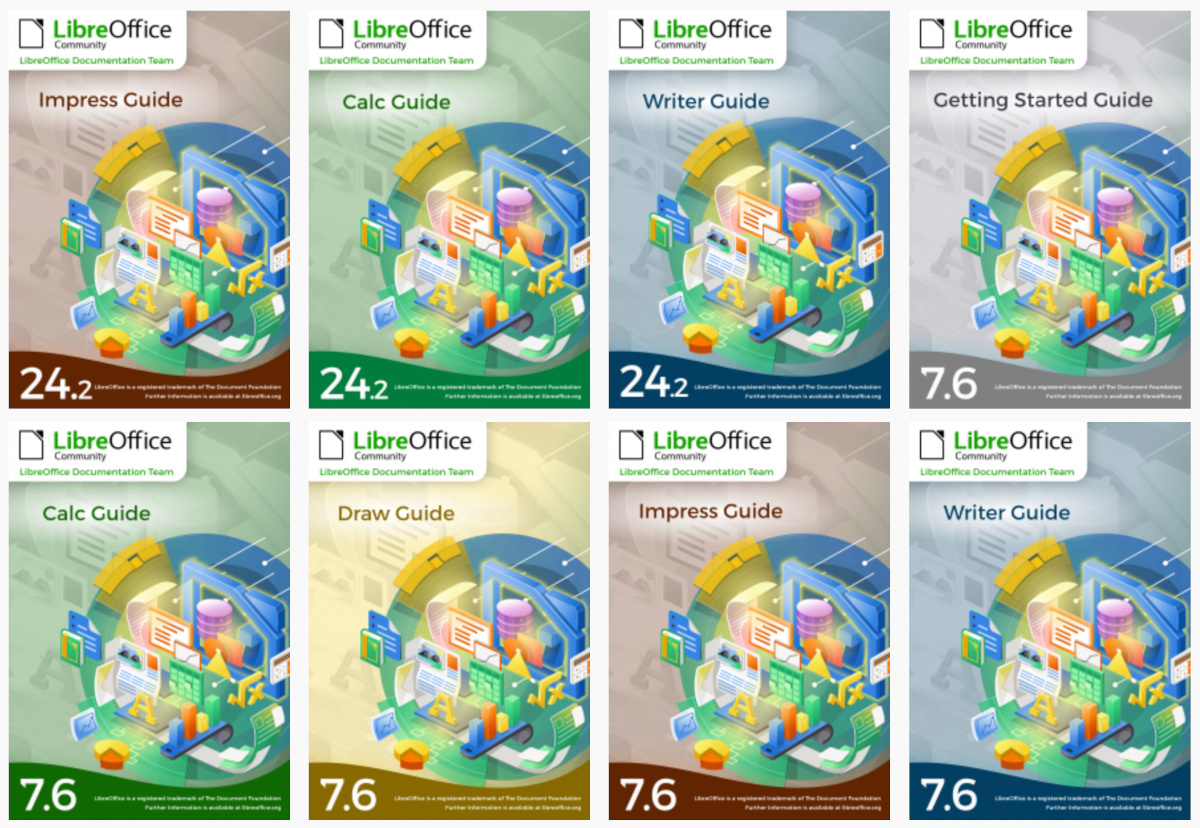
LibreOffice Bookshelf

In 2022, the documentation community continued to update LibreOffice guidebooks and the Help application

(This is part of The Document Foundation’s Annual Report for 2022 – we’ll post the full version here soon.)

New and translated guides

Throughout the year, the documentation project closed the gap between LibreOffice’s major releases, and the updates of the corresponding user guides. By the year end, all of the version 7 guides updated to match the release of LibreOffice 7.4, and ready to continue for the forthcoming release – 7.5 – which arrived in February 2023. The goal of tracking the software release closely was achieved, and the documentation team is now in a steady state of small updates between releases.

The updates and enhancements of the guides were an effort of all the team, coordinated by Jean Weber (Writer and Getting Started Guide), Olivier Hallot (Calc and Base guides), Peter Schofield (Impress and Draw guides), Rafael Lima (Math guide). A number of volunteers also worked in each guide by writing and reviewing contents and suggesting improvements. Special thanks to Jean Weber for making the guides available for sale in printed format via Lulu Inc.

LibreOffice Help updates

LibreOffice Help

The documentation community also had a team of Help page bug fixes, closing Help documentation bugs, bridging gaps, fixing typos and improving quality, a must-have update to keep LibreOffice in-shape for its user base. A total of 650 Help patches were merged in 2022. The Help pages, which are part of the LibreOffice code, were also refactored continuously for better maintenance and code readability. The L10N team of volunteers (localization and translators) were quick in flagging typos and English mistakes – while translating the help content and the user interface.

ScriptForge libraries, and Wiki updates

The documentation community also had a nice contribution from Jean Pierre Ledure, Alain Romedenne and Rafael Lima, for the development of the ScriptForge macro library, in synchronization with the much-needed Help pages on the subject, a practice rarely followed by junior developers of LibreOffice. As we know, undocumented software is software that’s lacking; features that are unknown to the user can be a cause of costly calls to a help desk in corporate deployments. ScriptForge developments came together with its documentation, demonstrating the ScriptForge team’s professional maturity.

Special thanks to Steve Fanning for his leadership of the Calc Functions wiki pages maintenance. And thanks to the dedication of Ilmari Lauhakangas (The Document Foundation) for making the Calc functions wiki pages available for translation.

LibreOffice Bookshelf

In 2022, the documentation community also updated the LibreOffice Bookshelf, another download page for LibreOffice guides that is different from the current documentation.libreoffice.org server page. The Bookshelf can be cloned and installed in organizations, libraries, colleges and schools, for immediate availability in controlled environments, as well as online reading of the guides. The OpenDocument Format chapters were transformed into static HTML pages, and are ready to display on computers, tablets and cell phones, bringing LibreOffice user guides closer to the public, anywhere, anytime.

Like what we do? Support the LibreOffice project and The Document Foundation – get involved and help our volunteers, or consider making a donation. Thank you!

Attracting New Contributors: TDF’s Annual Report 2022

Annual Report banner

Bringing new community members on board and helping them get started is an essential part of our work. Here’s what we did in 2022

(This is part of The Document Foundation’s Annual Report for 2022 – we’ll post the full version here soon.)

Onboarding tools and sites

Joining a large and established project like LibreOffice can be daunting for many. The software has a large codebase, and sub-projects use a wide array of tools. In recent years, we’ve made efforts to simplify the onboarding process by linking more services together with SSO (single sign-on), thereby reducing some of the complexity. In addition, we’ve created Easy Hacks and similar “bite size” projects in other areas, so that newcomers can get involved quickly and achieve something without months of work.

Screenshot of What Can I Do For LibreOffice website

Currently, we have two websites that function as starting points for new contributors: “What can I do for LibreOffice” and the get involved page. The former was set up by LibreOffice’s Albanian community, and lets users click through topics of interest, until they find something they want to do. The latter is a regular page, with a list of sub-projects inside LibreOffice, and quick steps to make initial contact.

Throughout 2022, we posted regular “Community Member Monday” interviews on this blog. In many cases, we emphasised how these contributors started off as regular LibreOffice users, but wanted to “scratch an itch” and start to make changes to the software. We highlighted the ways in which other community members helped newcomers to start working on projects, and used these as “success stories” on our social media accounts, encouraging others to make the step-up from being a user to an active contributor.

In addition, we have accounts and projects listed on various volunteering platforms, including VolunteerMatch and Idealist (English), Vostel (German), Vapaaehtoistyo (Finnish), TuDu (Polish) and HeroClan, Um sem um tam and Zapojim se (Czech).

Mentors at The Document Foundation

Thanks to donations, TDF has a team of mentors who help newcomers in the project to get started. Throughout 2022, Hossein Nourikhah (Developer Community Architect) and Ilmari Laukahangas (Development Marketing) interviewed and assisted interested newcomers, explaining how our projects and communities work, and showing them areas where they might like to get involved. We at TDF find this more “personal” approach to be more effective than just telling people to sign up to a mailing list, or read a wiki page.

Hossein Nourikhah

To assist new volunteer programmers, Hossein wrote blog posts and guides for modifying and building LibreOffice’s source code. This is a daunting task for many new developers, especially given the size of LibreOffice’s codebase, but the guides illustrated some basic ways to get started and make changes that can benefit all users of the suite.

Month of LibreOffice

In May and November 2022, we ran “Month of LibreOffice” social media and blog campaigns specifically targeted at new contributors – ie LibreOffice users who found the software useful, but weren’t yet contributing to the project itself. We showed them how to get involved in LibreOffice (in simple steps), highlighted their contributions, and rewarded them with some merchandise, such as stickers and T-shirts.

LibreOffice merchandise

Like what we do? Support the LibreOffice project and The Document Foundation – get involved and help our volunteers, or consider making a donation. Thank you!

LibreOffice user interface improvements: Annual Report 2022

Colibre icons

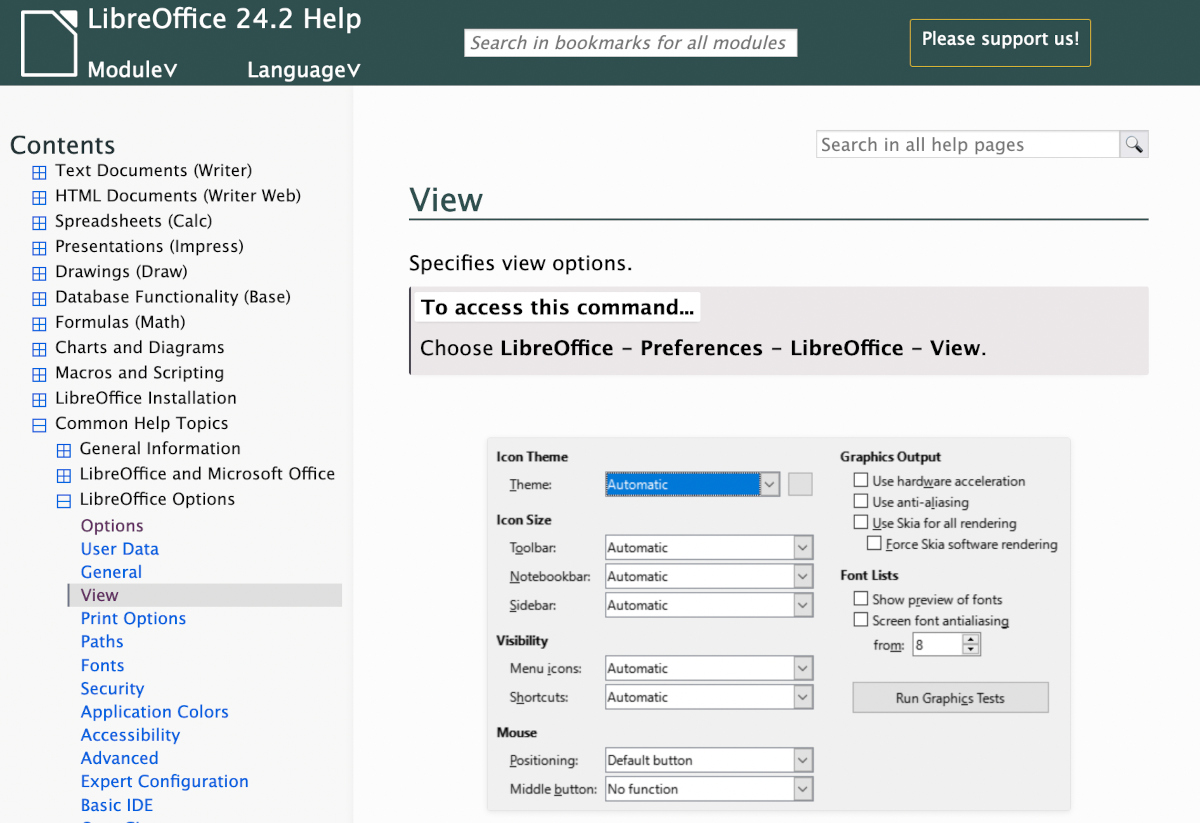
Design (UI and UX) has been one of the major focus points of LibreOffice in the last few years, and the Design community has produced new icon sets and a number of incremental updates to the user interface – menus, toolbars and the SideBar – along with improvements to the NotebookBar

(This is part of The Document Foundation’s Annual Report for 2022 – we’ll post the full version here soon.)

Improvements in LibreOffice 7.3

Several updates were done by LibreOffice’s design team. For instance, a larger change was implemented by Samuel Mehrbrodt and Vasily Melenchuk regarding the border style. The previously random line thickness options became organized with clearly defined names and reasonable steps.

Line widths in LibreOffice 7.3

Improvements in LibreOffice 7.4

A large number of improvements were implemented in LibreOffice Calc. First of all, “sparklines” mini-charts were introduced by Tomaž Vajngerl, which allow users to place a diagram-like image in cells that visually shows numerical content. In addition, hidden columns/rows can now have an indicator: if enabled, a dotted line will be drawn next to the hidden content.

Sparklines in LibreOffice 7.4

The sort options and sort items were made easier to access. While previously it was necessary to go to the sort options to change the sort direction and whether headers should be taken into account, these most frequently changed options are placed on the primary tab now.

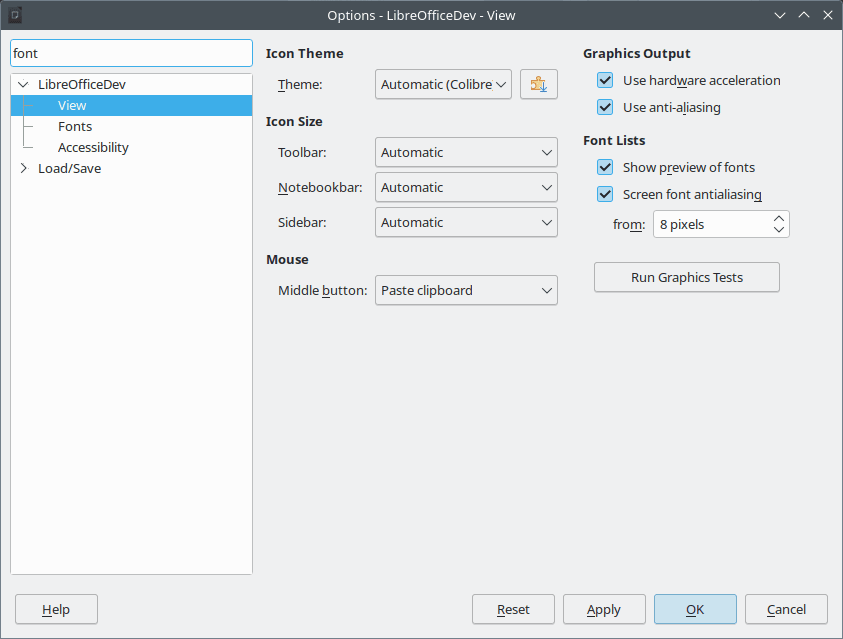
The font dialog was reworked to remain compact when Asian and/or complex languages are enabled. The design community aims for dialogs that work on very small screens too, and the font dialog was violating this rule. With the change, it now fits into the screen real estate, and allows to comfortably manipulate fonts for all language families.

Font dialog

Finally, Rizal Muttaqin improved the Colibre icon theme, which is the default theme in Windows. It has now a dark variant working much better on dark system themes, while maintaining the monochrome color composition from Microsoft.

Like what we do? Support the LibreOffice project and The Document Foundation – get involved and help our volunteers, or consider making a donation. Thank you!

Social media and LibreOffice: TDF’s Annual Report 2022

Annual Report banner

We use our social media channels to raise awareness about our work, share information and encourage new contributors to join us

(This is part of The Document Foundation’s Annual Report for 2022 – we’ll post the full version here soon.)

Social media

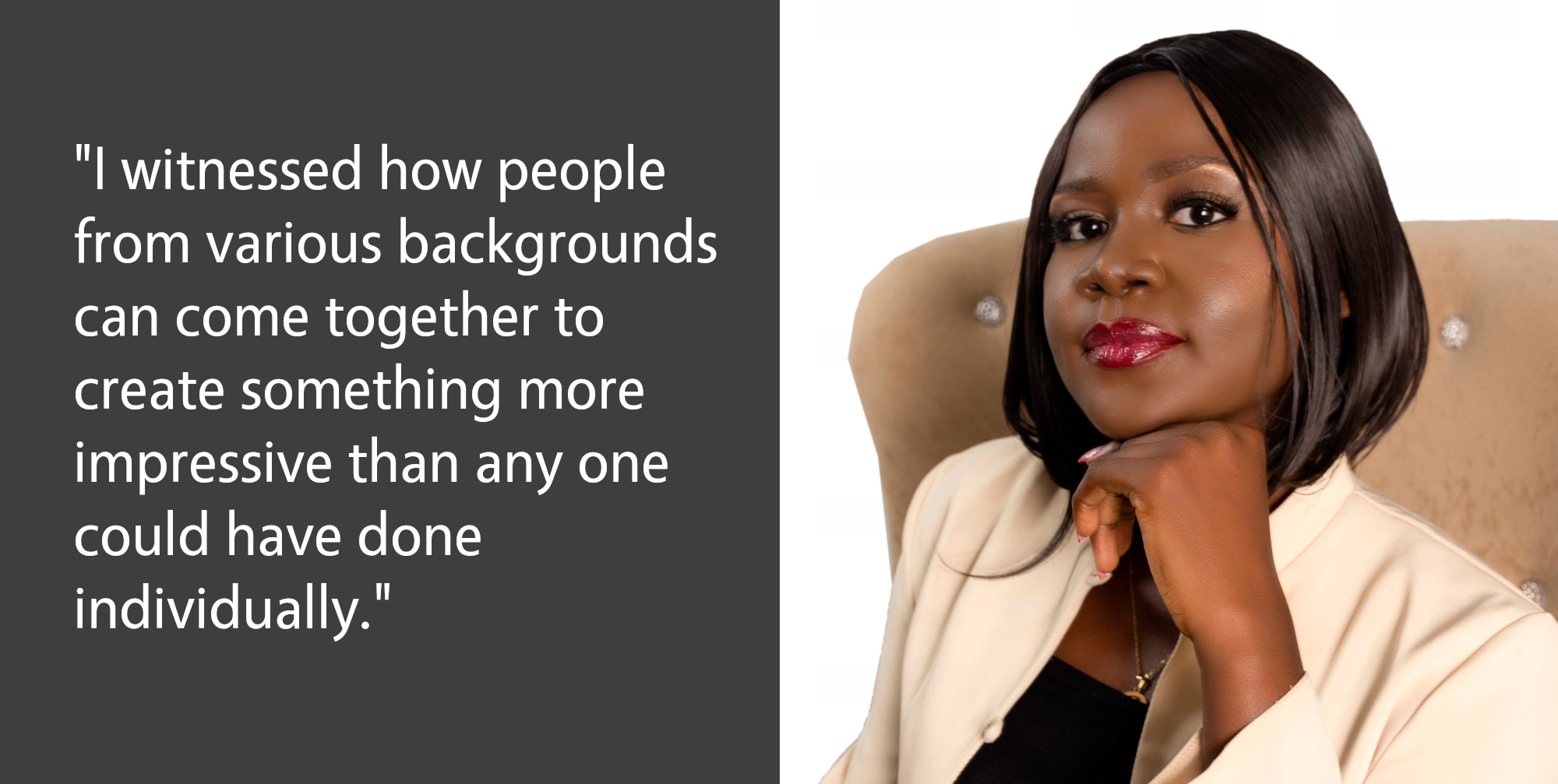
In January 2022, our English-language Twitter account @LibreOffice had 45,802 followers; by the end of the year, we had grown this to 52,808. Our most popular tweets were for major releases, but we also tweeted customised images for “Community Member Monday” interviews with short quotes, encouraging more users to get involved with LibreOffice projects.

In addition, we focused not only on our own tweets, but also retweeting announcements from the LibreOffice ecosystem and community members. We liked and retweeted messages of support from end users – many of whom were surprised and thankful that a large project would show them support. To keep the content flowing, we retweeted popular older tweets, and responded to individual messages.

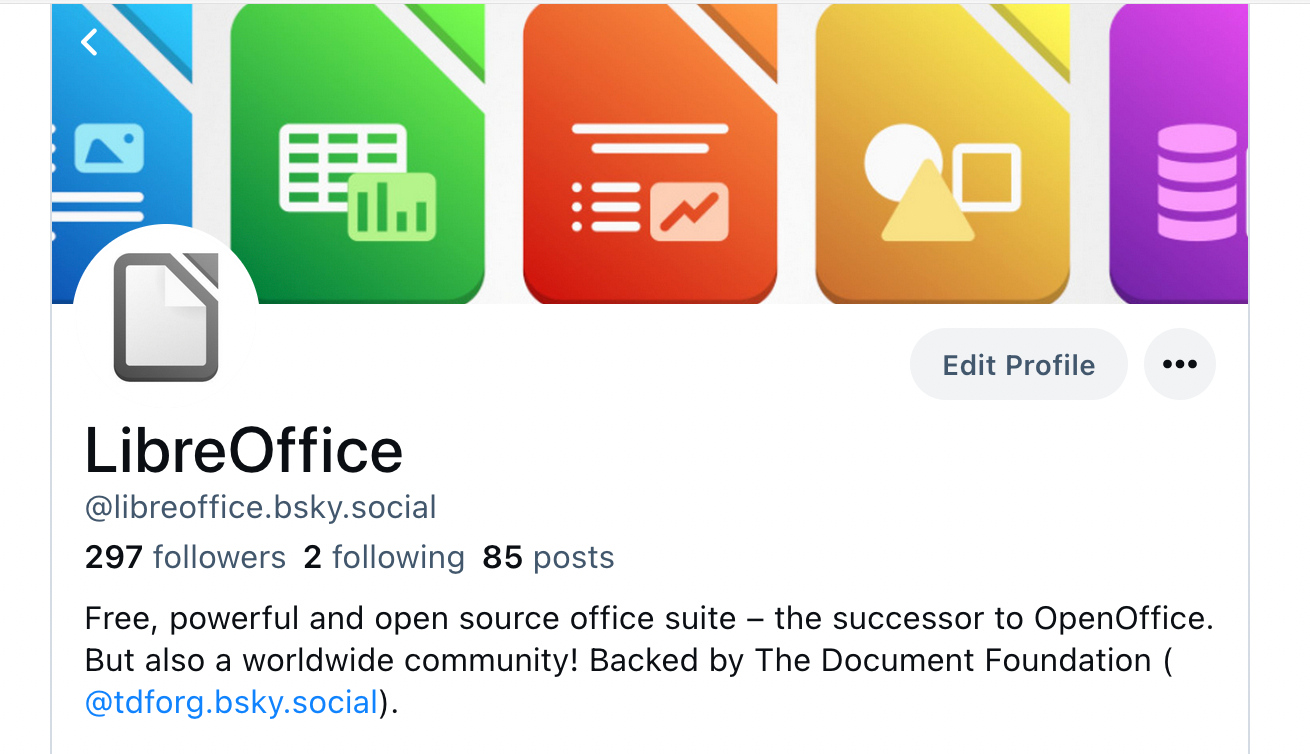
On other social media platforms, we focused on growing our account on Mastodon, a Twitter-like open source, federated and self-hosted microblogging service. In 2019 we set up @libreoffice and started posting content, often more focused on technical users, compared to our tweets and Facebook posts. In 2022 we worked more on expanding our activities here, and from January to December, we grew our follower base from 6,844 to 16,500.

Mastodon screenshot

Our Facebook page growth was smaller, from 59,241 page likes to 60,209. We’ve noticed a gradual reduction in activity on Facebook over the last few years, which reflects its changing audience, and the move towards newer mobile applications. Nonetheless, Facebook still provides a good opportunity to interact with end users of LibreOffice, and every day we checked in to answer questions, get feedback, and post announcements/tips about the software.

YouTube channel

Our YouTube channel grew from 15,015 subscribers and 2,420,699 video views in January 2022 to 17,964 subscribers and 2,858,092 video views by the end of the year. The “LibreOffice 7.3: New Features” video (a fantastic production by the Indonesian community) had over 196,000 views – while the video for LibreOffice 7.4 had over 47,000. We also added videos from FOSDEM and the LibreOffice Conference 2022.

Please confirm that you want to play a YouTube video. By accepting, you will be accessing content from YouTube, a service provided by an external third party.

YouTube privacy policy

If you accept this notice, your choice will be saved and the page will refresh.

Meanwhile, our community helped out with tutorial videos – in particular Harald Berger of the German community, who continued to produce a series of professional-looking step-by-step guides to installing and using LibreOffice.

Like what we do? Support the LibreOffice project and The Document Foundation – get involved and help our volunteers, or consider making a donation. Thank you!