🇹đŸ‡ș LibreOffice in Latin America: heading to Havana for the 2025 Latin American Congress

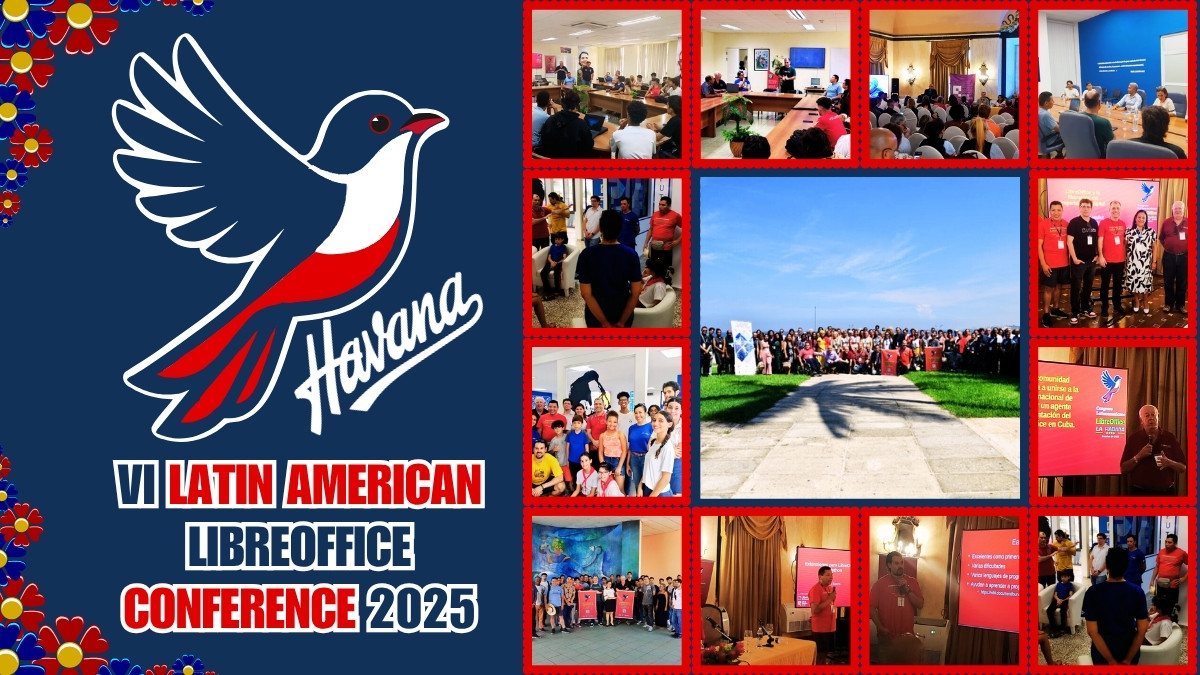
From October 6 to 9, Havana, Cuba, will host the Latin American LibreOffice 2025 Conference, a meeting that will bring together contributors, developers, universities, and governments from the region to celebrate and strengthen free software.

This year, the Latin American conference will be held as part of the IV International Congress on Digital Transformation (Cibersociedad 2025) in Havana, Cuba. This integration reinforces LibreOffice’s crucial role in the digital transformation of Latin American communities, promoting open innovation, technological sovereignty, and collaboration between countries.

The event will take place at the iconic Hotel Nacional de Cuba and will feature an intense program of lectures, panels, and workshops dedicated to LibreOffice, its communities, and institutional adoption initiatives.

🌍 A meeting that connects communities and governments

The opening ceremony will pay tribute to Cuban volunteer Carlos Parra, who passed away in 2022.

It was thanks to his dedication, articulation, and love for the community that the opportunity arose to hold the Latin American LibreOffice Congress in Cuba—a dream he helped make possible.

Carlos was the link between the Cuban community and The Document Foundation, and his contribution will remain as a legacy of collaboration and commitment to digital freedom.

During the event, Adlair Cerecedo-MĂ©ndez will present the experience of Office GobMX, the LibreOffice-based suite developed by the Mexican government. Other highlights include the panel “LibreOffice is freedom,” with Olivier Hallot, founding member of The Document Foundation and Documentation Coordinator for the LibreOffice Project, as well as discussions on government migration, extensions, technical quality, and the rebirth of the Cuban community — with participation from Gustavo Pacheco (Brazil), Mauricio Baeza (Mexico), and Xisco FaulĂ­ (Spain).

đŸ§‘â€đŸ« Training and academic innovation

At the University of Information Sciences (UCI), the event will open space for young people and educators with the “LibreOffice and Universities” lab, led by Gustavo Pacheco, and the “Creating my first extension” workshop, conducted by Mauricio Baeza — a practical opportunity for those who want to learn how to expand LibreOffice and contribute technically to the project.

💬 Regional meetings and plans for 2026

The congress will close with meetings between Latin American members of the LibreOffice community, addressing:

  • the 2026 events calendar (including esLibre and the next Latin American Congress);
  • academic projects such as Google Summer of Code and Outreachy;
  • and new partnerships with other free software communities, such as GNOME Latam.

These sessions reflect the collective commitment to strengthening collaboration between countries and consolidating a more active presence for Latin America within The Document Foundation.

đŸ’Ș An event driven by volunteers

The Congreso Latinoamericano de LibreOffice is an event organized entirely by volunteers, who dedicate their time, energy, and knowledge to make this initiative possible. Our special recognition and thanks go to Daniel Rodriguez (Argentina), GastĂłn Hannay (Uruguay), Omar Correa (Cuba), Gustavo Pacheco (Brazil), and Juan GonzĂĄlez (Mexico), who have been working tirelessly to make every detail of this edition possible.

We also express our sincere gratitude to the University of Computer Sciences (UCI) and the Cibersociedad 2025 organization for opening their doors and sharing their infrastructure—including rooms, laboratories, and technical support—making it possible to hold the Latin American LibreOffice Congress within their event.

This partnership reinforces the spirit of academic collaboration and the joint commitment to digital transformation in Latin America.

The Document Foundation (TDF), in its mission to promote LibreOffice and strengthen its global community, supports and sponsors these activities, enabling the participation of volunteers from different countries.

This support allows members of the Latin American community to meet in person, exchange experiences, and strengthen the international collaboration that sustains the project.

🌎 Freedom, collaboration, and the future

The LibreOffice Latin American Congress in Cuba is more than a technical event—it is a reunion of the Latin American community, united by ideals of freedom, solidarity, and technological sovereignty.

LibreOffice is, above all, a project made by people, for people. And this congress is living proof that collaboration can cross borders, languages, and generations.

📅 Date: October 6-9, 2025

📍 Location: Hotel Nacional de Cuba – Havana

🌐 More information: latam.conference.libreoffice.org

LibreOffice turns 15: a celebration of freedom, collaboration and open technologies and standards

Fifteen years ago, we announced our ambitious plan to provide the world with a fully free and open office suite created by and for the community. Today, we are celebrating 15 years of LibreOffice — a milestone not only for the software itself, but also for the global movement that it represents.

LibreOffice was born on 28 September 2010 when it was launched as a fork of OpenOffice. This was not just a technical split, but also a declaration of independence, transparency, and freedom. LibreOffice would be free: free to use, free to modify, and free from corporate constraints.

From day one, our mission has been clear: to empower people through open technology.

A community like no other

LibreOffice has never been alone. Throughout its journey, it has been supported by a community of thousands of contributors and dozens of companies who have contributed to development, design, localisation, quality assurance and other services to support its growth. Many have simply dedicated their time, skills and passion to creating something unique and better for everyone.

Over the years, the community has:

  • Released dozens of major versions, each more powerful and significantly better than the last;
  • Localised LibreOffice into over 120 languages, some of which are rare or at risk of disappearing, making it accessible to more than 5 billion people;
  • Kept the source code open, making it more modern and secure thanks to countless improvements and rewrites;
  • Organised conferences, workshops, and hackfests that have stimulated innovation and mentoring.

This is not just software. It is a living project, fuelled by real people and companies who are committed to its daily growth.

Why LibreOffice is more important than ever

In an era of cloud lock-in, creeping surveillance and disappearing ownership, LibreOffice remains a bastion of digital autonomy. It gives individuals, schools, non-profit organisations and governments the opportunity to own their tools rather than “renting” them under licence.

It supports ODF (Open Document Format), the only open document standard, which guarantees users transparent access to and management of their documents and perpetual control over their content. No subscriptions. No forced updates. No strings attached.

Looking back, moving forward

Fifteen years is a significant milestone, but LibreOffice is not slowing down. Thanks to continuous improvements to the user interface, increased compatibility, and greater integration with modern systems (including the cloud), the project is moving forward with the same energy with which it was launched.

Here’s what the future looks like:

  • More powerful collaboration tools for teams and organisations
  • Ever-improving compatibility with proprietary formats and native handling of the open document format standard
  • A flexible user interface and user experience to meet the compatibility needs of users accustomed to the rigid interface of proprietary software
  • Continuous performance and security improvements at all levels
  • An ever-expanding network of volunteer contributors and partner companies around the world.

Join the celebrations!

This anniversary is about more than just LibreOffice; it’s about you too: the users, volunteer contributors, ecosystem companies, supporters and everyone who believes in open-source software.

If you have ever reported a bug, done a translation, answered user questions, contributed to the documentation, written source code, organised an event, made a donation, or simply shared LibreOffice with someone else, then you are part of the story.

So raise your glass (or open a text document, spreadsheet, presentation, or drawing) and join us in celebrating 15 years of LibreOffice and the people who made it possible. The best is yet to come!

LibreOffice and Software Freedom Day 2025 in Nepal

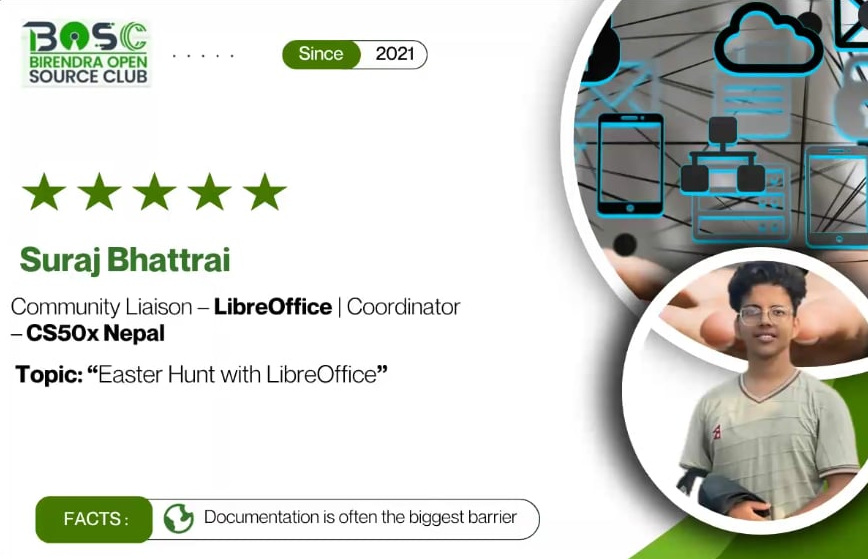
Opening slide of Suraj's talk

Updates from the Nepalese LibreOffice community:

Recent protests and stress in Nepal have disrupted regular activities. Almost everything was affected, including in-person events being canceled rapidly. For open source software users, Software Freedom Day 2025 was a big celebration. But many felt disillusioned about the event.

Despite all this, our community members in Nepal tuned in to an online call and turned Software Freedom Day 2025 into a success. Birendra Open Source Club – one of the student clubs and LibreOffice project contributors in Nepal, with support from Liaison Suraj Bhattarai and other key open source clubs, hopped onto Discord on 20 September. They carried out a series of talks among new and old enthusiasts and learners. The talks ranged from the importance of community and good first contributions, all the way up to open source in cybersecurity and open source pieces of hardware.

Suraj shared a short talk about Open Formats and added a little fun with the Easter hunt available on the LibreOffice Asia site.

Participants learned that a sense of freedom for software is only true when all the components, including formats or what we generally call “extensions,” share the same freedom as speech. It matters most in the case of canvas-based software and What You See Is What You Get (WYSIWYG) software, where there are different options to export or save the work in progress.

He emphasized that open formats are essential to software freedom because they let free software and users interoperate without barriers. Also, he highlighted the difference between open formats and closed formats.

TDF says: thanks to the Nepalese community for all their work! Click here to see Suraj’s presentation slides.

Community Member Monday: Devansh Varshney

Devansh Varshney

Today we’re talking to Devansh Varshney, who added histogram chart support to LibreOffice and is working on improvements to the Basic IDE…

Tell us a bit about yourself!

I am from Mathura in India, one of the historical cities where the first image of Buddha was carved during the Kushan Empire, Jain Tirthankar Neminatha’s birthplace and the more famous Bhagwan Krishna birthplace. A city where Greek kings also ruled and whose history has been documented by many travellers, the more famous Xuanzang and Faxian.

The rich history and diverse art culture of Mathura also reflects my interests too. My interests range from history to astrophysics to economics, and from tweaking custom Android ROMs back in high school to now tweaking the LibreOffice codebase which is one of the most interesting puzzles I came across. Even the people around me noticed and back in school I was given the name “Internet” – which was quite an interesting name but really reflects my nature.

Besides working on the LibreOffice codebase, I am also planning to complete my book on ADHD which I have mapped around first principles and physics. Hopefully by next year it will be complete.

Vishram Ghat by Umang108 on Wikimedia Commons

Vishram Ghatl on the banks of river Yamuna in Mathura (image: Umang108 on Wikimedia, CC-BY-SA)

What are you working on in the LibreOffice project right now?

This year I am working on making the Basic IDE better and more powerful by introducing a new Object Browser in the IDE, which is one of the most-demanded features as users working with LibreOffice had to visit the online API webpage to refer to the details of UNO APIs. That was quite a friction, and slows down not just the work but also decreases the user experience specially for macro developers.

Along with this, there is also the Basic code suggestion which will be available to users, so that they do not have to look every time what is going to be put when the suggestion can show the list of possible parameters and variables that can be placed.

Why did you choose to join the LibreOffice project, and how was the experience?

This is an interesting question. Back in 2017-2018 I experienced a lot of challenges with the Chrome browser, and thought about fixing them. That’s when I came across the Chromium project – upon which Chrome is based – and I did try to ask how to contribute and got some reply, but it was different from what I got in the LibreOffice project.

Here I did not get silence or confusion when I picked a bug, rather people showed interest and curiosity, and helped me do what I intended to fix. I am not putting other open-source projects on a pedestal – it’s just what I experienced at LibreOffice.

I also made some small contributions to the Google Benchmark and Blockly project and Phoenix Framework previously, but the big twist came last year when Ilmari got curious and asked me why I hadn’t mentioned the Google Summer of Code (GSoC) yet and pushed me to apply for 2024. I looked at the projects and found “Adding Native Histogram support to LibreOffice“.

Since in the past I had worked with machine learning, I saw that the need for these new chart types is crucial. But this is not just the point — while preparing the proposal for the histogram project, I found that CERN uses LibreOffice for their work and they even had a tutorial on a workaround of making histogram charts via column charts (link).

Which showed me two things: first, the lack of this feature is not just slowing human research, but also that the impact of LibreOffice is worldwide. This was the exact moment I realised that LibreOffice is not just about an office suite that lets people have autonomy over their data – but also its impact on human evolution and development is of sheer size.

Histogram charts in LibreOffice

Anything else you plan to do in the future? What does LibreOffice really need?

Yes, there is a lot of work remaining. First and foremost is the addition of Histogram Chart and other new chart types, as we later found challenges with how charts are being mapped in the codebase, and the newly introduced namespace by Microsoft for OOXML export made work more challenging. Then this year I got more interested in OCR with images and files like PDFs, natively available to users locally.

I tried to make an extension with Tesseract but its efficiency is not that great and it misses the whole structure of how the text was in the image.

Since LLMs (large language models) are something famous nowadays, I looked at how they are processing and reading images, and found they really can’t read images directly. The images first have to be processed by something called Vison Language Models (VLMs).

Nowadays there are some amazing open-source VLMs available which are also small in size and can run locally – even with the computing power of a mobile device. So I am also looking at ways we can get this working with LibreOffice, so that not just OCR but also reliable translation from text to the captured structure and modifying that structure can be done.

Many thanks to Devansh for the great contributions to LibreOffice! Everyone is welcome to find out what they can do to make the suite even better 😊

Video recap: LibreOffice Conference 2025

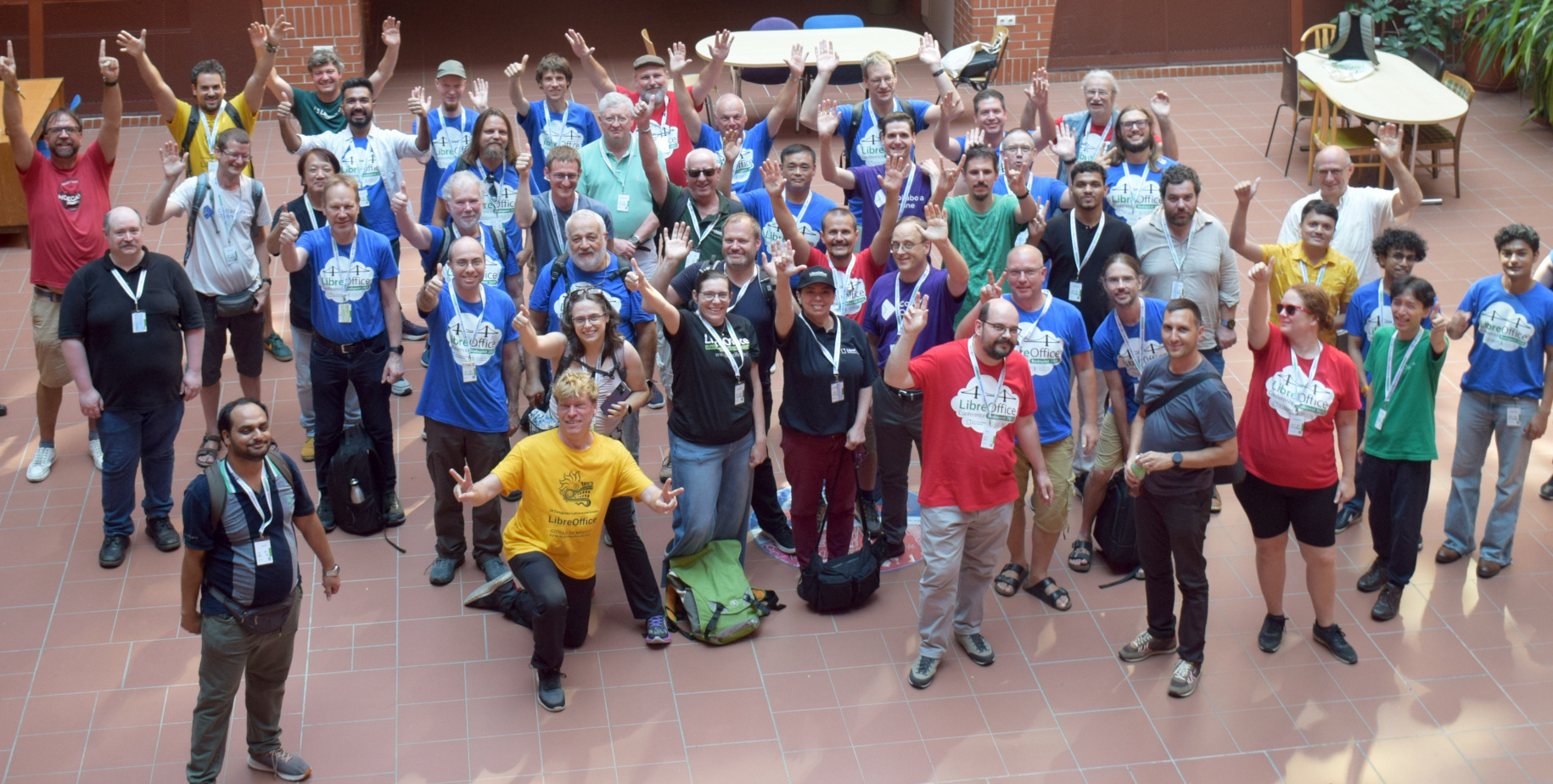
Here’s a quick video recap from the recent LibreOffice Conference 2025 which took place in Budapest. Thanks to everyone who attended 😊 (The video is also available on PeerTube.)

Please confirm that you want to play a YouTube video. By accepting, you will be accessing content from YouTube, a service provided by an external third party.

YouTube privacy policy

If you accept this notice, your choice will be saved and the page will refresh.