From Brazil to Germany, an Unforgettable LibreOffice Hackfest in Freiburg

José Guilherme Vanz and Marcos Souza, LibreOffice development in Brazil

Our first contact with the LibreOffice was in FISL 2012 (International Forum of Free Software, held in Porto Alegre, Brazil). Since then, we got quickly involved with the LibreOffice development community. Now we attend events in Brazil advocating to people about the better office suite ever done!

Months ago, after some time contributing to the project and participating in LibreOffice community, we, José Guilherme Vanz and Marcos Paulo de Souza were invited to participate in the Freiburg LibreOffice Hackfest. We were very happy and very excited! This invitation showed us that we were recognized for our humble work in the project and because this is a unique opportunity to work with people that we just know by mailing or IRC chats. So, we started the preparations of travel, such as paperwork, funds and a negotiation with our employers.

f3-1

We arrived in Germany thinking about how to learn more about LibreOffice code base, and learn some tips and tricks to code while contributing with the project. The guys at the hackfest work full time in the project, so we were very excited to improve our skills, including stuffs about how to make a nice hackfest and try setup one in Brazil!

Our journey in Germany began in the beautiful city of Munich, where we stayed for two days. We met Christian Lohmaier, the current release engineer of LibreOffice project. He and Florian Effenberger were patient and generous to show Munich to us and all nice places of this nice city! Thanks a lot guys!

Then we went to Freiburg, where the Hackfest was to start. The event took three days. We had the opportunity to meet some of the most famous mega developers! It was a very nice experience to link faces and names to IRC nicks, and of course, to question the “pythons” of the project in real time! Surely, we learned a lot in these 3 days!

Marcos did some work in LibreOffice Math. The first was about including tooltips in the new Elements Dock. To solve this bug, we basically need to create some strings with the descriptions of each element in the Elements Dock. These strings are stored inside “.src” files. These files are “compiled” and used by translators to translate each string to a specific language used in the user interface of LibreOffice. This fix was not difficult, just painful!

The second bug that Marcos worked was about to implement a scrollbar in the Elements Dock. We did not finish this fix because he had some doubts and some points that need some other fixes. Still in the event, we talked with some others hackers about other issues.

I was focused trying to execute a static checker to detect some error prone code and fix them.f2-1

After three days of hackfest, we started the “Hamburg Home Hacking Marathon”! We stayed four days in Hamburg, coding in the house of LibreOffice enginners! Again, we had the pleasure to work with Eike Ratke, Michael Stahl, Stephan Bergmann and Bjoern Michaelsen. All of them willing to help us teaching about the code base and showing some tips.

Using our precious time with them, Marcos worked in the issue 60698 (https://bugs.freedesktop.org/show_bug.cgi?id=60698). This bug is about unify some shared libraries that are built by few files. Doing this we get a smaller library because these libraries are compiled and built just once, and by this we avoid the dispersion of shared libraries. Working in this bug, Marcos unified all shared libraries of IO module.

Marcos tried yet to solve a bug in Calc, with the help of Eike as mentor. This bug was about ODS files using link to another sheets. By changing the referenced files, Calc was not allowed to update the data inside the file that was referencing. But, this bug was not so easy, and the problem was bigger than we thought. So we couldn’t solve this bug in that time, and Eike removed the bug from the easy hacks.

And I was still working in static checker. I started to look to a bug of Math, about the user interface. After some work, I fixed that bug!

In the third day, we went back to Stephan’s place, trying to solve bugs and learn more! This day Bjoern went to Stephan’s house too, totaling six guys programming in the same table! In this day Marcos worked in a bug(https://bugs.freedesktop.org/show_bug.cgi?id=63020) indicated by Bjoern. That bug was related to removing a class from LibreOffice. With Stephan’s help, Marcos could remove that class and use a better approach in the code.

And in the last day, we went again to Eike’s home, where we enjoyed to last moments with the great developers of LibreOffice! We talked a little about their work and how they work daily.

Two rookies and three masters of LibreOffice

For sure, these days were very fruitful, and we learned a lot of things that we’ll use in the future.

We came back to Brazil and we want to say a big THANK YOU for all of you guys! To the  Brazilian community, that welcomed us and keeps helping us. To The Document Foundation, who gave us this opportunity. To all developers that are helping us since we started in the project, specially YOU we met this wonderful German journey, and all people involved directly or indirectly in this amazing project!

Open Document Editors Devroom at FOSDEM 2014

Open document editors are coming again to FOSDEM with a shared
devroom which gives every project in this area a chance to present
ODF related developments and innovations. The devroom is organized
by Apache OpenOffice and LibreOffice.

We invite submission of talks for the Open Document Editors devroom,
to be held on Saturday, February 1st, from 10AM to 6PM.

Length of talks should be limited to 20 minutes, as we would like to
have questions after each presentation, and to fit as many
presenters as possible in the schedule. Exceptions must be
explicitly requested and justified.

Technical talks (code, extensions, localization, QA, tools and
significant adoption related cases) about open document editors or
the ODF format are welcome.

Submissions must be done using the Pentabarf system:
https://penta.fosdem.org/submission/FOSDEM14 .

While filing your proposal, please add a few lines about yourself
(although your profile might already be stored at Pentabarf) and
specify what product or topic (Apache OpenOffice, LibreOffice, both,
other editor, ODF in general…) your talk is about.

The deadline is Sunday, December 22, 2013. Accepted speakers
will be notified by January 5, 2014.

You can send any questions to the devroom mailing list:
office-devroom@lists.fosdem.org

LibreOffice QA volunteers: armed and ready

The current budget of the the Document Foundation reserved some funds to provide the most active members of the LibreOffice QA team with TDF-owned netbooks. These netbooks where specifically selected to be configured with a platform the volunteer does not use on his primary machine, thereby allowing these volunteers to have multiple native platforms at hand for quick triage work all the time. This first set of netbooks went out to: Florian Reisinger (famous for the implementation of the Server-Installation GUI helping QA volunteers everywhere), Joel Madero and Joren de Cuyper, the latter two both very active volunteers and key players in the QA team that among others went above and beyond in organizing the recent Bug Triage Contest. This bug triage contest itself also has been a huge success, with many new contributors getting involved in QA and more than 580 bugs triaged. Joining the LibreOffice QA team like so many did in the contest, is quite easy — to get started contact the team on irc-chat!

Florian with his triaging netbook
Florian with his new triaging netbook
Joels bug triaging setup
Jorens freshly unpacked netbook running LibreOffice

Keeping in mind that for each bug report fixed by a developer, there is another bug report triaged out of existance before that, the Document Foundation wishes Florian, Joel and Joren a smooth transition from the stressful pre-release phase of LibreOffice 4.1.0 to the for QA volunteers equally exciting post-release phase. Good hunting!

Getting Close to LibreOffice 4.1

I still remember the second I pushed the “send” button of the very first TDF press release, on September 28, 2010. A simple gesture, and a giant leap forward for the free office suite ecosystem.

On that day, though, the feeling was completely different.

Salto AngelWith some friends, I have made the following parallel to give a sense of the challenge: the decision to launch an independent foundation focused on the future of OpenOffice – and, as a consequence, to fork the software – was like diving from Salto Angel into the pond some 900 meters downhill instead of getting a regular shower during a hot summer day.

In both cased, you end up wet and refreshed…

Michael Meeks, who is British and definitely more rational than myself (the old grumpy emotional latin of the group) has a more rational take.

We were a group of friends who gathered – for different reasons and objectives – around OpenOffice between 2001 and 2005, and then spent the following 5 years in endless discussions about a different vision for the future of OOo.

A fundamental part of this vision was to create a happy home for developers and a welcoming atmosphere for all contributors.

At the time of the announcement, LibreOffice had 20 developers, and we all knew that 20 developers were not enough to manage and improve the 12 million lines of LibreOffice source code. Because of this fact, our announcement raised more than one eyebrow amongst people who – for different reasons – were not directly involved in the project.

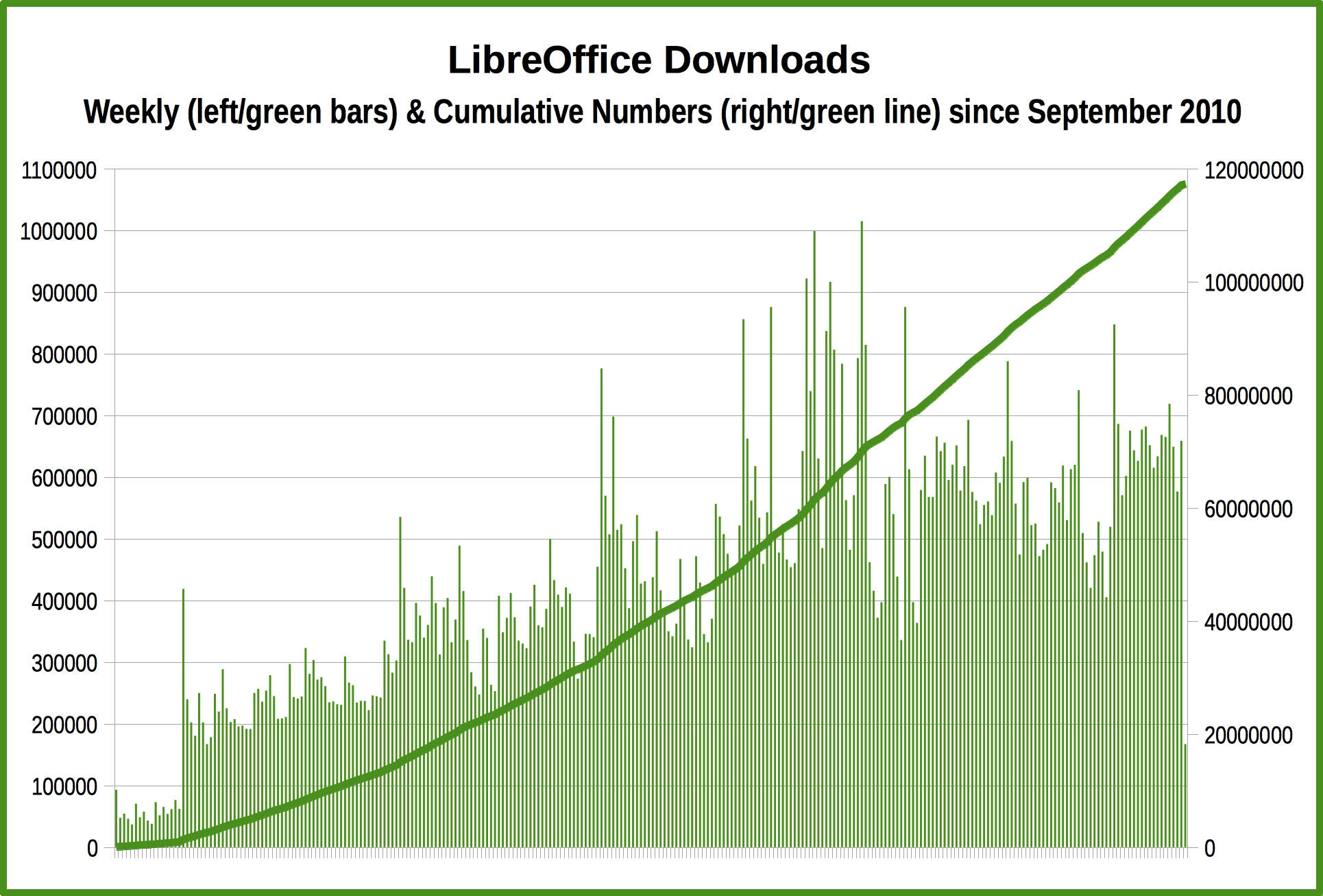
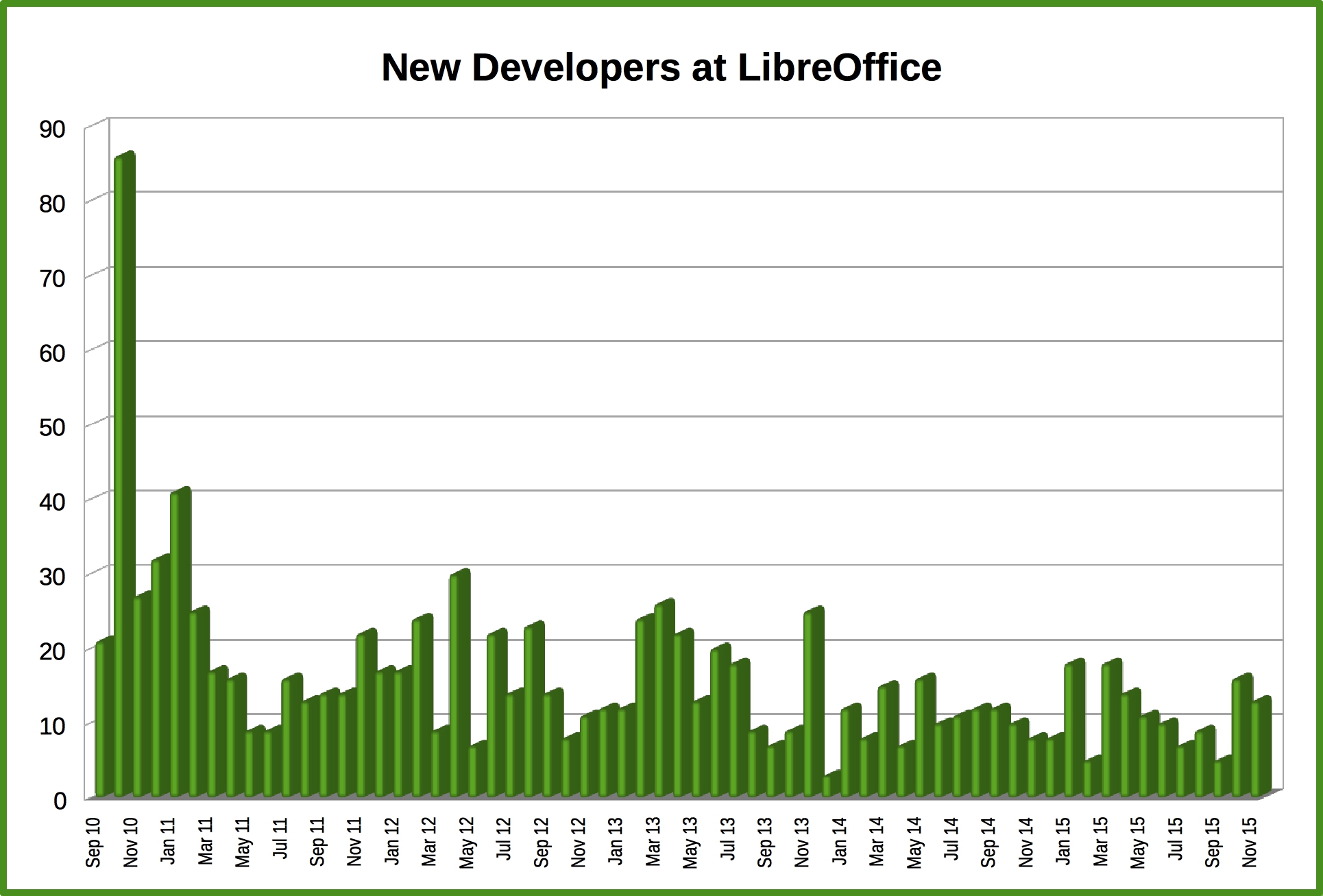
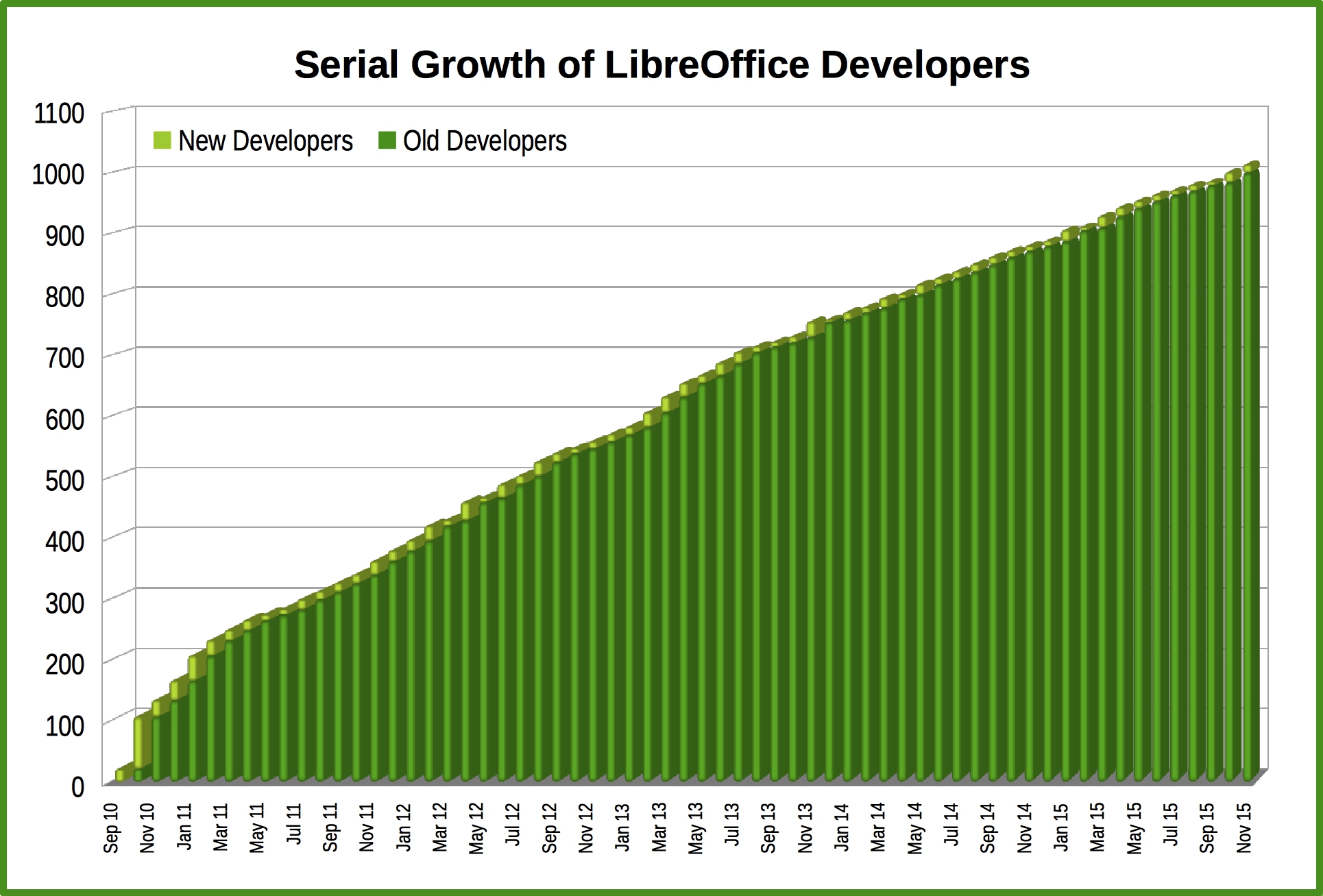
Growth of DevelopersBut we had the vision of the happy home, which was strong enough to attract over 80 developers during October 2010, and then another 580 since then. Developers who come to see and then decide how much they want to get involved in the project.

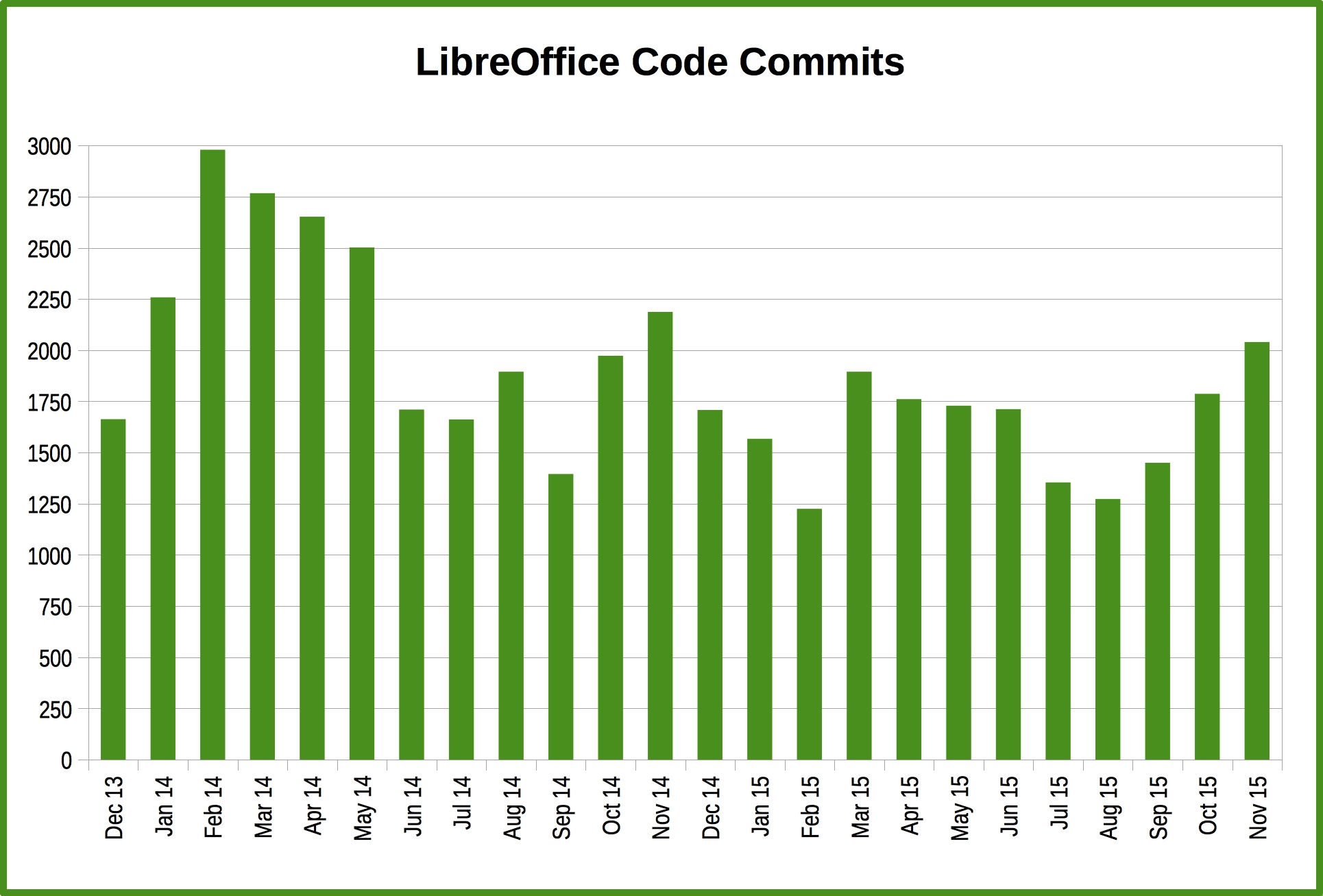
The histogram shows that we have been able to attract developers on a regular basis. Even after three years, we continue to enjoy working with new developers each week. We’re grateful for all the work that lots of people have contributed to our project so far, and we will try to maintain the welcoming atmosphere in the future.

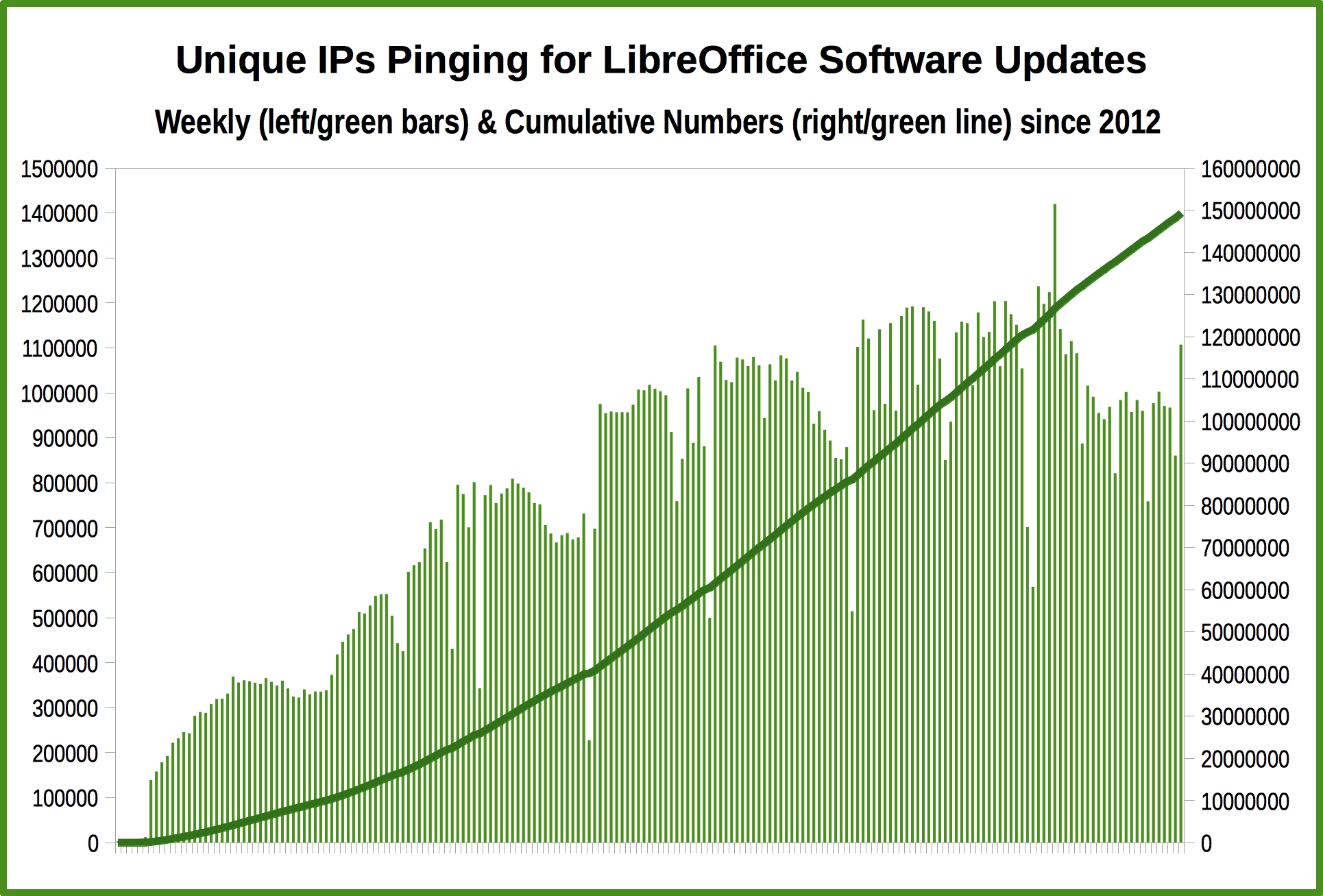
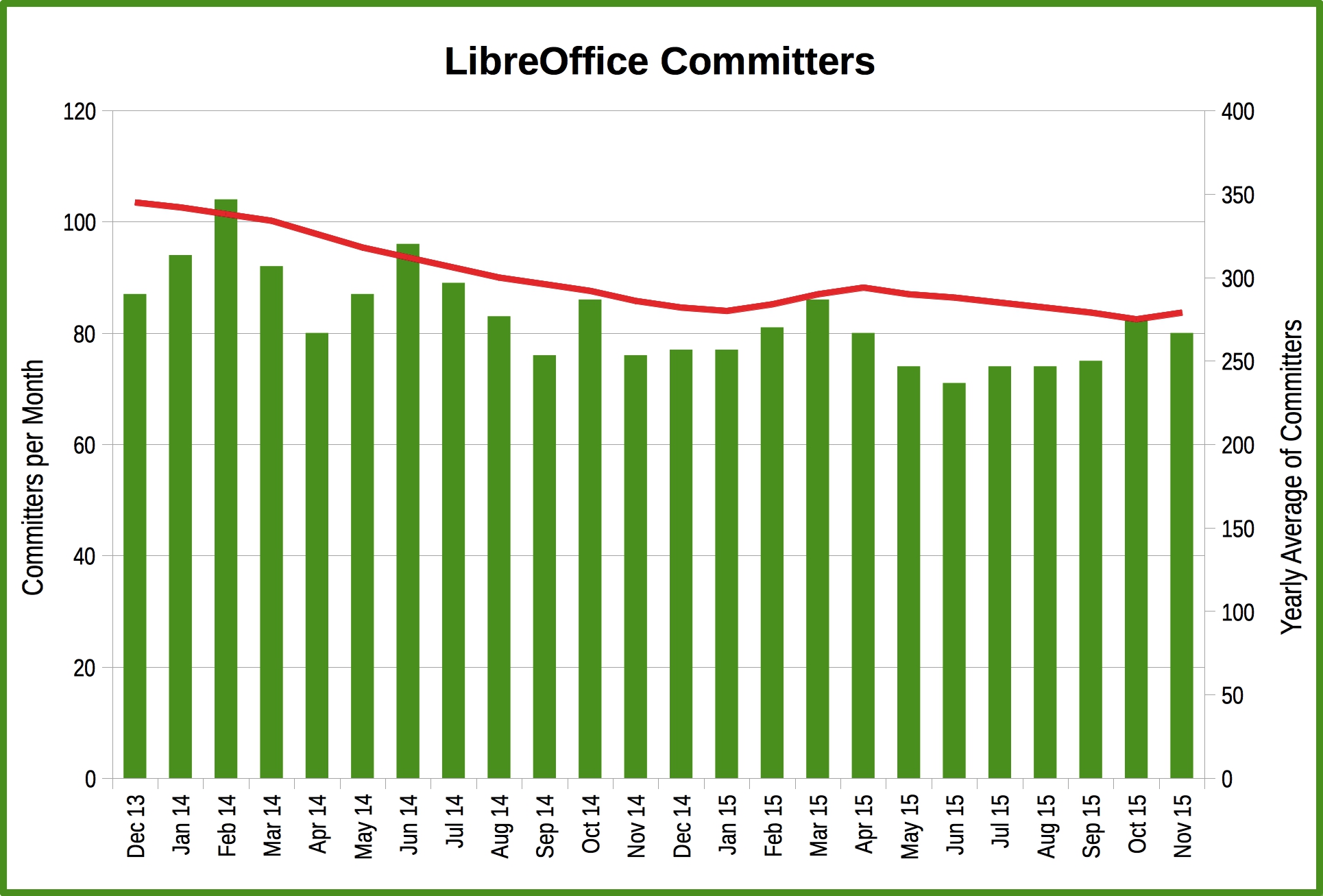
Developers on a Monthly BasisIn fact, the number of regular contributors has grown from just over 50 per month in the second half of 2011 to around 100 per month in the first half of 2013. This has been reflected in the number of developers active during the last 12 months which is now over 350.

This means that about 50% of all developers attracted by the project have contributed during the last 12 months. Furthermore, there is a growing number of core developers who get paid to hack LibreOffice code and therefore are working on a full time basis.

Long TailIf we look at the distribution of the 352 developers active during the last 12 months by number of commits, we realize that there is a long tail of contributors (which is healthy for the project). In addition, if we look at the pie of the 49 top developers with 50+ commits during the last 12 months, we find a lot of volunteers (which is even healthier for the project).

The two donut charts visualize the growth of diversity in our project, both in term of contributions by companies and groups and in term of individual contributors. Both charts compare the situation at the end of the first 12 months (September 2011) with the situation at the end of June 2013.

Donut Chart OneThe first shows the growth of the number of companies contributing to the project and the increasing weight of code developed by volunteers, SUSE and RedHat. At the same time, it shows the shrinking weight of legacy code inherited from OOo.

The second shows the distribution of contributors by affiliation. The largest group are volunteer developers, followed by the shrinking slice of OOo hackers, and by the many companies and organizations contributing to LibreOffice.

Donut Chart TwoFor completeness, these numbers also credit a few developers at Apache for work of theirs imported to LibreOffice. Naturally, we do not claim them as LibreOffice contributors, although we are grateful for their work.

LibreOffice 4.1 will be our sixth major release, and another giant leap forward in term of interoperability with proprietary file formats.

We have already provided a wealth of information on this subject, through the blog posts of Fridrich Strba, Eilidh McAdam and Miklos Vajna, three of the hackers most involved in creating or improving filters for proprietary file formats.

In addition, Michael Meeks has extensively described the less visible development activity focused on making LibreOffice source code leaner and cleaner. You can read the different steps here, here and here.

We have also summarized in a web page the most significant features of the best free office suite ever. LibreOffice 4.1 will be a landmark for interoperability, with dozens of improvements and new features focused on this specific issue.

Of course, if you want to dig deeply into the single new features, the pages we prepared for each major announcement might help in getting a better picture: 3.3, 3.4, 3.5, 3.6, 4.0 and eventually 4.1.

I look forward to firing another major release announcement in a few days. This time, I will push the button with a completely different mood, as most of our dreams have already come true.

Today, we have (1) a free office suite we can be very proud of, based on the superior qualities of the copyleft license; (2) a solid and independent foundation which represents a large and diverse global community, based on meritocracy and independence from a single corporate vendor; and (3) a bright future.

HINT: double clicking on visuals will open a larger image, which can be used for publication.

Sources of Data: Ohloh for histograms and pie charts, The Document Foundation for donut charts.

Open documents formats and LibreOffice at FISL 14

By Gustavo Pacheco

The 14th edition of the International Forum on Free Software FISL 14, from July 3rd to 6th in Porto Alegre, Brazil, will carry several LibreOffice and OpenDocument Formats (ODF) activities. This year, the good news are the participation of Italo Vignoli (Italy) and Bjoern Michaelsen (Germany) who will talk on the adoption of open standards and free software, respectively. Italo will present a lecture on LibreOffice: the History and A Reference Protocol for Migrations to Free Software and Open Document Standards. Bjoern will conduct the LibreOffice Workshop and will give the lecture LibreOffice Project: Getting Involved and LibreOffice – Continuous community integration.

The Brazilian LibreOffice community will also be in FISL 14. Klaibson Ribeiro will talk about LibreLogo early in Wednesday 3rd, a new feature included in LibreOffice 4 focusing beguinners-level programming teaching. In the afternoon we will run the panel The importance of of the open source public legal frameworks for the ODF ecosystem, where we will discuss the achievements with existing the open document formats bills, the challenge of the execution and maintenance of these regulations and the strategies for the adoption in administrations. On Friday, July 5th Olivier Hallot will run the workshop Modifying the LibreOffice Interface, and will present the development of the new dialog structures of LibreOffice, an old demand from the LibreOffice community. In the afternoon, Eliane Domingos will coordinate the LibreOffice Community Meeting where José Guilherme Vanz and Marcos Paulo de Souza will present their experience after one year hacking LibreOffice coding. At the end of the day the lecture The Rio Grande do Sul State Migration to Open Document Formats will show the ODF adoption case in the State Cabinet office.

For more details, please visit the official FISL page and register yourself for these full days of knowledge and collaboration!
Wednesday July 3rd
11:00 – 12:00

Room P11

Lecture – LibreLogo – See how easy is to start programming

Klaibson Natal Ribeiro Borges

The Logo programming language, created in the 60’s to help teaching programming by moving a small tortoise in the screen with the command line, will be presented. LibreLogo is an implementation of the Logo programming language inside LibreOffice Writer 4.0. We will show examples on how simple it is to start to program, and how to teach kids, teens and not so young people.

15:00 – 16:00

Room 40T – GNU

Panel – Importance of open documents format public regulation for the ODF ecosystem.

Antonio Augusto Ribeiro Guimarães, Gustavo Pacheco, Italo Vignoli, Klaibson Natal Ribeiro Borges, Vitorio Furusho

In the recent years, the regulation of the preferred use of open document formats for interoperability, specially with respect to the ODF standard, has been a constant issue for IT managers. The goal of this activity is to present and debate with Brazilian and foreign representatives, the challenges of the legal regulation of open formats.

16:00 – 17:00

Room 40T – GNU

Lecture – LibreOffice Project: Getting Involved

Bjoern Michaelsen

LibreOffice is one of the biggest and most important open source projects. Still we actively encourage volunteers to get involved. This talk presents possible entry points for a newcomer to get started and explains how the project takes effort to make your first contribution into the product less intimidating. Building on that, this talk will also showcase what some volunteers managed to archive and finally present you a set of opportunities to easily make your first contribution.
Thursday July 4th
10:00 – 13:00

Room 714

Workshop – LibreOffice Workshop

Bjoern Michaelsen

The LibreOffice workshop will be a hands-on workshop, covering these topics, depending on interest in the audience: – Building LibreOffice on Linux – running test suites – finding and fixing EasyHacks – testing developer builds – using gerrit.libreoffice.org and its build bots – tinderbox.libreoffice.org – bug triage – regression hunting with LibreOffice bibisect (https://wiki.documentfoundation.org/Bibisect) – whatever LibreOffice development topics come up during the session.

15:00 – 16:00, Room 40T – GNU

Lecture – LibreOffice: the History

Italo Vignoli

The birth of The Document Foundation and LibreOffice, and the growth of the project during the first three years: the new governance model, the development strategy through the numbers and the new features, and the future of the free office suite.
Friday July 5th
10:00 – 13:00

Room 714

Workshop – Modifying the interface of LibreOffice

Olivier Hallot

In this workshop we will show how to transform the decade-old LibreOffice dialogs into a new and modern open source based on GTK + Glade technology. It will also be a hands-on session for developers with abilities to program in C++ and some knowledge of LibreOffice. We aim to motivate hackers to work on the remaining dialogs that are still available for modernization.

15:00 – 16:00

Room 41A – Tux

Lecture – A Reference Protocol for Migrations to Free Software and Open Document Standards

Italo Vignoli

The Document Foundation has developed a reference protocol to ease migrations to free software and open document standards, targeted to enterprises and organizations, which has been thoroughly tested in Italy for the migration of Regione Umbria (Italia) to LibreOffice.

16:00 – 18:00

Room 701

Community Meeting – LibreOffice and Brazil, passion really matters.

Eliane Domingos de Sousa, José Guilherme Vanz, Marcos Paulo de Souza

Brazil has one of the largest LibreOffice user base. Under the coordination of the new developers generation, the Community Meeting of LibreOffice will present the landmark achievements in almost 3 years of existence. Besides the development, we will discuss other important activities of the project.

18:00 – 19:00

Room 41C

Lecture – Migration to open document formats in the Rio Grande do Sul State Administration

Rogério Alves

We will present the implementation case of LibreOffice as standard office suite inside the Cabinet Office to the ITC managers – ITC Forum.
Saturday July 6th
14:00 – 15:00

Room 40T – GNU

Lecture – LibreOffice – Continuous community integration

Bjoern Michaelsen

The LibreOffice has seen a tremendous growth since it was started 2 1/2 years ago, especially in the number of unaffiliated volunteer contributors. This growth came with a constant challenge to (re-)evaluate the communication and coordination means of the project. This talk gives an insight in how coordination in such a massive and distributed project works, but also tries to give some cautious hints what parts of that might apply to smaller projects.

The Document Foundation welcomes a new member of the Advisory Board: King Abdulaziz City for Science and Technology (KACST) of Saudi Arabia

KACSTBerlin, June 25, 2013 – The Document Foundation announces that King Abdulaziz City for Science and Technology (KACST) of Saudi Arabia is now an effective member of its Advisory Board. KACST sponsors the National Program for Free and Open Source Software Technologies (Motah: http://www.motah.org.sa/), which has been contributing to LibreOffice for almost one year, to enhance the Arabic language and the RTL (right-to-left) support, and to develop new features.

Motah LibreOffice Project (http://motah.org.sa/en/?q=node/94) is only one of the activities of Motah at KACST, where several software products are studied to explore the extent of Arabic support and their suitability for Arab users. LibreOffice was selected to be the first localization project because most Arab users need a full feature office suite.

liberoffice_image.png“Motah software engineers have been regularly contributing to LibreOffice since 2012, and are now one of the largest groups of full time developers hacking LibreOffice code, together with SUSE and Red Hat”, states Michael Meeks of SUSE, a Member of TDF Board of Directors. “Thanks to the injection of these new groups of hackers, during the last months we have been able to increase the number of contributors, which is now around 100 on a monthly basis and over 330 on a yearly basis”.

“It is fascinating to see The Document Foundation combining people from different cultures, languages and geographical locations around the development of LibreOffice, the best free office suite ever”, says Dr.Turki Alsaud, KACST VP for research institutes. “Having KACST inside TDF Advisory Board reflects our support to the development of LibreOffice, extending our reach from the improvement of the Arabic language version to the development of new features and the improvement of the user interface”.

With the addition of KACST, the Advisory Board of The Document Foundation has now ten members: FSF, Google, Intel, KACST, MIMO, Red Hat, SPI, Lanedo, Freies Office Deutschland e.V. and SUSE (https://wiki.documentfoundation.org/TDF/Advisory_Board).

About KACST

King Abdulaziz City for Science and Technology (KACST) is an independent scientific organization administratively reporting to the Prime Minister’s Office. KACST is both the Saudi Arabian national science agency and its national laboratories. The science agency function involves science and technology policy making, building national scientific database, funding of external research, and conducting applied scientific research in varius disciplines through its own research institutes and providing services such as the patent office, scientific information, and scientific consultations to public and private sector etc. KACST has currently over 2500 employees.

Media Contact KACST

Mohamed Alkanhal – Director of Computer Research Institute
Phone: + 966 11 4813765 – Email: cri@kacst.edu.sa (website: http://www.kacst.edu.sa)