Winners in the Month of LibreOffice, May 2023!

Month of LibreOffice banner

At the start of May, we began a new Month of LibreOffice, celebrating community contributions all across the project. We do these every six months – so how many people got sticker packs this time? Check it out…

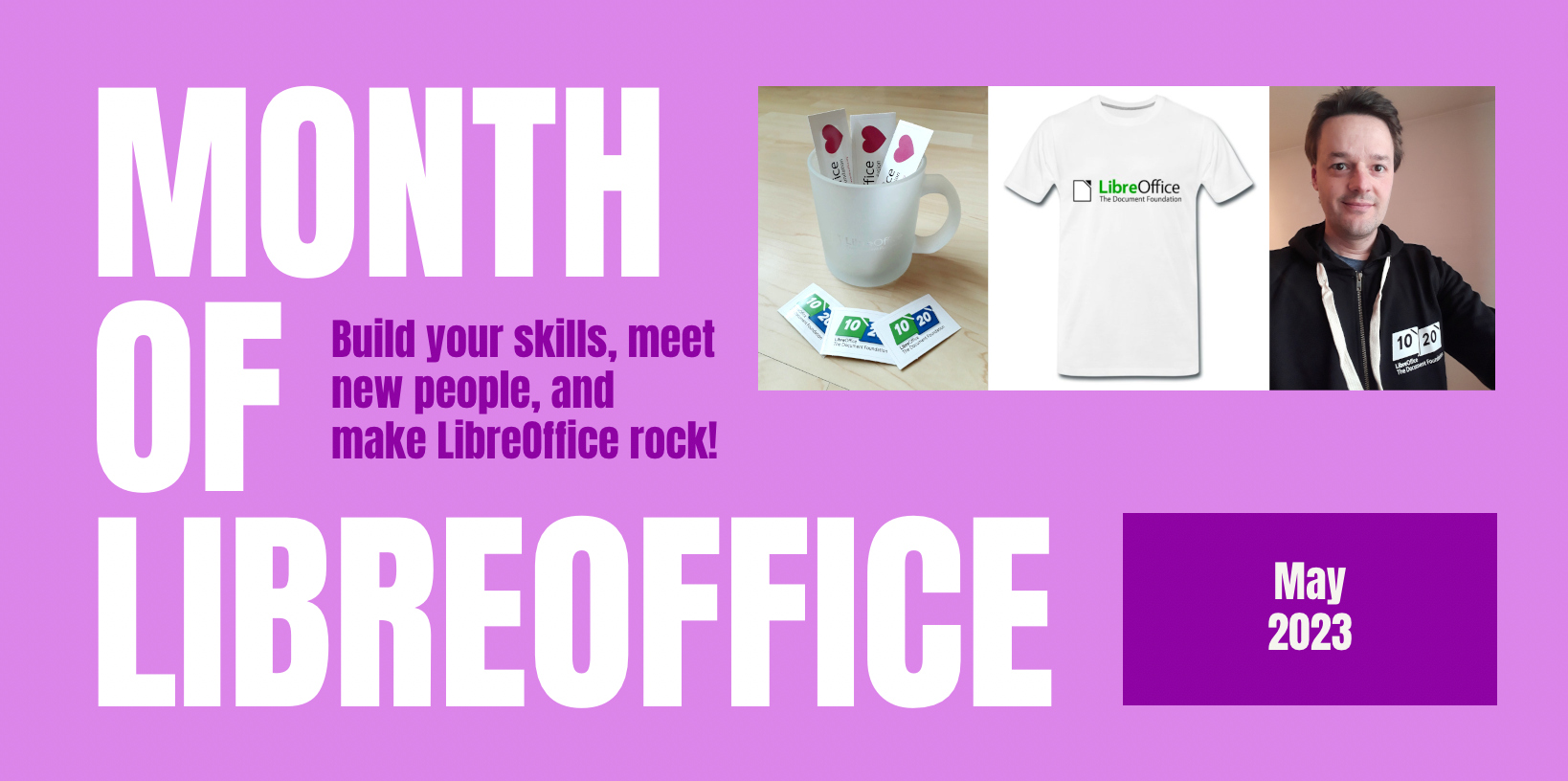
Awesome work, everyone! Hundreds of people, all across the globe, have helped out in our projects and communities. We’re hugely thankful for your contributions – and, of course, everyone who’s listed on the wiki page can get a sticker pack, with these stickers and more:

How to claim

If you see your name (or username) on this page, get in touch! Email mike.saunders@documentfoundation.org with your name (or username) from the wiki page so that we can check, along with your postal address, and we’ll send you a bunch of stickers for your PC, laptop and other kit.

(Note: your address will only be used to post the stickers, and will be deleted immediately afterwards.) If you contributed to the project in May but you’re not on the wiki page, please let us know what you did, so that we can add you!

There is one more thing…

And we have an extra bonus: nine contributors have also been selected at random to get an extra piece of merchandise – a LibreOffice hoodie, T-shirt, rucksack or snazzy glass mug. Here are the winners (names or usernames) – we’ll get in touch personally with the details:

  • joshua4
  • Czesław Wolański
  • Peter Gervai
  • Jeff Fortin Tam
  • Chris Tapp
  • Mahmoud Alnaanah
  • devseppala
  • Harvey Nimmo
  • Nguyễn Hoàng Minh
  • goodosuser

Congratulations to all the winners, and a big thanks once again to everyone who took part! Your contributions keep the LibreOffice project strong. We plan to have another Month of LibreOffice later in the year, but everyone is welcome to see what they can do for LibreOffice at any time!

LibreOffice Conf Asia x UbuCon Asia 2023 – Surakarta

LibreOffice Conf.Asia 2023 logo

Our community in Asia let us know about an event they’re organising…


LibreOffice Conf Asia x UbuCon Asia 2023 (hereinafter referred to as LOUCA23) is an event that brings together Linux and Open Source Software (OSS) activists, contributors, users, communities, and businesses in the Asian region, mainly related to and focused on the LibreOffice and Ubuntu projects.

This year’s LOUCA23 will be held in the city of Surakarta, Central Java, Indonesia, and is targeting as many as 500 participants from students, university students, academics, professionals, government agencies, NGOs, cooperatives, and companies.

Objective

LOUCA23 is organised as an active contribution of the LibreOffice Indonesia and Ubuntu communities, by bringing together experts and practitioners, business entities, institutions, activists, contributors, and users of LibreOffice and Ubuntu to discuss and share knowledge directly. This activity is expected to provide benefits in terms of knowledge, relationships, finance, and so on for participants who are directly involved during the activity process.

Participants

LOUCA23 targets at least 500 participants including students, academics, professionals, government agencies, NGOs, cooperatives and companies.

Agenda

Here are some of the types of activities that will be part of the LOUCA23 event:

  • Roadshow
  • Special Host Event / Pre Event
  • Keynote session
  • Parallel class
  • Panel discussion
  • Exhibition Booth
  • Community Meet Up

Venue

Venue

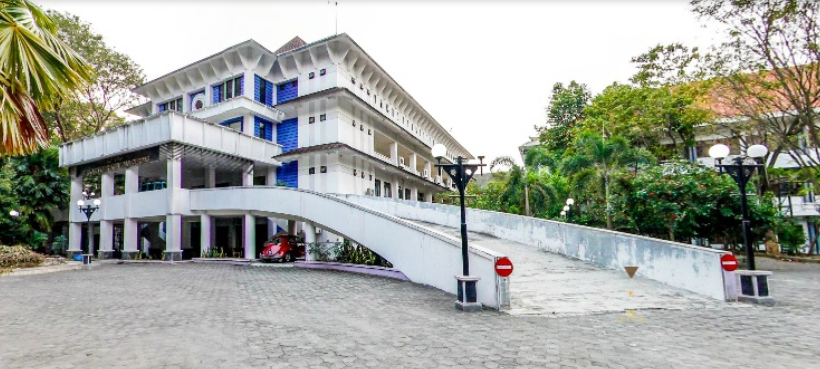
Aula FKIP (Gedung F) UNS

https://goo.gl/maps/uvELNcUQ9Ut8NVwq5

Capacity

600 persons

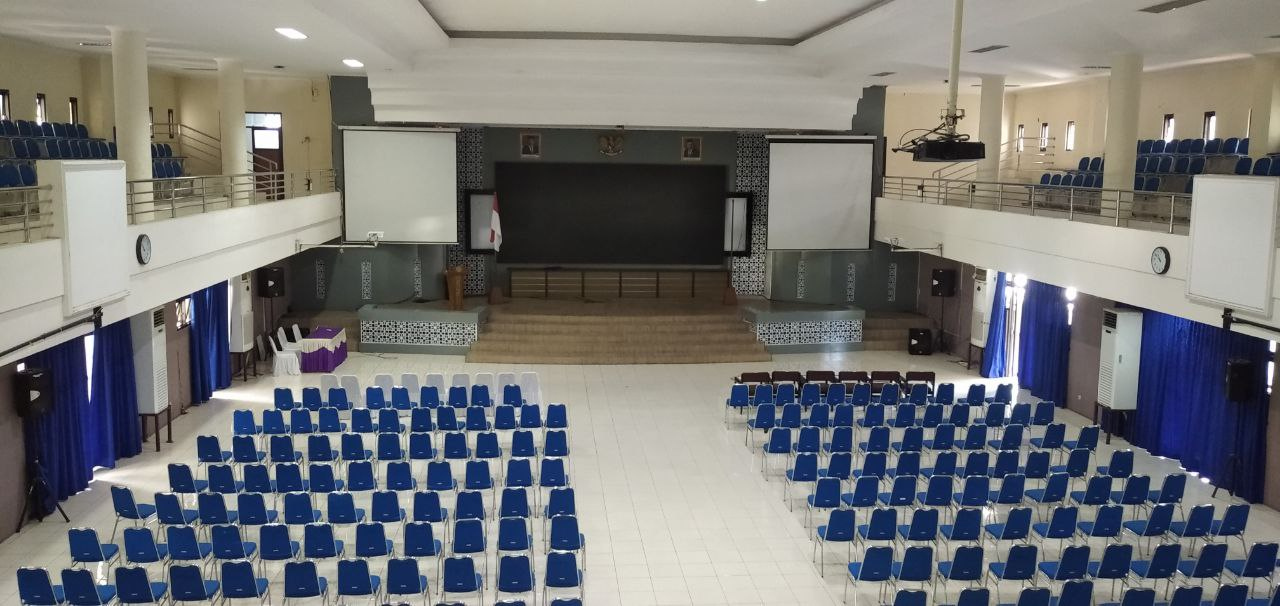
Facilities

– AC

– Seats 600

– Sound system

– Projector

– Custom screen

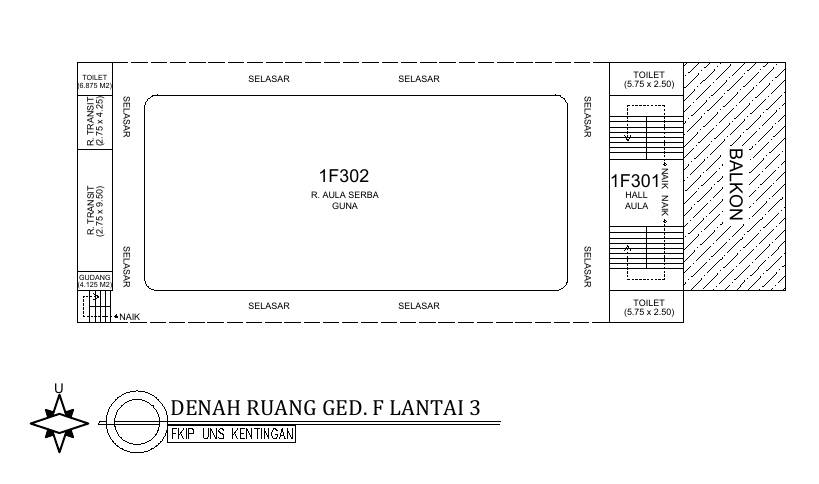
– Backstage / Transit Room

– There are 3 toilets (2 in front and 1 in the Backstage).

Classroom (needed)

In Building G there are 6 classes on the 3rd floor,

Distance +- 80 m from the location

Prayer Room

There is a prayer room on the 1st and 2nd floors

Nurul Huda UNS Mosque

+- 800m

https://goo.gl/maps/bAGksMFmh4urwjL49

UNS Campus Church

+- 150m

https://goo.gl/maps/nhtWXDTzvqdQCTMNA

Venue Contact Person

– Head of Mikroptik

Sanya +62 896-5347-9229

Promotion Media

Date

The event will be held on Friday – Sunday, 6 – 8 October 2023

Venue Pictures

LibreOffice Conf.Asia 2023 venue

LibreOffice Conf.Asia 2023 venue

LibreOffice Conf.Asia 2023 venue

LibreOffice project and community recap: May 2023

Community members in Italy

Here’s our summary of updates, events and activities in the LibreOffice project in the last four weeks – click the links to learn more…

  • We started May with the Month of LibreOffice! This is a campaign that we run twice a year, encouraging users to join our community and help to improve the software. Everyone can learn new things – and get some merchandise as thanks! Results will be announced here on the blog very soon…

Month of LibreOffice banner

LibreOffice logo banner

  • LibreOffice’s YouTube channel went over the 3 million views mark. Great stuff! We’d like to say a special thanks to community members who’ve contributed great work, such as the Indonesian community for the “New Features” videos (major LibreOffice releases), and Harald B. in the German community for his tutorials. (Note that many of the videos are also available on PeerTube.)

Video thumbnails

  • Our QA (Quality Assurance) community helps to identify and fix bugs in LibreOffice. Every week, Ilmari Lauhakangas from The Document Foundation (the non-profit entity behind LibreOffice) live-streams bug triaging sessions, so that others can see how he works on bug reports, and ask him questions. So, what do attendees think of the sessions so far? We asked some regulars – here’s what they said

Ilmari Lauhakangas

LibreOffice icons

  • The LibreOffice Conference 2023 is coming up in Bucharest, Romania – September 21 – 23! And sponsorship packages are now available. Get in contact with one of the largest open source communities in the world, showcase your brand, and support FOSS!

LibreOffice Conference 2023 logo

  • One of the goals of The Document Foundation and the community it represents is to improve LibreOffice to make it even more competitive with other office suites. And one of the tools to achieve this goal are tenders for the development of specific features, such as the implementation of OpenDocument Format version 1.3, the standard format used by LibreOffice and other applications. So we are looking for tender ideas and proposals to improve LibreOffice – let us know what you think.

Spanish-speaking community members

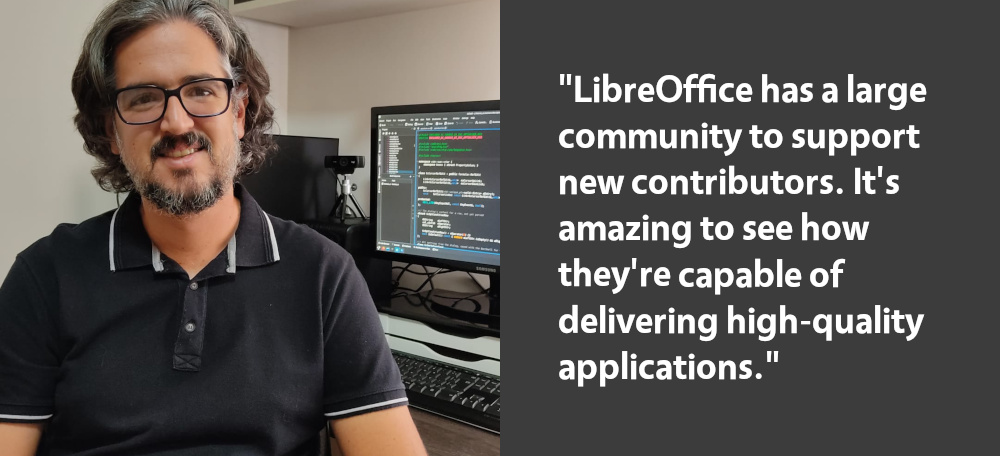
  • Ever heard the term “scratching your own itch”? Wiktionary describes it as “doing something out of motivation to solve a personal problem”. In the world of free and open source software development, this happens a lot! Anyone can contribute to FOSS projects like LibreOffice, and help to improve them. And that’s exactly what Rafael Lima did, with a long-standing limitation in LibreOffice. Here’s what he had to say.

Rafael Lima

Italian community members

GSoC logo

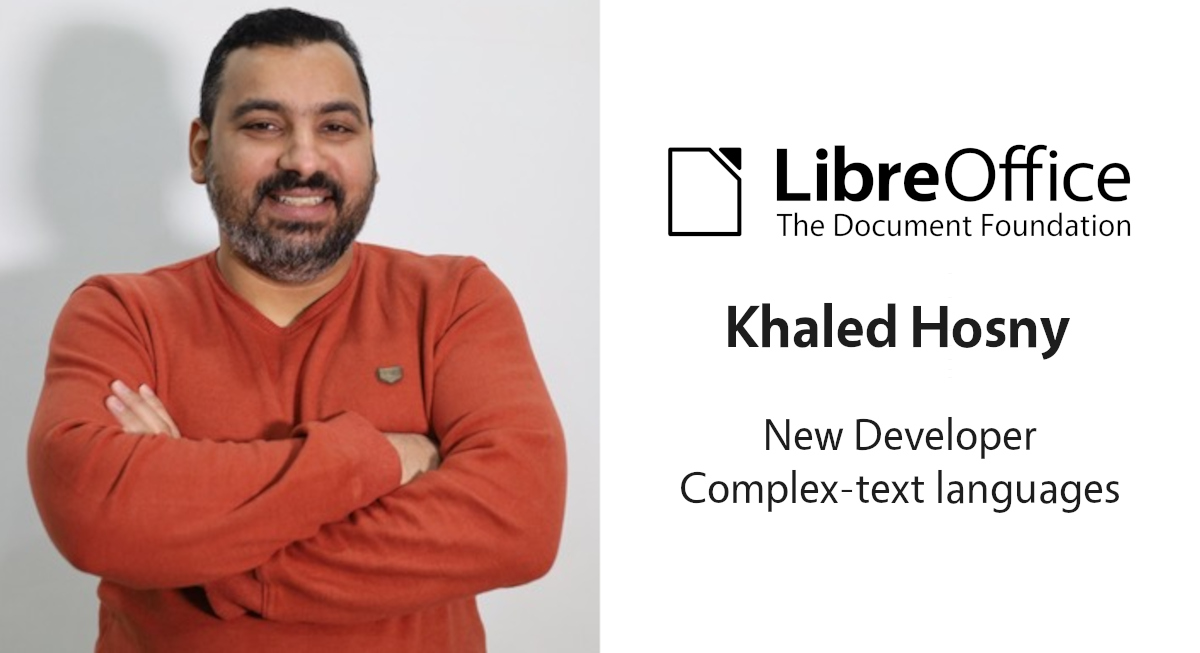
  • And finally, we welcomed Khaled Hosny to the team at TDF. He’ll focusing on improving LibreOffice’s language support, making the software more accessible to hundreds of millions of people around the world.

Khaled Hosny

Keep in touch – follow us on Twitter, Facebook and Mastodon. Like what we do? Support our community with a donation – or join us and help to make LibreOffice even better!

Development and Quality Assurance: TDF’s Annual Report 2022

Annual Report banner

In 2022, 11,769 commits were made to the LibreOffice source code, from 218 authors, in 10 repositories. We also took part in the Google Summer of Code, to support student developers

(This is part of The Document Foundation’s Annual Report for 2022 – we’ll post the full version here soon.)

Infrastructure for developers

TDF provides infrastructure for the developer community to continue their work on LibreOffice. These include Git and Gerrit, to make changes to the source code, along with Bugzilla (to track bug reports and enhancement requests), a wiki (to document changes), and Weblate (for translations).

Most technical discussions took place on the developer mailing list and IRC channel, with the latter providing more real-time communication. Members of the Engineering Steering Committee met weekly, to discuss the most pressing issues with the codebase.

Google Summer of Code (GSoC)

GSoC logo

GSoC is an annual programme in which student developers of free and open source software projects receive stipends from Google for their work. LibreOffice takes part in GSoC every year, and in 2022, two students developed features and updates in the software. Let’s go through them…

Hannah Meeks – VBA Macros – Tests and missing APIs: LibreOffice supports VBA (Visual Basic for Applications) Macros, but the implemented API isn’t complete and the API functions aren’t largely tested. The consequence of this is that the VBA macros in OOXML documents don’t run as intended in LibreOffice, which causes compatibility problems. The goal of this project is to add tests for the functions already implemented and then look for what functions are missing for a method or module and add them. Hannah described her results:

I wrote lots of macros tests which was the main aim of the project and found lots of bugs/areas to fix, so my summer was a success! I also really enjoyed looking into the core and fixing some of these problems. Lots of my tests are still broken in LibreOffice so need fixing – for example, I found that there seem to be problems with new lines being created in Microsoft Word that are not created in LibreOffice Writer.

The second project was by Paris Oplopoios – Extend Z compressed graphic format support. Some graphic formats are compressed with ZIP (deflate) to make them smaller, while the formats themselves don’t support compression. In LibreOffice we already support SVGZ format, but not other formats. The goal of this idea was to look at how SVGZ is implemented and extend that to other formats (EMF, WMF). The extended goal was to implement support for compressing in addition to extracting.

Paris got off to a flying start with the originally defined goal, which was to add import functionality for Z compressed EMF and WMF graphics and thus to improve compatibility with Microsoft documents. In the end, he also implemented exporting of WMZ, EMZ and SVGZ graphics, replaced homegrown PNG export code with one that uses libpng and added automated tests for PNG export in addition to tests for the Z compressed formats.

For more details about the students’ great achievements, see the video below and the results post – and thanks to Tomaž Vajngerl and Miklos Vajna (Collabora) and Thorsten Behrens (allotropia) for mentoring the students.

Please confirm that you want to play a YouTube video. By accepting, you will be accessing content from YouTube, a service provided by an external third party.

YouTube privacy policy

If you accept this notice, your choice will be saved and the page will refresh.


Quality Assurance (QA)

In 2022, the QA team triaged thousands of bugs, bisected hundreds of regressions, and answered questions from countless bug reporters. As one of the most visible groups directly responding to end users, the QA team must be nimble and able to adapt to changes. In addition, it must deal with specific requests for help from other teams.

The QA team meets regularly on IRC on the #libreoffice-qa channel, which is the best medium for discussing bugs and regressions. The IRC channel provides an excellent opportunity to remain in close contact with team members, and to tutor new members in the art and skill of LibreOffice QA. This is bridged to the Telegram group.

During 2022, 5,966 bugs were reported by 2,650 users, which means 115 new bugs were reported every week on average. The QA team prepared monthly reports about their activity and posted on the QA blog.

Top 10 bug reporters

  1. Telesto (288)
  2. Eyal Rozenberg (207)
  3. Mike Kaganski (165)
  4. Xisco Faulí (126)
  5. Gabor Kelemen (111)
  6. Rafael Lima (108)
  7. sdc.blanco (104)
  8. Regina Henschel (93)
  9. NISZ LibreOffice Team (93)
  10. Hossein (59)

Triaging

During 2022, 6,100 bugs were triaged by 391 people. Here are the top 10 bug triagers:

  1. Buovjaga (675)
  2. Dieter (462)
  3. Heiko Tietze (445)
  4. Xisco Faulí (354)
  5. Timur (327)
  6. raal (303)
  7. Julien Nabet (276)
  8. m.a.riosv (268)
  9. Rafael Lima (218)
  10. Mike Kaganski (207)

Bibisecting

Also, during 2022, the QA team performed 622 bibisects of regressions by 32 people. These are the top 10 bisecters:

  1. raal (144)
  2. Xisco Faulí (140)
  3. Timur (63)
  4. Aron Budea (57)
  5. Buovjaga (40)
  6. Stéphane Guillou (stragu) (24)
  7. Timur (20)
  8. Gabor Kelemen (19)
  9. Mike Kaganski (19)
  10. Telesto (18)

Like what we do? Support the LibreOffice project and The Document Foundation – get involved and help our volunteers, or consider making a donation. Thank you!

Welcome Khaled Hosny, new Developer at TDF

Khaled Hosny

The Document Foundation (TDF) is the non-profit entity behind LibreOffice, providing infrastructure and support for the community that makes the suite. Recently, TDF decided to expand its small team with a new Developer, focusing on improving LibreOffice’s language support. This will help to make the software more accessible to hundreds of millions of people around the world.

The new Developer is Khaled Hosny, so let’s hear from him…


Tell us a bit about yourself!

I’m a software developer based in Cairo, Egypt. My area of expertise is centered around written language; fonts, text layout in general and so-called “complex” text layout in particular (I don’t like how some text layout is signaled out as being complex – all text layout is complex, but some complexity is obvious right away while others are more subtle), PDF, and so on.

I have been involved with FOSS since 2006. I started with doing Arabic localization, then Arabic fonts, and a few years later I started programming to fix Arabic bugs (I think my first patch was to fix a right-to-left UI issue for Sugar, the desktop environment for the OLPC XO laptop, if anyone still remembers it). I contributed and continue to contribute to many FOSS projects – Firefox, GNOME, HarfBuzz, XeTeX, LuaTeX, to name some.

I got involved with LibreOffice in early 2011, and I have been lurking around since then.

I’m also a type designer and font engineer. I have designed and built a few Arabic and math fonts (I can’t read much of the math notation – I was taught math in Arabic notation and I hardly remember any of that either, but I’m fascinated by the 2D nature of math typesetting).

Funnily enough, I had no formal training in any of this, I actually graduated from medical school and worked as a doctor for few years before quitting to focus on a software career (I was already deep into localization and fonts while still at medical school).

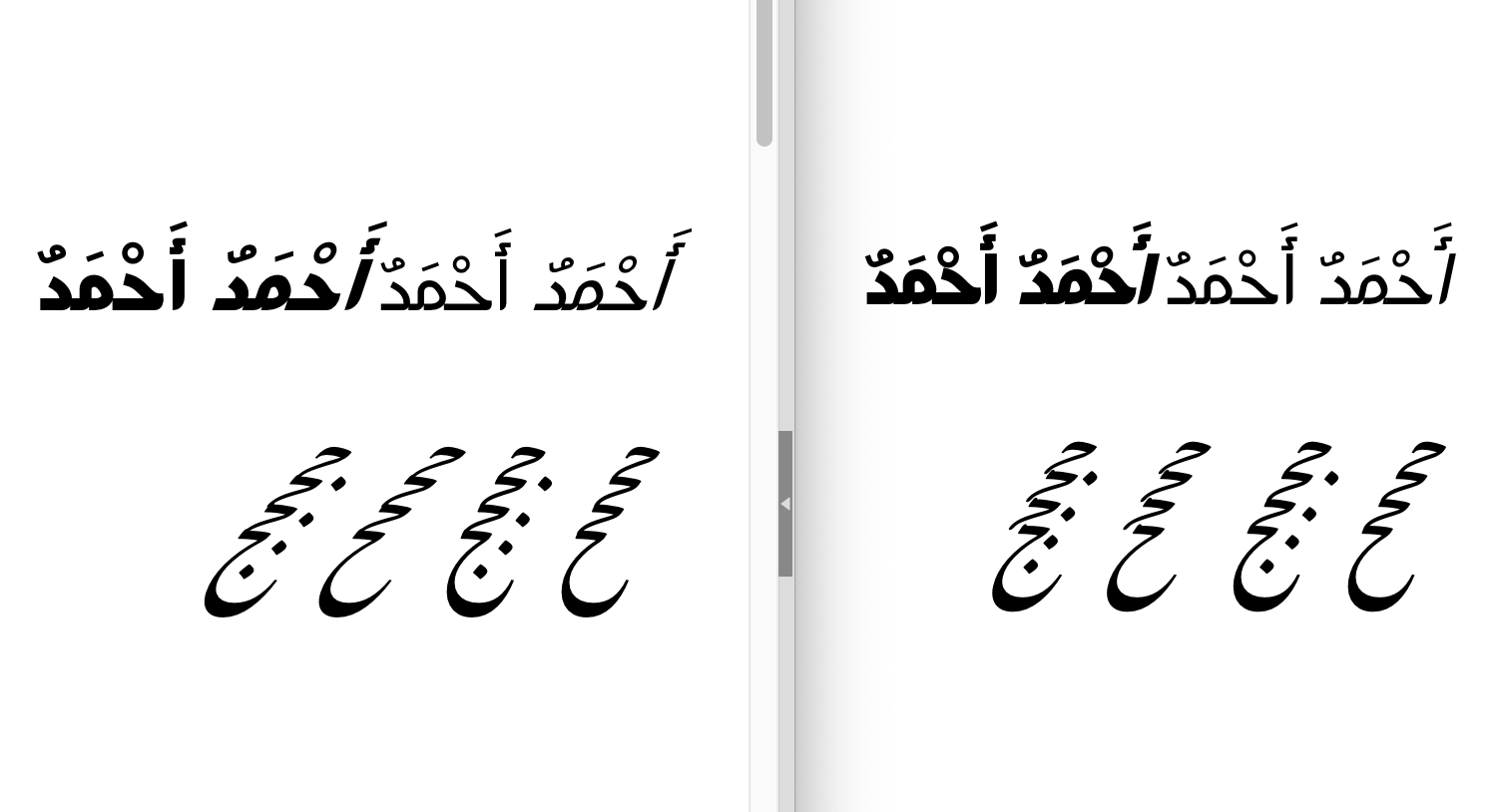
Improved glyph positioning of artificial italic text in LibreOffice 7.5

Improved glyph positioning of artificial italic text, especially combining marks – implemented by Khaled in LibreOffice 7.5


What’s your new role at TDF?

I’m joining the team as a LibreOffice developer focusing on areas of right-to-left and the aforementioned so-called “complex” text layout. These are some of the underserved areas of LibreOffice development while disproportionately affecting a very large group of (existing and potential) users.

I hope my role at TDF will help to widen the LibreOffice community, attract more people to it, and make it accessible to more users.

What will you be working on?

I will be fixing bugs and implementing features related to right-to-left text layout and user interface issues which affect languages like Arabic, Hebrew, Persian, and Urdu, as well as text layout issues involving writing systems that require more involved text layout, like Arabic script, and the Indic group of scripts.

I will be also working on fonts, PDF export (text extraction from PDF is major pain point for many scripts), and related areas.

I’m also looking forward to mentoring new developers interested in working on any of these areas.

Do you have any tips for new developers, who’re eager to get involved with the LibreOffice codebase?

LibreOffice is a large code base and can be overwhelming, so try to read any existing documentation as much as possible, don’t be afraid to ask for help, and in general be patient.


We’re really happy to have Khaled on board! Follow this blog and our Mastodon and Twitter accounts for updates on his work – plus more news from the LibreOffice community.

LibreOffice Community at Events in Italy, Spring 2023

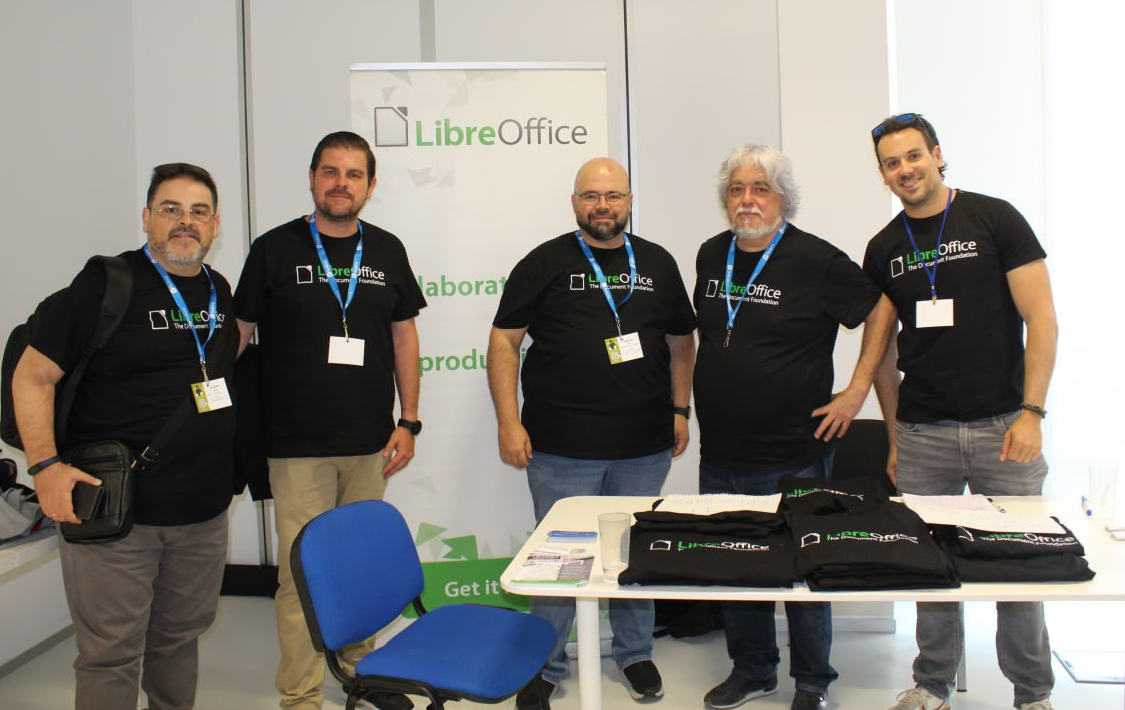
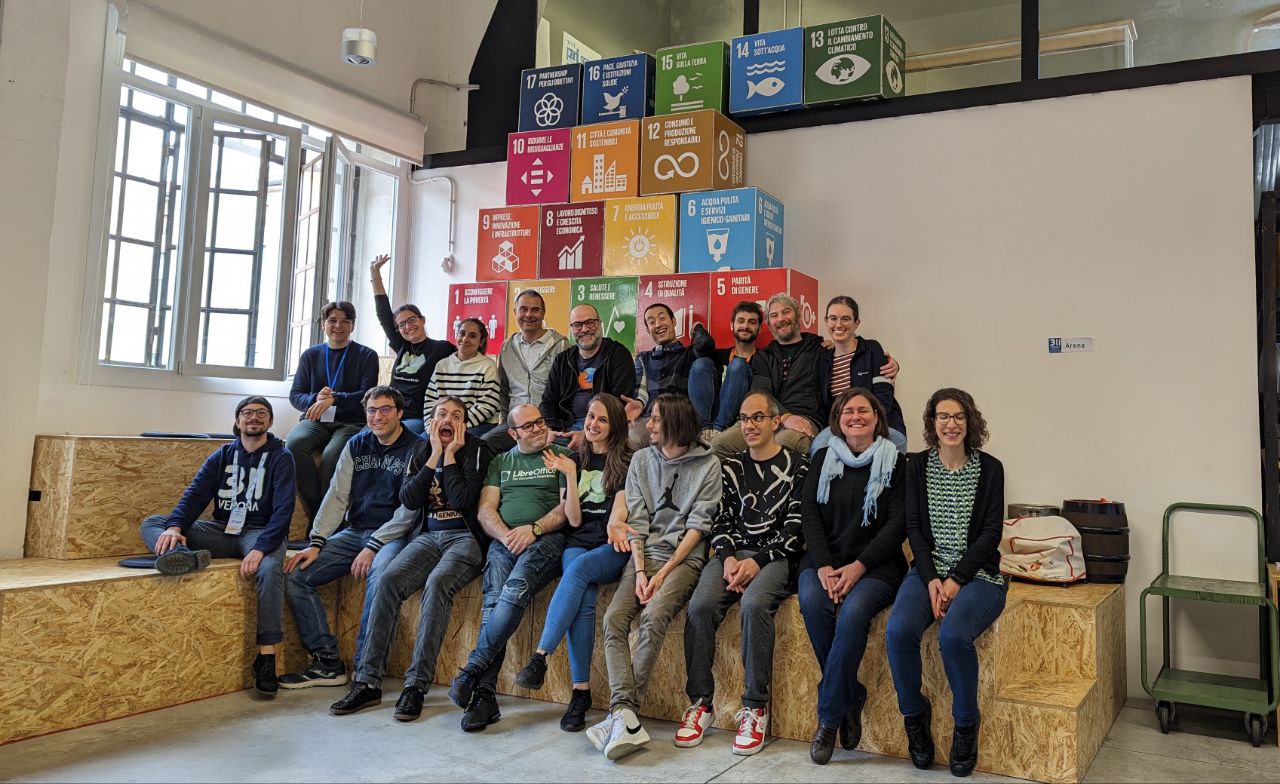
LibreOffice meetup in Italy, 2023

Emiliano Vavassori, Deputy Chairperson in The Document Foundation’s Board of Directors, give us an update on recent events in Italy:


Linux Arena at Fiera del Radioamatore – Pordenone, April 23rd and 24th

As in every spring, the Pordenone Linux Users Group (PNlug) organizes an internal event inside the local ham radio/electronics fair, «Fiera del Radioamatore», called Linux Arena. This is an occasion for them to gather a multitude of representatives from different FLOSS projects (Odoo, OpenWRT, various GNU/Linux distros) and other local organizations (other Linux Users Groups, other FLOSS associations like LibreItalia) to show bystanders and interested people that using FLOSS software for a large variety of goals is indeed fun.

The Document Foundation has been hosted by them for a long time – at first with Italo Vignoli and then, in the more recent past, with the quite constant presence and support from Marco Marega (he goes by the name Akurery on the wiki, and he is one of the most prolific translators of LibreOffice documentation and manuals inside the Italian native language project community).

The turnout was unfortunately low, as the weather those two days was really nice, sunny and cool; nonetheless, we got the chance to speak with users and potential new contributors on a different number of topics, from simple use cases to troubleshooting and integration with other software.

We look forward to continuing the collaboration with PNlug at the November session of the Fiera del Radioamatore, by trying to propose different activities to the bystanders, such as a private cloud solution with a collaboration suite based on LibreOffice Technology.

PNlug released a summary of the event over LinkedIn, with photos! Linux Arena 2023: Spring edition (Google translated)


MERGE-it – Verona, May 12th to 14th
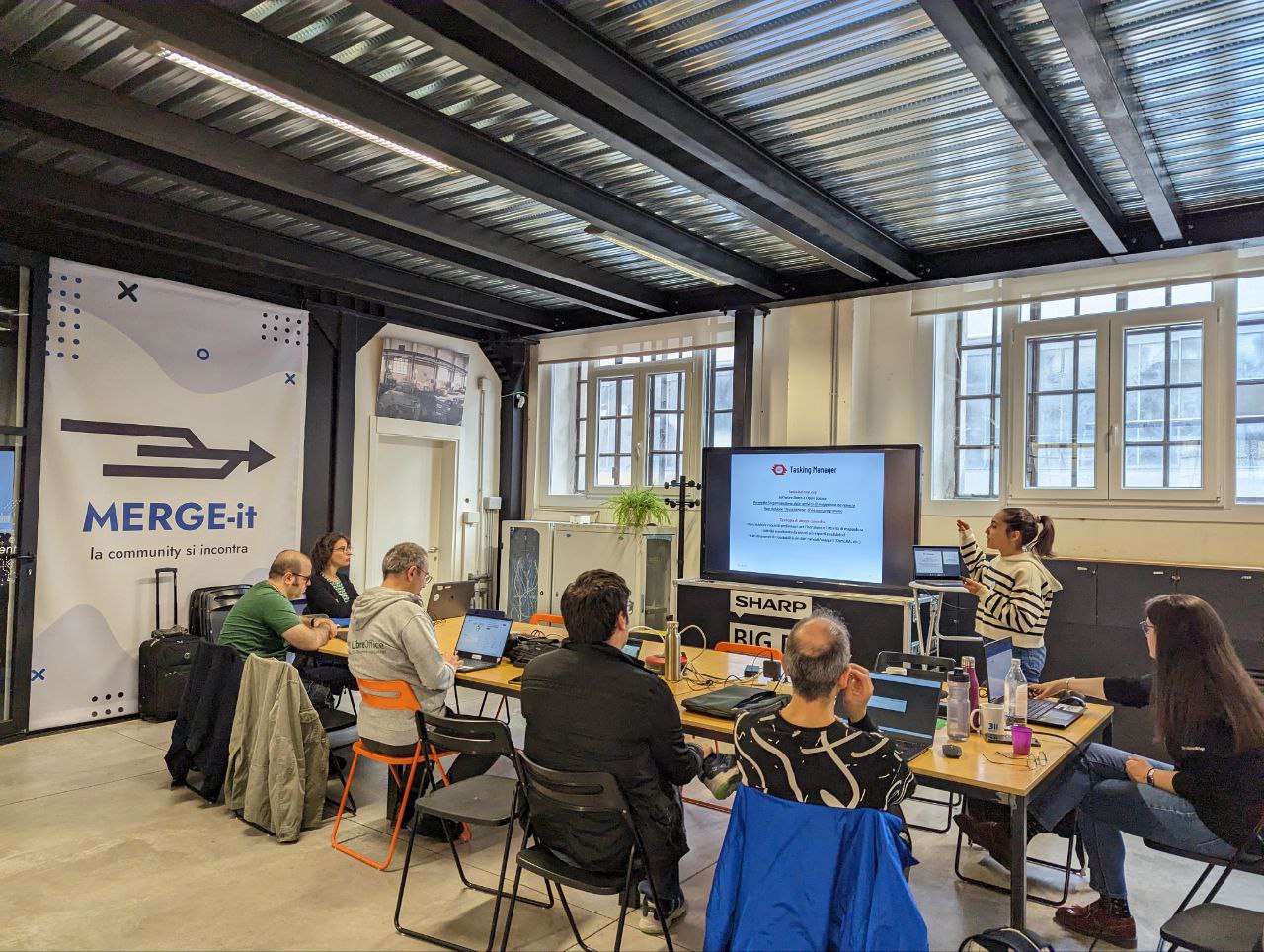
LibreOffice meetup in Italy, 2023

MERGE-it has been designed, since its inception back in 2018, by members of the Italian Linux Society (ILS) as an event where the Italian FLOSS communities can meet and exchange ideas, projects and collaborations, while trying to explain the advantages of the FLOSS to enterprises and public sdministrations.

The event is held once every other year, and this year’s event was the first one after the pandemic; the chosen venue was 311 Verona, a co-working and creative space hosting different companies, startups and volunteer associations often involved with FLOSS software – for example the local CoderDojo, a gym to teach young people about coding, and FabLab, an association of makers.

The first day (May 12th) was dedicated to enterprises and public administrations, mixing between regular users and makers of FLOSS with pretty important corporate realities in the Italian landscape (DevCode Srl with their ERP OpenSTAManager, Nethesis Srl with their complete software package based on NethServer, a CentOS-based distribution developed with their international community, all the enterprises under the RIOS consortium, which is a member of the APELL initiative). Participants on the first day were in the order of about 100 people.

The second day (May 13th) was devoted to the community-based projects and associations, creating a melting-pot of ideas, values and projects between very active communities in Italy, like Wikimedia Italia, FSFE, ILS, OpenStreetMap Italia, onData and our local community, LibreItalia; between those bigger groups, also other local Linux Users Groups from all around Italy (from Bolzano to Palermo). The very diverse composition of the bystanders helped in delving into various topics, organised as frontal speeches as well as in managed panel discussions, such as planning strategies to get FLOSS to be adopted in schools in Italy, how to involve younger contributors, and better collaboration and communication between communities with similar goals and values.
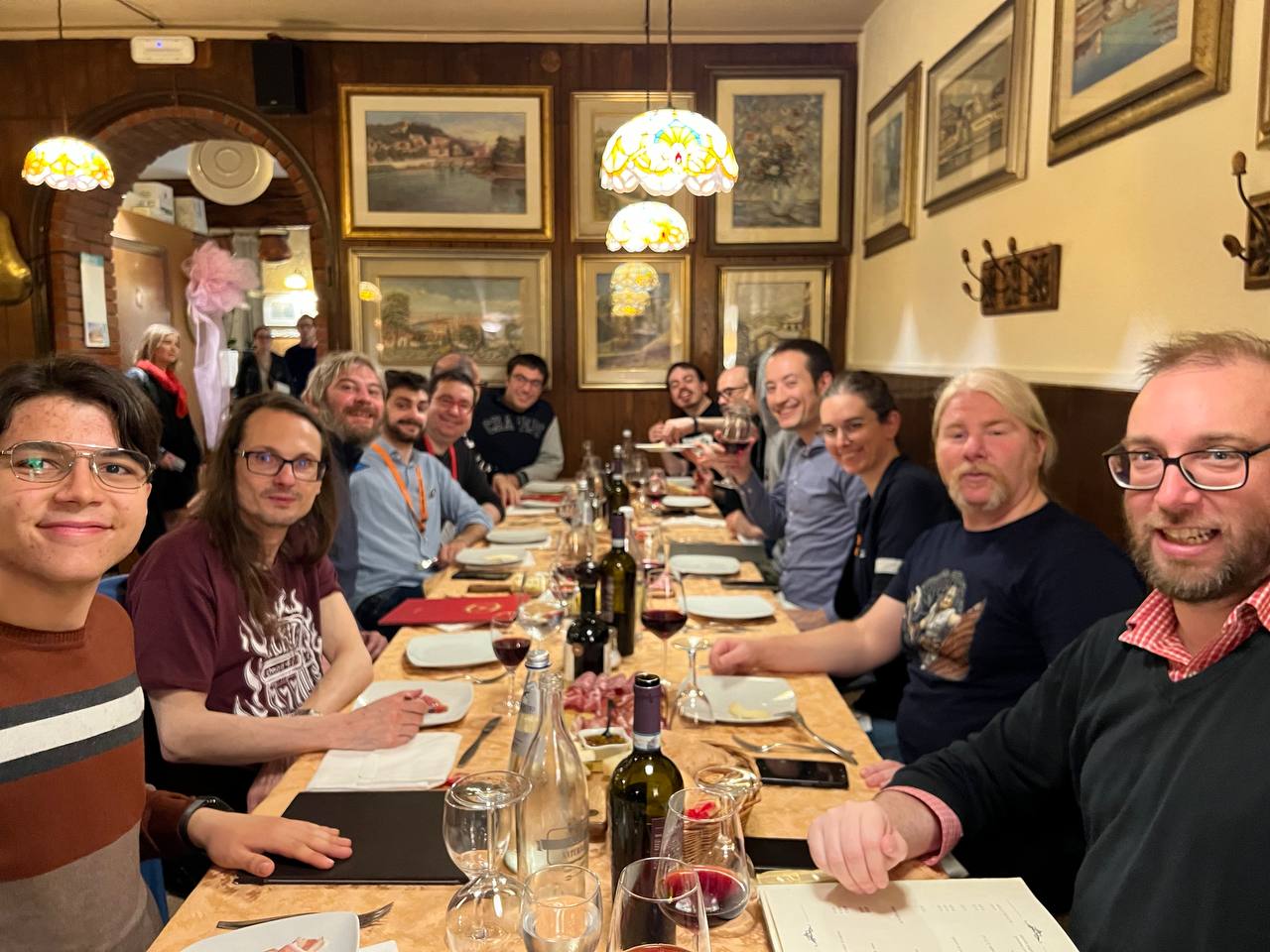
LibreOffice meetup in Italy, 2023

Although the attendance on the second day was a little bit lower (about 50-60 people), organisers shared the clear impression that the participation was felt much more than the first day. Of course, knowing very well that the best networking happens when seated for a meal, we tried to do our best by having dinner together on Friday and Saturday evenings!

On Sunday 14th, another couple of activities were scheduled: a hackathon, to better organize ILS’s online resources for its members, and a mapathon, hosted by OpenStreetMap Italia professional mappers, who came specifically for the event from Milan and Florence; the mapathon unfortunately suffered a slight change of scope, as heavy rains hit Verona and made impossible to do field mapping. But the hackathon was instead pretty successful, migrating most of ILS repositories out of GitHub to a self-hosted GitLab instance.

Our community was represented by Marco Marega, Gabriele Ponzo and Emiliano Vavassori, all TDF trustees as well as members of LibreItalia.

Overall, it was a positive, fun and constructive event to experience, and positive vibes were confirmed by most of the participants. We look forward to the next iterations to tighten ties with other FLOSS communities operating in Italy!