Winners in the Month of LibreOffice, May 2024 – Get your free sticker pack!

Month of LibreOffice stickers

At the beginning of May, we began a new Month of LibreOffice campaign, celebrating community contributions all across the project. We do these every six months – so how many people got sticker packs this time? Check it out…

Awesome work, everyone! Hundreds of people, all across the globe, have helped out in our projects and communities. We’re hugely thankful for your contributions – and, of course, everyone who’s listed on the wiki page can get a sticker pack, with the stickers shown above.

How to claim

If you see your name (or username) on this page, get in touch! Email mike.saunders@documentfoundation.org with:

  • your name (or username) from the wiki page
  • along with your postal address

and we’ll send you a bunch of stickers for your PC, laptop and other kit. (Note: your address will only be used to post the stickers, and will be deleted immediately afterwards.) If you contributed to the project in May but you’re not on the wiki page, please let us know what you did, so that we can add you!

There is one more thing…

And we have an extra bonus: ten contributors have also been selected at random to get an extra piece of merchandise – a LibreOffice hoodie, T-shirt, rucksack or snazzy glass mug. Here are the winners (names or usernames) – we’ll get in touch personally with the details:

  • Abduqadir Abliz
  • p.wibberley
  • Huanyu Liu
  • @johkra@mastodon.social
  • Rafał Dobrakowski
  • ms777
  • Zainab Abbasi
  • Andy Flagg
  • @jake4480@c.im
  • Yoshida Saburo

Congratulations to all the winners, and a big thanks once again to everyone who took part – your contributions keep the LibreOffice project strong. We plan to have another Month of LibreOffice in November, but everyone is welcome to see what they can do for LibreOffice at any time!

LibreOffice 24.2.4 Community available for download

Berlin, 6 June 2024 – LibreOffice 24.2.4 Community, the fourth minor release of the free, volunteer-supported office suite for personal productivity in office environments, is now available at https://www.libreoffice.org/download for Windows, MacOS and Linux.

The release includes over 70 bug and regression fixes over LibreOffice 24.2.3 [1] to improve the stability and robustness of the software. LibreOffice 24.2.4 Community is the most advanced version of the office suite, offering the best features and interoperability with Microsoft Office proprietary formats.

LibreOffice is the only office suite with a feature set comparable to the market leader. It also offers a range of interface options to suit all user habits, from traditional to modern, and makes the most of different screen form factors by optimising the space available on the desktop to put the maximum number of features just a click or two away.

LibreOffice for Enterprises

For enterprise-class deployments, TDF strongly recommends the LibreOffice Enterprise family of applications from ecosystem partners – for desktop, mobile and cloud – with a wide range of dedicated value-added features and other benefits such as SLAs: https://www.libreoffice.org/download/libreoffice-in-business/

Every line of code developed by ecosystem companies for enterprise customers is shared with the community on the master code repository and contributes to the improvement of the LibreOffice Technology platform.

Availability of LibreOffice 24.2.4 Community

LibreOffice 24.2.4 Community is available at https://www.libreoffice.org/download/. Minimum requirements for proprietary operating systems are Microsoft Windows 7 SP1 and Apple MacOS 10.15. Products based on LibreOffice Technology for Android and iOS are listed here: https://www.libreoffice.org/download/android-and-ios/

For users who don’t need the latest features and prefer a version that has undergone more testing and bug fixing, The Document Foundation maintains the LibreOffice 7.6 family, which includes several months of back-ported fixes. The current release is LibreOffice 7.6.7 Community, but it will soon be replaced exactly by LibreOffice 24.2.4 when the new major release LibreOffice 24.8 becomes available.

The Document Foundation does not provide technical support for users, although they can get it from volunteers on user mailing lists and the Ask LibreOffice website: https://ask.libreoffice.org

LibreOffice users, free software advocates and community members can support the Document Foundation by making a donation at https://www.libreoffice.org/donate.

[1] Fixes in RC1: https://wiki.documentfoundation.org/Releases/24.2.4/RC1. Fixes in RC2: https://wiki.documentfoundation.org/Releases/24.2.4/RC2.

Community Member Monday: Isabelle Dutailly

Today we’re talking to Isabelle Dutailly, who’s creating and updating templates for LibreOffice…

Tell us a bit about yourself!

I live in Paris, France, not that it really matters, and I am a writer. My favourite tool to write with is absolutely LibreOffice Writer. I also used to training adults on office software. So I think I can say why Writer is the best word processing software I know.

And I am a knitter which led me to make some tools for knitters with Calc. That was surprisingly easy, knowing my absolute lack of abilities in maths. These tools are online and free to download. I designed and made this little guy:

Isabelle Dutailly's knitted avatar

My computer runs Linux (Mageia) and only with free software, not because they are free of charge (and considering how much money and time I put on them, they certainly are not 😊) but because they give me freedom. I did things with LibreOffice that I never did with a proprietary office suite.

For example, in 2017, because I needed (and still need) to organize the colours I use, I looked at the code (which was not difficult but I am not a developer, just a writer) and I wrote a tutorial for me and for my website. What was rewarding was to learn that the extension PaletteMaker, which I use and recommend, was made using this tutorial. I will never even think about doing the same using proprietary software. The empowerment free software gives us is huge.

What else? I write tutorials on LibreOffice on my website and I also write some articles on LibreOffice (and other subjects) on the French website LinuxFr.org.

What are you working on in the LibreOffice project right now?

I often hear that LibreOffice lacks templates or that they are ugly. Which is not necessarily false. Also some templates are pretty old and do not give justice to the qualities and features of the software.

Not having good templates is bad for LibreOffice. It gives the office suite a bad image: “It’s ugly, you can’t do this or that etc.”. This is detrimental to a tool as powerful and well-designed as LibreOffice. I do think that one of the best ways to communicate on LibreOffice (or any other free software) consists in talking on their qualities and features. One good way, beside making tutorials, is having templates that use and show these features.

So I make templates. The last I did were some fun things like invitation for parties and so on: somebody asked me if there were nice templates for a birthday party. I saw this was something that the Extensions repository really lacked. Well, I did some.

Invitation template for LibreOffice.

And sometimes I answer on the French mailing-list for users of LibreOffice.

Why did you choose to join the project, and how was the experience?

LibreOffice is a very good application. It has wonderful features that are not promoted enough. And yes, as I said, LibreOffice gives the opportunity to learn more and more things, which I find awesome. Even when it may have some annoying bugs sometimes (the risk of choosing the very latest release of LibreOffice Community).

Anything else you plan to do in the future? What does LibreOffice really need?

In the past, I was a bit active on the wiki. I may work on it again.

LibreOffice probably needs to be better promoted, not only as a free office suite but on its features and per se, without any comparison with any other same kind of software. The choice and the customization of the interface for example. It is unique and far from being just a gadget. Having a tool exactly made for one’s needs is more than great. It is like having made-to-measure clothes or shoes instead of ready-to-wear. And there are many other features than can be better promoted I think.

Also I think that the websites of The Document Foundation should be available in more languages. For example the blog. They do not need to be identical; that is the case for the blog of my Linux distribution Mageia for example. The announcements of releases are translated into various languages. But some posts might only be in one language. Also the Extensions repository should be readable in various languages. Not all end-users are familiar with English.

And, maybe, LibreOffice could have a page “Contribute and Promote” like the vector graphics editor Inkscape has.

Many thanks to Isabelle for all her contributions! Everyone is welcome to discover what they can do for LibreOffice – and learn new things along the way 😊

LibreOffice project and community recap: May 2024

LibreOffice project and community recap banner

Here’s our summary of updates, events and activities in the LibreOffice project in the last four weeks – click the links to learn more…

Month of LibreOffice

Donate banner

GSoC logo

LibreOffice Conference 2024

Budapest

TDF Annual Report 2023 banner

Keep in touch – follow us on Mastodon, X (formerly Twitter), Bluesky, Reddit and Facebook. Like what we do? Support our community with a donation – or join our community and help to make LibreOffice even better!

The Document Foundation in 2023 – Annual Report

TDF Annual Report 2023 banner

In 2023 we had elections for the foundation’s Board of Directors, along with regular Advisory Board calls, and support for other projects and activities

(This is part of The Document Foundation’s Annual Report for 2023 – we’ll post the full version here soon. And note that this section is only about TDF’s activities – we’ll post about all the changes and improvements to LibreOffice soon too!)

Election of new Board of Directors

The “BoD” is the Foundation’s Board of Directors, the main administration of the Foundation’s projects and teams. Directors are directly elected by community members every two years, and serve for a two-year term. The Board of Directors consists of seven (7) members and three (3) deputies. The Board of Directors may launch any other teams or committees ad hoc if necessary.

TDF’s Membership Committee announced the election in October, opening the nomination phase for candidates. The final list of candidates was published on December 11, and this was immediately followed by three live “town-hall” Q+A meetings with the candidates, so that community members could ask questions and discuss the responses. We made video recordings of these meetings, and posted them on our video channel, for those who couldn’t take part live.

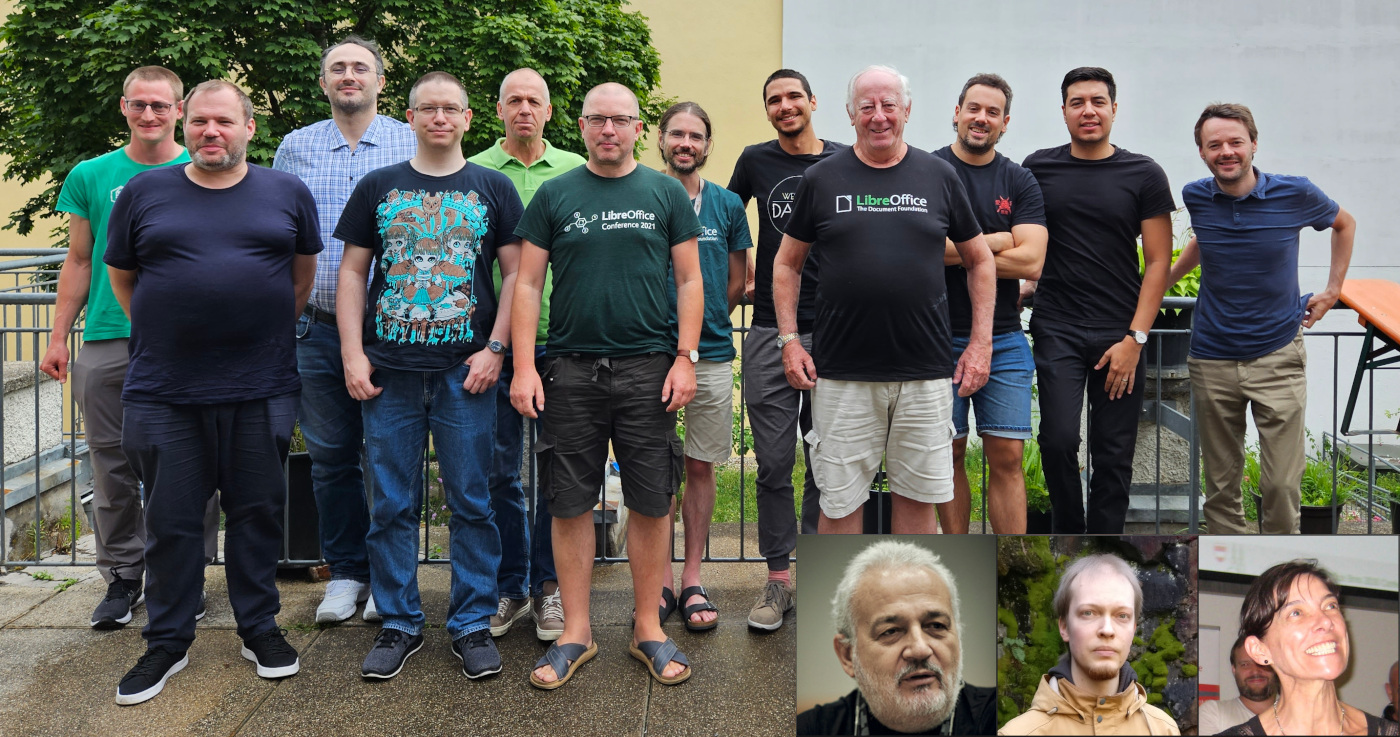
On December 29, the Membership Committee announced the preliminary results, along with a challenging phase for members to check their votes. On January 11, 2024, we announced the final results, with the following confirmed as full Board Members: Sophie Gautier, László Németh, Simon Phipps, Italo Vignoli, Bjoern Michaelsen, Eliane Domingos and Eike Rathke. Deputy members: Osvaldo Gervasi, Paolo Vecchi and Mike Saunders.

TDF Board of Directors

TDF would like to say thank you to all past and current members of the Board for their service to the community, and to all candidates for running.

Advisory Board members and meetings

The Document Foundation relies on its Advisory Board Members in order to receive advice and support. The Advisory Board’s primary function is to represent The Document Foundation’s supporters and to provide the Board of Directors with advice, guidance and proposals. Current members are Adfinis SyGroup, allotropia software GmbH, Collabora, GNOME, CAGE Technologies Inc, City of Munich (Landeshaupstadt München), Open Source Business Alliance (OSBA), Software in the Public Interest (SPI), KDE e.V., and the Free Software Foundation Europe (FSFE).

Throughout the year, TDF had regular calls with representatives of the Advisory Board. Staff and Board members at TDF provided updates on the foundation, LibreOffice software and community, and described plans and activities for the future. Advisory Board members were invited to provide valuable feedback on TDF’s work, and various ideas and proposals were discussed during the calls. TDF would like to express its thanks to all of the members for their help and support.

New team members

In January, we welcomed Juan José González, TDF’s new Web Technology Engineer to the team. “JJ” (as he’s informally known) dedicates his time to support, fix and improve the experience of TDF’s websites and services. He started with the extensions site, the place where users can get templates and extensions for LibreOffice. He began by replying to reported issues from users and improving the overall experience.

Juan José González

Then, in July, our team was expanded by Michael Weghorn who joined as a LibreOffice Developer, focusing initially on accessibility – ie improving the experience for users with limited vision or motor impairments. His initial focus was fixing problems encountered in the user interface when using LibreOffice with a screen reader.

Michael Weghorn

Highlights of activities

Throughout the year, TDF supported – and provided information about – various campaigns and events, via this blog and our social media channels. For instance, in March we celebrated International Women’s Day, looking forward to a world that’s diverse, equitable, and inclusive. One of our goals in TDF is to encourage more women to join our community (such as “LibreLadies”).

In April, we reported about TDF’s policy-related activities in the European Union. TDF has been involved in several discussions about policies which can affect or are affecting the adoption of free and open source software (FOSS), or the freedom of users’ choice for hardware, operating systems and software. A freedom of choice which should be protected by laws, especially when involving public administrations (with a strong focus on schools and universities, where future citizens grow up).

In May, we announced projects selected for LibreOffice in the Google Summer of Code 2023, while in June we collaborated with Thunderbird, an open source email client (which is very often used alongside LibreOffice) to see how we can make our applications work better together.

LibreOffice and Thunderbird logos

Then, in July, our Membership Committee announced a new membership management system called Proteus. In August we posted about Weblate (translation tool) improvements funded by TDF, and in November we supported freedom and the sustainable use of electronic products in the European Union.

Finally, throughout the year we celebrated our community of translators, who provide LibreOffice in over 110 different languages (with more hopefully becoming available in the future), more than any other software. This helps us to fulfil one of the most important objectives of The Document Foundation: “to support the preservation of mother tongues by encouraging all people to translate, document, support, and promote our office productivity tools in their native language”. Today, there are over four billion people in the world who can use LibreOffice in their native languages. We are very thankful to our hard-working community members who make all of this possible.

Like what we do? Support the LibreOffice project and The Document Foundation – get involved and help our volunteers, or consider making a donation. Thank you!