LibreOffice developer interview: Laurent Balland-Poirier

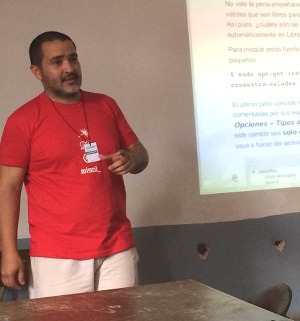
Following our previous interviews with Xisco Fauli and Muhammet Kara, we now speak to Laurent Balland-Poirier, who works in his spare time on Calc.

Where are you based, and do you work for a LibreOffice-related company or just code in your spare time?

I’m teaching chemical engineering at Rouen University (Normandy, France), and doing some research in industrial process safety. So I can only hack on LibreOffice code during my spare time.

How did you get involved with LibreOffice?

I started using StarOffice 5.2 in the late 1990s. My first contributions were bug reports, then I helped to improve the French documentation (the OpenOffice.org wiki with its great FAQ, and translations of official guides).

As I have some basic C++ coding skills, I was always interested in hacking on LibreOffice, but I was afraid of code complexity. So I started really simple. One of my first patches was correcting a typo in an obscure hyperbolic function in Math. Encouragements from other experienced coders make me feel proud about this little contribution, so I then continued with more audacious patches.

What areas of the code do you normally work on? Anything else you want to tackle?

As I am using LibreOffice in my daily life, I feel concerned about annoying small bugs. The patch that I’m the most proud of was fixing bug 54686: preventing entering percentage value in Calc with the French locale.

I extended my knowledge of the LibreOffice code with how numbers are displayed in Calc. The most visible contribution (for those who care with engineering calculation in Calc) was introducing engineering notation. I also made some light improvements to trend lines (regression curves) in Chart.

I would really like to able to modify text elements in Chart (axis labels or trend line equations), to have superscript/subscript, and so on.

What is your vision for the future, or what would you most like to see improved in LibreOffice?

I think it is necessary to improve how help is built, because it is quite complex for contributors to make corrections/improvements to the help text. However, I have no idea where to start 🙂

What do you do when you’re not working on LibreOffice?

When I return to real life, during holidays, I like traveling and hiking in the desert. I am fan of board games and like playing with friends: Ticket to Ride, Stone Age, Splendor…

Thanks Laurent! And to any other interested developers reading this: join our community and help to make LibreOffice even better.

LibreOffice documentation: join us in this adventure

olivier_hallot_07062010_964x1036
The LibreOffice documentation team produces the guidebooks, reference materials, wiki and online help to support users of the software. We’re working hard to add all the exciting new features and functions of recent LibreOffice versions, to show how your office productivity can be improved thanks to the free office suite – and your help would be very much appreciated! Even if you can only spare 30 minutes each week, your contribution would be very valuable, and you’ll also get experience with a big-name open source project. Read on for the full details…

(more…)

Improving LibreOffice User Experience (UX)

g4hDOEET

Effective from May 2016, Heiko Tietze has started working as a consultant to drive LibreOffice UX one step further.

Heiko has been one of the most active UX volunteers during the last few years, and has been instrumental in a rather large number of the user interface improvements since LibreOffice 4.4.

In addition, he has coordinated UX focused research, which has – amongst other results – led to the development of the human interface guidelines (HIG), and to incremental UI changes to menus and toolbars. Currently, the focus is on the improvement of the LibreOffice Draw user interface.

Most of Heiko’s and other UX volunteers’ activities are reflected in the TDF Design blog, where Heiko has extensively reported about the research and the most significant UX improvements, such as the reorganization of toolbars and the new application specific-menus launched in LibreOffice 5.1.

Heiko’s main objectives will be to work with developers to find out what is technically possible and makes sense to improve LibreOffice UX, to grow the UX and design contributor base, and help with UX-related bugs.

Heiko Tietze has a degree and a doctorate in psychology at the University of Jena, where he has also worked as researcher in general psychology. In his professional career, he has worked with neurophysiological methods like electroencephalogram (EEG) and eye tracking (EOG) on different topics, such as vigilance in traffic and the outcome of automation.

On top of his strong methodological and statistical background, he has developed the skills to write software code to deal with large bulks of data, and has specialized in computer science. In the last ten years, he has focused on usability for different customers, with projects from embedded systems to complex desktop software.

In addition to LibreOffice, Heiko is also a long time contributor to the KDE project and a member of the visual design group (VDG).

LibreOffice developer interview: Xisco Fauli

Xisco Fauli LibreOffice developer

A few weeks ago we talked to Muhammet Kara about his work on LibreOffice, and today we hear from Xisco Faulí, a Spanish developer who started with Easy Hacks to get familiar with the code…

Where are you based, and do you work for a LibreOffice-related company or just code in your spare time?

I live and work in Madrid, Spain, but originally I’m from Valencia, on the east coast of the Iberian Peninsula. Currently, I work for a private company as a QA engineer, so I write code for LibreOffice in my spare time, normally late at night.

How did you get involved with LibreOffice?

Before LibreOffice existed, I knew OpenOffice.org as the open source alternative to Microsoft Office, but I never thought of contributing to the project because from my point of view, it looked really difficult for someone like me with little knowledge in C++ and no previous experience in an open source project, to contribute to such a big project.

However, when LibreOffice was forked, I came across the LibreOffice Easy Hacks page and I realized that some of the easy hacks didn’t require much knowledge in C++ – so I decided to give it a try. In fact, my first contribution to the project was as simple as deleting some commented lines, but it was really encouraging to see how welcoming the community was to me and how fast my patch was merged into master, so I got hooked right away.

What areas of the code do you normally work on? Anything else you want to tackle?

In 2011, I was accepted as a student in the Google Summer of Code to work on porting Java wizards to Python in order to reduce the Java dependency. During the program, I ported the Letter, Fax and Agenda wizards. Later on, the Web wizard was ported by Javier Fernandez (Igalia). However, there are still some database wizards that need to be ported: tdf#83814. So I take the opportunity to encourage anyone interested to work on this task.

More recently, I’ve done some work in the SVG filter (which I hope it will be deprecated soon) and in the SVGIO filter, especially adding unit tests in order to avoid regressions. More info: http://x1sc0.blogspot.com. Besides, I’m also working on tdf#89329 with the help of Noel Grandin, and tdf#62525 with the help of Thorsten Behrens (thanks to them both!) and I must say it’s helping me a lot to improve my knowledge in the code base and in C++.

What is your vision for the future, or what would you most like to see improved in LibreOffice?

I’d love to see more Spanish contributors in the project and a more active Spanish community. It would be nice to have something like in Germany, Japan, Brasil or Italy and celebrate local meetings from time to time. This could also help to have more widespread use of LibreOffice in the Spanish public administrator, which would be another thing I’d love to see in the near future.

What do you do when you’re not working on LibreOffice?

I like sports, specially those done in the mountains like climbing, skiing and trail running. I also like traveling – recently I’ve discovered the pleasure of travelling by bicycle and I must say I love it. When I have evenings free, I like to go to the cinema, the theater or go out with friends.

Thanks Xisco! And to any other interested developers reading this: join our community and help to make LibreOffice even better.

LibreOffice 5.1.4 available for download

noun_23937Berlin, June 23, 2016 – The Document Foundation (TDF) announces LibreOffice 5.1.4, the fourth minor release of the LibreOffice 5.1 family, targeted at individual users and enterprise deployments. Users of previous LibreOffice releases should start planning the update to the new version.

For enterprise deployments, The Document Foundation suggests the backing of professional support by certified developers, migrators and trainers (the full list is available at: http://www.libreoffice.org/get-help/professional-support/).

People interested in technical details about the release can access the change log here: https://wiki.documentfoundation.org/Releases/5.1.4/RC1 (fixed in RC1) and https://wiki.documentfoundation.org/Releases/5.1.4/RC2 (fixed in RC2).

LibreOffice Conference

In 2016, LibreOffice Conference will be hosted by the Faculty of Information Technology at Brno University of Technology, and organized by OpenAlt, from September 7 to 9.

Details of Call for Papers, open until July 15, 2016, are available at: https://blog.documentfoundation.org/blog/2016/04/08/libreoffice-brno-conference-call-for-paper/. Registration for the conference is open at: http://conference.libreoffice.org/2016/registration/.

Download LibreOffice

LibreOffice 5.1.4 is immediately available for download from the following link: http://www.libreoffice.org/download/libreoffice-fresh/.

LibreOffice users, free software advocates and community members can support The Document Foundation with a donation at .

TDF Marketing Activity (and a Debian Bug Squashing Party!)

As we head towards the second half of the year – and an exciting new release of LibreOffice in August – I wanted to recap some work from the Marketing Team that I’ve been involved in over the last few months. But before that, I’d also like to say congratulations to the LiMux team for a great Debian Bug Squashing Party!

LiMux is a project by the City of Munich to transition away from proprietary software and closed document formats to free software and open standards. GNU/Linux and LibreOffice are key components in this migration, and on 27 – 29 May the LiMux offices hosted a Debian Bug Squashing Party. As the name suggests, this is a mini hackfest where developers work to fix bugs in the Debian GNU/Linux distribution (and related software).

LiMux is based on Kubuntu, which in turn builds on Debian’s mighty foundations; other developers associated with KDE, Kolab and LibreOffice were present as well. Lots of hacking was done and bugs fixed – but it was also a great opportunity just to chat about the state of LiMux, make new contacts, and try great food! The Indian dishes on the first evening were especially good…

Marketing updates

Moving on to Marketing at The Document Foundation: we’ve had a busy few months, attending the CeBIT show in Hannover with new flyers and other materials. Thanks to the ever-industrious community, we received audio translations for our LibreOffice 5.1 New Features videos – so there are now versions in French, German and Spanish. Following this, we started work on the 2015 Annual Report, a summary of last year’s news and activity inside The Document Foundation and LibreOffice. It will be online soon, so stay tuned to this blog!

The LibreOffice main website and The Document Foundation wiki are packed with useful information, but some of it is duplicated or slightly dated, so we’ve been going through both sites to perform cleanups and updates. In addition, we added a new page to track migrations to LibreOffice, a First Steps guide for potential contributors to the marketing project, along with a style guide. On the main website we updated the screenshots and added a new “Who uses LibreOffice?” page.

The Document Liberation Project (DLP) is another effort supported by The Document Foundation, and we’ve been working to raise awareness about its mission and spread the word. After talking with the teams at Inkscape and Scribus, both of those projects now feature DLP logos on their sites, while the DLP front page has been redesigned to more succinctly express what it does. On top of that, we made a short video summarising the DLP’s goals.

Month of LibreOffice

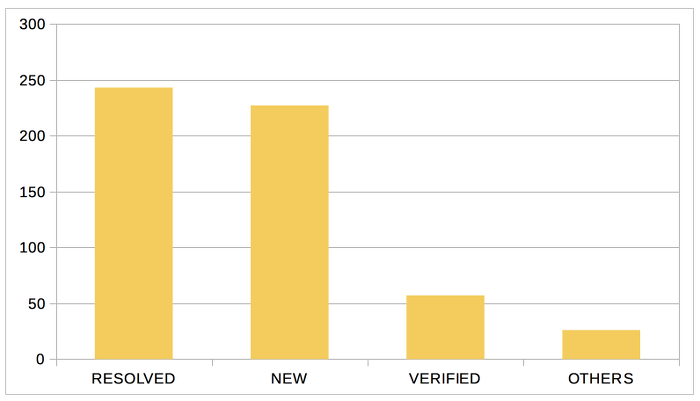
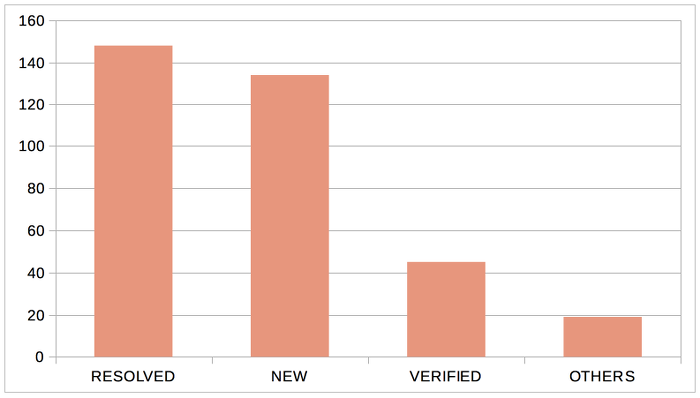
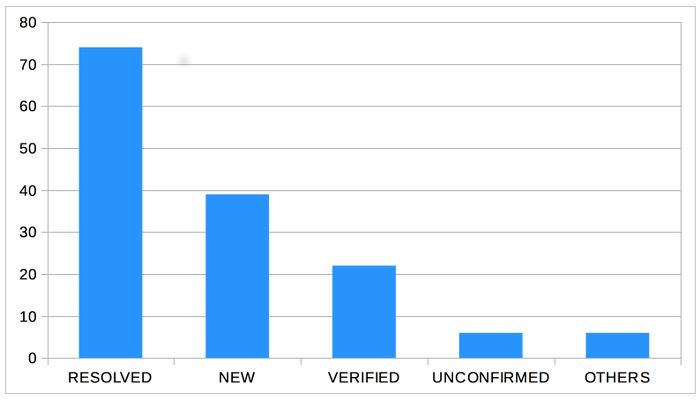
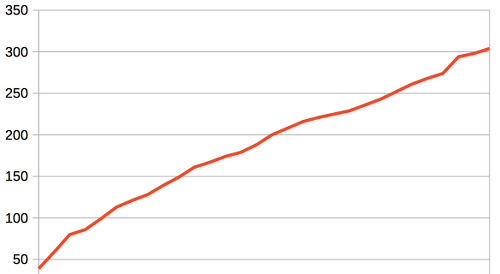
Most recently, we had our Month of LibreOffice campaign, highlighting activity across all areas of the software. Many people think that contributing to an open source project is all about code – but we’ve tried to show that it’s possible to help in other ways including translations, confirming bugs, writing documentation and simply spreading the word. We awarded over 330 badges, so thanks to everyone who got one, and we plan to do another campaign like this later in the year.

The next few months are going to be busy as well: LibreOffice 5.2 is due to be released in August with many new features, and then we’ll have our yearly conference in September. We hope to see you there!