Berlin, September 26, 2017 – The Document Foundation (TDF) announced today that Kopano, the leading European provider of open source groupware and collaboration software, has joined the project’s Advisory Board. Kopano wants to contribute to the project in areas of its expertise, for example in user experience.
Kopano is a continuation of Zarafa. It offers a platform for communication, content sharing and self-organization, is entirely modular, and provides third party software vendors with simple integration options (e.g. via widgets).
Most features and integrations are available via a browser, thanks to Kopano WebApp, while smartphones, tablets and Outlook can be connected through Z-Push – the open source implementation of the Exchange ActiveSync Protocol (EAS). Kopano’s desktop client DeskApp is available for Windows, macOS and Linux.
Solutions like Kopano, combined with LibreOffice, help users to free themselves from the dependency of Microsoft and other cloud software, and enable companies to retain freedom and ownership of their data and software stack.
“Kopano is a welcome addition to the LibreOffice community, as they are extending the reach of LibreOffice in self-hosted Enterprise-environments by integrating LibreOffice Online with their collaboration solution. By becoming a member of the project’s Advisory Board, Kopano will provide experiences and insights necessary to improve the presence of LibreOffice Online”, says Simon Phipps, TDF Board Member.
“With our collaboration-products for messaging, ChatOps, Video Meetings, e-mail and groupware we offer the benefits of cloud-software in a self-hosted open source-stack. A powerful LibreOffice Online is the missing puzzle-piece for Enterprise-customers to keep their whole stack of modern collaboration under their own control”, says Brian Joseph, CEO of Kopano.
TDF Advisory Board’s (AB) primary function is to represent sponsors of the project, and to provide the Board of Directors (BoD) with advice, guidance and proposals. In addition, the AB is at the kernel of the LibreOffice ecosystem, and as such is key to the further development of the project.
About Kopano
Kopano is a leading European provider of open source groupware and collaboration software serving thousands of customers ranging from European governments to larger organizations. As a continuation of Zarafa, Kopano puts messaging, collaborative editing, video meetings, email and calendaring in one single interface. Website: https://kopano.com
Thursday, 28th September 2017 will be a special day – not only is it the seventh birthday of The Document Foundation, but we will also be running an “Ask me (us) Anything” session on Reddit – specifically, the /r/linux subreddit.
Team and board members from The Document Foundation will be on hand to answer questions and point people in the right directions. The AmA will run from 12:00 UTC, and we’ll be around for several hours to answer questions. (And indeed we’ll check the post the following day for any extra questions).
We look forward to taking part and talking to everyone!
Yesterday, the Free Software Foundation (FSF) announced that the opportunity to apply for LibreOffice certification for migrations and training is now available to FSF Associate Members. In 2015, TDF began offering LibreOffice certification to certify “individuals actively promoting LibreOffice deployments, thanks to their competence in specific areas” including development and L3 support, migrations to LibreOffice, and LibreOffice training. In 2017, TDF Certification Committee decided to open the certification process to members of other FLOSS projects, starting from those sitting in TDF Advisory Board.
People certified in LibreOffice migrations and training are able to help companies and government offices make the switch away from proprietary office suites, and that raises the value of a deep understanding of LibreOffice. Italo Vignoli, Chair of the LibreOffice Certification Committee, said: “By extending LibreOffice certification to FSF members, we are widening the reach of our program to foster migrations to LibreOffice. In several geographies, the availability of certified professionals has triggered a number of large deployments in public administrations and enterprises.”
LibreOffice’s native file format is the fully standardised OpenDocument Format. This is ideal for long-term storage of data, but many of us have to work with other file formats as well, including those generated by proprietary software. The Document Liberation Project (DLP) develops libraries to help us access these files, and there have been various updates in the last two weeks, so let’s see what’s new:
libfreehand 0.1.2 – This is a library for importing Aldus/Macromedia/Adobe FreeHand documents. In this release, the library can import more elements, such as text on paths, text effects, stroke patterns, arrows and paragraph attributes.
libzmf 0.0.2 and libcdr 0.1.4 – libzmf is a library for importing Zoner drawing and bitmap files, currently supporting Callisto/Draw 4-5 and Bitmap, while libcdr is a library that parses the file format of CorelDRAW documents of all versions. Both have been made more secure thanks to OSS-Fuzz, which we talked about recently, and there have been build fixes as well.
libwpg 0.3.2 and libwpd 0.10.2 – The former is for importing WordPerfect Graphics images, and has performance improvements when reading image data from WPG2 files, while the latter has had build system improvements and also fixes from the aforementioned OSS-Fuzz.
These improvements will be included in future major releases of LibreOffice, and indeed other open source programs that use Document Liberation Project libraries.
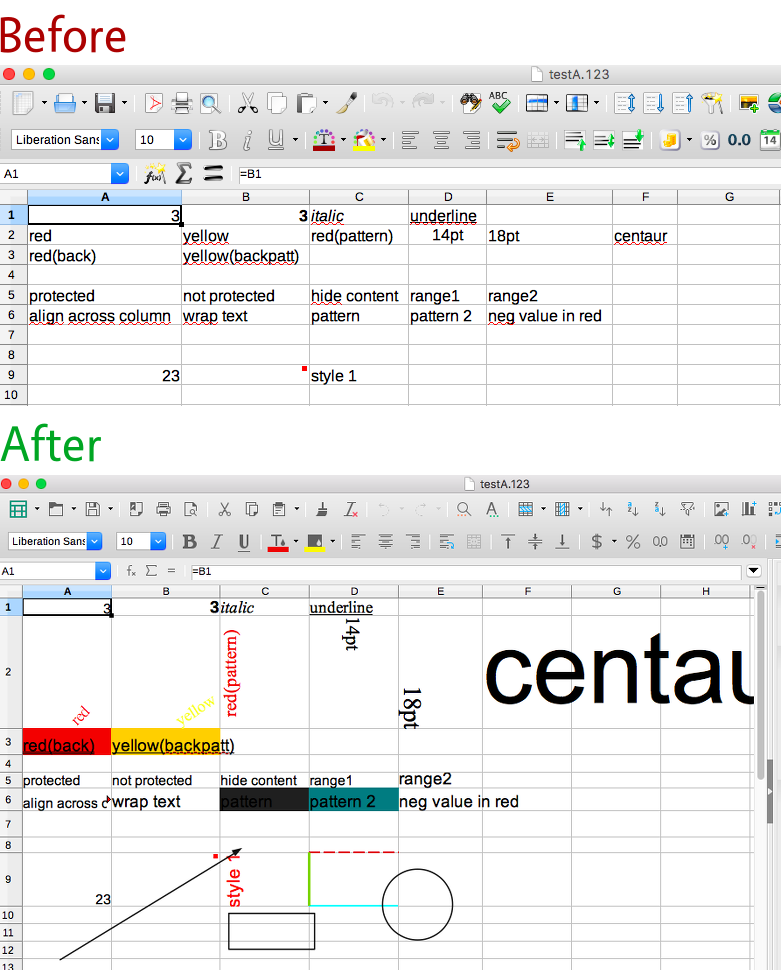
Meanwhile, DLP developer Laurent Alonso sent us this great before-and-after picture, showing recent improvements to the import of Lotus 123 spreadsheets. At the top you can see a Lotus 123 file (that contains lots of formatting) being displayed in LibreOffice 5.3 – but the formatting is missing. Thanks to improvements in DLP libraries, though, LibreOffice 5.4 can read and display the spreadsheet much more accurately, as you can see underneath (click for bigger):
The DLP community appreciates all contributions, and even if you’re not a coder, there are many ways to help – such as documenting file formats, or preparing sample documents. To learn more about DLP, check out our short video:
Please confirm that you want to play a YouTube video. By accepting, you will be accessing content from YouTube, a service provided by an external third party.
Thanks to donations to The Document Foundation, along with valued contributions from our community, we maintain a small team working on various aspects of LibreOffice including documentation, user interface design, quality assurance, release engineering and marketing. Together with Italo Vignoli, I help with the latter, and today I’ll summarise some of the achievements so far in 2017.
Videos
The year started off with preparations for LibreOffice 5.3, a major release that arrived on February 1st. We’ve found that videos are a great way to demonstrate new features to end users – and news websites often embed them as well. So I created a series of New Features videos for LibreOffice 5.3 covering the suite as a whole, along with Writer, Calc and Impress. So far they’ve had over 150,000 views in total:
Please confirm that you want to play a YouTube video. By accepting, you will be accessing content from YouTube, a service provided by an external third party.
If you accept this notice, your choice will be saved and the page will refresh.
I also coordinated script translations from our diligent localisation community, so that the videos had subtitles in 17 different languages. Thanks to everyone who helped!
Around the same time, FOSDEM took place in Brussels, and I used the opportunity to record video interviews with various people involved in The Document Foundation. If you want to learn more about how TDF works, and what you can do to help the project, check out this playlist:
Please confirm that you want to play a YouTube video. By accepting, you will be accessing content from YouTube, a service provided by an external third party.
In May, we had another Month of LibreOffice, celebrating contributions from right across the project. But this time we awarded printed stickers to everyone who took part:
Over 300 contributors won stickers, and we gathered together some photos showing them in action on laptops, PCs, and even a bike!
Regarding events, I attended the MuvGoc ’17 BarCamp in Munich together with Thorsten Behrens. We discussed removing barriers in the digital world, and the relationship between open data and open source. See here for the write-up.
From 23 – 25 of June, I helped to organise a German LibreOffice community meeting in Berlin. We talked about various topics, including ways to bring in new contributors and link different parts of the project and community together – see here for the details (German version).
Website, blog and infrastructure
The LibreOffice download page was due for a facelift, so I worked with Christian Lohmaier (Cloph) on a new design: this makes the download button more prominent, provides better and clearer information, and is generally more pleasant to look at. Similarly, we worked on a restructured donate page, making it significantly simpler and more user-friendly than the previous version.
Meanwhile, I created a new Frequently Asked Questions page on the site, to handle some of the queries TDF receives every day. Community members can point users to these answers where necessary, and discuss them further on Ask LibreOffice.
Various LibreOffice-related events around the globe have taken place since the start of the year, and I collected information about them and wrote a short report. In addition, I summarised various updates from the Document Liberation Project.
If you haven’t seen TDF’s 2016 Annual Report yet, check out out – the TDF team worked together to write it and translate it into German.
Infrastructure-wise, Guilhem Moulin and I set up a new Nextcloud instance for community members to host and share data. We also moved the events calendar to Nextcloud as well.
LibreOffice timeline and LibreOffice 5.4
LibreOffice has a rich history behind it, starting with StarOffice in the 1990s and being open sourced as OpenOffice.org in 2000. To showcase many of the important steps along the way, we worked on a LibreOffice timeline on the website. Along with new versions of the suite, you can see news of major LibreOffice migrations and events that took place.
In August, TDF welcomed a new Development Mentor, Teodor Mircea Ionita (aka Shinnok). I worked with him to examine the state of our build system documentation, to see how we can make it friendlier for new developers – here’s my report.
Finally, for LibreOffice 5.4 I created another New Features video – and again, our localisation communities did a great job providing subtitle translations:
Please confirm that you want to play a YouTube video. By accepting, you will be accessing content from YouTube, a service provided by an external third party.
If you accept this notice, your choice will be saved and the page will refresh.
So that’s the progress so far this year – but there’s more to come, with the LibreOffice Conference in October, another Month of LibreOffice in November, and preparations for LibreOffice 6.0 – which is due to be released early next year!
LibreOffice’s development community has been growing steadily for seven years, thanks to the great enthusiasm demonstrated by several core members. They have mentored an entirely new generation of LibreOffice developers, also thanks to Hackfests and other face-to-face meeting opportunities such as FOSDEM and the LibreOffice Conference.
After seven years is now the right time to start thinking about the new generation of Hackfests. For several reasons, their number has decreased over the last couple of years, and they have never really gone beyond European borders (even with core developers flying over the Atlantic to attract potential new developers).
Bjoern Michaelsen will be hosting a conference call to discuss HackFests “The New Generation” on Sunday, September 17, at 4:30PM CEST (Berlin time, or UTC +2). Everyone interested is warmly invited to participate, especially from LibreOffice native language communities around the world.
If you cannot connect, make your voice heard by sending a couple of ideas by email to the Projects mailing list: projects@global.libreoffice.org.

 Berlin, September 26, 2017 – The Document Foundation (TDF) announced today that Kopano, the leading European provider of open source groupware and collaboration software, has joined the project’s Advisory Board. Kopano wants to contribute to the project in areas of its expertise, for example in user experience.
 Thanks to