TDF Annual Report 2019

The Annual Report of The Document Foundation for the year 2019 is now available in PDF format from TDF Nextcloud in two different versions: low resolution (6.4MB) and high resolution (53.2MB). The annual report is based on the German version presented to the authorities in April.

The 54 page document has been entirely created with free open source software: written contents have obviously been developed with LibreOffice Writer (desktop) and collaboratively modified with LibreOffice Writer (online), charts have been created with LibreOffice Calc and prepared for publishing with LibreOffice Draw, drawings and tables have been developed or modified (from legacy PDF originals) with LibreOffice Draw, images have been prepared for publishing with GIMP, and the layout has been created with Scribus based on the existing templates.

All pictures are licensed under the Creative Commons Attribution-Share Alike 4.0 License, courtesy of TDF Members from Albania, Brasil, Czech Republic, Germany, Italy, Japan, Nepal, Paraguay, Taiwan, Uganda and Turkey. Stock photos are CC0 by Pixabay.

Lothar Becker, Chairman of TDF Board of Directors, has written in the welcome address:

What we have achieved so far goes beyond the most optimistic forecasts of the project’s founders back in 2010. After ten years, the challenge is still to further grow the project by leveraging the contributions of both volunteers and ecosystem members, engage new enthusiastic supporters in both areas, and increase the number of happy users worldwide. Our manifesto, the vision behind all our work, has to evolve in a new era of office productivity, with versions of LibreOffice on the desktop, in the cloud and on mobile devices!

I look forward to another great year for our global community, even with the current challenge of lockdowns in many locations, and the lack of in-person meetings and events because of the pandemic. I’m proud, honored and humbled to be part of this amazing project, and invite you all to keep on contributing to it in one of the many possible ways, and have fun together while achieving our common dream!

Announcement of LibreOffice 7.0

LibreOffice 7.0: the new major release of the best FOSS office suite ever is available on all OSes and platforms, and provides significant new features

Berlin, August 5, 2020 – The LibreOffice Project announces the availability of LibreOffice 7.0, a new major release providing significant new features: support for OpenDocument Format (ODF) 1.3; Skia graphics engine and Vulkan GPU-based acceleration for better performance; and carefully improved compatibility with DOCX, XLSX and PPTX files.

  • Support for ODF 1.3. OpenDocument, LibreOffice’s native open and standardised format for office documents, has recently been updated to version 1.3 as an OASIS Technical Committee Specification. The most important new features are digital signatures for documents and OpenPGP-based encryption of XML documents, with improvements in areas such as change tracking, and additional details in the description of elements in first pages, text, numbers and charts. The development of ODF 1.3 features has been funded by donations to The Document Foundation.
  • Skia graphics engine and Vulkan GPU-based acceleration. The Skia graphics engine has been implemented thanks to sponsorship by AMD, and is now the default on Windows, for faster performance. Skia is an open source 2D graphics library which provides common APIs that work across a variety of hardware and software platforms, and can be used for drawing text, shapes and images. Vulkan is a new-generation graphics and compute API with high-efficiency and cross-platform access to modern GPUs.
  • Better compatibility with DOCX, XLSX and PPTX files. DOCX now saves in native 2013/2016/2019 mode, instead of 2007 compatibility mode, to improve interoperability with multiple versions of MS Office, based on the same Microsoft approach. Export to XLSX files with sheet names longer than 31 characters is now possible, along with exporting checkboxes in XLSX. The “invalid content error” message was resolved when opening exported XLSX files with shapes. Finally, there were improvements to the PPTX import/export filter.
    LibreOffice offers the highest level of compatibility in the office suite arena, starting from native support for the OpenDocument Format (ODF) – with better security and interoperability features over proprietary formats – to almost perfect support for DOCX, XLSX and PPTX files. In addition, LibreOffice includes filters for many legacy document formats, and as such is the best interoperability tool in the market.

Summary of Other New Features [1]

GENERAL

  • New icon theme, the default on macOS: Sukapura
  • New shapes galleries: arrows, diagrams, icons and more…
  • Glow and soft edge effects for objects

WRITER

  • Navigator is easier to use, with more context menus
  • Semi-transparent text is now supported
  • Bookmarks can now be displayed in-line in text
  • Padded numbering in lists, for consistency
  • Better handling of quotation marks and apostrophes

CALC

  • New functions for non-volatile random number generation
  • Keyboard shortcut added for autosum

IMPRESS & DRAW

  • Semi-transparent text is supported here too
  • Subscripts now return to the default of 8%
  • PDFs larger than 500 cm can now be generated

LibreOffice Technology

LibreOffice 7.0’s new features have been developed by a large community of code contributors: 74% of commits are from developers employed by companies sitting in the Advisory Board, such as Collabora, Red Hat and CIB, plus several other organizations, and 26% are from individual volunteers.

In addition, there is a global community of individual volunteers taking care of other fundamental activities, such as quality assurance, software localization, user interface design and user experience, editing of help content and documentation, along with free software and open document standards advocacy.

A video summarizing the top new features in LibreOffice 7.0 is available on YouTube: https://www.youtube.com/watch?v=XusjjbBm81s and also on PeerTube: https://tdf.io/lo70peertube

Products based on LibreOffice Technology are available for all major desktop operating systems (Windows, macOS, Linux and ChromeOS), for the cloud and for mobile platforms. They are released by The Document Foundation, and by ecosystem companies contributing to software development.

LibreOffice for End Users

LibreOffice 7.0 represents the bleeding edge in term of features for open source office suites, and as such is targeted at technology enthusiasts, early adopters and power users. The Document Foundation does not provide any technical support for users, although they can get help from other users on mailing lists and the Ask LibreOffice website: https://ask.libreoffice.org

For users whose main objective is personal productivity and therefore prefer a release that has undergone more testing and bug fixing over the new features, The Document Foundation maintains the LibreOffice 6.4 family, which includes some months of back-ported fixes. The current version is LibreOffice 6.4.5.

LibreOffice in Business

For enterprise-class deployments, TDF strongly recommends sourcing LibreOffice from one of the ecosystem partners, to get long-term supported releases, dedicated assistance, custom new features and other benefits, including SLA (Service Level Agreements): https://www.libreoffice.org/download/libreoffice-in-business/. The work done by ecosystem partners is an integral part of LibreOffice Technology.

For migrations from proprietary office suites and training, professional support should be sourced from certified professionals who provide value-added services which extend the reach of the community to the corporate world, and offer CIOs and IT managers a solution in line with proprietary offerings. Reference page: https://www.libreoffice.org/get-help/professional-support/.

In fact, LibreOffice – thanks to its mature codebase, rich feature set, strong support for open standards, excellent compatibility and long-term support options from certified partners – represents the ideal solution for businesses that want to regain control of their data and free themselves from vendor lock-in.

Availability of LibreOffice 7.0

LibreOffice 7.0 is immediately available from the following link: https://www.libreoffice.org/download/. Minimum requirements for proprietary operating systems are Microsoft Windows 7 SP1 and Apple macOS 10.12. Builds of the latest LibreOffice Online source code are available as Docker images from TDF: https://hub.docker.com/r/libreoffice/online/

LibreOffice Technology based products for Android and iOS are listed here: https://www.libreoffice.org/download/android-and-ios/, while for App Stores and ChromeOS are listed here: https://www.libreoffice.org/download/libreoffice-from-microsoft-and-mac-app-stores/

LibreOffice users, free software advocates and community members can support The Document Foundation with a donation at https://www.libreoffice.org/donate

LibreOffice 7.0 is built with document conversion libraries from the Document Liberation Project: https://www.documentliberation.org

[1] A more comprehensive list of LibreOffice 7.0 new features is available on the Release Notes wiki page: https://wiki.documentfoundation.org/ReleaseNotes/7.0

Press Kit

The press kit with press release and high-resolution images and screenshots, is available here: https://tdf.io/lo70presskit

50 Open Badges awarded for top LibreOffice translators!

A few months ago, we announced Open Badges for LibreOffice contributors. These are custom images with embedded metadata, awarded to our most active community members to say thanks for their great work!

The metadata describes the contributor’s work, and the badge can be verified using an external service. Open Badges are used by other free software projects, such as Fedora.

Anyway, today we’re awarding 50 Open Badges to the most active members in our localisation community, based on Weblate activity so far this year. Congratulations to everyone who got a badge – we’ve emailed it to you! Here’s the list of winners:

  • Joan Montané
  • Adam Rak
  • jwtiyar ali nariman
  • Paul Roos
  • Mihkel Tõnnov
  • Modestas Rimkus
  • Adolfo Jayme Barrientos
  • Donald Rogers
  • Valter Mura
  • eglejasu
  • Stanislav Horáček
  • Asier Sarasua Garmendia
  • Kolbjørn Stuestøl
  • Dimitris Spingos
  • Xosé
  • Tolmantas
  • Andika Triwidada
  • Baurzhan Muftakhidinov
  • Mihail Balabanov
  • tmtfx
  • Còdaze Veneto
  • Cheng-Chia Tseng
  • Karl Morten Ramberg
  • Christian Kühl
  • Stuart Swales
  • Ming Hua
  • Tuomas Hietala
  • Bachka
  • Andreas Pettersson
  • Yaron Shahrabani
  • Євген Кондратюк
  • Sérgio Marques
  • Jean-Baptiste Faure
  • Jørgen Madsen
  • Michael Wolf
  • gpopac
  • Ayhan YALÇINSOY
  • Miloš Šrámek
  • Milo Ivir
  • Ingmārs Dīriņš
  • Xuacu Saturio
  • Xandru Martino Ruz
  • kees538
  • Rhoslyn Prys
  • Khairul Aizat Kamarudzzaman
  • SteenRønnow
  • Sveinn í Felli
  • Jeanmi2403
  • kompilainenn
  • vpanter

We’ll be issuing more badges in the coming months, so stay tuned to the blog for more…

LibreOffice monthly recap: July 2020 – News, events and more…

Here’s our summary of updates, events and activities in the LibreOffice project in the last four weeks – click the links to learn more…

  • At the start of the month, we announced a Bug Hunting Session for LibreOffice 7.0 RC1. Yes, the next major release is just around the corner! You can still help us to test it before the official announcement, which is due next week…

  • But we’re still maintaining the LibreOffice 6.4 branch, and on July 2, we announced LibreOffice 6.4.5. It includes over 100 bug fixes and improvements to document compatibility and interoperability with software from other vendors.
  • In recent months, TDF and the community have been discussing marketing plans for the next five years. How can we keep the LibreOffice project sustainable in the long term? Volunteers are a huge part of the project and we’re immensely grateful for them, but companies in the ecosystem also write the majority of the source code to implement new features, so it’s important that they prosper too. See the first update and second update.
  • On July 13, we talked to Khairul Aizat Kamarudzzaman about his work in the LibreOffice community, helping with advocacy and marketing. He recently decided to become a Member of The Document Foundation – welcome on board!

  • Speaking of Members, TDF’s Membership Committee has elections coming up. The mission of the Committee is to administer membership applications and renewals following the criteria defined in the Foundation’s Statutes.

  • July 19 marked 20 years of free and open source office suites, as Sun Microsystems announced on July 19 2000 that StarOffice, which it recently acquired, would become free and open source software. This, of course, became OpenOffice, and lives on today in the form of LibreOffice, the most active and developed successor project.

  • With the ongoing coronavirus pandemic, many communities are meeting online, such as the Spanish-speaking LibreOffice community. They had a live broadcast with a series of talks, over six hours, covering translations, migrations and LibreOffice Online.

  • The joint openSUSE + LibreOffice conference will take place in October, and we’ve extended the Call for Papers until August 4. Join us, give a talk about your favourite topic, and let’s share knowledge together!

  • Lastly, we talked to Sandra Louvezo, another new TDF Member, about her experiences in the LibreOffice community in Congo. A big thanks to Sandra, and everyone in our growing LibreOffice communities in Africa, for all their great work.

Keep in touch – follow us on Twitter, Facebook and Mastodon. Like what we do? Support our community with a donation – or join us and help to make LibreOffice even better for everyone!

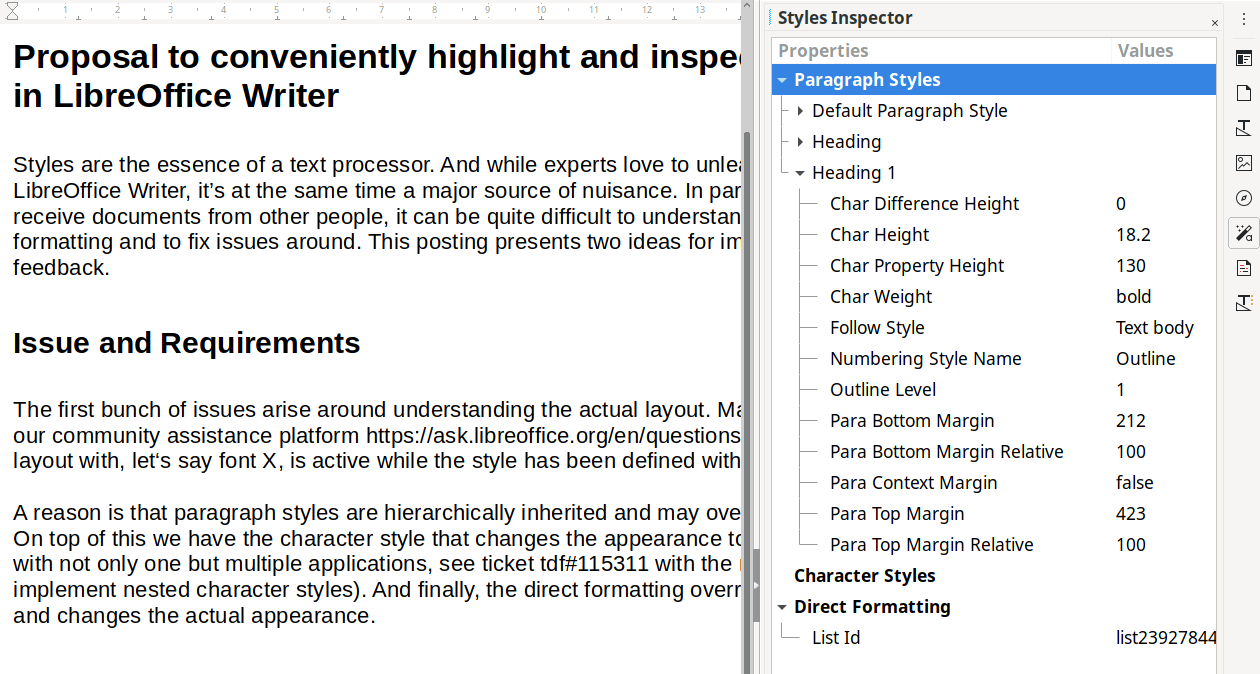
Tender for implementing support for a dedicated, built-in UNO object inspection tool in LibreOffice (#202007-02)

The Document Foundation (TDF) is the charitable entity behind the world’s leading free/libre open source (FLOSS) office suite LibreOffice.

We are looking for an individual or company to implement support for a dedicated, built-in UNO object inspection tool in LibreOffice, to start work as soon as possible.

In order to make working with UNO objects easier and to avoid the need to always install extensions before debugging, it is necessary to be able to inspect UNO objects in a running LibreOffice instance effectively.

This task involves reading the existing Basic IDE Watch code, evaluating how it can be improved based on ideas implemented in external tools like xray and MRI and extending the Watch code to be a first-class inspector that allows focusing the relevant part of the UNO API for opened documents and also based on your current selection (similar to what is possible in web browsers).

A good part of the features are implemented already. Work carried out under this tender will therefore mostly consist in making the features more accessible and more stable, adjusting the UI and refactoring things.

The work has to be developed on LibreOffice master, so it can get released in the next major version.


The following required features need to be implemented:

  • Dockable toolbar that can appear at the bottom of a document frame, similar to find-bar.
  • Left-hand side of the toolbar exposes a snapshot of a useful subset of the DOM as a tree view: Writer paragraphs, Calc sheets, Impress slides
    • This tree widget should populate its content on-demand whenever possible in order to ensure performance.
  • Point&click inspect mode (similar to F12 in Chrome): combine Help -> What’s this (point on something & then an action) and normal selection, so it’s possible to point on something (e.g. an image), make it the current selection and automatically launch DevTools on it. Perhaps rename ‘DevTools’ to something else.

    Note that this is mostly UI work, ThisComponent.CurrentController.Selection in Basic already gives access to the current selection in a not-so-convenient way.

  • Right-hand side: show details in a table about the current selected item in the “DOM tree-view”, which is implemented as part of the watch window in the Basic IDE:
    • object’s UNO properties
    • object methods
    • supported services and interfaces
  • User documentation for the new dialog is mandatory.
  • Brief developer documentation for the newly introduced classes is required.
  • Whenever adding new functionality, it should be considered if it’s possible to test the functionality with automated tests with reasonable amount of effort.

The following are optional features:

  • Configuration support: remember which tabpage was open last time (properties, methods, etc.)
    • Remember sorting settings (prioritize paragraphs/sheets/slides and other relevant properties or sort alphabetically)
  • Click on value for details: primitive types
    • This is useful if the user selected lots of text for inspection, we can’t show all the content in a table cell, but can if a multi-line edit replaces the table widget.
  • Click on value for details: re-launch DevTools on a sub-object on the right-hand side. This is already handled to a large degree in the existing watch variable code, which represents the object already as a tree.
    • This allows recursion: double-click on a value with a complex type, which has its own properties, methods, etc -> inspect it.
  • Show implementation name of object
    • If a consistent name is provided by the object, this can allow jumping to the relevant C++ code from DevTools easily.
  • Copy&paste support:
    • Normally content of a table in a widget is not easily copy&paste-able. It can help debugging if add explicit support to copy the table content still, e.g. all property names and their primitive values.
  • Improved presentation of the DOM for Writer/Calc/Impress:
    • The inspector tool could be just a generic presenter for any UNO object, but in practice macro and extension authors are interested in a subset of the extremely rich and generic API we provide.
    • The idea is to select a few key properties for each component, so it’s trivial for the user to see how to access the most important details of a document:
      • Writer: style families, paragraph list, text portion list, etc.
      • Calc: sheets, columns, cells, named ranges, etc.
      • Impress: slides, shapes, etc.

Required skills

  • Extensive knowledge of C++
  • Experience working on the LibreOffice source code
  • Knowledge of UNO

Other skills

  • English (conversationally fluent in order to coordinate and plan with members of TDF)

We use free, libre and open source (FLOSS) software for development wherever possible, and the resulting work must be licensed under the Mozilla Public License v2.0.

TDF welcomes applications from all suitably qualified persons regardless of their race, sex, disability, religion/belief, sexual orientation or age.

Bidders will get a preference for including a partner or independent developer who has not been involved in a successful tender before.

As always, TDF will give some preference to individuals who have previously shown a commitment to TDF, including but not limited to certified developers and/or members of TDF. Not being a member, or never having contributed before, does not exclude any applicants from consideration.
Further discussions on this tender took place on the public board discussion mailing list of The Document Foundation.

The task offered is a project-based one-off, with no immediate plans to a mid- or long-term contractual relationship. It is offered on a freelance, project basis. Individuals and companies applying can be located anywhere in the world.

When budgeting, we anticipated that this project (incl. optional tasks) to take in the region of 60 days of work. Bidders are free to bid on the required features only. Bidders who bid on both the required and optional features are asked to provide a breakdown in terms of costs for each.

TDF is looking forward to receiving your applications for one or more of the aforementioned tasks, your financial expectations and the earliest date of your availability, via e-mail to a committee at tender20200702@documentfoundation.org no later than September 1, 2020.

Applicants who have not received feedback by October 15, 2020 should consider that their application, after careful review, was not accepted.

Community Member Monday: Sandra Louvezo

Today we’re talking to Sandra Louvezo, who is helping to spread the word about LibreOffice and FOSS in Congo. Also, she recently became a Member of The Document Foundation, the non-profit entity behind LibreOffice…

To start with, tell us a bit about yourself!

I was born on August 31, 1984 in Pointe-Noire, the economic capital of Congo-Brazzaville. I achieved a BAC+3 in Human Resources Attaché at the Magrebin Institute of Science and Technology in Tunis, Tunisia (IMSET) in 2008.

Then I returned to Congo in 2009, where I worked for five years in local companies as an Accounting Assistant – Claims Writer – Head of Life and Health Insurance services at the Huet de Baroquer group, under the H branch in B Congo Insurance. Then I was Director of Human Resources in a service subsidiary and provision of Health, Safety and Environment (HSE) staff for two years.

For the past two years, until now, I have started my own business as a motivational and personal development coach, as well as a nutritional coach and caterer.

What are you working on in the LibreOffice project right now?

In Pointe-Noire I belong to a community called “Librists”. Our goal is to help people discover the world of open source software here in Congo – which very few people know about. I am responsible for training people to use the LibreOffice suite, and we have named the training “SPRINT”, which lasts 60 days per component starting from Writer, Calc, Impress etc.

The aim of this sprint is to help users learn the applications, and get their comments, to then bring back to the LibreOffice Francophone community, to which I also belong. Then we can continue to improve LibreOffice.

Why did you decide to become a member of TDF?

I decided to become a member in order to raise awareness, mobilize people, and bring LibreOffice to my country and Africa in general. Discovering LibreOffice and open source was a delight for me, and I want to teach others this life lesson: contribute back to open source, and help make the world a better place.

Anything else you plan to do in the future?

I am training to prepare the next SPRINT, which will start from the end of July to the beginning of August 2020 in several African countries such as: Congo Brazzaville, Cameroon, the Democratic Republic of Congo, Togo, Senegal and Benign. For 60 days, users will learn to use and discover LibreOffice Writer in the form of exercises, and the answers will be returned at the end of ech day.

The goal is to be present, so that each African country discovers LibreOffice and builds a mini community around it, before we start to offer the application to the different companies that have everything to gain from using it.

Thanks to Sandra for all her contributions! Our native language communities are always open for more help – so if you want LibreOffice and its website localised in your language, give us a hand!