Coming up on December 22: Bug Hunting Session for LibreOffice 6.0 RC1

2017 is coming to a close, but our community is still busy preparing for the release of LibreOffice 6.0, which is due in late January 2018. Many new features have been added to this version, and to make it as reliable as possible, we want your help!

On December 22 we will have an international Bug Hunting Session (BHS), testing the RC1 (first release candidate) of LibreOffice 6.0. You can download, try out and test this RC1 version – and if you spot any bugs, let our QA (Quality Assurance) community know.

Mentors will be available to help you file bugs from 11:00 UTC to 15:00 UTC on that day. All assistance is greatly appreciated – together we can make LibreOffice 6.0 the best release ever, for millions of people around the world! For full details on the Bug Hunting Session, and how to get involved, see our wiki:

Click here for full details about the Bug Hunting Session

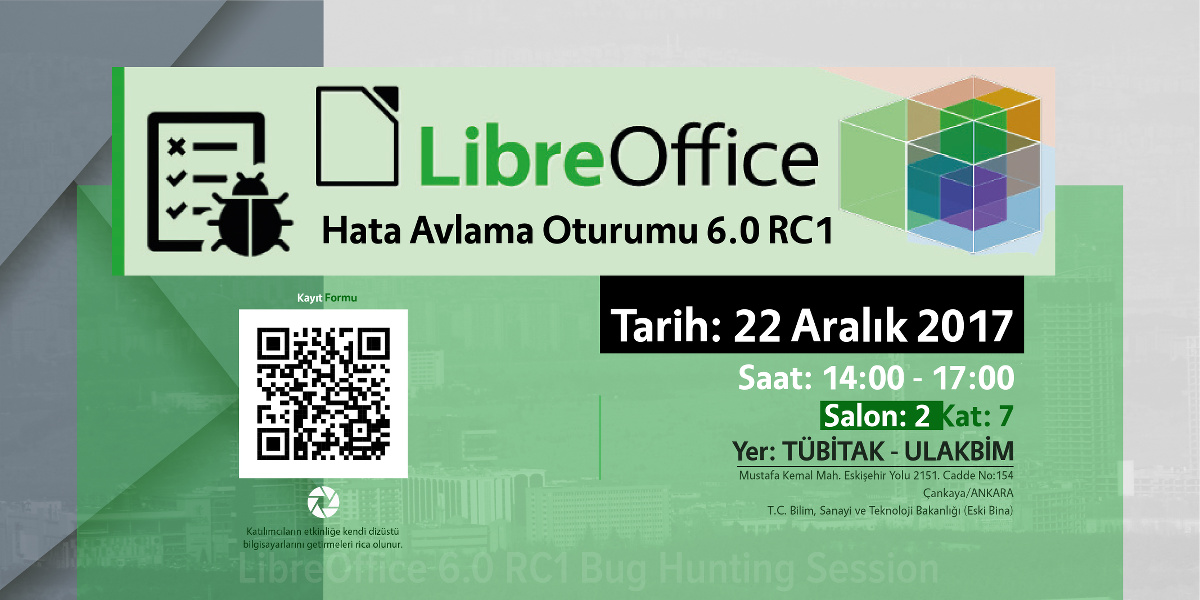
In addition, there will be a local event in Ankara, organised by the Turkish LibreOffice community. Here are the details:

  • Date: Dec 22 Friday
  • Time: 14:00-17:00 (UTC+3)
  • Location: TUBITAK ULAKBIM, 7th Floor, Meeting Room 2
  • Registration form: https://goo.gl/forms/paVTg3ExZDn0Oytj1
  • Attendees will bring their own laptops. Registration until Thursday 17:00 (UTC+3) is required. There will be snacks, tea, and some swag!

Second Bug Hunting Session for LibreOffice 6.0

After the first Bug Hunting Session for LibreOffice 6.0, which was held on October 20th 2017, we’re glad to announce the Second Bug Hunting Session on November 27th – this time being held on a Monday, for the first time!

LibreOffice 6.0 will be announced at the end of January 2018, and so far, almost 800 bugs have been fixed in this version, with more than 700 people reporting, triaging or fixing those bugs. More info can be found here. Besides that, a large number of new features, which are summarized in the release notes, have been added.

In order to find, report and triage bugs, the tests during the Second Bug Hunting Session will be performed on the first Beta version of LibreOffice 6.0, which will be available on the pre-releases server a few days before the event. Builds will be available for Linux (DEB and RPM), macOS and Windows, and will run in parallel with the production version.

Mentors will be available on November 27th 2017, from 8AM UTC to 10PM UTC for questions or help in the IRC channel: #libreoffice-qa (connect via webchat). Of course, hunting bugs will be possible also on other days, as the builds of this particular Beta release (LibreOffice 6.0.0 Beta1) will be available until mid December.

And it’s still the Month of LibreOffice!

Throughout November we’ve been running a Month of LibreOffice, awarding cool stickers to contributors across the project. The Bug Hunting Session is your chance to get a sticker for your laptop or PC – so get involved and help us make LibreOffice 6.0 the best release yet! See here for more about the Month of LibreOffice.

And there’s more information about how to hunt bugs in LibreOffice 6.0 Beta1 in this wiki page.

Coming up on Friday: first Bug Hunting Session for LibreOffice 6.0 Alpha 1

The LibreOffice community has returned from a great conference in Rome (more on that later this week), and we’re now working eagerly on LibreOffice 6.0, which is due to be released at the end of January 2018. This version will include a large number of new features – and those already implemented are summarised on the release notes page.

In order to find, report and triage bugs, the LibreOffice QA team is organizing the first Bug Hunting Session on Friday October 20, 2017. Tests will be performed on the first Alpha version of LibreOffice 6.0, which will be available on the pre-releases server a few days before the event. Builds will be available for Linux (DEB and RPM), macOS and Windows, and will run in parallel with the production version.

Mentors will be available from 08:00 UTC to 22:00 UTC. Of course, hunting bugs will be possible also on other days, as the builds of this particular Alpha release (LibreOffice 6.0.0 Alpha 1) will be available until mid November.

During the day there will be two dedicated sessions: the first to chase bugs on the main LibreOffice modules between 15:00 UTC and 17:00 UTC, and the second to test a set of the top 5 features between 17:00 UTC and 19:00 UTC. All details of the second bug hunting session are available on the wiki.

During the dedicated sessions, we will concentrate our efforts to chase and reproduce bugs, in order to confirm and file them in a more comprehensive way. Of course, the more comprehensive the bug report, the easier it will be for developers to solve the bugs in time for the final release. Thanks in advance for your help, and we look forward to your input!

Surpassed the 40,000 closed bugs milestone

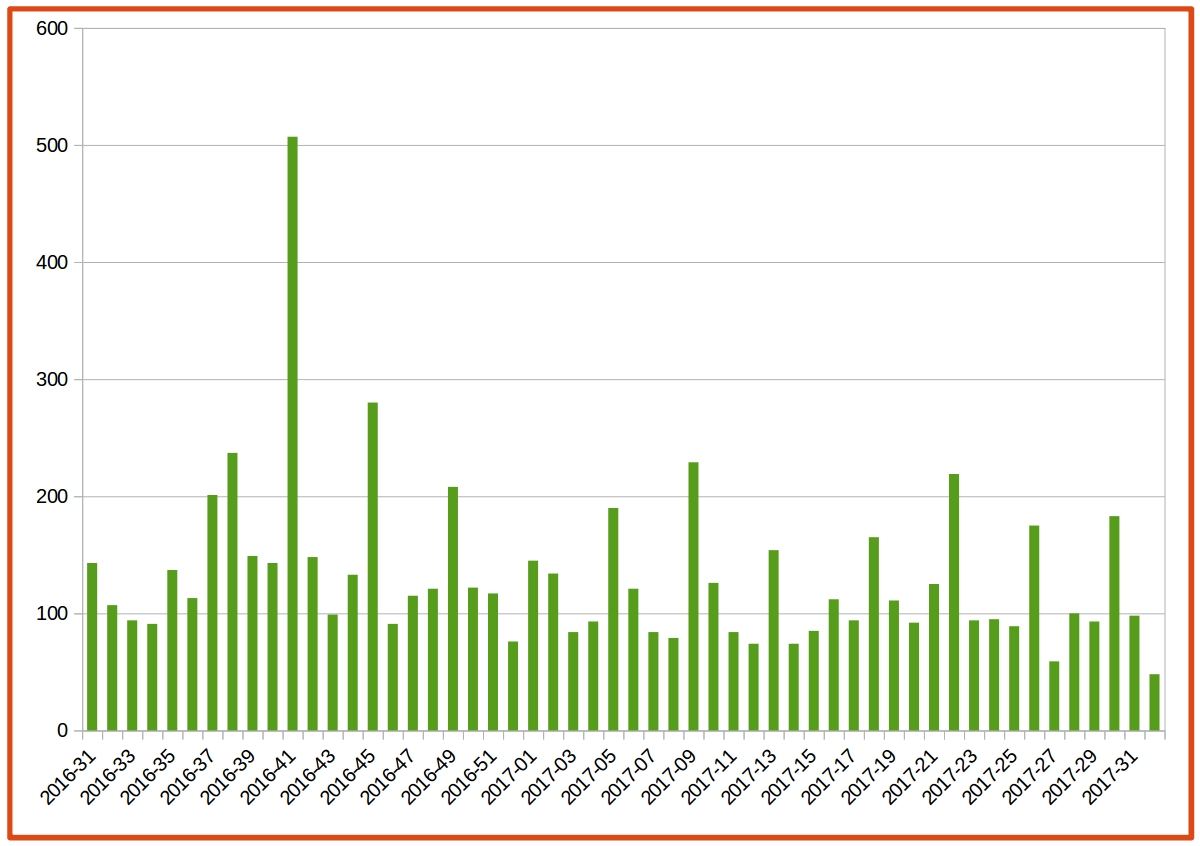
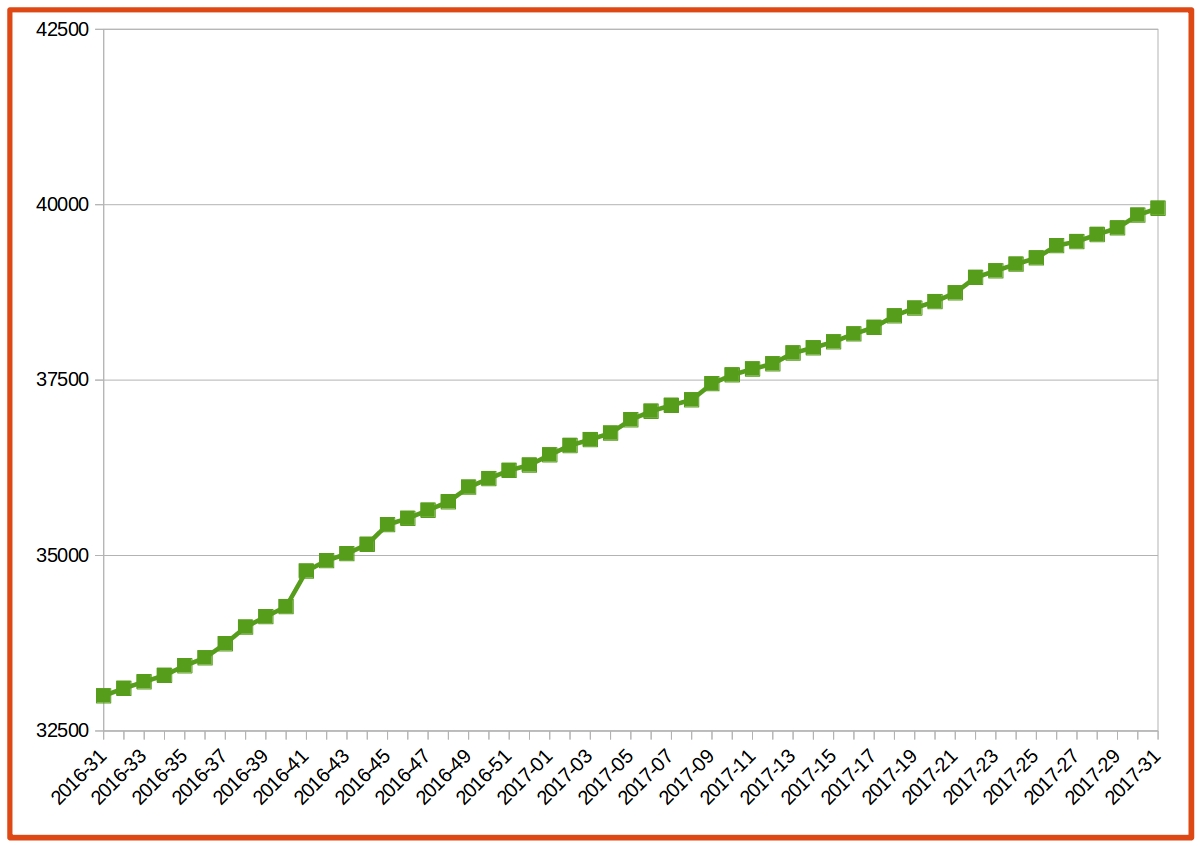
As Tommy kindly mentioned on the QA mailing list, this week the LibreOffice project has surpassed the 40,000 resolved bugs milestone – a huge achievement demonstrating the enormous amount of effort the community puts into software quality. If we take a look at the numbers from August 2016 (the month we started to collect data from Bugzilla) up to now, 7,143 bugs have been closed during this year, with an average of 133 bugs closed each week.

Let’s see some charts for the mentioned timeframe.

Number of bugs closed each week
Accumulative number of bugs closed
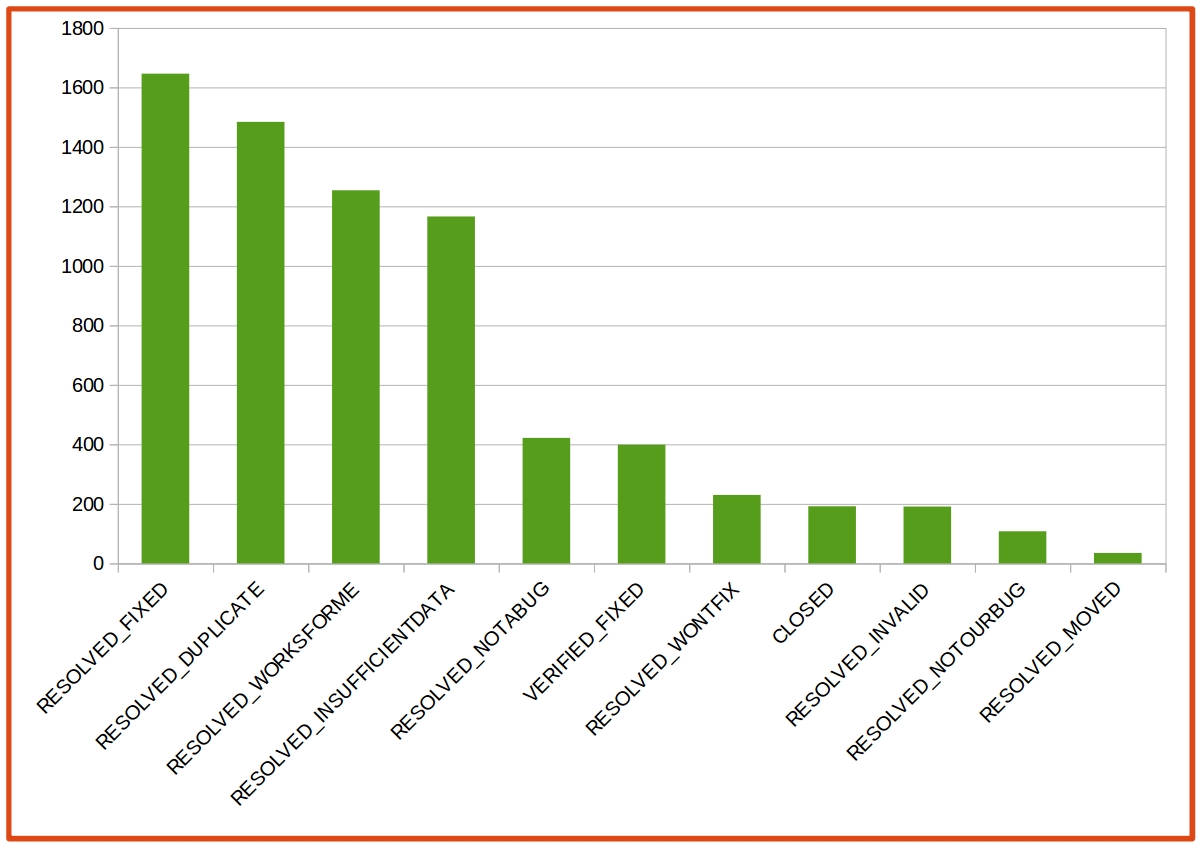
Statuses of the bugs closed

Get Involved!
So, you’ve seen what the QA team is doing across the LibreOffice project – why not get involved and help out? Even if you only have half an hour of spare time each week, by confirming bugs (and fixes) you can make LibreOffice better for millions of people around the world. And in addition, you build up valuable experience working with a large project and open source community – which could be very useful for a future career! Discover more about the QA team in our video interview with QA engineer Xisco Fauli.

(Notes about this blog post: raw data can be checked here. For more stats, visit the stats page in the QA wiki.)

LibreOffice Quality Assurance: six months in statistics (part 2)

This is the second part in our blog series about the LibreOffice QA (quality assurance) community – see here for the first part.

Regressions

During the six month period from 23 November 2016 to 21 May 2017, 553 bugs were identified as regressions by 61 people. This means a feature behaved correctly in the past – but a change in the code made it work incorrectly. This is an expected problem in any software project, especially when many changes to the code are done every day. For that reason it’s very important to determine whether a bug is a regression or not – and to identify regressions as soon as possible to maintain the quality of the software.

It’s also important to mention the tremendous amount of effort developers spend on adding new unit tests in order to avoid regressions from being introduced again. More information about that here.

Top 15 regression identifiers:

  1. Xisco Faulí (190)
  2. Buovjaga (81)
  3. Telesto (50)
  4. Áron Budea (35)
  5. Alex Thurgood (32)
  6. Justin L (11)
  7. Cor Nouws (11)
  8. tommy27 (11)
  9. Julien Nabet (9)
  10. Yousuf Philips (jay) (9)
  11. m.a.riosv (9)
  12. V Stuart Foote (7)
  13. Kevin Suo (6)
  14. Luke (6)
  15. Jacques Guilleron (6)

These are the statuses of the bugs identified as regressions:
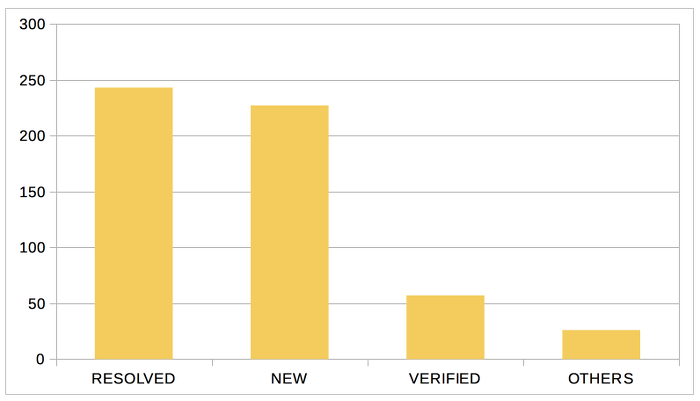
More than half of these bugs have been RESOLVED (243), or resolved and VERIFIED (57) – 54.2% to be exact.

Bisected

Once we identify that a bug is a regression, we can use a tool called bibisect to identify at which point the regression was introduced, allowing us to speed up the process of fixing the bug.

During the last 6 months, 346 bugs have been bisected by 14 people.

Top 14 ‘bisecters’:

  1. Xisco Faulí (186)
  2. Áron Budea (77)
  3. raal (50)
  4. Justin L (10)
  5. Terrence Enger (6)
  6. Michael Stahl (4)
  7. Mike Kaganski (4)
  8. Miklos Vajna (3)
  9. Buovjaga (1)
  10. Kevin Suo (1)
  11. Luke (1)
  12. Jean-Baptiste Faure (1)
  13. Caolán McNamara (1)
  14. Katarina Behrens (1)

And these are the statuses of the bugs bisected:
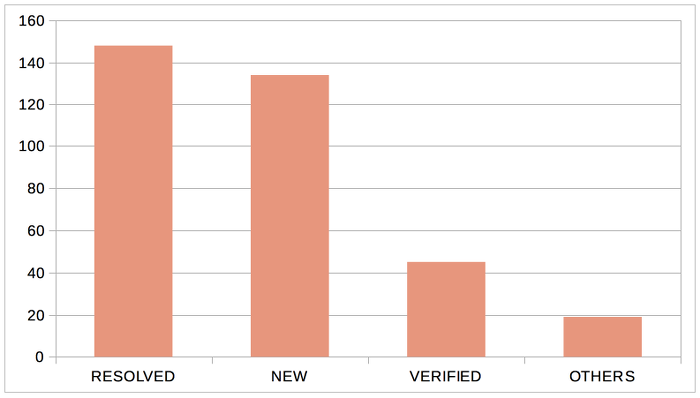
Of the bisected bugs, 55.7% are either RESOLVED (148), or resolved and VERIFIED (45).

Backtraces

Another way to accelerate the fixing process is by providing a debug trace when there’s a crash, slowness or a freeze in the software.

During the last 6 months, a debug trace has been added to 140 bugs by 14 people.

Top 13 debug trace providers:

  1. Julien Nabet (48)
  2. Xisco Faulí (35)
  3. Buovjaga (28)
  4. fiftyigfuci_f_mi (10)
  5. Alex Thurgood (6)
  6. V Stuart Foote (4)
  7. Áron Budea (4)
  8. Telesto (3)
  9. Terrence Enger (3)
  10. Yousuf Philips (jay) (2)
  11. JoNi (2)
  12. Kevin Suo (1)
  13. Cor Nouws (1)

These are the statuses of the bugs with a debug trace:
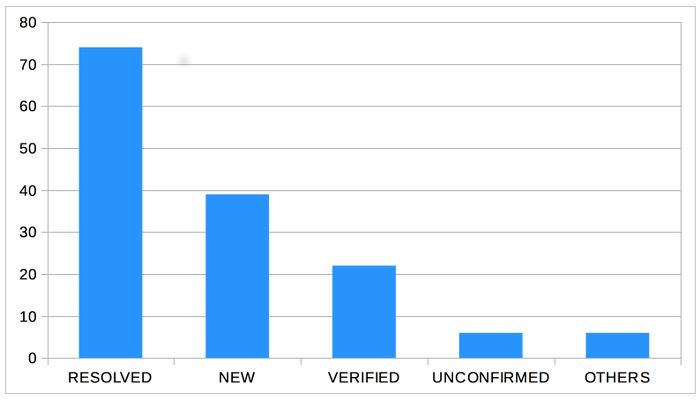
More than two-thirds of these bugs have been RESOLVED (74), or resolved and VERIFIED (22) – 69.4% to be exact.

Duplicate bugs

Knowing that many bugs are reported everyday, it’s important to identify if a certain bug was reported previously and therefore whether it’s a duplicate or has never been reported before.
During the last six months, 757 bugs have been identified as duplicates by 91 people.

Top 20 duplicate identifiers:

  1. Xisco Faulí (142)
  2. Buovjaga (116)
  3. V Stuart Foote (79)
  4. Áron Budea (40)
  5. Telesto (31)
  6. Alex Thurgood (28)
  7. m.a.riosv (27)
  8. Julien Nabet (26)
  9. Heiko Tietze (20)
  10. Timur (19)
  11. Khaled Hosny (18)
  12. Yousuf Philips (jay) (15)
  13. Maxim Monastirsky (14)
  14. Adolfo Jayme (13)
  15. Gábor Kelemen (11)
  16. Mike Kaganski (10)
  17. Cor Nouws (10)
  18. Jacques Guilleron (8)
  19. Bartosz (8)
  20. Regina Henschel (6)

Resolved bugs

The cornerstone of the project is its development work. During the six month period, 955 bugs were set to RESOLVED FIXED by 147 people.

Top 20 fixers:

  1. Caolán McNamara (73)
  2. Miklos Vajna (53)
  3. Eike Rathke (41)
  4. Michael Stahl (39)
  5. Julien Nabet (38)
  6. Justin L (36)
  7. Adolfo Jayme (33)
  8. Heiko Tietze (29)
  9. Samuel Mehrbrodt (29)
  10. Xisco Faulí (26)
  11. Gábor Kelemen (25)
  12. Yousuf Philips (jay) (23)
  13. Maxim Monastirsky (22)
  14. Markus Mohrhard (22)
  15. V Stuart Foote (19)
  16. Zolnai Tamás (18)
  17. Mike Kaganski (18)
  18. Katarina Behrens (17)
  19. Khaled Hosny (16)
  20. Winfried Donkers (15)

Verified fixed bugs

Finally, once a bug has been fixed, it’s important to verify that it has indeed been fixed.

During the last six months, 212 fixes have been verified by 28 people.

Top 15 verifiers:

  1. Justin L (65)
  2. Xisco Faulí (24)
  3. Buovjaga (18)
  4. Timur (16)
  5. m.a.riosv (11)
  6. Julien Nabet (9)
  7. Heiko Tietze (7)
  8. Terrence Enger (7)
  9. Jean-Baptiste Faure (7)
  10. Thomas Lendo (6)
  11. Áron Budea (6)
  12. raal (4)
  13. Yousuf Philips (jay) (4)
  14. Cor Nouws (4)
  15. V Stuart Foote (3)
  16. Kevin Suo (3)
  17. Luke (3)
  18. Jacques Guilleron (3)
  19. Zineta (2)
  20. Alex Arnaud (2)

Get Involved!

So, you’ve seen what the QA team is doing across the LibreOffice project – why not get involved and help out? Even if you only have half an hour of spare time each week, by confirming bugs (and fixes) you can make LibreOffice better for millions of people around the world. And in addition, you build up valuable experience working with a large project and open source community – which could be very useful for a future career! Discover more about the QA team in our video interview with QA engineer Xisco Fauli.

(Notes about this blog post: raw data can be checked here. For more stats, visit the stats page in the QA wiki.)


Second Bug Hunting Session for LibreOffice 5.4

LibreOffice 5.4 will be announced at the end of July 2017, with a large number of new features which are summarized on the release notes page: https://wiki.documentfoundation.org/ReleaseNotes/5.4. In order to find, report and triage bugs, the QA team is organizing the second bug hunting session on Friday, June 09, 2017. Tests will be performed on the second Beta version of LibreOffice 5.4, which will be available on the pre-releases server (http://dev-builds.libreoffice.org/pre-releases/) a few days before the event. Builds will be available for Linux (DEB and RPM), MacOS and Windows, and will run in parallel with the production version.

Mentors will be available on June 09, 2017, from 8AM UTC to 10PM UTC on FreeNode #libreoffice-qa channel (connect via web chat). Of course, hunting bugs will be possible also on other days, as the builds of this particular Beta release (LibreOffice 5.4.0 Beta2) will be available until the third week of June.

During the day there will be two dedicated sessions: the first to chase bugs on the main LibreOffice modules between 3PM UTC and 5PM UTC, and the second to test a set of the top 7 features between 5PM UTC and 7PM UTC. All details of the second bug hunting session are available on the specific wiki page.

During the dedicated sessions, we will concentrate all efforts to chase and reproduce the bugs, in order to confirm and file them in a more comprehensive way. Of course, the more comprehensive will be the bug report, the easier will be for the developers to solve the bugs in time for the final release.

Besides, there will also be manual tests to be executed in TestLink, our new platform for manual tests. More information about TestLink here.

As a new feature this time, we will reward every participant who reports a bug found [*] in LibreOffice 5.4 Beta2 with a shiny ‘Proud Contributor’ sticker:

[*] In order to claim the sticker the bug needs to be reproducible in LibreOffice 5.4 Beta2 and it needs to be a not-yet-reported regression introduced in LibreOffice 5.4, a crash or a bug in a new feature introduced in LibreOffice 5.4. The bug’s description must have the detailed steps to reproduce the problem and the affected document if needed.