The Annual Report of The Document Foundation for the year 2018 is now available in PDF format from TDF Nextcloud in two different versions: low resolution (6.4MB) and high resolution (53.2MB). The annual report is based on the German version presented to the authorities in April.
The 52 page document has been entirely created with free open source software: written contents have obviously been developed with LibreOffice Writer (desktop) and collaboratively modified with LibreOffice Writer (online), charts have been created with LibreOffice Calc and prepared for publishing with LibreOffice Draw, drawings and tables have been developed or modified (from legacy PDF originals) with LibreOffice Draw, images have been prepared for publishing with GIMP, and the layout has been created with Scribus based on the existing templates.
All pictures are licensed under the Creative Commons Attribution-Share Alike 4.0 License, courtesy of TDF Members from Albania, Brasil, Germany, India, Indonesia, Italy, Japan, Nepal, Taiwan and Turkey. Stock photos are CC0 by Pixabay.
Marina Latini, Chairwoman of TDF Board of Directors, has written in the welcome address:
After eight full years, the challenge is to further grow the project, by leveraging the presence of active volunteers, enthusiastic supporters and happy users in many geographies. During the last couple of years, a growing number of events has been organized by native language communities around the world, with significant growth in Asia.
What we have achieved so far goes beyond the most optimistic forecasts of the project’s founders back in 2010, thanks to the commitment of the large group of people who manage the foundation and take care of related activities, and the volunteer contributions of organizations and individuals in every continent. Of course, what we are now would not be possible without the generosity of thousand of donors and the valued members of the Advisory Board who support the growth of LibreOffice, the Document Liberation Project and the ecosystem around them.
Today, LibreOffice is the only suite for personal productivity with the ambition of providing desktop and cloud users with the same seamless experience, based on a solid set of features. Mobile apps are under development, to further extend the reach.
This Annual Report of The Document Foundation is a showcase of all community activities which support the growth of LibreOffice and the Document Liberation Project.
We are getting closer to our 10th anniversary. I look forward to another great year for our global community of friends, working united on the goal of creating the best free office software ever. Thank you very much to all of you who made this dream come true!
Berlin, July 22, 2019 – The Document Foundation (TDF) announces that the UK’s Government Digital Service (GDS) has joined the project’s Advisory Board, effective immediately.
The Government Digital Service (GDS) is part of the UK Cabinet Office [1]. It leads the digital transformation of Government in the UK, helping people interact with government more easily and supporting government to operate more effectively and efficiently.
In July 2014, the UK Cabinet Office announced the selection of the Open Document Format (ODF) for sharing and viewing government documents.
The Open Standards Team within GDS support and encourage the use of open standards in government. Their aim is to help identify and contribute to open standards for software interoperability and to promote data formats that will help to meet user needs across the UK government and support the delivery of common components.
“GDS has been a long-term supporter of the adoption of Open Document Format, and their participation in the TDF Advisory Board represents a strong endorsement of the project’s commitment to the advancement of open standards and ODF”, says Simon Phipps, TDF Director.
John Strudwick, Interim Director for Service Design and Assurance at GDS, said: “GDS are delighted to have joined the Advisory Board of TDF. We believe that open standards are important in meeting the needs that users have of Government and that ODF plays a big role in helping to deliver this.”
TDF Advisory Board’s (AB) [2] primary function is to represent supporters of the project, and to provide the Board of Directors (BoD) with advice and guidance. In addition, the AB is at the kernel of the LibreOffice ecosystem, and as such is key to the further development of the project.
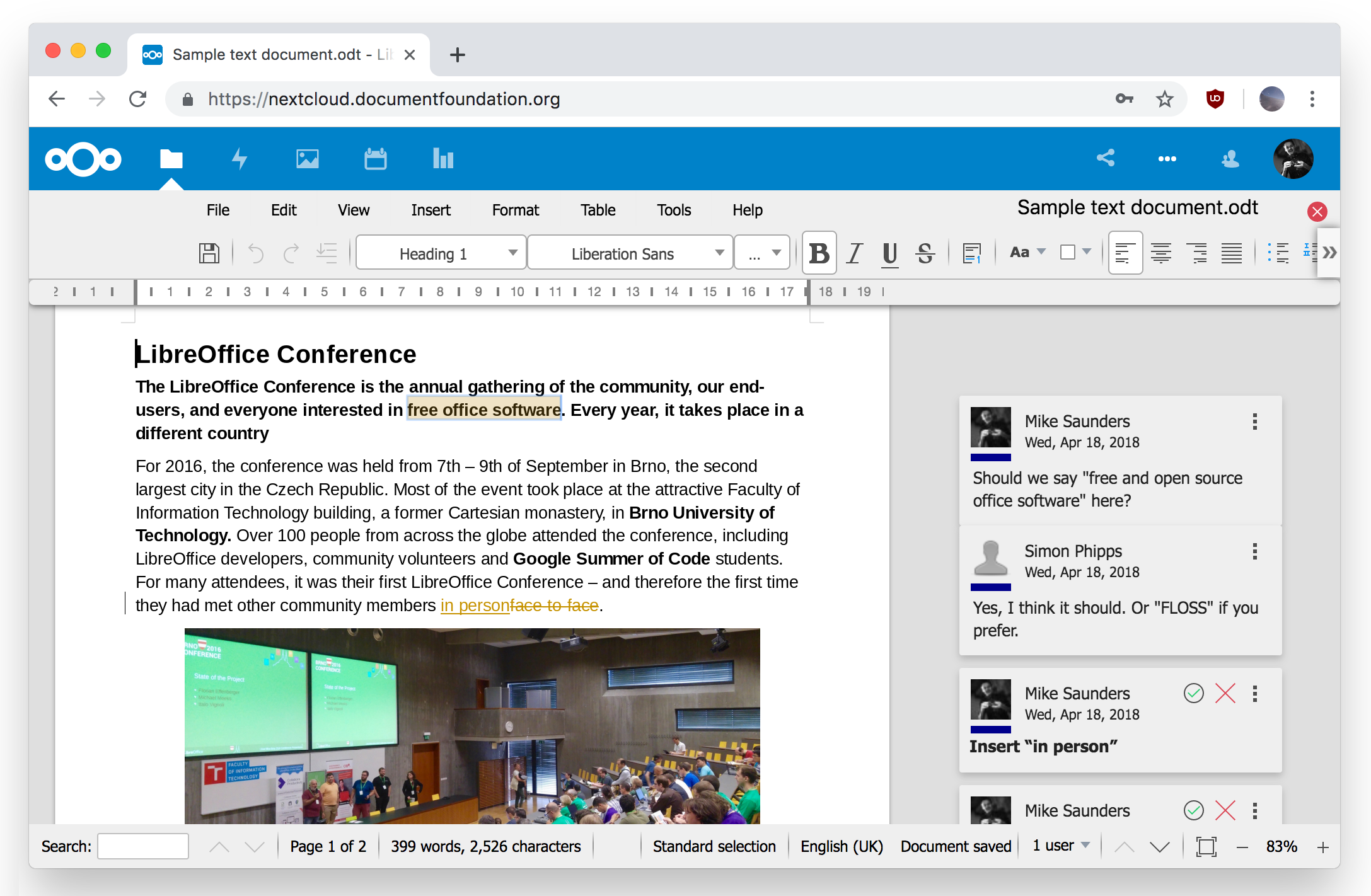
LibreOffice Online is a cloud-based version of the suite that end users can access via a web browser. It uses the same underlying engine as the desktop app, so that documents look identical across the versions. But where did it come from, what happened in 2018, and how can you deploy it on your infrastructure? Read on to find out…
Some History
Development of LibreOffice Online started back in 2011, with the availability of a proof of concept of the client front-end, based on HTML5 technology, produced by SUSE. In 2015, this proof of concept was re-written into an initial Online Development Edition by Collabora, allowing advanced users to check out LibreOffice in the cloud for the very first time.
In 2016, the first source code release of LibreOffice Online, a cloud office suite which provides basic collaborative editing of documents in a browser by re-using LibreOffice desktop’s “core engine”, was added to the master branch for the announcement of LibreOffice 5.3.
This last development brought collaborative editing to LibreOffice Online, a feature which transforms the application into a state of the art cloud office suite – the first to natively support the ISO/IEC standard Open Document Format (ODF) with collaborative editing features.
The rendering fidelity of LibreOffice Online is equivalent to that of the desktop software, and interoperability matches that of LibreOffice thanks to the support of both standard and proprietary document formats. LibreOffice Online has been developed mainly by Collabora, a leading contributor to the LibreOffice codebase and community.
LibreOffice Online in 2018
The main feature in online office suites is collaborative editing, and LibreOffice Online is no exception. The server module, which is key for this feature, is improved with every new major release of LibreOffice, with a focus on performance and security.
The graphical user interface was enhanced with the release of LibreOffice 6.1 by exposing various dialogs in LibreOffice core to the web browser. These dialogs were:
Writer: Find & Replace, Edit Style, Hyperlink, Special Character, Index Entry, Character, Paragraph, Bullets & Numbering, Table Properties, Spelling & Grammar, Word Count, Change Tracking Management, Insert Header & Footer, and Column Formatting
Calc: Ability to Add Autofilter, Ability to Filter Items via Autofilter Popup, Format Cell, Sorting Functionality, Support for Hidden Tabs, Support for Chart Data Series Editing, and Data Validation
Impress: Position & Size, Line and Area
The most significant improvements and new features announced at the time of LibreOffice 6.2 were the following:
Performance: improvements of scroll wheel, zooming, disk space, session and cache management, reduction of latency and unnecessary animation, and avoidance of repeated re-layout of comments & red-lines
Mobile: simplification of user interface, improvement of on-screen keyboard and cursor handling, addition of context toolbar and cleaning of other toolbars, and improvements to comment rendering
Integration: insertion of remote graphic from integration, addition of configurable time-limit for document conversion, installation of sample webserver config snippets, and addition of hosting/capabilities endpoint to list online features
Document signing: integration of Vereign compatible authentication and document signature, new LibreOfficeKit signing and certificate APIs, configuration to enable/disable the signature, and addition of a signing infobar
Other features: opening PDF files in a new tab instead of downloading them, improving configuration options for track changes, addition of a new shape insertion toolbar and of missing configuration defaults, and cleaner and more attractive 404 error reporting
LibreOffice Online Positioning
LibreOffice Online is server software which – to be fully functional – must be integrated with a service that provides file storage and authentication. As such, it can be considered an enabling technology for the public cloud of ISPs, or the private cloud of enterprises and large organizations, when it is integrated – for example – with enterprise file sync and sharing software, or a groupware solution.
The Document Foundation does not plan to develop or deploy a public cloud solution similar to existing products from Google and Microsoft, because this would not be in line with the original mission of the project. The task is therefore open to ISPs and providers of open source cloud solutions, with many options already available on the market.
Given the mission-critical nature of LibreOffice Online, The Document Foundation will not be maintaining binaries for enterprises, because this would create expectations which could not be fulfilled by volunteer-based support. However, builds of the latest code, suitable for home users and those who wish to contribute to development – which is encouraged – are available as Docker images.
Thanks to your generous donations, and contributions from our ecosystem of certified developers, we released two major releases of LibreOffice in 2018: 6.0 on January 31, and version 6.1 on August 8.
In addition, 14 minor releases were also made available throughout the year, for the 5.4, 6.0 and 6.1 branches. Meanwhile, several Bug Hunting Sessions were held in preparation for the new major releases. These typically took place on a single day between set times, so that experienced developers and QA engineers could help new volunteers to file and triage bugs via the IRC channels and mailing lists. The Bug Hunting Sessions for LibreOffice 5.4 were held on April 27, May 28 and July 3 – while those for LibreOffice 6.2 took place on October 22, November 19 and December 21.
LibreOffice 6.0
On January 31, LibreOffice 6.0 was officially released after six months of development. This included a new ePUB filter, for saving documents as eBooks, while support for opening QuarkXPress documents was added as well. Other new features included: a revamped special characters dialog; OpenPGP support for signing and encryption on all desktop platforms; a brand new web browser-based help system; and better flexibility when using custom dictionaries.
In addition, LibreOffice 6.0 lets users perform mail merge operations using data from tables inside Writer itself, while in Calc, new commands were added to select unprotected cells on protected or unprotected sheets. Impress was also improved thanks to 10 new templates, designed for home and business use. This video summarises the improvements:
Please confirm that you want to play a YouTube video. By accepting, you will be accessing content from YouTube, a service provided by an external third party.
If you accept this notice, your choice will be saved and the page will refresh.
LibreOffice 6.1
Later in the year, on August 8, LibreOffice 6.1 was made available. This release included many new features such as Colibre, a new icon theme for Windows based on Microsoft’s icon design guidelines, which makes the office suite visually appealing for users coming from the Microsoft environment.
The image handling engine was reworked to be significantly faster and smoother thanks to a new graphic manager and an improved image lifecycle, with some advantages also when loading documents in Microsoft’s proprietary formats.
Then there was the reorganization of Draw menus with the addition of a new Page menu, for better UX consistency across the different modules, along with a major improvement for Base, only available in experimental mode: the old HSQLDB database engine has been deprecated, though still available, and the new Firebird database engine is now the default option (users are encouraged to migrate files using the migration assistant from HSQLDB to Firebird, or by exporting them to an external HSQLDB server).
Finally, Online Help pages were enriched with text and example files to guide the users through various features, and are now easier to localize. Check out the other short video:
Please confirm that you want to play a YouTube video. By accepting, you will be accessing content from YouTube, a service provided by an external third party.
If you accept this notice, your choice will be saved and the page will refresh.
This was all possible thanks to your donations! Support our community today, so we can keep improving LibreOffice, organising events and sharing knowledge. Thank you!
OW2con 2019 is the annual open source event bringing together the OW2 community, technology experts, software architects, IT project managers and decision-makers from around the world. The conference will be hosted by the Orange Gardens Innovation Center, Paris-Châtillon, on June 12-13, 2019.
The central theme of OW2con 2019 is: “Open Source Toward Industry Maturity”. Indeed, with open source becoming mainstream, IT developers, vendors, users and even open source organisations such as OW2 have to adapt. Today, open source projects are becoming increasingly competitive and all IT developers, vendors and users must have an open source strategy.
During OW2con 2019, The Document Foundation and LibreOffice Online will be presented during two different talks:
Breakout Session – Adding LibreOffice To Your Online Solution, managed by Michael Meeks (Collabora), Philippe Hemmel (Arawa) and Thorsten Behrens (CIB), on Wednesday June 12, from 1:45pm to 3:45pm.
LibreOffice Online can be integrated into cloud solutions, as in the case of Nextcloud, ownCloud, Pydio and Seafile. The software is 100% open source and can be the perfect solution for GDPR issues in organizations. During the session it will be possible to get an overview of the application, and ask both technical and business-related questions.
Talk – Introducing The Document Foundation, by Simon Phipps (TDF/OSI), on Thursday June 13, from 9:45am to 10:00am.
The Document Foundation is one of OW2’s newest Affiliate organisations, and is a global charity based in Germany that works to promote open source productivity tools. Its flagship project, LibreOffice, is available across major desktop platforms and continues the fourth decade of impact from the code that started life as Star Writer on CP/M.
More information about OW2con 2019 are available on the event website: https://www.ow2con.org/view/2019/.
Every year, The Document Foundation produces an Annual Report, detailing its activities in the projects and community. We’ll be posting parts of it here on the blog, while we prepare a final printed version…
Election of TDF Chairperson and Deputy
In February, the Board of Directors of The Document Foundation – during its first meeting of the new term – confirmed Marina Latini in the role of Chairwoman, and appointed Björn Michaelsen to the role of Deputy Chairman.
Marina said: “Our project is growing fast with contributors from several countries, and we need to focus much more on lowering the barriers to being a really welcoming community. I would like our community to become as inclusive as possible, and never leave out those who, just in appearance, look different to us. Openness is a state of mind.”
Björn, who had previously served as a Deputy on the Board, added: “I am encouraged to see strong contributors to the project as new candidates in this election, and hope to share the duty of serving with them, together providing a strong and reasonable voice of independent and unaffiliated input in the Board. Ultimately, I hope after this one last term I can confidently leave TDF’s Board with many new diverse and independent voices in all parts of the project and foundation, and retire back to spending my contributions more on – for instance – the source code again.”
New Advisory Board member
In May, TDF announced that BPM-Conseil, a company focused on open source business intelligence and based in Lyon (France), had joined the project’s Advisory Board. BPM-Conseil will develop the integration of LibreOffice with its business intelligence solutions Aklabox and Vanilla, and also create business intelligence-related extensions for LibreOffice.
BPM-Conseil is focused both on development of open source business intelligence solutions and on the related consultancy and integration activities. The company has a large roster of clients in France, such as the Ministries of Environment, Energy and Sea, Lyon Metropole, Nimes Metropole and City, La Rochelle Agglomeration, Haute and Basse Normandie, the Aveyron Department, and the University of Corsica.
Tenders
In 2017, TDF launched four tenders aimed at sharing knowledge about improving LibreOffice in several strategic areas, where the tasks are beyond the capabilities of independent volunteer developers. In 2018, companies selected to implement two of the tenders reported back on their work.
Firstly, Collabora was selected for the tender “improve image handling in LibreOffice (#201705-01)”. A new image life-cycle was developed, with simpler memory management for handling images and new swapping strategy. The results were incorporated into the LibreOffice 6.1 release – and a more detailed technical description of the work is on the blog, in order to share knowledge and experience from this project with the developer community and the general public.
The second tender, “implement HSQLDB binary format import in LibreOffice (#201705-03)”, was also assigned to Collabora and implemented by Tamás Bunth. He developed a mechanism to import database files with high fidelity from the HSQLDB binary file format, used by many existing ODB files, by reading the Java serialization code, and writing a filter to import all data into LibreOffice Base. The objective was to remove the legacy Java/HSQLDB database and to simplify the move to Firebird. More details are provided here.
Highlights of activities
Throughout the year, TDF supported initiatives and campaigns from other organisations that promote free and open source software. For instance, in February, we joined “I love Free Software Day”, a campaign by the Free Software Foundation Europe (FSFE). As they explain: “We should remember the power of a simple ‘thank you’ to motivate Free Software contributors in their important work for society. And the 14th of February is the ideal day to do that.”
March 27 was “Document Freedom Day 2018”, a campaign about open standards and document formats, aimed at non-technical people. The goal is to make regular users more aware of interoperability issues, and the importance of storing documents (and indeed any kind of data) in open and standardised formats. This helps users to avoid vendor lock-in, giving them more freedom to use the software they want – and this is also important for governments, companies and organisations.
In September, we joined the “International Day against DRM”. DRM, or Digital Rights Management, is a set of access control technologies for restricting the use of proprietary hardware and copyrighted works, by controlling the use, modification, and distribution of copyrighted works. Instead of educating users, companies prefer to restrict them from exercising their legal rights under the copyright law.
DRM is an epidemic spreading across the web, infiltrating homes, classrooms, workplaces, and just about everywhere else users can go. Tools, technologies, books, games, movies, and music are coming to us locked down with DRM, whether they are streaming or claim to be locally hosted. TDF supports the International Day Against DRM as part of its daily fight to make content sharing available to all individuals, and to educate them to adopt open standards to foster innovation.
Document Liberation Project
TDF also hosts and supports the Document Liberation Project (DLP), a sister project of LibreOffice, which fosters the development of software libraries that can import and export data in many different file formats. DLP libraries are used by many free and open source software projects, such as Inkscape, Scribus and LibreOffice, and help users to get control of their data – especially from old and proprietary file formats. In 2018, new libraries were added to the DLP project and the community produced videos encouraging people to contribute. Learn more about DLP in this quick video:
Please confirm that you want to play a YouTube video. By accepting, you will be accessing content from YouTube, a service provided by an external third party.

 The Annual Report of The Document Foundation for the year 2018 is now available in PDF format from TDF Nextcloud in two different versions: low resolution (6.4MB) and high resolution (53.2MB). The annual report is based on the German version presented to the authorities in April.