Berlin, November 2, 2017 – The Document Foundation (TDF) announces LibreOffice 5.3.7, the seventh and last minor release of the LibreOffice 5.3 family, targeted at enterprises, government bodies and individual users in production environments.
TDF suggests deploying LibreOffice in production environments with the backing of professional support by certified developers, migrators and trainers (a list is available at: https://www.libreoffice.org/get-help/professional-support/).
LibreOffice users, free software advocates and community members can support The Document Foundation with a donation at https://www.libreoffice.org/donate/. Donations help TDF to maintain its infrastructure, share knowledge, and organise events such as the Month of LibreOffice, which has started yesterday and will be active until the end of November (https://blog.documentfoundation.org/).
Several companies sitting in TDF’s Advisory Board (https://www.documentfoundation.org/governance/advisory-board/) provide either value-added LTS versions of LibreOffice or consultancy services for migrations and training, based on best practices distilled by The Document Foundation.
Berlin, October 5, 2017 – The Document Foundation (TDF) announces LibreOffice 5.4.2, the second minor release of the LibreOffice 5.4 family, which was originally announced in early August. LibreOffice 5.4.2 continues to represent the bleeding edge in terms of features, and as such is targeted at technology enthusiasts and early adopters.
LibreOffice users, free software advocates and community members can support The Document Foundation with a donation at https://www.libreoffice.org/donate/. Donations help TDF to maintain its infrastructure, share knowledge, and organise events such as the LibreOffice Conference, which is taking place next week in Rome (https://conference.libreoffice.org).
Several companies sitting on TDF’s Advisory Board (https://www.documentfoundation.org/governance/advisory-board/) provide either value-added Long Term Supported versions of LibreOffice or consultancy services for migrations and training, based on best practices distilled by The Document Foundation.
Results of survey amongst desktop users confirm project’s momentum
Berlin, September 28, 2017 – Today, the LibreOffice community celebrates the 7th anniversary of the leading free office suite, adopted by millions of users in every continent. Since 2010, there have been 14 major releases and dozens of minor ones, fulfilling the personal productivity needs of both individuals and enterprises, on Linux, macOS and Windows.
LibreOffice is available in over 100 native languages, and as such is contributing to the preservation of native cultural heritages, as in the case – for instance – of the Guarani language in South America, and the Venitian language in Northern Italy. All localizations are managed by local volunteers.
LibreOffice is also a reference implementation of the Open Document Format (ODF) ISO standard for office documents, which today represents the only choice in the market for true interoperability.
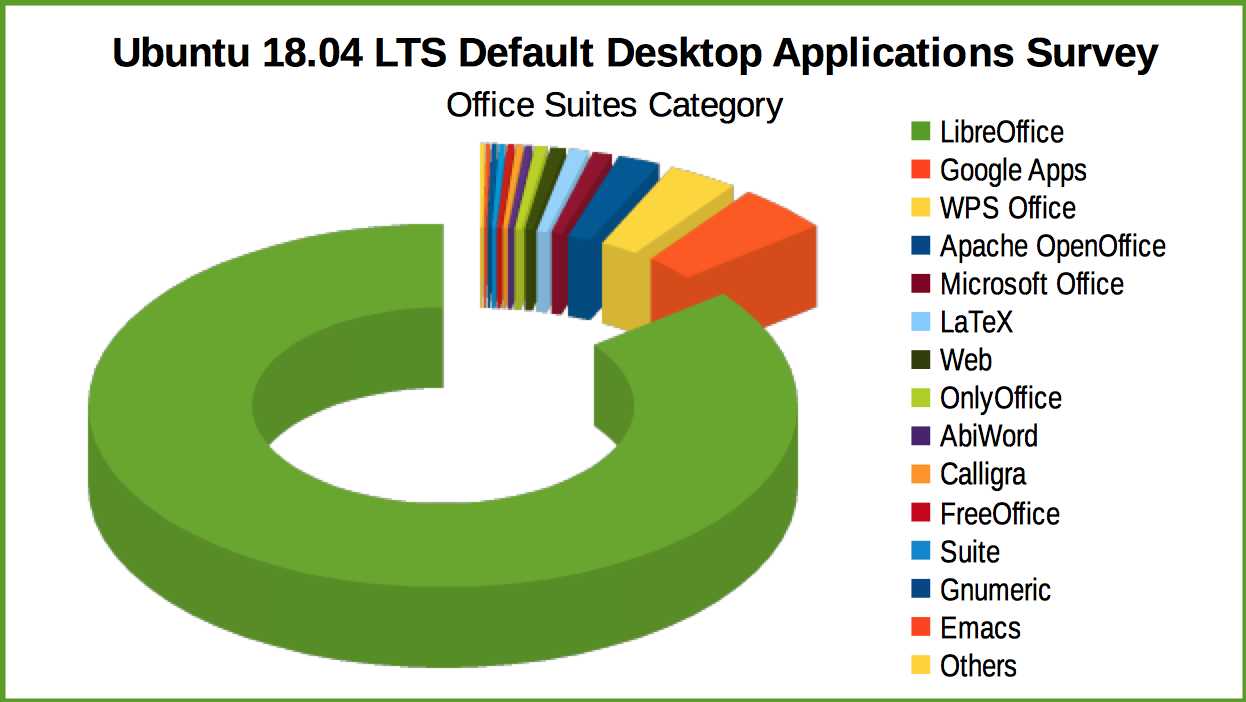
Results of Ubuntu 18.04 LTS Default Desktop Applications Survey
LibreOffice’s leadership amongst office suites has been recently confirmed by the survey of Ubuntu users for desktop productivity software, with 85.52% of the votes. The closest competitors were Google Docs with 4.29%, WPS Office with 3.22% and Apache OpenOffice with 1.96%.
The Ubuntu 18.04 LTS Default Desktop Applications Survey produced over 15,000 responses in total, with over 6,400 for the office suite category. LibreOffice received the largest margin of preference of the entire survey. Results are available here: http://blog.dustinkirkland.com/2017/09/results-of-ubuntu-desktop-applications.html (video and slides).
LibreOffice users, free software advocates and community members can support The Document Foundation with a donation at https://www.libreoffice.org/donate/. Donations help TDF to maintain its infrastructure, share knowledge, and organise events such as the LibreOffice Conference, with the next one taking place in October in Rome (https://conference.libreoffice.org).
31 organisations ask to improve public procurement of software
Digital services offered and used by public administrations are the critical infrastructure of 21st-century democratic nations. To establish trustworthy systems, government agencies must ensure they have full control over systems at the core of our digital infrastructure. This is rarely the case today due to restrictive software licences.
Today, 31 organisations are publishing an open letter in which they call for lawmakers to advance legislation requiring publicly financed software developed for the public sector be made available under a Free and Open Source Software licence. The initial signatories include CCC, EDRi, Free Software Foundation Europe, KDE, Open Knowledge Foundation Germany, openSUSE, Open Source Business Alliance, Open Source Initiative, The Document Foundation, Wikimedia Deutschland, as well as several others; they ask individuals and other organisation to sign the open letter. The open letter will be sent to candidates for the German Parliament election and, during the coming months, until the 2019 EU parliament elections, to other representatives of the EU and EU member states.
“Because the source code of proprietary software is often a business secret, it radically increases the difficulty of discovering both accidental and intentional security flaws in critical software. Reverse engineering proprietary software to improve or strengthen it is an absolute necessity in today’s environment, but this basic technical requirement is unlawful in many circumstances and jurisdictions. With critical infrastructure such as hospitals, automobile factories, and freight shippers having all been brought offline this year due to flaws concealed within proprietary software, unauditable code is a liability that states can no longer subsidize with special legal privileges without incurring a cost denominated in lives.
Right now, the blueprints for much of our most critical public infrastructure are simply unavailable to the public. By aligning public funding with a Free Software requirement — “Free” referring to public code availability, not cost — we can find and fix flaws before they are used to turn the lights out in the next hospital.” says Edward Snowden, President of the Freedom of the Press Foundation about the “Public Money Public Code” campaign launch.
Public institutions spend millions of euros each year on the development of new software tailored to their needs. The procurement choices of the public sector play a significant role in determining which companies are allowed to compete and what software is supported with tax payers’ money. Public administrations on all levels frequently have problems sharing code with each other, even if they funded its complete development. Furthermore, without the option for independent third parties to run audits or other security checks on the code, sensible citizen data is at risk.
“We need software that fosters the sharing of good ideas and solutions. Only like this will we be able to improve digital services for people all over Europe. We need software that guarantees freedom of choice, access, and competition. We need software that helps public administrations regain full control of their critical digital infrastructure, allowing them to become and remain independent from a handful of companies,” says Matthias Kirschner, President of the Free Software Foundation Europe.
That is why the signatories call on representatives all around Europe to modernise their digital infrastructure to allow other public administrations, companies, or individuals to freely use, study, share and improve applications developed with public money. Thereby providing safeguards for the public administration against being locked in to services from specific companies that use restrictive licences to hinder competition, and ensuring that the source code is accessible so that back doors and security holes can be fixed without depending on only one service provider.
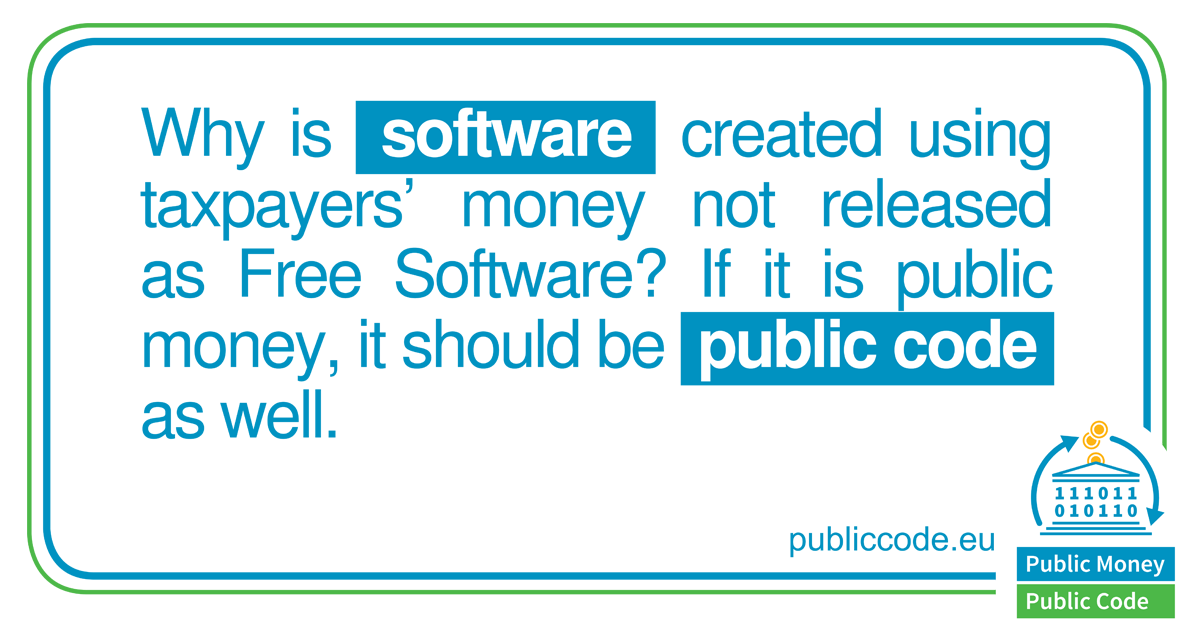
“Public bodies are financed through taxes. They should spend funds responsibly and in the most efficient way possible. If it is public money, it should be public code as well!”, says Kirschner.
Please confirm that you want to play a YouTube video. By accepting, you will be accessing content from YouTube, a service provided by an external third party.
Berlin, August 31, 2017 – The Document Foundation (TDF) announces LibreOffice 5.4.1, the first minor release of the new LibreOffice 5.4 family, which was announced in early August, and LibreOffice 5.3.6, the sixth release of the mature LibreOffice 5.3 family, which was announced in January 2017.
LibreOffice 5.4.1 represents the bleeding edge in term of features, and as such is targeted at technology enthusiasts and early adopters, while LibreOffice 5.3.6 is targeted at conservative users and enterprise deployments.
LibreOffice users, free software advocates and community members can support The Document Foundation with a donation at https://www.libreoffice.org/donate/. Donations help TDF to maintain its infrastructure, share knowledge, and organise events such as the LibreOffice Conference, with the next one taking place in October in Rome (http://conference.libreoffice.org).
Several companies sitting in TDF’s Advisory Board (https://www.documentfoundation.org/governance/advisory-board/) provide either value-added Long Term Supported versions of LibreOffice or consultancy services for migrations and training, based on best practices distilled by The Document Foundation.
Berlin, August 3, 2017 – The Document Foundation (TDF) announces LibreOffice 5.3.5, the fifth minor release of the LibreOffice 5.3 family, targeted at enterprises and individual users in production environments.
TDF suggests deploying LibreOffice in large organisations, public administrations and enterprises with the backing of professional support by certified people (a list is available at: http://www.libreoffice.org/get-help/professional-support/).
LibreOffice users, free software advocates and community members can support The Document Foundation with a donation at http://www.libreoffice.org/donate/. Donations help TDF to maintain its infrastructure, share knowledge, and organise events such as the LibreOffice Conference, with the next one taking place in October in Rome (http://conference.libreoffice.org).
Several companies sitting in TDF’s Advisory Board (http://www.documentfoundation.org/governance/advisory-board/) provide either value-added Long Term Supported versions of LibreOffice or consultancy services for migrations and training, based on best practices distilled by The Document Foundation.

 Berlin, November 2, 2017 – The Document Foundation (TDF) announces LibreOffice 5.3.7, the seventh and last minor release of the LibreOffice 5.3 family, targeted at enterprises, government bodies and individual users in production environments.

 Berlin, August 31, 2017 – The Document Foundation (TDF) announces LibreOffice 5.4.1, the first minor release of the new LibreOffice 5.4 family, which was announced in early August, and LibreOffice 5.3.6, the sixth release of the mature LibreOffice 5.3 family, which was announced in January 2017.