LibreOffice project and community recap: May 2022

Here’s our summary of updates, events and activities in the LibreOffice project in the last four weeks – click the links to learn more…

  • We kicked off May with the Month of LibreOffice. This is an event that we run twice a year, awarding sticker packs (and the chance to win more merchandise) to everyone who contributes to LibreOffice. We posted an update later in May – and we’ll soon post the final results on this blog!

  • During the month, we released two updates to the suite: LibreOffice 7.3.3 on May 5, and 7.2.7 on May 12. (The latter is the last release in the LibreOffice 7.2 series. Also, LibreOffice is now available to download on SourceForge.

  • Then we had updates about the LibreOffice Conference 2022, which will take place in Mikan, northern Italy from September 28 – October 1. We announced the Call for Papers, followed by the sponsorship package. We look forward to seeing you there – in-person, or online!
  • Our Indonesian community reported on recent activities, including an online session to broaden students’ knowledge of LibreOffice and FOSS (free and open source software) in general.

  • We’re glad that more in-person events are becoming possible again, and LibreOffice community members were present at the Univention Summit 2022 in Bremen, northern Germany.

  • In May, LibreOffice won two awards: SourceForge’s Open Source Project of the Month, and Software Informer’s Editor’s Pick.

Keep in touch – follow us on Twitter, Facebook and Mastodon. Like what we do? Support our community with a donation – or join us and help to make LibreOffice even better!

Last week of the Month of LibreOffice, May 2022!

So far, 233 sticker packs have been awarded in the Month of LibreOffice, May 2022. But there’s still one more week to go – so if your name (or username) isn’t on the list, join in, help to make LibreOffice even better, and get some cool swag! We’ll have 10 bonus pieces of merchandise to give away, to 10 lucky people…

How to take part

So, let’s get started! There are many ways you can help out – and as mentioned, you don’t need to be a developer. For instance, you can be a…

  • Handy Helper, answering questions from users on Ask LibreOffice. We’re keeping an eye on that site so if you give someone useful advice, you can claim your shiny stickers.
  • First Responder, helping to confirm new bug reports: go to our Bugzilla page and look for new bugs. If you can recreate one, add a comment like “CONFIRMED on Windows 10 and LibreOffice 7.3.2”.
  • Drum Beater, spreading the word: tell everyone about LibreOffice on Twitter or Mastodon! Just say why you love it or what you’re using it for, add the #libreoffice hashtag, and at the end of the month you can claim your stickers.
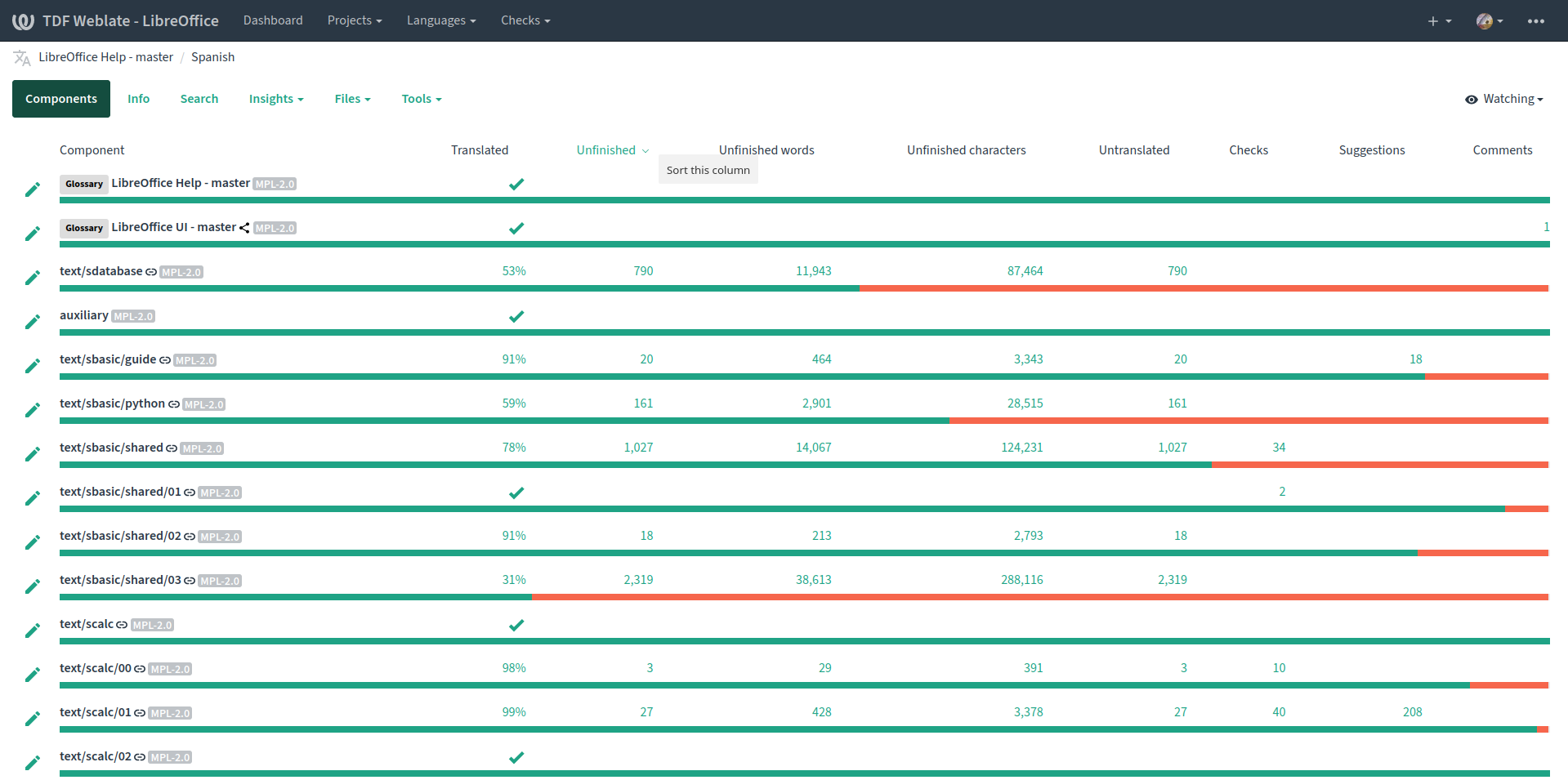
  • Globetrotter, translating the user interface: LibreOffice is available in a wide range of languages, but its interface translations need to be kept up-to-date. Or maybe you want to translate the suite to a whole new language? Get involved here.
  • Docs Doctor, writing documentation: Whether you want to update the online help or add chapters to the handbooks, here’s where to start.

Join in, learn new things, and have fun! We’ll post the final results in early June…

LibreOffice at the Univention Summit 2022

After two years of pandemic restrictions, more and more in-person events are now taking place. Members of the LibreOffice community attended the recent Univention Summit 2022 in Bremen, northern Germany. They had a stand with LibreOffice merchandise, talked to visitors and answered questions.

Thorsten Behrens, Chairperson of The Document Foundation’s (TDF) Board of Directors, said: “The event was super, and it was great to talk to people in-person again.”

Lothar Becker, who served on the Board from 2020 to 2022, added:

The representation of TDF and the LibreOffice project at the event, along with partners, was very well received – and perceived as important in terms of digital sovereignty, both for users and other projects and providers. Intensive discussions for the first time – also in person again – especially regarding integration topics, and the role of TDF, were very encouraging and motivating for all after the long period of the pandemic. The evening then offered the opportunity to continue these discussions in a more informal atmosphere.

Let’s wrap up with a couple more pictures from the event. We plan to attend many more this year – keep an eye on this blog for updates!

Annual Report 2021: Attracting new contributors to LibreOffice

Bringing new community members on board, and helping them to get started in the LibreOffice community, is an essential part of our work. Here’s what we did in 2021…

(This is part of The Document Foundation’s Annual Report for 2021 – we’ll post the full version here soon.)

Onboarding tools and sites

Joining a large and established project like LibreOffice can be daunting for many. The software has a large codebase, and sub-projects use a wide array of tools. In recent years, we’ve made efforts to simplify the onboarding process by linking more services together with SSO (single sign-on), thereby reducing some of the complexity. In addition, we’ve created Easy Hacks and similar “bite size” projects in other areas, so that newcomers can get involved quickly and achieve something without months of work.

Currently, we have two websites/pages that function as starting points for new contributors: What Can I Do For LibreOffice and the Get Involved page. The former was set up by LibreOffice’s Albanian community, and lets users click through topics of interest, until they find something they want to do. The latter is a regular page, with a list of sub-projects inside LibreOffice, and quick steps to make initial contact.

Throughout 2021, we posted regular “Community Member Monday” interviews on this blog. In many cases, we emphasised how these contributors started off as regular LibreOffice users, but wanted to “scratch an itch” and start to make changes to the software. We highlighted the ways in which other community members helped newcomers to start working on projects, and used these as “success stories” on our social media accounts, encouraging others to make the step-up from being a user to an active contributor.

In addition, we have accounts and projects listed on various volunteering platforms, including VolunteerMatch and Idealist (English), Vostel (German), Vapaaehtoistyo (Finnish), TuDu (Polish) and HeroClan, Um sem um tam and Zapojim se (Czech).

LibreOffice New Generation

In early 2021, we announced LibreOffice New Generation, a project to bring new – and especially younger – people into the LibreOffice community. While The Document Foundation is proud that our community is diverse and has people from all ages, younger people help to bring fresh ideas and approaches to the project. So we wanted to make it easier for everyone to join, get involved and have fun – regardless of age.

To achieve this, we set up the New Generation project with communication channels, contact points in the community, and initial ideas for things to work on. The community grew quickly, with 300 members arriving in the Telegram group within the space of a few weeks, and many ideas being proposed. One was to create a distinctive flyer that can be distributed in schools and universities, which not only explains what LibreOffice does, but how all users can also get involved and help to improve the software. New Generation community members created an initial design for the flyer, along with an update, and then translated it into several languages. TDF used funds from its marketing budget to get flyers printed and distributed to people around the globe.

Open Badges

We also continued to issue Open Badges, special, custom images with embedded metadata, confirming contributions from people in the community. For instance, we sent our personalised badges to French translators of the Math Guide, along with Brazilian Portuguese documentation team members and Czech documentation contributors.

Like what we do? Support the LibreOffice project and The Document Foundation – get involved and help our volunteers, or consider making a donation. Thank you!

Indonesian LibreOffice community: recent activities

Rania Amina from the Indonesian LibreOffice community writes:

On Wednesday, 18 May 2022, I had the opportunity to talk in one of the sessions at the Virtual Visit of SMK Amaliah 1 Ciawi Bogor. This activity is a routine agenda for Amaliah Vocational School in the form of seminars and visits to institutions or communities to broaden students’ knowledge of Information and Communication Technology to Support Creative and Innovative Education.

I represent the Indonesian LibreOffice community, given the opportunity to provide material for the activities. The topic that I conveyed revolves around LibreOffice and FOSS in general, and how the open source community ecosystem can be well developed so that it can be a space for self-development before pursuing a career in that field.

This event was held virtually, starting at 08:00 WIB (Western Indonesian Time/GMT+7) until 12:00 WIB, with around 90 participants. The enthusiasm of the participants in this activity was quite high, considering that apparently both LibreOffice and FOSS were new things for the students. On this occasion, I also conveyed to them to never hesitate to start contributing, both in the coding and non-coding spheres, for example as testers, bug hunters, making designs for promotions in their environment, creating events related to LibreOffice, and more.

We hope that – after this activity – LibreOffice ID will collaborate again with Amaliah Vocational School to organize offline activities in the future.

Many thanks to Rania and the community for their great work! Learn more here.

Annual Report: TDF’s infrastructure in 2021

In 2021, the infrastructure team migrated our “Ask LibreOffice” site to Discourse, deployed a Decidim instance, and assisted with video streaming during the LibreOffice Conference.

(This is part of The Document Foundation’s Annual Report for 2021 – we’ll post the full version here soon.)

LibreOffice’s infrastructure team is responsible for maintaining the hardware, virtual machines and services that enable the wider community to develop, market, test, localize and improve the software. The public infrastructure is powered by around 50 kernel-based virtual machines (KVMs) spread across four hypervisors, plugged to an internal 10Gbps switch, hosted at Manitu in St. Wendel (Germany), and managed with libvirt and its KVM/QEMU driver. The virtual disk images are typically stored in GlusterFS volumes – distributed across the hypervisors – except for some transient disks (such as cache) where the IOPS requirement is higher and the redundancy less important.

As 2021 marked another “pandemic year” with only online events, the infrastructure team helped to make these a pleasant experience from home. Notably, they deployed a Pretalx instance to manage conference submissions and the schedule, and put in place a streaming backend based on Jitsi/Jibri/RTMP during the annual conference, thereby providing several participation options to chose from.

Ask LibreOffice

After several months of tests and feedback from the community, the infra team also concluded the migration of LibreOffice’s Q&A platform (“Ask LibreOffice”) to Discourse. Over 65,000 questions and 130,000 replies from 50,000 users — spanning over 17 languages — were imported, with a focus on preserving post attribution and overall layout. The metric collection engines (Matomo as well as the public Grimoire Dashboard) were updated to reflect that change.

Also on the community participation front, the infrastructure team deployed a Decidim instance to structure debate and encourage democratic participation from community members. The instance is currently still under test.

On the Continuous Integration (CI) front, the team deployed new buildbots for Windows and Linux baselines, as well as a buildbot for the WebAssembly (WASM) effort. They also migrated and refactored the bibisect setup to better suit the needs of the quality assurance community.

Backends

As for the backends: Debian GNU/Linux 11 (codename “Bullseye”) was released in the middle of 2021, and the team upgraded most of TDF’s virtual machines accordingly during the second half of the year. However, for the lower layers of the virtualization stack, the upgrade is planned for 2022. Furthermore, lots of work was done in planning the restructuring of database engines, most notably around Point-in-Time Recovery; this work was driven by contributor Brett Cornwall. Finally, the team assisted the Membership Committee with the architecture of the back-end side of their new tooling.

Like what we do? Support the LibreOffice project and The Document Foundation – get involved and help our volunteers, or consider making a donation. Thank you!