LibreOffice design, UX and UI updates – TDF’s Annual Report 2023

TDF Annual Report banner

Design has been one of the major focus points of LibreOffice in the last few years, and the Design community has produced new icon sets, new MIME type icons, a hugely improved dark mode, and improvements to the NotebookBar

(This is part of The Document Foundation’s Annual Report for 2023 – we’ll post the full version here soon.)

Based on LibreOffice’s Human Interface Guidelines (HIG), during 2023 there were various improvements to LibreOffice’s user interface.

Improvements in LibreOffice 7.5

Support for dark and high contrast operating system themes on Windows, macOS and Linux were greatly improved. More than 40 bugs were fixed by contributors including Caolán McNamara (Red Hat), Rafael Lima, Michael Weghorn (TDF) and Rizal Muttaqin.

LibreOffice on macOS in dark mode

In addition, Maxim Monastirsky implemented an improved version of the single toolbar user interface, supporting context-aware controls and their customization. It can be activated via View > User Interface > Single Toolbar. Finally, Heiko Tietze (TDF) updated the Start Center so that it can filter recent documents by type.

Improvements in LibreOffice 7.6

Andreas Heinisch worked on the recent documents picklist under File > Recent Documents; it now shows the five most recent module-specific items first. The list can be configured using the “ShowCurrentModuleOnly” expert option to show only files that can be handled by the current LibreOffice module.

Andreas also made it possible for documents in the Start Center to be pinned, to show them at the beginning of the recently opened document list. To pin a document, users can hover the corresponding document and click on the pin icon in the top-left corner. The selected document is then shown in a separate line at the beginning of the list, along with already pinned documents.

LibreOffice pinned documents in the Start Center

Heiko Tietze (TDF) did further work on the colour schemes: sets of “Automatic” application colours can now be chosen independently from the Application Color scheme in Tools > Options > LibreOffice > Application Colors.

Lastly, Michael Weghorn (TDF) improved keyboard navigation for the Special Characters dialog box.

Like what we do? Support the LibreOffice project and The Document Foundation – get involved and help our volunteers, or make a donation. Thank you!

Websites and Blogs – TDF’s Annual Report 2023

TDF Annual Report banner

Our two main websites are vital sources of information for The Document Foundation and the LibreOffice software. In 2023 we posted regular updates on our blog, including press releases and community interviews

(This is part of The Document Foundation’s Annual Report for 2023 – we’ll post the full version here soon.)

TDF website (documentfoundation.org)

The Document Foundation website provides general information about the foundation (overview, statutes, code of conduct, financials and reports) and its governance (board of directors, membership committee, members, advisory board, and engineering steering committee), and about LibreOffice certification, including a list of certified developers, and professionals for migrations and trainings.

In 2022, we launched a new version of documentfoundation.org, using the Hugo website building framework. In 2023 we worked on updates to this site, refining the design and keeping content about the foundation’s various bodies up-to-date.

During 2023, the foundation’s website was visited 107,558 times, with 143,731 page views, a slight reduction in both statistics from 2022. Continent-wise, the largest chunk of visits were from Europe (49%), followed by North America (30-%) and Asia (15%). And for operating systems: the most visits were from PCs using the Windows (61%) operating system, followed by GNU/Linux (13%, a 3% gain from 2022) and macOS (8%), while for browsers: Chrome had 41%, followed by Firefox (16%) and Microsoft Edge (14%).

This image shows weekly visits to documentfoundation.org, throughout 2023:

Weekly visits to documentfoundation.org

LibreOffice website (libreoffice.org)

The LibreOffice website provides information about the office suite and the document format, the various download options, how to get help, how to contribute to the project, events where users can get to know the LibreOffice community, and how to make a donation to support the project and the community.

In 2023, we continued to make improvements and tweaks to the website, updating the timeline that shows events, activities and new releases of LibreOffice. We also worked on updates to the “Discover” and “New features” sections of the site, to reflect new versions of the software.

During 2023, the English-language LibreOffice website was visited 19,176,691 times (a 0.8% gain over 2022), with 46,011,840 page views (a -1.1% drop). Most visits were from Europe (52%), followed by Asia (18%), North America (15%) and South America (10%), from PCs using the Windows operating system (82%), followed by macOS (5%) and Linux (2.5%). Regarding web browsers, Chrome was the most popular (43%), followed by Microsoft Edge (28%) and Firefox (13%).

This image shows weekly visits to www.libreoffice.org, throughout 2023:

Weekly visits to www.libreoffice.org

Blogs

TDF’s blogs are essential for communicating activities inside and around the project, including new releases of LibreOffice, community events and support for other free and open source initiatives. In 2023, we used them to post regular interviews with community members and provide updates from team members about documentation, marketing, QA, design and more.

Blogs were also maintained by various native language communities including Japanese, French, Spanish, German and others. Thanks to the hard work of community members, we had press releases, tips and other articles translated into many languages, and picked up by local media organisations.

These native language blogs complement the information provided by the main blog in English, and by the two blogs managed by members of the design and the quality assurance projects, which provide updates about activities for the upcoming major releases.

In 2023, the English-language blog had 151,352 visits and 196,287 page views. The press releases for LibreOffice 7.5 and 7.6 were the most popular posts, followed by posts for minor bugfix releases.

Like what we do? Support the LibreOffice project and The Document Foundation – get involved and help our volunteers, or make a donation. Thank you!

LibreOffice Documentation Updates in 2023 – TDF’s Annual Report

LibreOffice Bookshelf

In 2023, the documentation community continued to update LibreOffice guidebooks, and the Help application

(This is part of The Document Foundation’s Annual Report for 2023 – we’ll post the full version here soon.)

New and translated guides

Throughout the year, the documentation project closed the gap between LibreOffice’s major releases, and the updates of the corresponding user guides. By the year end, all of the version 7.x guides were updated to match the release of LibreOffice 7.6, and ready to continue for the forthcoming release – 24.2 – which arrived in February 2024. The goal of tracking the software release closely was achieved, and the documentation team is now in a steady state of small updates between releases.

The updates and enhancements of the guides were an effort of all the team, coordinated by Jean Weber (Writer and Getting Started Guide), Olivier Hallot (Calc) Steve Fanning (Calc and Base guides), Peter Schofield (Impress and Draw guides), Vítor Ferreira (Math guide). A number of volunteers also worked in each guide by writing and reviewing contents and suggesting improvements. Special thanks to Jean Weber for making the guides available for sale in printed format via Lulu Inc.

LibreOffice Help updates

The documentation community also had a team of Help page bug fixes, closing Help documentation bugs, bridging gaps, fixing typos and improving quality, a must-have update to keep LibreOffice in-shape for its user base and documented reference of the application features. A total of 650 Help patches were merged in 2023. The Help pages, which are part of the LibreOffice codebase, were also refactored continuously for better maintenance and code readability. The localisation and translation team of volunteers was quick in flagging typos and English mistakes – while translating the Help content and the user interface.

LibreOffice Help

LibreOffice Developer Guide

Thanks to Ilmari Lauhakangas and Hossein Nourikah, the LibreOffice Developer Guide is now available on TDF’s infrastructure and under LibreOffice developers’ control, allowing update and improvements of the guide for the specifics of the LibreOffice application.

ScriptForge libraries, and Wiki updates

The documentation community also had a nice contribution from Jean Pierre Ledure, Alain Romedenne and Rafael Lima, for the development of the ScriptForge macro library, in synchronization with the much-needed Help pages on the subject, a practice rarely followed by junior developers of LibreOffice. As we know, undocumented software is software that’s lacking; features that are unknown to the user can be a cause of costly calls to a help desk in corporate deployments. ScriptForge developments came together with their documentation, demonstrating the ScriptForge team’s professional maturity.

LibreOffice Bookshelf

In 2023, the documentation community also updated the LibreOffice Bookshelf, another download page for LibreOffice guides that is different from the current documentation.libreoffice.org server page. The Bookshelf can be cloned and installed in organizations, libraries, colleges and schools, for immediate availability in controlled environments, as well as online reading of the guides. The Open Document Format chapters were transformed into static HTML pages, and are ready to display on computers, tablets and cell phones, bringing LibreOffice user guides closer to its public, anywhere, anytime.

Like what we do? Support the LibreOffice project and The Document Foundation – get involved and help our volunteers, or make a donation. Thank you!

LibreOffice project and community recap: June 2024

LibreOffice project and community recap banner

Here’s our summary of updates, events and activities in the LibreOffice project in the last four weeks – click the links to learn more…

LibreOffice invitation template

Donate button

LibreOffice stickers

LibreOffice Conference 2023 group photo

LibreOffice Impress Guide 24.2 cover

Keep in touch – follow us on Mastodon, X (formerly Twitter), Bluesky, Reddit and Facebook. Like what we do? Support our community with a donation – or join our community and help to make LibreOffice even better!

LibreOffice development in 2023 – TDF’s Annual Report

TDF Annual Report banner

In 2023, 11,272 commits were made to the LibreOffice source code, from 253 authors, in 21 repositories. We also took part in the Google Summer of Code, to support student developers

(This is part of The Document Foundation’s Annual Report for 2023 – we’ll post the full version here soon.)

Infrastructure for developers

TDF provides infrastructure for the developer community to continue their work on LibreOffice. These include Git and Gerrit, to make changes to the source code, along with Bugzilla (to track bug reports and enhancement requests), a wiki (to document changes), and Weblate (for translations).

Most technical discussions took place on the developer mailing list and IRC channel, with the latter providing more real-time communication. Members of the Engineering Steering Committee met weekly, to discuss the most pressing issues with the codebase.

Google Summer of Code (GSoC)

GSoC logo

Google Summer of Code (GSoC) is an annual programme in which student developers of free and open source software projects receive stipends from Google for their work. LibreOffice takes part in GSoC every year, and in 2023, five students developed features and updates in the software. They were mentored by developers from the LibreOffice ecosystem and TDF. Let’s go through them…

  • Improving OpenPGP encryption experience in LibreOffice by Ahmed Gamal Eltokhy: LibreOffice can encrypt documents using OpenPGP public key cryptography by making use of external applications such as gpg4win, GPGTools and gnupg. Thanks to Ahmed’s work, it is now easier to manage and search keys and faster to navigate large keyrings.
  • Selecting tests to run on Gerrit patches based on machine learning by Baole Fang: This project was inspired by Mozilla’s work on Firefox’s continuous integration. There is now a system in place that makes predictions on the test failure possibility of submitted code changes and decides the most efficient way to build the changes. As this kind of machinery is very new to everyone, we expect many tweaks to follow.
  • Search Field in Options by Bayram Çiçek: Searching through options is standard in applications these days, so it is about time LibreOffice learned how to do it. This makes it much easier for end users to find specific options and settings, by simply typing a few letters, rather than having to navigate though a large set of menus and widgets.

Screenshot of search field in LibreOffice options dialog

  • Convert Writer’s Java UNO API Tests to C++ by Dipam Turkar: The idea here was to reduce the dependency on Java during the LibreOffice build process. Half of the tests for Writer were converted.
  • Add APNG import/export support by Paris Oplopoios: APNG is short for Animated Portable Network Graphics. It is not an official extension to PNG, but nevertheless has broad support in web browsers these days. Thanks to Paris’s work, LibreOffice now fully supports this format.

For the full details about the students’ work, see this post. And thanks to Andreas Heinisch, Thorsten Behrens (allotropia), Heiko Tietze (TDF), Hossein Nourikhah (TDF), Tomaž Vajngerl (Collabora), Xisco Faulí (TDF), Stéphane Guillou (TDF) and Christian Lohmaier (TDF) for mentoring the students.

Like what we do? Support the LibreOffice project and The Document Foundation – get involved and help our volunteers, or make a donation. Thank you!

LibreOffice social media in 2023 – TDF’s Annual Report

TDF Annual Report 2023 banner

We use our social media channels to raise awareness about our work, share information and encourage new contributors to join us

(This is part of The Document Foundation’s Annual Report for 2023 – we’ll post the full version here soon.)

Social media

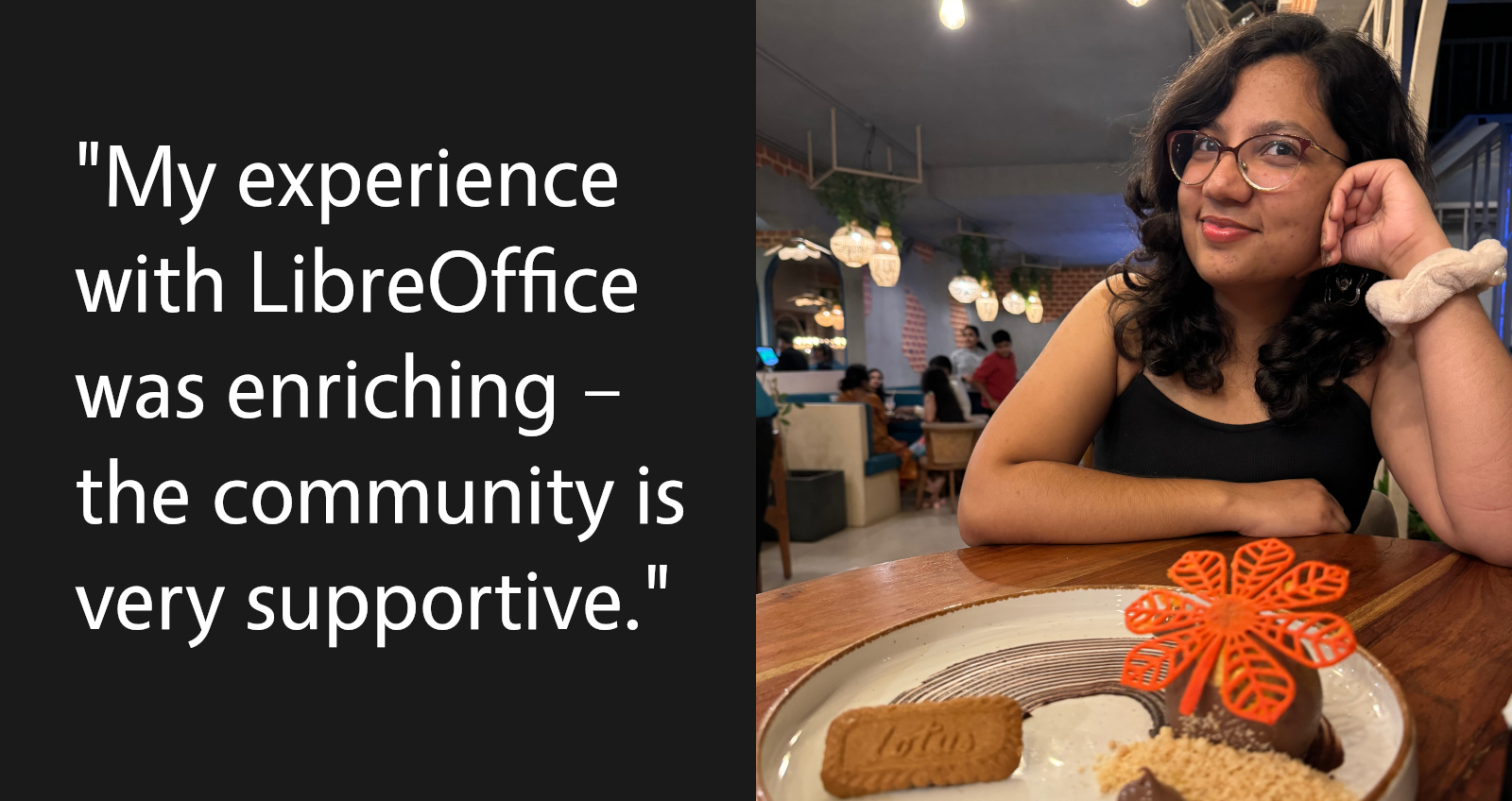
In January 2023, our X (formerly known as Twitter) account @LibreOffice had 53,541 followers; by the end of the year, we had grown this to 62,443. Our most popular tweets were for major releases, but we also tweeted customised images for “Community Member Monday” interviews with short quotes, encouraging more users to get involved with LibreOffice projects.

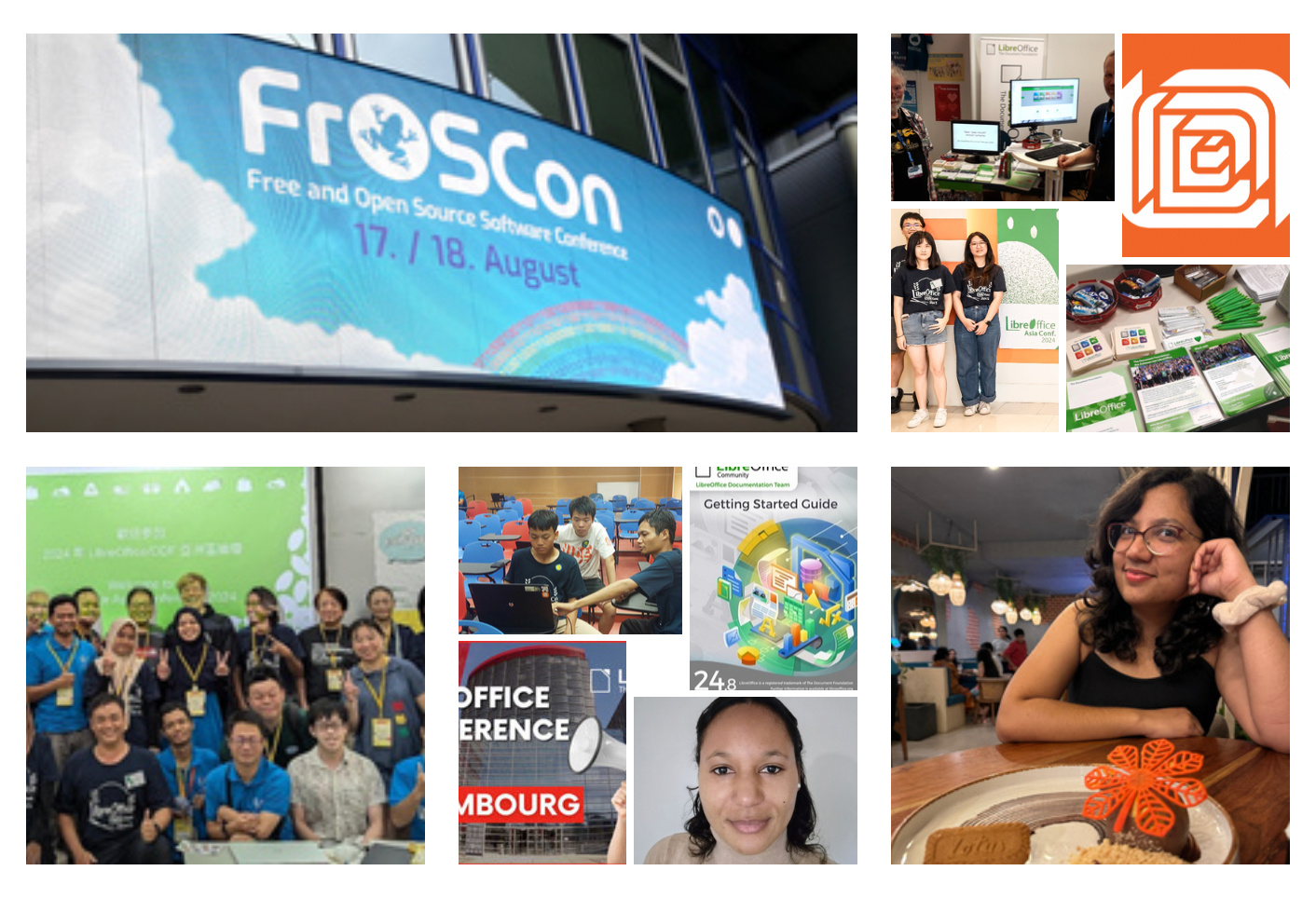
Outreachy and LibreOffice installer improvements: Rachael Odetayo

In addition, we focused not only on our own tweets, but also retweeting announcements from the LibreOffice ecosystem and community members. We liked and retweeted messages of support from end users – many of whom were surprised and thankful that a large project would show them support. To keep the content flowing, we retweeted popular older tweets, and responded to individual messages.

On other social media platforms, we focused on growing our account on Mastodon, a Twitter-like open source, federated and self-hosted microblogging service. In 2023 we worked more on expanding our activities on our account @libreoffice@fosstodon.org, and from January to December, we grew our follower base from 17,632 to 24,987. We also joined Bluesky in 2023 thanks to invites from a community member, with our new account @libreoffice.bsky.social reaching over 150 followers by the end of the year.

LibreOffice on Bluesky

Our Facebook page growth was smaller, from 60,278 page followers to 63,189. We’ve noticed a gradual reduction in activity on Facebook over the last few years, which reflects its changing audience, and the move towards newer mobile applications. Nonetheless, Facebook still provides a good opportunity to interact with end users of LibreOffice, and every day we checked in to answer questions, get feedback, and post announcements/tips about the software.

YouTube channel

Our YouTube channel grew from 18,108 subscribers and 2,886,284 video views in January 2023 to 20,504 subscribers and 3,217,282 video views by the end of the year. The “LibreOffice 7.5: New Features” video (a fantastic production by the Indonesian community) had almost 60,000 views – while the video for LibreOffice 7.6 had over 60,000. We also added videos of talks, presentations and workshops from the LibreOffice Conference 2023.

Please confirm that you want to play a YouTube video. By accepting, you will be accessing content from YouTube, a service provided by an external third party.

YouTube privacy policy

If you accept this notice, your choice will be saved and the page will refresh.

Meanwhile, our community helped out with tutorial videos – in particular Harald Berger of the German community, who continued to produce a series of professional-looking step-by-step guides to installing and using LibreOffice.

Like what we do? Support the LibreOffice project and The Document Foundation – get involved and help our volunteers, or make a donation. Thank you!