LibreOffice Conference 2018: Opening session and sponsor videos

We’ve started to edit and upload videos from the LibreOffice Conference 2018 which was held in Tirana in September. Here’s the first batch – more presentations to come. (Tip: use headphones for the best audio.)

First, the opening session, including a special welcome from the mayor of Tirana:

Please confirm that you want to play a YouTube video. By accepting, you will be accessing content from YouTube, a service provided by an external third party.

YouTube privacy policy

If you accept this notice, your choice will be saved and the page will refresh.

Then a presentation from Collabora, one of the conference’s sponsors:

Please confirm that you want to play a YouTube video. By accepting, you will be accessing content from YouTube, a service provided by an external third party.

YouTube privacy policy

If you accept this notice, your choice will be saved and the page will refresh.

And CIB, another sponsor:

Please confirm that you want to play a YouTube video. By accepting, you will be accessing content from YouTube, a service provided by an external third party.

YouTube privacy policy

If you accept this notice, your choice will be saved and the page will refresh.

Interview: Guilhem Moulin on LibreOffice infrastructure and services

A large free and open source software project like LibreOffice requires a lot of infrastructure, to support our users, developers and worldwide community. Today we speak to Guilhem Moulin, who is in charge of TDF’s infrastructure and services, about new developments and how others can get involved…

To start, please give us a quick overview of TDF’s public infrastructure.

The public infrastructure is powered by about 50 Kernel-based Virtual Machines (KVM) spread across 4 hypervisors plugged to an internal 10Gbps switch and hosted at Manitu in St. Wendel (Germany), and managed with libvirt and its KVM/QEMU driver. The virtual disk images are typically stored in GlusterFS volumes — distributed across the hypervisors — except for some transient disks (such as cache) where the IOPS need is higher and the redundancy less important.

All our public VMs run Debian GNU/Linux (currently a mix of Jessie — which are to be upgraded — and Stretch), each typically hosting a single service for better isolation. The rest of the stack is fairly usual: systemd as PID 1 & service manager, a mix of MySQL and PostgreSQL as RDMS, and nginx as SSL/TLS endpoint & reverse HTTP proxy. All of this is orchestrated and managed using saltstack.

About half of our Virtual Machines host public-facing websites; the other half are used for test instances, various production backends and internal services, as well as for tinderboxes and other hacking VMs. Some of these websites are mostly useful for developers, such our Bugzilla or gerrit instances — an overview of the development-focused sites can be found at https://devcentral.libreoffice.org. The remaining sites include the main LibreOffice website, the download page, the Wiki, Askbot, and of course the blog.

Beside these VMs, we also operate a handful of other machines for backups, monitoring, and mail systems, which are hosted offsite for obvious reasons.

What have been the most significant infra developments in the last six months?

Single Sign On (SSO) is probably what’s been the most visible to the community. Traditionally each frontend (Wiki, Bugzilla, Askbot, etc.) has its own private authentication backend, so once someone sign in to multiple services, they would have to remember multiple sets of credentials, which is cumbersome and makes password & email rotation difficult.

We now have a central authentication system (which uses an LDAP DIT as backend), but aren’t pointing individual services to it, as it would 1/ expose the shared credentials to all services hence increase the attack surface; and 2/ doesn’t solve the fact that users would have to enter their password to each service individually. Instead we’re deploying a solution using the SAML 2.0 protocol: unauthenticated users are redirected to an authentication portal against which they can authenticate, and they are redirected to the protected page afterwards.

Not all services have been migrated to SSO yet. An issue is that we have to unify accounts (people use different usernames in different services); and while we want a “critical mass” of active user accounts in LDAP before migrating a service, it’s been rather difficult to reach out to people — even among TDF officials! — and convince them to create an account in the new system. Fortunately since we migrated the authentication system of our wiki, more and more people (among whom a lot of dormant accounts, probably spammers unfortunately) started using the new system.

While it’s only visible to infra team members, we also replaced our Graphite (+ Carbon + Icinga2) based monitoring system with Prometheus (+ data exporters + alert manager). Furthermore, still on the monitoring front but public this time, we just deployed a new service, CachetHQ, to show a quick overview of TDF’s infra status:
https://status.documentfoundation.org.

Last but not least, earlier this spring we were fairly busy with GDPR compliance.

What are you working on at the moment, and what are your plans for the next six months?

Aside from daily maintenance and occasional emergencies (system crashes, hardware hiccups, performances issues, etc.), infra team members still spends quite a lot of time on the above, as this is not completely finished yet. Projects for next year include working on a better backup solution, in particular regarding database snapshots. The data collection system for download metrics needs some improvement, too.

Finally, what cool things can new volunteer admins do to get involved and help the project?

We have a wide variety of systems, ranging for highly sensitive (election, internal mail, LDAP DIT, whitebox monitoring) to pretty much fully public beside the access logs (bitergia dashboard, blackbox monitoring). We can’t give upfront access to the sensitive side of the spectrum to everyone, but there are things to help with on the other side too (developer-focused services are typically less sensitive, since development is open anyway).

Sometimes we also start fresh and replace a service with something equivalent on a brand new box; in that case there is no sensitive data at stake, and it’s a great way for new volunteer admins to gain trust. I mentioned the monitoring migration earlier; we could also imagine replacing our ageing MirrorBrain deployment with a more modern solution like Mirrorbits, for instance.

Thanks to Guilhem for his time and help. If you’re interested in joining our infra community and gaining valuable experience in a large FOSS project, see here to get started!

LibreOffice monthly recap: September 2018

Here’s our regular recap of events and updates in the last month!

  • From 25 to 28 September, our Albanian community organised the LibreOffice Conference 2018 in Tirana. They did an excellent job, so we’d like to give a special thanks to all the organisers for their help! The conference brought together developers, users and supporters from across the world – see the conference website for full details and the programme. Talks and presentations were filmed, so we’ll work on editing and uploading them in the next couple of weeks – keep an eye on the blog!

  • Throughout the event, we posted regular updates on the blog, including photos from day 1, day 2 and day 3. We’ll post a recap video soon, but in the meantime check out the group photo shot of over 100 of the attendees who were present on day 3:

  • During the conference, we also announced LibreOffice 6.1.2, the second minor release of the LibreOffice 6.1 family, targeted at early adopters, technology enthusiasts and power users. A big thanks to all our community members and certified developers who contributed to this release.
  • Meanwhile, LibreOffice release engineer Christian Lohmaier gave a talk at droidcon Vienna about LibreOffice Viewer for Android. We’re always looking for more help to improve the app and make the experimental editing mode a standard feature, so if you’re familiar with coding Android apps and want to give us a hand, get started here.

  • On September 18, we celebrated the International Day Against DRM. Digital “Rights” Management (which could also be called “Restrictions” Management) is a set of technologies to limit and control users. The Document Foundation supports the International Day Against DRM as part of its daily fight to make content sharing available to all individuals, and to educate them to adopt open standards to foster innovation.
  • Our documentation community released the Getting Started Guide 6.0, an introductory text covering all of the main components in LibreOffice. If you want to learn more about the suite and discover some features you may not have come across, check it out! It’s available in digital and printed formats.

  • Finally, as part of our regular “Community Member Monday” posts, we talked to Battsengel Ichinnorov, a new TDF member, who helps to localise LibreOffice for Mongolian users.

Keep in touch – follow us on Twitter, Facebook and Google+. Like what we do? Support our community with a donation – or join us and help us to make LibreOffice even better!

LibreOffice Conference 2018: Day 3 in pictures

We started the day with presentations – such as LibreOffice’s user experience advantages:

Meanwhile, the Engineering Steering Committee met in person:

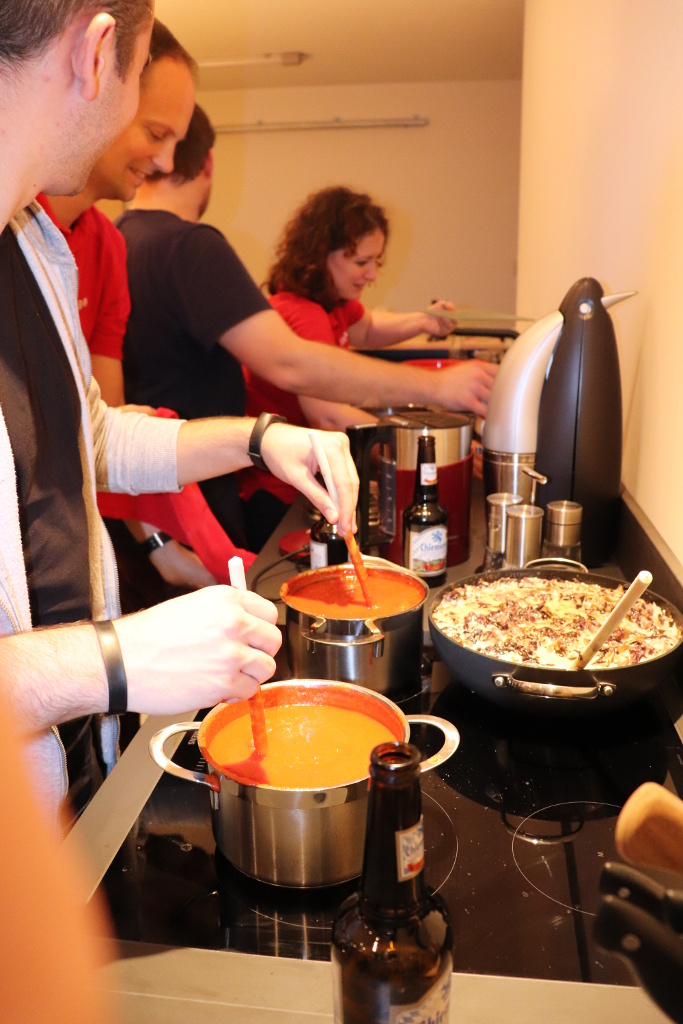
Relaxing with pasta for lunch!

And then time for the group photo…

Having fun at the hackfest in the evening:

Now we’re into the final day! Stay tuned…

LibreOffice Conference 2018: Day 2 in pictures

We welcomed attendees this morning:

Then the opening session began!

Erion Veliaj, Mayor of Tirana, joined us to talk about the importance of free and open source software in the city:

Fun and games at lunchtime:

Björn Michaelsen and Florian Effenberger celebrated 20 years of the Open Source Initiative:

Meanwhile, Heiko Tietze gave a talk about recent user interface improvements in LibreOffice:

See you tomorrow!