Behind the scenes at TDF: LibreOffice major releases

tdf-roadtolo52LibreOffice has a time-based release schedule (https://wiki.documentfoundation.org/ReleasePlan), with a major announcement every six months: early February, and early August. A time-based release schedule is predictable, and as such makes it easier to plan large deployments and subsequent updates.

On the other hand, a major announcement every six months translates to a “project that never sleeps”. In fact, you start thinking about the next major release a few weeks after the previous one is over.

In advance of every release, we listen to end users about requested features and changes requested to support the individual workflow. We do not only listen but iteratively present proposals in order to create a user experience that is in alignment with our long-term vision of being the best free office suite, easy for beginners and powerful for experts.

noun_27464Let’s take the just-released LibreOffice 5.2 as an example of the many activities which have been carried out during five full months – from early March to early August – by several members of the team, and a very large number of community members in every geography.

LibreOffice is available in a large number of native languages (actually, it is the office suite available in the largest number of native languages), thanks to the localization activity carried out by volunteers in many geographies. This activity is extremely important, but is one of the less known, as many of the people involved are more interested in getting the work done than in raising their visibility inside the project.

In early March, the development team consolidates the release plan (https://wiki.documentfoundation.org/ReleasePlan/5.2), and the marketing team sets the release date according to industry events or major software announcements. Of course, the release date might need last minute changes, as in 2015, when the launch of LibreOffice 5.0 was shifted because of the announcement of Windows 10.

From that point on, developers work on finalizing new features, which are usually described in the release notes on the wiki (https://wiki.documentfoundation.org/ReleaseNotes/5.2). Based on that page, and on other sources of information within the project, the marketing team starts to brainstorm about the messaging.

LibreOffice 5.2 has been a rather nice example of successful messaging, as many significant articles on popular media underlined the enterprise focus based on a few specific features like document classification and new Calc financial forecasting functions.

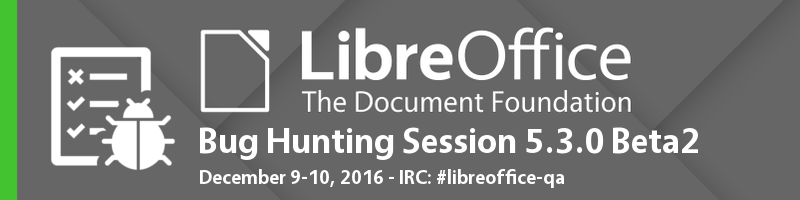
noun_83830_ccAt the same time, the Quality Assurance team – with volunteers active in many geographies on many different language version of the office suite – start testing nightly builds to discover bugs and regressions over previous LibreOffice releases. As soon as Alphas and Betas are available, Quality Assurance volunteers organize global bug hunting sessions (https://wiki.documentfoundation.org/BugHunting_Session_5.2.0_Alpha).

Bug hunting sessions are one or two day “virtual” events, where Quality Assurance volunteers provide their expert support to less skilled users, to help them file reports about bugs and regressions. Although they may look boring on paper, they are usually rather engaging, as most people involved get the distinctive feeling of contributing in a significant way to the success of the new LibreOffice major release.

Bug hunting sessions are usually announced in advance on this blog. Stay tuned for the next one, to test the first Beta of LibreOffice 5.3.

Alphas and Betas are extremely important for the marketing team, too. In fact, they are used to test new features, and to understand their relevance for the upcoming announcement. In some cases, as for the classification feature, the team gathers additional information, to add a background document to the press kit.

When the first Release Candidate is announced, around six weeks before the launch date, most of the back office activities have been completed. At that time, the different teams start to concentrate on the final details, to be ready for the new major release.

Localizers have already completed their activity, and committed all translated strings into the Pootle translation system. Quality Assurance experts are focusing their attention on bugs and regressions which might impact on the release, with the help of developers who are refining new features while getting rid of the last “wrinkles” in the source code.

The marketing team defines the announcement strategy, and the media relations activities for the week prior to the announcement. According to the media angle, they develop a couple of different mailing lists: a smaller one for press briefings where recipients are sent individual messages, and a large one for press releases. In addition, country-specific mailing lists are used for press releases in native languages.

classificationAt the same time, the launch documents go from draft to final: a press release, a technical backgrounder for the classification feature, the image visually explaining classification levels, an infographics for the top feature list, and a slide deck which is going to be used for press briefings.

The last steps are coordinated by team members: release management prepares the builds and loads them on the mirrors, in time for the launch, while marketing hosts the phone press briefings with journalists (with the participation of board members, who provide statements about the new release).

On the launch date, release management switches the links on the download page, while marketing publishes the blog post and sends out the email to TDF members and announce mailing lists (https://blog.documentfoundation.org/blog/2016/08/03/libreoffice-5-2-fresh-released-for-windows-mac-os-and-gnulinux/). In addition, it handles the distribution of press releases in English, and in many other native language translations provided by community volunteers, by using the free open source PHPList.

Each LibreOffice major release is a real team effort, which is possible thanks to the contribution of many people around the world.

Last, but not least, we should not forget companies sitting in the Advisory Board (http://www.documentfoundation.org/governance/advisory-board/), which are supporting the global development effort by employing a large number of full time hackers. In addition, a couple of these companies provide a Long Term Supported version of LibreOffice (at the moment, based on the LibreOffice 5.1 family).

The Document Foundation and the FSFE strengthen their relationship

logoBerlin, 17 August 2016 – The Free Software Foundation Europe (FSFE, https://fsfe.org) is joining the Advisory Board of The Document Foundation. At the same time, The Document Foundation is becoming an associated organisation of the FSFE (https://fsfe.org/associates/associates.en.html).

The Free Software Foundation Europe’s aim is to help people control technology instead of the other way around. However, this is a goal which no single organisation can achieve on its own. Associated organizations are entities that share the FSFE’s vision and support the foundation and Free Software in general by encouraging people to use and develop Free Software, by helping organisations understand how Free Software contributes to freedom, transparency and self-determination, and by removing barriers to Free Software adoption.

With this mutual expression of support, both organisations strengthen each other in their effort to keep the general public in the technological driver seat. While the FSFE embodies the principles of the community movement working in pro of the adoption of Free Software in companies, public administrations and for private citizens, The Document Foundation turns principles and ethics into actual products, putting a first class, full-featured, but completely free productivity suite in the hands of users.

fsfe-summit-logo“We are happy to welcome the Free Software Foundation Europe as a member of our Advisory Board. Together, we will be able to further develop the adoption of Free Software in Europe, amongst public administrations and enterprises”, said Eike Rathke, a Director of The Document Foundation and a long time Free Software advocate and hacker.

“We believe it is important to join forces with all the organisations active in Free Software around Europe,” said Matthias Kirschner, President of the Free Software Foundation Europe, “and work together to reach our common goals. With our associated organisations we want to show that we are a strong and cohesive movement, and we work to achieve common objectives. To do this, we exchange ideas, coordinate efforts, motivate each other, and find opportunities to work together on specific projects. This is the case with The Document Foundation, steward of one of the most successful Free Software projects: LibreOffice”.

Several members of The Document Foundation will join FSFE Summit 2016 in Berlin, from September 2 to September 4, to celebrate FSFE 15th anniversary (https://fsfe.org/community/events/2016/summit/frontpage.en.html).

Getting Started with LibreOffice 5.1, a new book from the community addresses the demand for updated documentation on the software

GS51-GettingStartedLOThe new manual supports the large number of organizations and individuals deploying LibreOffice “Still” 5.1 to get superior quality and stability

Berlin, August 16, 2016 – Volunteers active in LibreOffice Documentation Project within The Document Foundation announce the availability of the Getting Started Guide for LibreOffice 5.1. The book updates the traditional introductory text with the new features provided by the “still” version of the software, targeted to enterprise deployments and to individual users looking for superior quality and stability.

Updated by members of the community, the book is an effort to fill the gap in official documentation for LibreOffice. The Document Foundation is working hard to reduce the delay between the release of the software and its companion documentation, for a better user experience and a stronger competitive offering.

“Many communities consider the Getting Started Guide as a source for translation into their native language, to create localized textbooks for teaching LibreOffice in all environments, from academia to the enterprise,” says Olivier Hallot, documentation coordinator at TDF. “A timely release of these books will send a strong message about the commitment of the community for professional collaterals.”

“In addition to the free downloads of the book in PDF and ODT (editable) forms, users can buy printed copies,” says Jean Hollis Weber, volunteer writer, editor, and publisher of the official LibreOffice guides. “I’ve been working with a great group of other documentation volunteers, but we always need more people.”

To download or buy copies (from Friends of OpenDocument Inc., an Australia-based volunteer organization with members around the world, which supports the LibreOffice project), visit https://www.libreoffice.org/get-help/documentation.

Annual Report 2015

Annual_Report_2016-08-07-page001The Document Foundation (TDF) is proud to announce its 2015 Annual Report, which can be downloaded from the following link: http://tdf.io/report2015 (3.6 MB PDF). The version with HD images can be downloaded from http://tdf.io/report2015hq (22.1 MB PDF).

TDF Annual Report starts with a Review of 2015, with highlights about TDF and LibreOffice, and a summary of financials and budget.

Community, Projects & Events covers the LibreOffice Conference 2015 in Aahrus, Certification, Website and QA, Hackfests in Brussels, Gran Canaria, Cambridge, Hamburg, Terni and Madrid, Native-Language Projects, Infrastructure, Documentation, Marketing and Design.

Software, Development & Code reports about the activities of the Engineering Steering Committee, LibreOffice Development, Google Summer of Code, and the Document Liberation Project.

The last section focuses on People, starting with Top Contributors, followed by TDF Staff, the Board of Directors and the Membership Committee, the Board of Trustees, or the body of TDF Members, and the Advisory Board.

To allow the widest distribution of the document, this is released with a CC BY 3.0 DE License, unless otherwise noted, to TDF Members and free software advocates worldwide.