Update on openSUSE + LibreOffice Conference

Organizers of the openSUSE + LibreOffice Conference had a meeting this week to discuss various topics surrounding COVID19 and how it may affect the conference and planning for it. At this point, it is uncertain what restrictions governments may keep in place in the coming months. While October is some months away, there are many aspects we are considering as to how to run the event, including travel restrictions, flights, hotel and venue availability, event capacity and our community members’ ability to attend the conference. We hope to make a decision about the conference at the latest by mid-June.

In these difficult times, we want to assure our communities that we are actively engaged in a good outcome for all members, sponsors and interested parties involved with a successful openSUSE + LibreOffice Conference. We are looking at alternatives for the conference like possibly doing a virtual conference and exploring what tools might help us to achieve this should we decide it’s a viable option.

Please remember that the Call for Papers is open and people can submit their talks until July 21. We are moving forward, assuming the conference will take place as planned from October 13 to October 16 in Nurnberg, and will keep our communities informed of any decisions we make regarding the plans for the conference and any alternative options like a virtual conference. Stay safe, healthy and strong during these hard times and we hope to see all of you later this year; celebrating together our anniversary under much better circumstances!

Document Freedom Day 2020

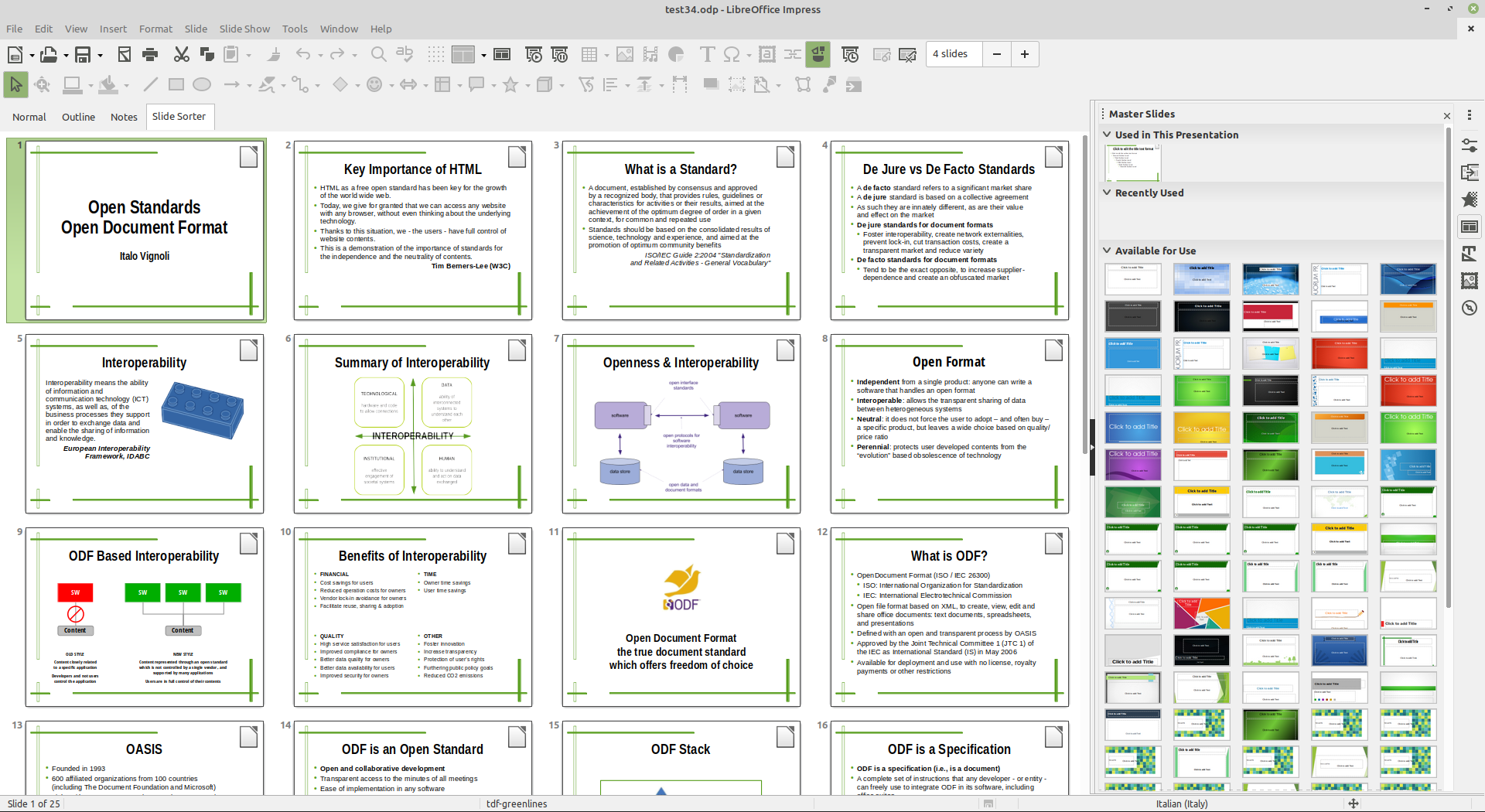
Document Freedom is based on Open Formats, such as ODF or Open Document Format, the ISO standard native file format of LibreOffice and other FOSS office suites.

What is an Open Format?

When you save a document on your computer, it is stored in a computer file. Whether it is a text file, a picture, a video or any other kind of work, it is saved with a specific coded structure, known as the file format.

To be able to share data, software programs must be able to communicate with each other. It implies that no barrier whatsoever may hinder the exchange of data and the related write or read operations. For such a seamless exchange to be possible, software programs are required to be “interoperable”.

Interoperability is guaranteed when it relies on open standards, i.e. public technical specifications, freely usable by everyone, without restriction nor compensation, and maintained by an open decision-making process. File formats based on these open standards are “Open Formats”.

Where software interoperability is set aside, or if a program editor does not give access to the key information for interoperability or if the file design recipe is kept undisclosed, or if the file design recipe is available but is not followed by the program, file formats are considered to be “closed” and do not allow interoperability. For a software user, choosing between an Open File Format or a closed one has a deep impact on the ownership of and the access to his/her own data and their availability over time.

What are the benefits of Open Formats?

  • Open Format documents are readable and writable, by oneself or by third parties.
  • Open Format document readability is guaranteed over time as the format evolves without disruptions.
  • Open Formats have the advantage of being freely usable by many software programs, enabling interoperability.
  • Open Formats support freedom of choice as they do not promote any company’s specific format. They help avoid the monopolistic position of software editors who aim at locking users through their own proprietary formats.

Free Software and open formats, the perfect duo!

Free Software are programs that offer four freedoms to users: the liberty to copy and to distribute the software to others, the right to use it for every kind of use, the right to study it in order to know its functioning, and the right to modify in order to improve it. Free Software designers usually favour existing Open Formats, and contribute to their evolution.

Furthemore, as Free Software developers publish their source code (the software design recipe), recording methods and format descriptions used are de facto distributed with the software.

Open Formats and Free Software share the same goals: to be at the service of eveyone and to ensure users the full ownership and control over their data as well as perennial availability of those data.

Let’s celebrate Document Freedom Day 2020 by sharing with other people the information about the importance of Open Formats. Create your own DFD Dove.

[This text is almost entirely based on a document developed by April (https://www.april.org/en) for a previous Document Freedom Day, and released under Creative Commons Attribution Share Alike 2.0 License]

LibreOffice 6.4.2 available for download

Berlin, March 19, 2020 – The Document Foundation announces the availability of LibreOffice 6.4.2, the 2nd minor release of the LibreOffice 6.4 family, targeted at technology enthusiasts and power users. LibreOffice 6.4.2 includes several bug fixes and improvements to document compatibility.

Mac users will be happy to know that the issue of blurry fonts on Retina displays has been resolved.

LibreOffice 6.4.2 represents the bleeding edge in term of features for open source office suites, and as such is not optimized for enterprise class deployments, where features are less important than robustness. Users wanting a more mature version can download LibreOffice 6.3.5, which includes some months of back-ported fixes.

LibreOffice 6.4.2’s change log pages are available on TDF’s wiki: https://wiki.documentfoundation.org/Releases/6.4.2/RC1 (changed in RC1) and https://wiki.documentfoundation.org/Releases/6.4.2/RC2 (changed in RC2).

LibreOffice’s individual users are helped by a global community of volunteers: https://www.libreoffice.org/get-help/community-support/. On the website and the wiki there are guides, manuals, tutorials and HowTos. Donations help us to make all of these resources available.

LibreOffice in business

For enterprise class deployments, TDF strongly recommend sourcing LibreOffice from one of the ecosystem partners to get long-term supported releases, dedicated assistance, custom new features and other benefits, including Service Level Agreements (SLAs). Also, the work done by ecosystem partners flows back into the LibreOffice project, benefiting everyone.

Also, support for migrations and trainings should be sourced from certified professionals who provide value-added services which extend the reach of the community to the corporate world and offer CIOs and IT managers a solution in line with proprietary offerings.

In fact, LibreOffice – thanks to its mature codebase, rich feature set, strong support for open standards, excellent compatibility and long-term support options from certified partners – represents the ideal solution for businesses that want to regain control of their data and free themselves from vendor lock-in.

Availability of LibreOffice 6.4.2

LibreOffice 6.4.2 is immediately available from the following link: https://www.libreoffice.org/download/. Minimum requirements are specified on the download page. TDF builds of the latest LibreOffice Online source code are available as Docker images: https://hub.docker.com/r/libreoffice/online/.

LibreOffice Online is fundamentally a server-based platform, and should be installed and configured by adding cloud storage and an SSL certificate. It might be considered an enabling technology for the cloud services offered by ISPs or the private cloud of enterprises and large organizations.

All versions of LibreOffice are built with document conversion libraries from the Document Liberation Project: https://www.documentliberation.org.

Support LibreOffice

LibreOffice users are invited to join the community at https://ask.libreoffice.org, where they can get and provide user-to-user support. People willing to contribute their time and professional skills to the project can visit the dedicated website at https://whatcanidoforlibreoffice.org.

LibreOffice users, free software advocates and community members can provide financial support to The Document Foundation with a donation via PayPal, credit card or other tools at https://www.libreoffice.org/donate.

Document Freedom in 2020

In the age of the cloud, most people think they don’t have “real” files any more, as these have been replaced by pointers in an online system. They don’t realise they have lost their freedom until they download the file to edit it on their laptop. At that point, they realize that without buying a proprietary office suite they are unable to access their very own contents, as these are hostage of a proprietary file format. Something that wouln’t have happened if they had chosen the standard Open Document Format (ODF), which can be fully implemented by any software vendor without special permission, and without having to reverse engineer an obfuscated pseudo-standard format owned by a single company.

Back in 2012, European Commission Vice President Neelie Kroes said: “Open standards create competition, lead to innovation, and save money,” while announcing the publication of a new policy to help public authorities avoid dependence on a single ICT supplier. At the time, following the recommendations of the new approach against lock-in could save the EU’s public sector more than € 1.1 billion a year.

Working with open standards – rather than specifying a single ICT brand, tool, system, or product – when procuring ICT systems could save taxpayers’ money. However, many organisations were either lacking the expertise to decide which standards are relevant to their ICT needs, or fearing that the initial costs of change would be too costly and might lead to loss of data. As a result, after eight years they still remain locked into their ICT systems or into a relationship with only one provider. How much are we globally losing – in term of end user or taxpayer money – by sticking to the insane decision of using proprietary or pseudo-standard document formats?

Open Document Format is a well designed and flexible open document standard format to store information in a future proof and portable way. Probably its best feature for regular users is that they won’t really notice they are using it, as things just work as expected independently from the specific product used to create the original document. Contents are preserved, and the document has the same visual look even when accessed with a different software running on a different operating system, as with ODF the way you store documents is not related to the software you work with. ODF files are platform independent and do not rely on any specific piece of software whatsoever.

Open Document Format does have a number of obvious advantages which make it unique:

  • ODF documents are smaller in size than their legacy and proprietary equivalents, because they are structurally simpler, and as such are more robust
  • Content as well as media objects (images, movies, etc) are directly accessible and easy to work with from outside the office application, even for non technical users
  • The simple XML syntax is human readable and easy to understand, and this allows to easily recover documents by unzipping the file and access the content directly
  • ODF is more secure, as the light-weight structure makes it easier than ever to enforce even the strictest security policies
  • ODF reuses a large number of existing standards whereever possible, and this makes the standard smaller, more robust, easier and cheaper to implement and support
  • Smart technical users can easily add machine processable data to the content of the document, to create “smart documents” with can be populated automatically
  • The well-defined and concise OpenFormula standard for spreadsheet formulas gets rid of legacy bugs known to spreadsheets, including the 43 year old leap year bug

Key benefits for enterprises and government bodies include:

  • ODF is an open and durable standard, and as such can ensure that a document saved today will not be technologically locked or abandoned tomorrow, and it will be always possible to access contents independently from any vendors’ commercial strategies
  • ODF keeps contents (information) separated from the application used to develop it, so that any document can be processed by any applications seamlessly and with fidelity, without interference of any proprietary code or any other restrictions
  • Because ODF is a truly open standard, it levels the playing field for multiple software providers to compete on functionality and price, and provides greater choice due to competition among vendors, including both proprietary and open source applications
  • ODF provides a platform-independent format on which any company can build and distribute new applications and services, while ensuring that documents will remain accessible even after innovations have been added thanks to the base-line open standard
  • ODF is the only open, XML-based document file format currently on the market that satisfies the basic need of enterprises and governments to access documents of potential historical
    significance, created and stored in digital form, not only today but also for future generations
  • The adoption of ODF is also compelling in the context of emergency situations, to guarantee the possibility of accessing and sharing information essential to the relief efforts without having to worry about the characteristics of the original document

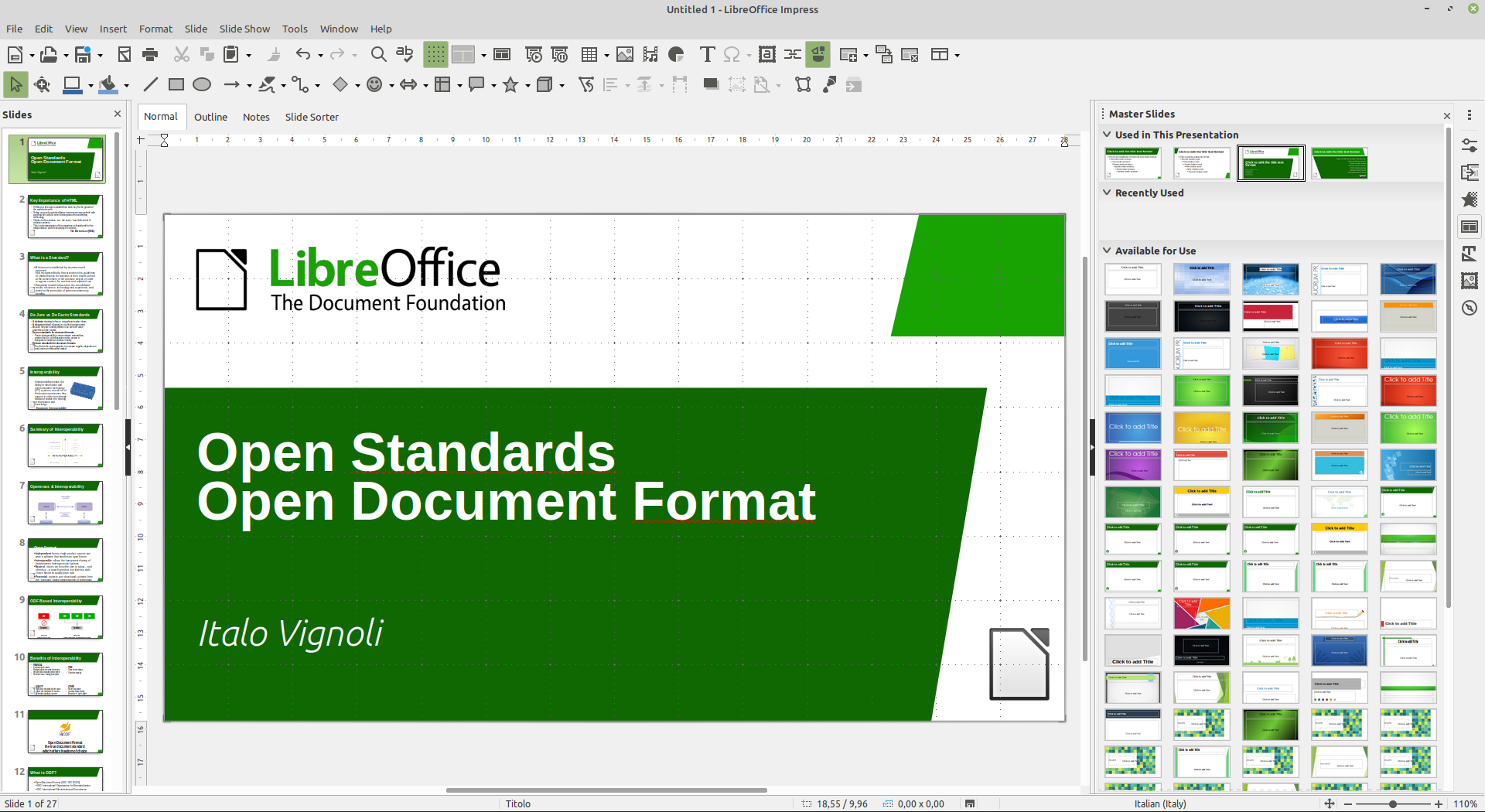
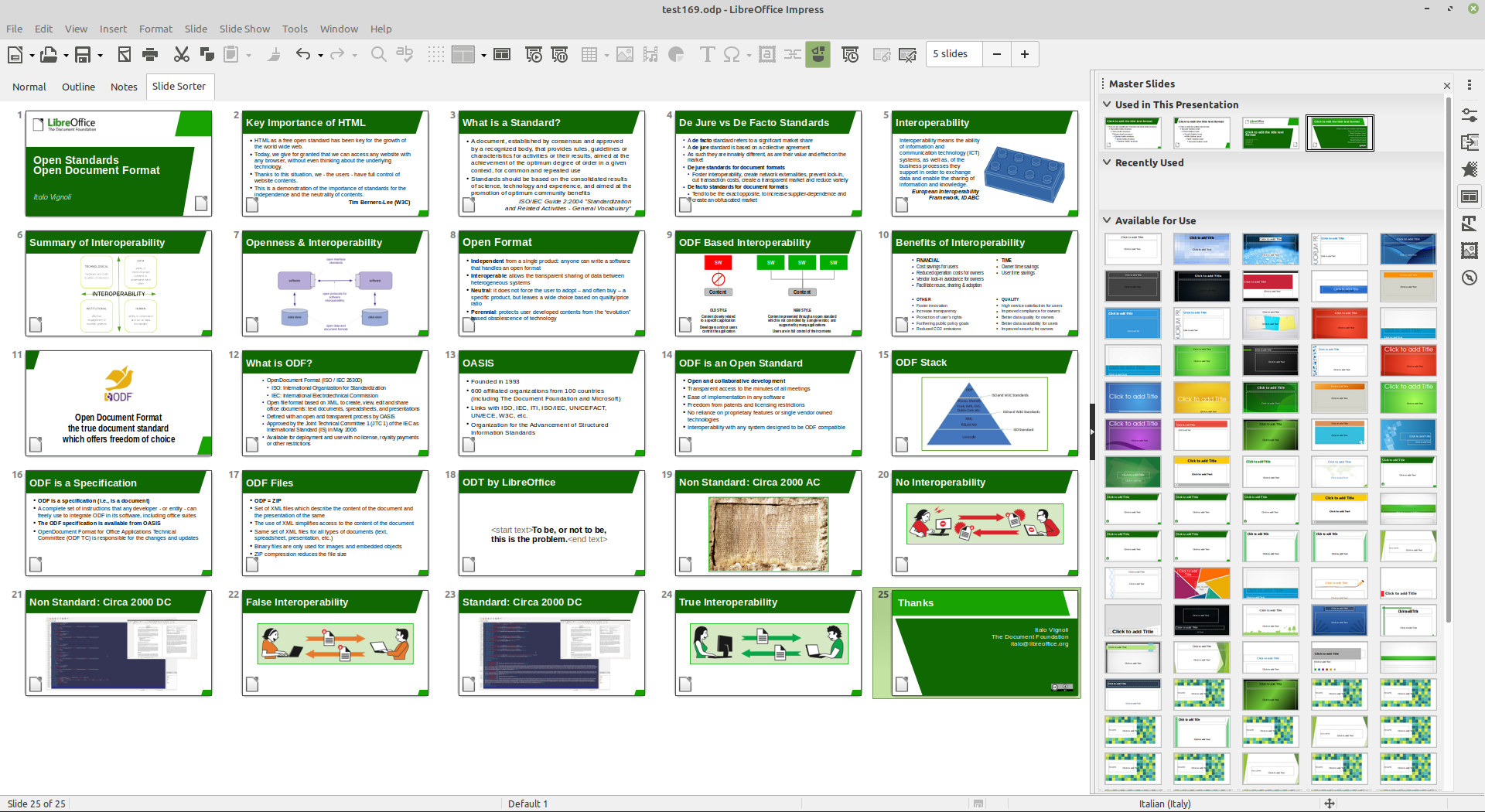
To learn about ODF, you can start from Wikipedia, or read the white paper Open by Design, The Advantages of the OpenDocument Format (ODF), by the OASIS ODF Adoption TC (now replaced by the ODF Advocacy Open Project at OASIS). Here you can find other documents about ODF and its advantages: Open Forum Europe – Dual Standards More Choice or LessItalo Vignoli – Keep it Open, and a comprehensive slide deck about Open Document Format.

The Cabinet Office of the UK Government, who has decided to adopt ODF as the reference standard for all documents, has published an interesting Policy Paper on Open Standard Principles and a Guidance on Using Open Document Formats (ODF) in your organisation, which provide an interesting point of view about the specific advantages of open standards and ODF for governments.

In a week from now, on March 25, we will celebrate the Document Freedom Day, to educate organizations and users about the importance of adopting an open document standard to get back the full ownership of documents and contents that they have developed, and then have – often unconsciously – left in the hands of a proprietary software vendor. This, independently from the fact that documents are in the cloud or on their local hard disk.

In the next few days, we will publish some images for all of us to share on blog posts and social media on March 25. Stay tuned!

TDF new Board of Directors

TDF Board of Directors (old and new), Membership Committee and Team members in Brussels, just before FOSDEM 2020 (Marina Latini and Sophie Gautier arrived after the meeting, while Osvaldo Gervasi did not attend FOSDEM, so they are all missing from the picture)

The new Board of Directors of The Document Foundation has just started the two year term on February 18, 2020. Members are: Michael Meeks, Thorsten Behrens, Franklin Weng, Daniel Rodriguez, Cor Nouws, Lothar Becker and Emiliano Vavassori. Deputies are: Nicolas Christener and Paolo Vecchi.

Five people have been elected for the first time to the Board of Directors: Daniel Armando Rodriguez from Posadas in Argentina; Lothar Becker from Karlsruhe in Germany; Emiliano Vavassori from Bergamo in Italy; Nicholas Christener from Bern in Switzerland; and Paolo Vecchi from Luxembourg (in Luxembourg).

During the first meeting of the Board of Directors, the nine members have elected Lothar Becker as Chairman and Franklin Weng as Deputy Chairman. In the meantime, also the responsibilities and areas of oversight have been discussed and decided.

At the same time, six people – who have served as board members and deputies during the previous term(s) – have left the board, but will continue their activity as TDF Members: Marina Latini, Chairwoman; Björn Michaelsen, Deputy Chairman; Eike Rathke, Member; and Jan Holešovský, Simon Phipps and Osvaldo Gervasi, Deputies.

Each one of these six people was responsible for several BoD activities:

  • Marina Latini: QA, Documentation, and Certification (and other business development activities) after four years of service (BoD);
  • Björn Michaelsen: Releases (including schedules), Events, and Affiliations after eight years of service (BoD);
  • Eike Rathke: Development, and Contracts/Legal (hiring, taxes, compliance, GDPR, trademarks and brands) after eight years of service (BoD/MC);
  • Jan Holešovský: Infrastructure, and Documentation after six years of service (BoD/MC);
  • Simon Phipps: License, Affiliations, and Contracts/Legal (hiring, taxes, compliance, GDPR, trademarks and brands) after six years of service (BoD/MC);
  • Osvaldo Gervasi: Documentation, and Native Language Projects (localization, marketing, non-English QA activities, etc) after four years of service (BoD).

Being a Board member means donating each year several weeks of activity to TDF – for full day face-to-face meetings (twice a year, at FOSDEM in Brussels and LibOCon), and for bi-weekly calls (which usually last a couple of hours) – to manage the foundation and administer the budget, mostly based on donations.

We are deeply grateful to all of these for their dedication, contribution to decision making and for all of their volunteer time spent in BoD duties, as well as for their ongoing contribution to the project.