LibreOffice community focus: QA (quality assurance)

With LibreOffice 6.0 due to be released at the end of the month, we’ve been talking to various communities involved in the project. In the last couple of weeks, we’ve chatted with the localisation and documentation teams, and today it’s the turn of QA (quality assurance), which is coordinated by Xisco Fauli

What has the QA community been working on in preparation for LibreOffice 6.0?

During the development of LibreOffice 6.0, three Bug Hunting Sessions were held (6.0 Alpha1, 6.0 Beta1 and RC1), the last one just two weeks ago. There was also a parallel event organized by Muhammet Kara in Ankara, where volunteers gathered to test LibreOffice 6.0 RC1. Besides that, the QA team is constantly testing the latest daily builds, testing new features, and triaging the bugs reported on Bugzilla.

What are your favourite new features in this release?

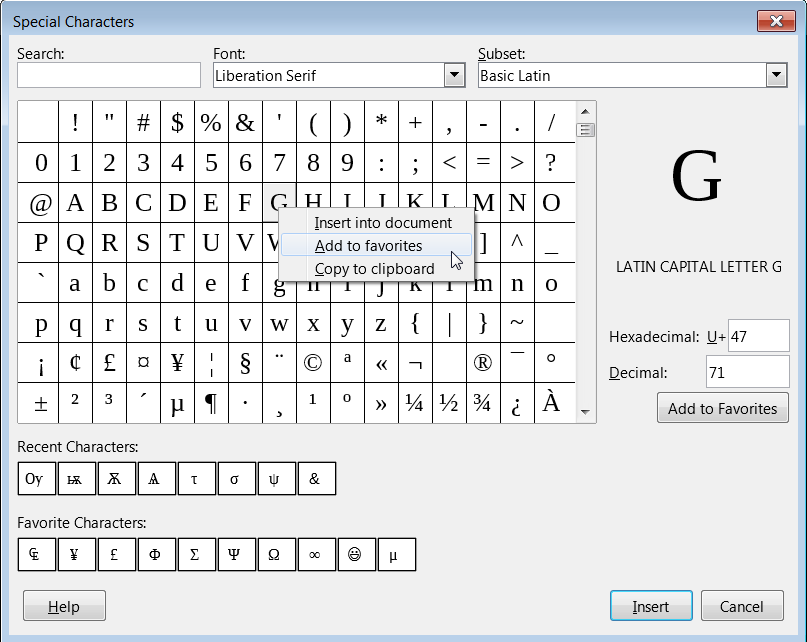
That’s a difficult question, especially taking into account all the improvements done in this release to LibreOffice Android Viewer, to LibreOffice Online or the work done by the Google Summer of Code students among others. But if I had to choose one, I think I’d go for the characters dialog refactoring done by Akshay Deep and the UX (user experience) team, as this is probably the feature I will use the most in the near future. Here’s how it looks:
What tools and services do you use in the QA community?

A very handy tool recently completed by Markus Mohrhard is the automated updater for Windows and Linux, which allows the QA team to test daily builds without having to manually download the latest build every time.

This is very practical as testers no longer need to worry about constantly updating to the latest build, and can focus more on testing the program instead, assured that they are testing changes done to the code just the day before.

This tool was presented at the beginning of the LibreOffice 6.0 development cycle, and I believe it will have a very positive impact on the quality of 6.0 as it shortens the time between a problem being introduced in the code, and the time it’s found.

Another tool we’ve been using for some time now is the bibisect repositories, which allow us to find the exact code commit where a bug was introduced, increasing the chances that the bug gets fixed and reducing the time until it gets fixed.

Another tool which is fulling working now is a set of scripts called office-interoperability-tools that we use to automatically find document layout regressions in the master code branch compared to other office suites (in our case we use MS Office). Right now we use it with 8,450 files, and I believe it will also have a positive impact on the quality of LibreOffice 6.0.

Finally, it’s important to mention the main tool used in QA, Bugzilla, the place where all bugs are reported and triaged. Then there’s the wiki page where the QA documentation can be found, and testlink, the application to manage manual tests.

Finally, how can people get involved with the QA community?

The’re many ways one can help LibreOffice QA. Probably the simplest one would be: download the latest pre-release build (LibreOffice 6.0 RC2 as of today), install it and use it as you would use LibreOffice in your daily basis (but take into account it’s still a pre-release, so it’s not recommended to use it with important documents). If you find anything working incorrectly, please report it to Bugzilla.

On the other hand, if you prefer to follow a set of manual tests, you can use testlink (see the documentation for that. We also need help to triage bugs that are not-yet-confirmed, or retest old bugs to see if they might have been fixed.

Lastly, if you’re looking for something especially exciting things to do, you can help us to test daily builds, bisect bugs or write UI-tests. Don’t hesitate to join the #libreoffice-qa channel and say hello. We’ll be grateful to help you with any question or problem you have!

Much gratitude to Xisco and the diligent QA community for helping to make LibreOffice 6.0 a solid release. Their efforts are appreciated by users across the world. Next up, we talk to the design and development communities – more on this blog very soon…

Tender for consultancy on LibreOffice feature implementation incl. on-site development training (#201801-01)

The Document Foundation (TDF), the charitable entity behind the world’s leading free office suite LibreOffice, seeks for companies or individuals to

provide consultancy on implementing features in LibreOffice

to start work as soon as possible. TDF is looking for an individual or company to give technical consultancy on the implementation of one or more of the following:

As part of the tender, TDF is explicitly looking into on-site development training on these topics for the community to share knowledge and enable contributors to get involved. This training is to be delivered during the next LibreOffice Hackfest in Hamburg (April 7-8, 2018)

  • both in groups not larger than four people, ideally via pair programming
  • as well as a public presentation during the event
  • the latter one will also be published by TDF as recording for reference

More details on this approach can be found at https://listarchives.documentfoundation.org/www/board-discuss/msg03988.html

Required skills

  • Extensive knowledge of C++
  • Experience working on the LibreOffice source code
  • Available for a two day in-person meeting at the next Hackfest in Hamburg (April 7-8, 2018)
  • Available for preparation and aftermath coordinating with a community member over email and/or video conference software (approx. 1-2 additional man days).

We exclusively use free, libre and open source (FLOSS) software for development wherever possible, and the resulting work must be licensed under the the Mozilla Public License v2.0.

Other skills

  • English (Conversationally fluent in order to coordinate and plan with members of TDF)

Applications should

  • contain a maximum of 300 words on the developer you intend to send to the Hackfest as consultant
  • contain a maximum of 300 words on the issue the developer intends to help implementing

TDF welcomes applications from all suitably qualified persons regardless of their race, sex, disability, religion/belief, sexual orientation or age.

As always, TDF will give some preference to individuals who have previously shown a commitment to TDF, including but not limited to certified developers and/or members of TDF. Not being a member, or never having contributed before, does not exclude any applicants from consideration.

The task offered is a project-based one-off, with no immediate plans to a mid- or long-term contractual relationship. It is offered on a freelance, project basis. Individuals and companies applying can be located anywhere in the world.

TDF is looking forward to receiving your applications, your financial expectations and the earliest date of your availability, via e-mail to Florian Effenberger at floeff@documentfoundation.org no later than February 5, 2018. You can encrypt your message via PGP/GnuPG.

Applicants who have not received feedback by February 18, 2018 should consider that their application, after careful review, was not accepted.

Sunday Marketing #2

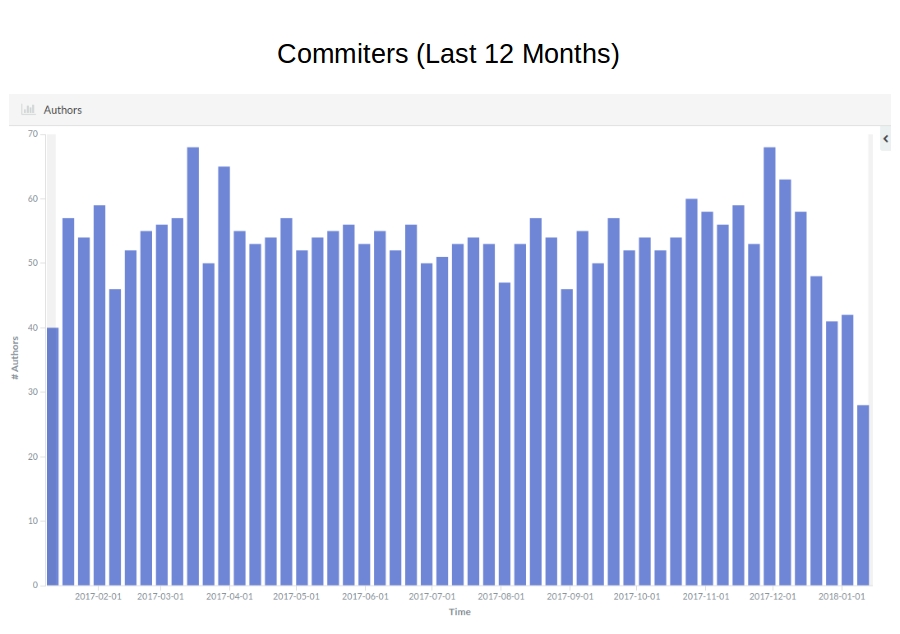
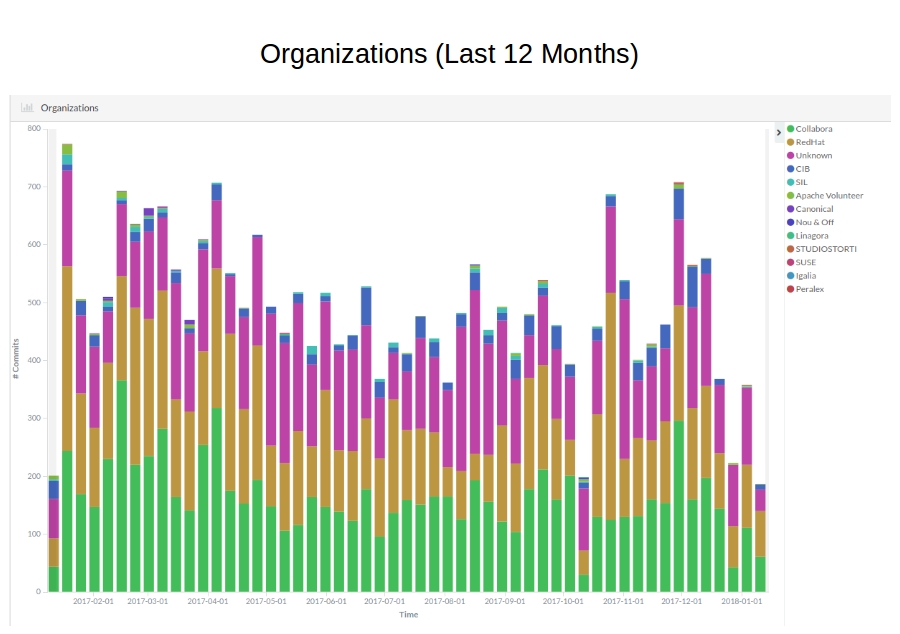
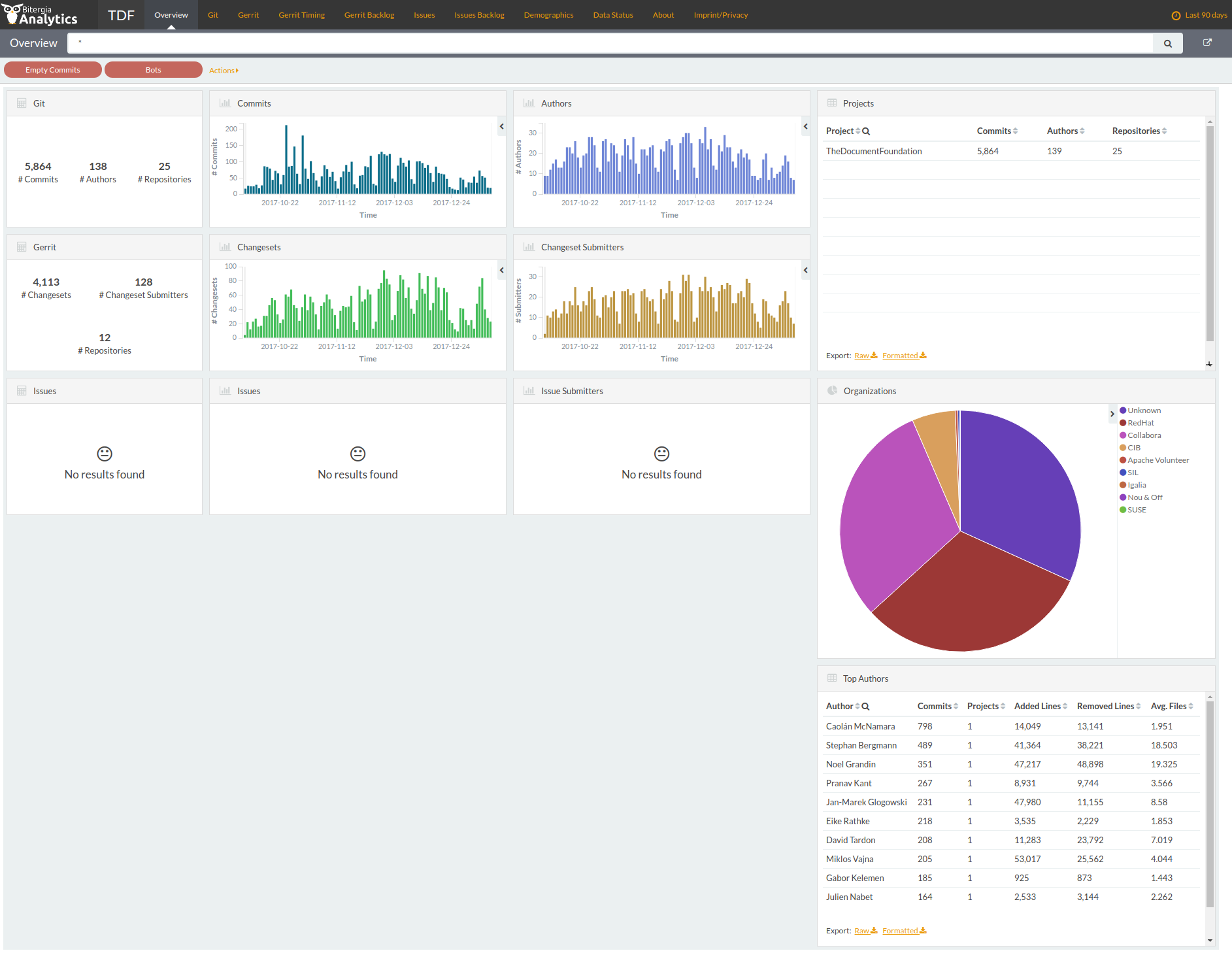
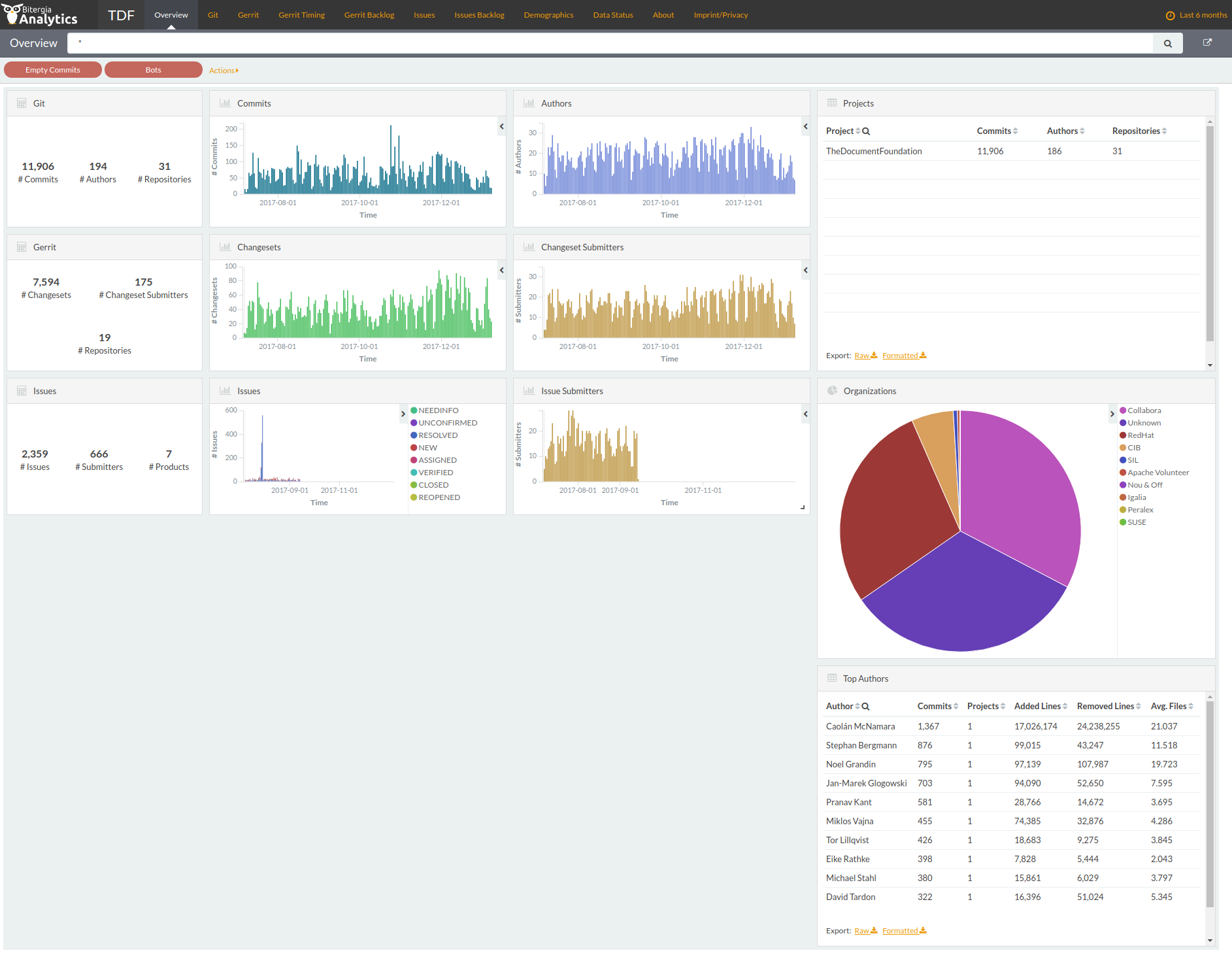
In 2017, The Document Foundation has announced the availability of a Dashboard, based on data gathered from several development-related repositories. It is a very useful resource for marketing, as it can be configured to provide either an overview of the project or several detailed charts which can be used to get a more precise picture of what has happened in term of commits, committers, organizations, and issues. The time span covered by the dashboard can be set by the user, from days to years.

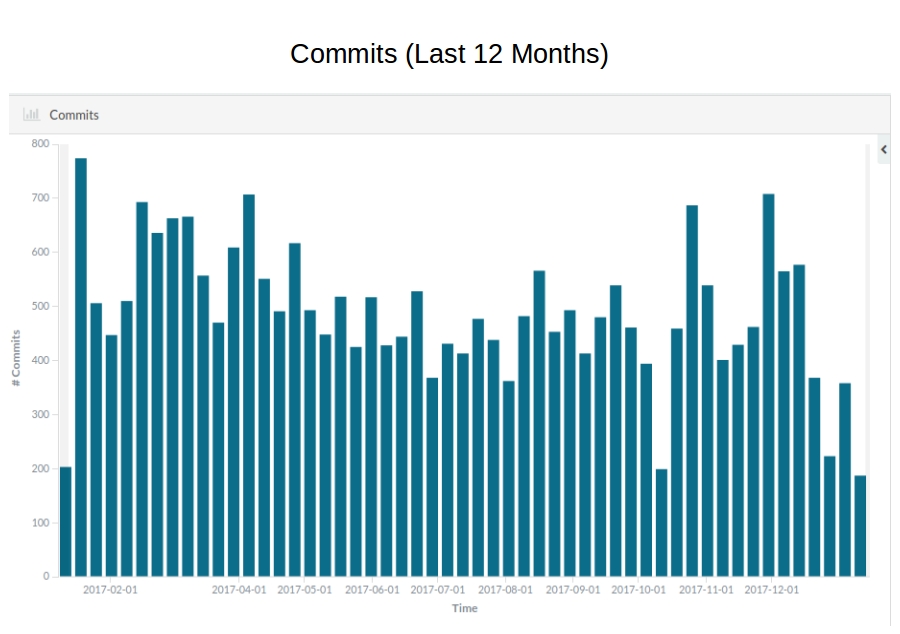
The three histograms show trends related to commits, committers and organizations during the last 12 months (clicking on the thumbnails will open a large image, easier to read).

Commits and committers show a rather stable trend, which confirms the maturity of the project. The very few lows in commits are either seasonal or related to the LibreOffice Conference, when core developers are spending most of their time on knowledge sharing rather than on code hacking.

The organizations’ histogram adds the affiliation bit to commits. Collabora, Red Hat and independent volunteer developers (marked as “unknown” in the legend) are the three largest group of contributors, followed by CIB and SIL. Of course, we would like to see more contributions from developers paid by large organizations deploying LibreOffice for personal productivity.

The following four thumbnails show the dashboard home configured for the following time intervals: 2 years, 1 year, 6 months and 90 days. They provide some interesting insights.

Wednesday Community #1

Our global community of volunteers, represented by The Document Foundation and based on many independent native language projects, is one of the main strengths of LibreOffice. Starting from today, we launch a new weekly blog post – scheduled on Wednesday – focused on community activities: events, seminars, conferences, projects with schools and central or local government bodies, achievements, etcetera. We want to show the world how diverse and inclusive is our community, and at the same time we want our community members to be proud of being part of it.

One of the largest and strongest LibreOffice communities is based in Indonesia. From March 23 to March 25, 2018, they will organize their first LibreOffice Conference Indonesia in Surabaya: 3 days of meetings based on Workshops, Seminars, Discussions about The Document Foundation, and gathering of LibreOffice advocates and activists. The event is also intended to be a form of thanks to LibreOffice developers who have provided the outstanding free software solution.

LibreOffice Conference Indonesia will be hosted by the Politeknik Elektronika Negeri Surabaya. The event will start on March 23 with a workshop focused on testing LibreOffice builds and localizations, and will follow on March 24 with a full day of seminars on everything LibreOffice, from an introduction to LibreOffice 6.0 to success stories and technical talks. The last day, March 25, will be dedicated to the meeting of LibreOffice Indonesian community members. Call for Papers is already open, and will close on February 8, 2018.

LibreOffice community focus: Documentation

Earlier this month we talked to the localisation community about the preparations they are making for LibreOffice 6.0, which is due to be released in late January (or early February). Now we turn to the documentation project, and Olivier Hallot, who is coordinating updates to guidebooks and a new help system…

olivier_hallot_07062010_964x1036What has the documentation community been working on in preparation for LibreOffice 6.0?
The community is engaged in delivering two major features for the 6.0 release: the first is a new and updated Getting Started Guide, a book targeted at new users of LibreOffice 6.0. We included the latest developments that are in the scope of an introductory text for LibreOffice 6.0. For 2018 we are assembling a team of writers to update our other guides, starting with the Calc Guide.

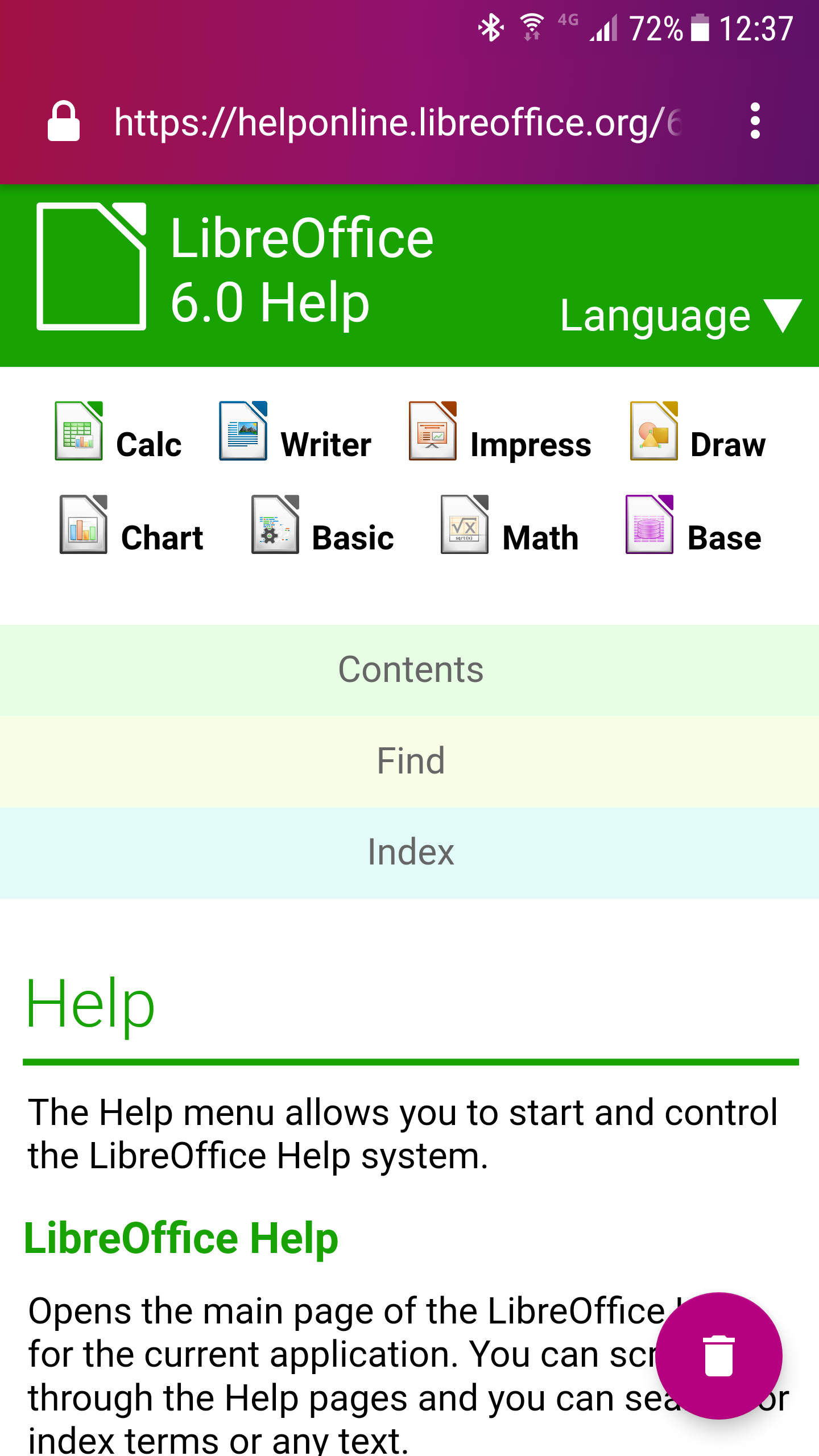
The other major feature is the new LibreOffice help system, a completely redesigned help system that now uses the operating system’s web browser to display help pages. Here’s a screenshot from the LibreOffice 6.0 release notes, showing how it looks in a mobile web browser:

What are your favourite new features in this release?

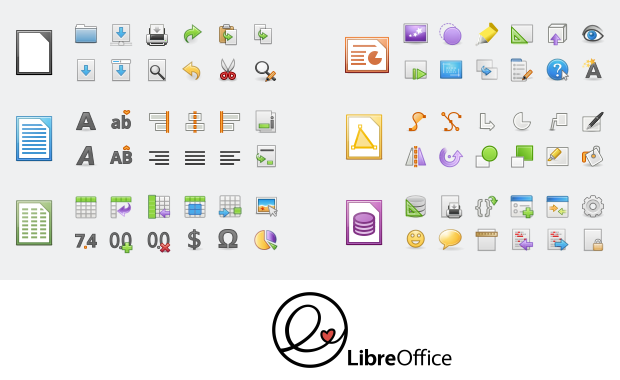
I always appreciate applications that have beautiful aesthetics. When choosing between two applications or desktop environments with the same features, I take the one that’s good-looking and has a well-crafted user interface. There are so many excellent programs with clumsy interfaces or ugly aesthetics struggling to survive. It is purely subjective but in the end, beauty pays. So my take for 6.0 are the features that bring a better and nicer UI: new icons, toolbars and redesigned dialogs. Here’s a preview of the Elementary icon set, which will be included in 6.0:

Aesthetics, together with essential technology evolutions, were the drive to develop our new help system based on web technology. We expect to open an avenue for improving the contents of our help with multimedia, animations and better navigation – altogether bringing a modern web experience for our users who are reading the help.

What tools and services do you use in the documentation community?

At the moment we use Plone as our document repository, and we have a workflow for editing, revision and publication. Released documents are available on our documentation website for download, and some l10n (localisation) communities prefer to use the TDF wiki.

With the recent developments in LibreOffice Online, I am planning to use it for document editing and production, in a simpler way than using Plone. LibreOffice Online is by far the best online editor for OpenDocument formatted files, and is an essential feature for preserving our current documents and making editing easier.

For 2018, we will work to develop an special online editor for help files, making it easier for occasional contributors to make changes to the content.

Finally, how can people get involved with the documentation community?

The first step is to read this page and follow the instructions there. We need good software documenters, along with people who really know how an office suite works, and who are capable of writing about new features with authority.

Thanks Olivier, and thanks to the whole documentation community for their work in LibreOffice 6.0. Over the next few weeks, we’ll be talking to other projects, including QA and development – keep checking this blog for updates.

Sunday Marketing #1

Starting from today, we launch a weekly blog post focused on marketing topics. We will try to provide ammunition to community members advocating LibreOffice and the Open Document Format, and food for thought to people still trying to understand the viability of FOSS on the desktop.

Let’s start with some numbers about LibreOffice.

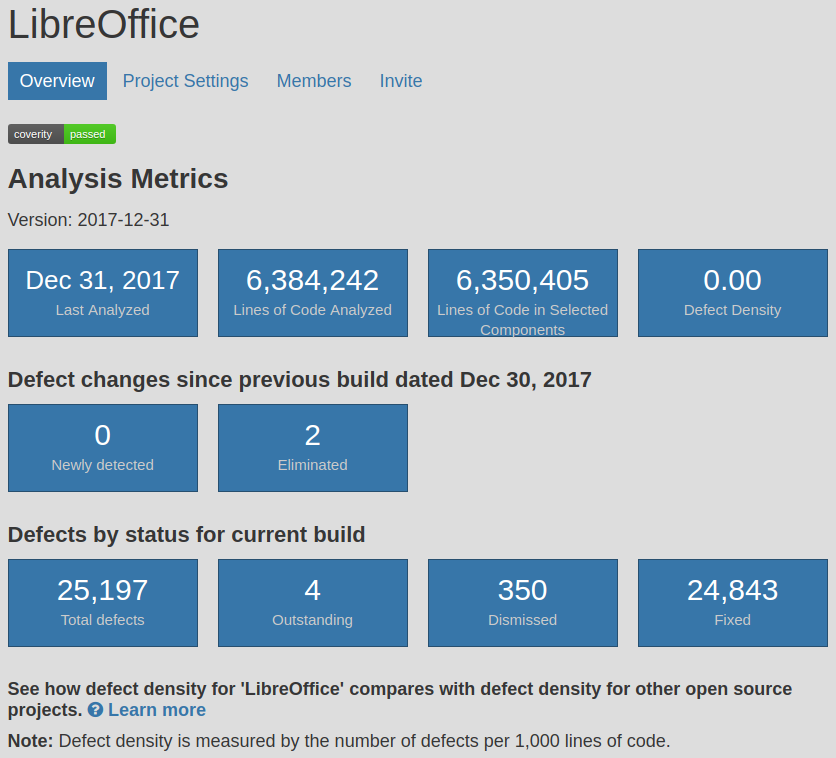
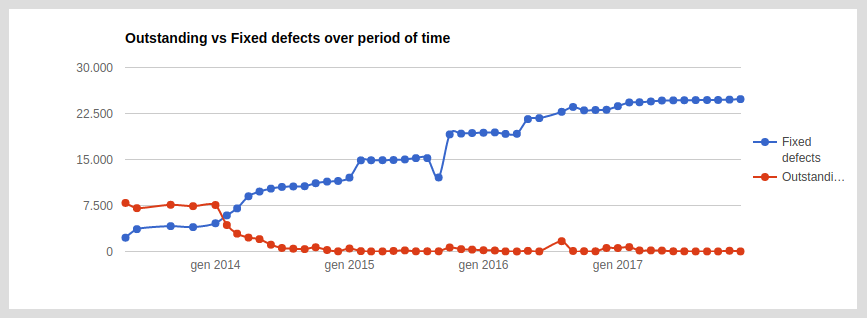
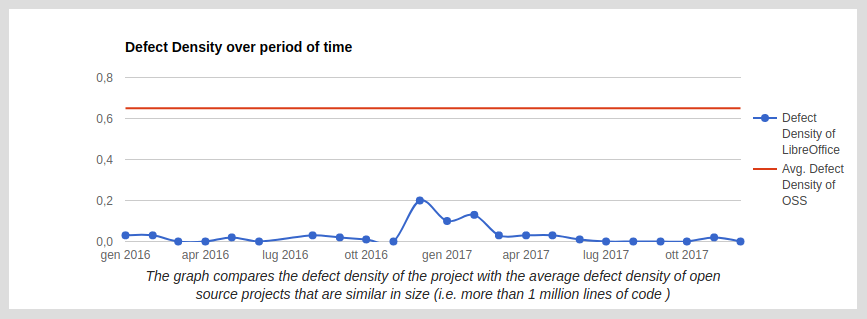
Although LibreOffice defect density score – according to Coverity Scan – has been around 0.00 per 1,000 lines of code for ages, we should never forget that it is the outstanding result of the commitment to quality of LibreOffice developers (and we should always mention it with pride when we present the software).

The bulk of the activity related to Coverity Scan weekly reports is under the responsibility of Red Hat developers, but we cannot forget that the result is related to the quality of the entire development process. Of course, LibreOffice – as any other software – is not immune from bugs and regressions, but improvements with every new version have been acknowledged by both enterprise and individual users.

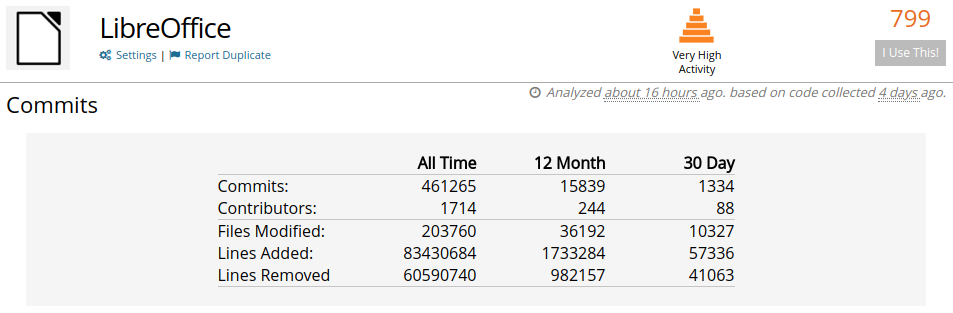
Let’s have a look at development numbers provided by OpenHub. During the last 12 months (2017) there have been 15,389 commits by 244 contributors, and during the last 30 days (December 2017) there have been 1,334 commits by 88 contributors. The chart on the left shows that during the last three years the monthly number of contributors has been rather stable, with highs close to 100 and lows close to 75.

After Coverity Scan and OpenHub, which are independent sources, next week we will analyze an internal tool for the analysis of development-related information: TDF Dashboard.