LibreOffice contributor interview: Edmund Laugasson
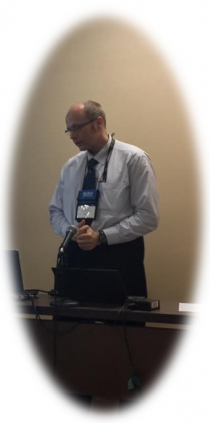
Edmund Laugasson

LibreOffice is being used in governments and companies around the world, and this is largely thanks to support and advocacy from local communities and developers. Today we’re talking to Edmund Laugasson, a member of the Estonian LibreOffice community, who is promoting the software and the Open Document Format (ODF) in his country…

How popular is Free, Libre and Open Source Software (FLOSS) and LibreOffice in Estonia?

To be honest, it has not yet been deeply investigated, but the Estonian Ministry of Economic Affairs and Communications has published a “State Information System Interoperability Framework” (in Estonian) where clearly ODF is the main format suggested to use. The status of OOXML is only “allowed”. OOXML should not be confused with the file formats used by MS Office, which differs from OOXML by several proprietary changes. Even LibreOffice offers two different versions to save, e.g. docx – one is OOXML and the another one is used in MS Word. The same applies also to rest of OOXML, MS Office formats that coexist in LibreOffice. As the status of ODF is “suggested”, it is not mandatory. Despite that, ODF is quite widely used – for instance, educational institutions usually have LibreOffice installed, along with some local authorities.

Research is quite challenging as people usually do not respond to questionnaires, and researchers need to meet people directly in order to get reliable answers to questions.

What is your background and involvement in FLOSS?

I live in a small city called Rapla in Estonia, but I work as a lecturer at IT College, which is part of the Tallinn University of Technology. I am involved in FLOSS in many ways. When teaching, I use FLOSS as much as possible: the operating system in university is Ubuntu Linux, and I use derivates like Linux Mint MATE, all 64-bit and the latest LTS (Long Term Support) versions. The office suite is LibreOffice everywhere under GNU/Linux but under MS Windows next to MS Office. It is very important to have LibreOffice installed on every operating system that is used. Also, at least ODF file formats should be opened by LibreOffice by default. Then it would be much easier to deploy ODF in future when the ground is prepared properly. We have a dual-boot system (Microsoft Windows 10 and Ubuntu Linux 16.04.4), and in one classroom also a triple-boot (with macOS 10.12).

In addition I am involved as a board member of the Estonian Free and Open-Source Software Association, taking care of FLOSS in general in Estonia. Also I am involved in the Network of Estonian Teachers of Informatics and Computer Science (NETICS) as a board member. There I promote FLOSS – LibreOffice in particular – to encourage people to use it.
The next involvement is my doctoral studies at Tallinn University, where the current topic is “Technology approval as a factor of adopting a free software ecosystem”.

Further activities will come when I graduate and can focus more on wider deployments of FLOSS, particularly LibreOffice. I have serious plans to arrange all this, but as people in Estonia are not very cooperative, it takes more time – regardless of the fact that Estonia is small. Lots of people just do not believe in better future full of FLOSS, and those few who still believe, will act towards that goal. So to anyone who feels the FLOSS spark inside: do not hesitate to contact me.

What do you think are the biggest obstacles to wider FLOSS and LibreOffice adoption in Estonia?

My first paper in 2013 (published at the IFIP conference) showed that awareness of FLOSS is still relatively low, but interest in getting more information is quite high. Microsoft is doing relatively strong lobbying work, also in Estonia, and the government has quite weak power regarding FLOSS. There is also sometimes controversial behaviour: five state-arranged procurements in the FLOSS field (four state procurements relating to LibreOffice, one state procurement to create an interoperability framework), but weak activities around FLOSS in general. So I decided to start my doctoral studies to fix this situation in a scientific (weighted) way.

Thanks to Edmund for his time and effort helping the FLOSS cause. Click here to see many more interviews from LibreOffice contributors – and why not become one yourself! Build up skills, join a friendly community, and help to make LibreOffice better for everyone.
Report of LibreOffice Conference Indonesia

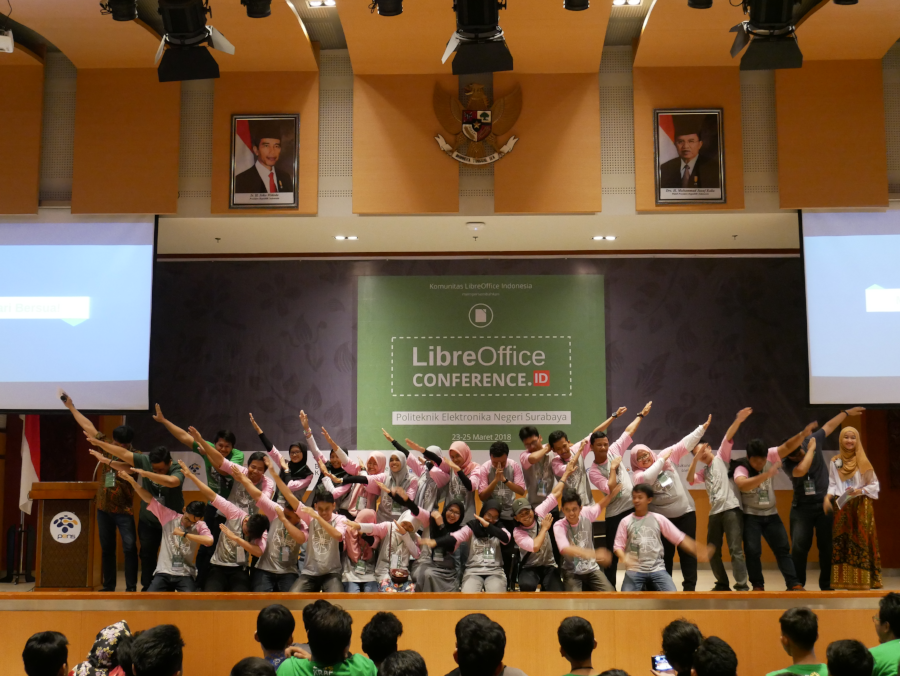
I have attended LibreOffice Conference Indonesia on Saturday, March 25, and Sunday, March 26. The event, hosted by Politeknik Elektronika Negeri Surabaya (PENS), has been the first of its kind in South East Asia, and I hope it will be followed by many similar events in other countries in the region. Of course, the concept of local LibreOffice Conferences in Asia has been launched by the Japanese community, which is a leading example of commitment.

The day before the conference the Indonesia LibreOffice community has organized a localization workshop, led by Andika Triwidada, a long time contributor which has coordinated the Indonesia localization since almost forever.

The day after the conference we have visited the outskirts of Surabaya, with magnificent memories of the past. We have also visited the famous Sampoerna cigarette factory in Surabaya.

On Tuesday, in the morning we have had a meeting with a group of PENS’ IT professors, led by the university dean, with whom we have discussed the opportunity of increasing the presence of open source software in their syllabus. In addition, the university is going to evaluate the migration to open source software and LibreOffice, including the migration to ODF as a way to overcome vendor’s lock-in.

In the afternoon, Frankling Weng and me have keynoted in front of a large student audience about getting involved in open source, and have been followed by Ahmad Haris – the amazing conference coordinator – with a workshop in Indonesian on open source software. Haris has already provided a report in English about the conference, where he offers several insights on the organization. In addition, pictures of the entire event are available on Flickr.

The conference has been a fantastic learning opportunity for me, especially in terms of better understanding local communities in Asia. Last year, I started my full immersion in this topic when I visited Taiwan to attend COSCUP and meet the local community and the country’s Ministry of Innovation, Audrey Tang. Participating in local community events is very important to strengthen the ties between The Document Foundation core team – Board of Directors, Membership Committee and staff members – and LibreOffice incredible global community.

As I said several times during my talks, I have learned more about the community during the four days spent in Surabaya than in weeks of email and social media interactions. Of course, they are both important, but the human face-to-face relation is still invaluable in terms of relationship building. I hope to be able to attend similar events in the future, in other countries in Asia, South America and Africa.

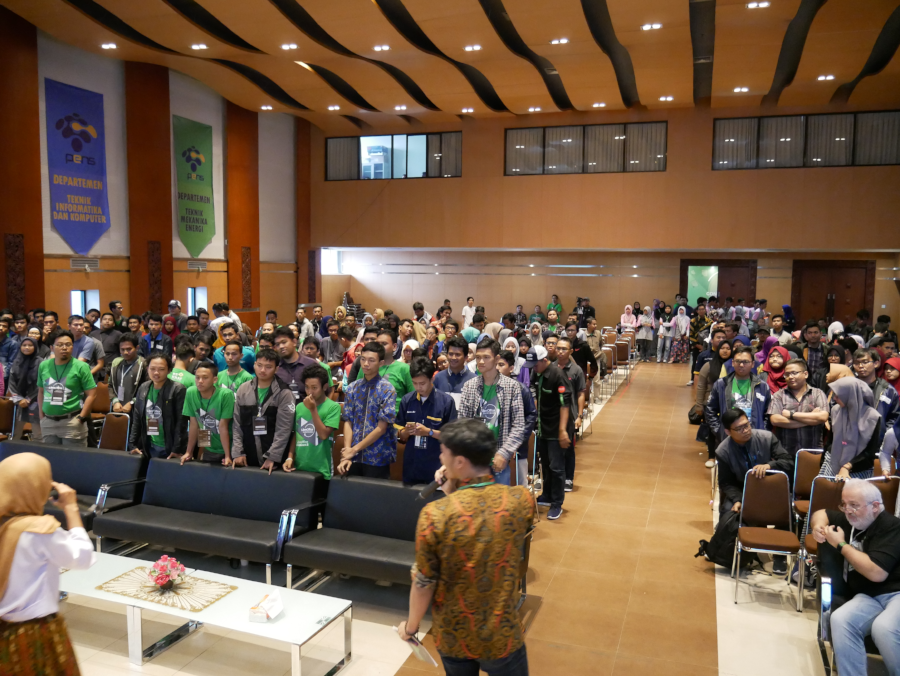
The crowd at LibreOffice Conference Indonesia
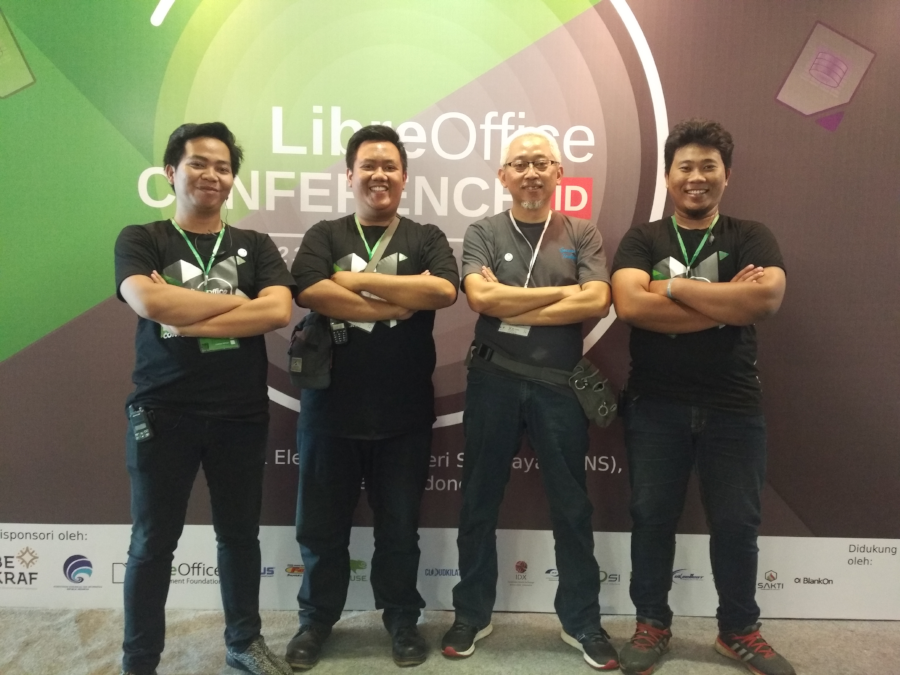
Conference volunteers having fun on stage
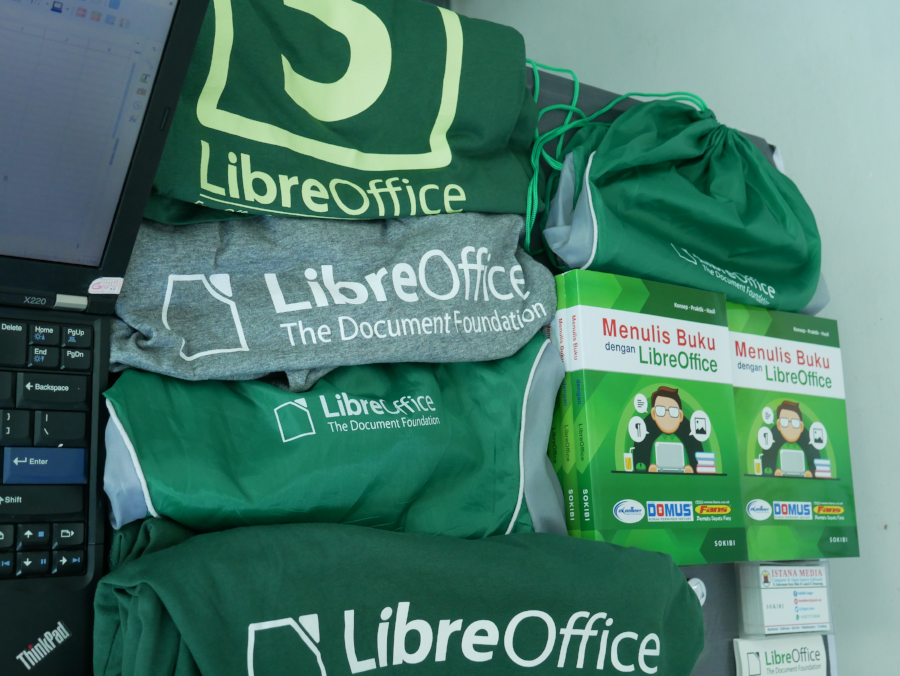
LibreOffice t-shirts, backpacks and books
Andika Triwidada with conference team

LibreOffice 6.0.3 now available for download

Berlin, April 5, 2018 – The Document Foundation (TDF) announces LibreOffice 6.0.3, the third minor release of the LibreOffice 6 family, with around 70 bug and regression fixes.
LibreOffice 6.0.3 represents the bleeding edge in terms of features and as such is targeted at early adopters, tech-savvy and power users, while LibreOffice 5.4.6 – provided as an alternative download option – is targeted at mainstream users and enterprise deployments.

TDF suggests to always deploy LibreOffice in production environments with the backing of certified developers, migrators and trainers (an updated list is available at https://www.libreoffice.org/get-help/professional-support/). This is extremely important for the growth of the LibreOffice ecosystem.

Technical details about LibreOffice 6.0.3 bug and regression fixes are available, as usual, in the change logs: https://wiki.documentfoundation.org/Releases/6.0.3/RC1 (fixed in RC1) and https://wiki.documentfoundation.org/Releases/6.0.3/RC2 (fixed in RC2).

Download LibreOffice

LibreOffice 6.0.3 is immediately available for download at the following link: https://www.libreoffice.org/download/download/.

LibreOffice users, free software advocates and community members can support The Document Foundation with a donation at https://www.libreoffice.org/donate/. Donations help TDF to maintain its infrastructure, share knowledge, and fund the activities of local communities.

Several companies sitting in TDF’s Advisory Board (https://www.documentfoundation.org/governance/advisory-board/) provide either value-added LTS versions of LibreOffice or consultancy services for migrations and training, based on best practices distilled by The Document Foundation.

LibreOffice monthly recap: March 2018

There’s so much going on in the LibreOffice project – in development, documentation, design, QA, translations and much more. So at the end of each month we’ll be posting summaries of recent activities and updates, to help you get an overview of what’s going on. Here’s what happened in March…

  • LibreOffice 5.4.6 was released, with almost 60 bug and regression fixes. This is part of the 5.4 branch, targeted at mainstream users and enterprises. More information in the press release.
  • The Indonesian community organised a three day conference, supported by The Document Foundation. The website has details (in Indonesian), and below is a video promoting the event – English subtitles are available:

Please confirm that you want to play a YouTube video. By accepting, you will be accessing content from YouTube, a service provided by an external third party.

YouTube privacy policy

If you accept this notice, your choice will be saved and the page will refresh.

  • Meanwhile, we’re already getting excited about the main LibreOffice Conference due later this year, in Tirana. But we’re looking even further ahead, and announced a call for locations for the LibreOffice Conference 2019. The deadline for sending proposals is June 30, so if you want to help out, let us know!
  • Buovjaga from the QA community wrote a blog post describing the importance of quality assurance in open source projects. “QA is acting like neurotransmitters in the body of the project”, he writes, explaining that QA is involved in many different areas.
  • This year’s Google Summer of Code (GSoC) is fast approaching, and we reached out to potential participants. In recent years, GSoC students have contributed many great features and updates to LibreOffice, so we look forward to seeing what will happen this year.

  • Olivier Hallot from the documentation community wrote about rich content arriving in the new help system. “The new help can now access external videos on YouTube or similar services, and also open or download OpenDocument files to support the textual explanations of LibreOffice features in the help pages.”
  • Also in blog news, Lera Goncharuk summarised migrations to LibreOffice in Russia on his blog. These include migrations at the federal government level, along with regional administrations.
  • Finally, development continues on LibreOffice 6.1, which is due to be released in early August. You can see some of the new features in the release notes, such as the ability to sort images anchored to cells in Calc:

Keep in touch – follow us on Twitter, Facebook and Google+. Like what we do? Support our community with a donation – or join us and get involved!

Document Freedom Day 2018

Today is Document Freedom Day (DFD) 2018, an annual event to celebrate and raise awareness about Open Standards scheduled on the last Wednesday of March. Document Freedom Day was first celebrated on 26 March 2008. Since 2016, Document Freedom Day is organised by a team of volunteers of the Digital Freedom Foundation. It was previously organised by the Free Software Foundation Europe.

Document Freedom Day is a campaign about open standards and document formats, aimed at non-technical people. Open Standards ensure document interoperability, a pre-condition for knowledge sharing amongst individuals.

Document freedom addresses much more than just texts and spreadsheets, as it is about the control of any kind of digital data, which should be stored in open and standard ways to empower knowledge sharing by users. On the contrary, most digital data is normally stored in proprietary and closed formats, which constrain and manipulate users at enormous cost.

In fact, documents that are not free are locked to some particular software or company. Often, even their original author is not able to access their contents, as they are controlled by artificial technical restrictions.

Open Standards are essential for interoperability and freedom of choice, based on the merits of software applications. They provide freedom from data lock-in and the subsequent vendor lock-in. This makes Open Standards essential for governments, companies, organisations and individual users of information technology.

Open Standards must be:

  • Subject to full public assessment and use without constraints in a manner equally available to everyone
  • Without any components or extensions that have dependencies on formats or protocols that do not meet the definition of an open standard themselves
  • Free from legal or technical clauses that limit its utilisation by any party or in any business model
  • Managed and further developed independently of any single supplier in a process open to the equal participation of competitors and third parties
  • Available in multiple complete implementations by competing suppliers, or as a complete implementation equally available to all parties

Let’s celebrate Document Freedom Day 2018 to make Open Standards a reality. Open Document Standard (ODF), the native document format of LibreOffice and many more software applications, is the only Open Standard available in the domain of personal productivity for organizations and individuals. Every LibreOffice users should advocate, support and use ODF.

[Source of Informations: https://en.wikipedia.org/wiki/Document_Freedom_Day]

Rich Contents Arrives in New Help

Last week the new help system – online and offline – received enhancements to add multimedia and other resources for a richer user experience of LibreOffice Help. The new help can now access external videos stored in You Tube or similar services and also to open or download OpenDocument files to support the textual explanations of LibreOffice features in the help pages.

External videos can be displayed in New Help pages

(more…)